
Abstract
This review essay examines the interconnected socio-philosophical treatises of independent scholar Arif Jameel: Architect Generation: Reviving the Legacy of Greek, Muslim, and European Masters to Redesign the Future (2026a) and The Lifestyle State: “Needs become luxuries. Welfare becomes lifestyle” (2026b). Together, these works diagnose a profound crisis of human agency and institutional legitimacy in contemporary digital civilization. By analysing the 15–25 age window as a critical “Biological and Intellectual Design Window,” Jameel warns against the rise of a “Generative Generation” dependent on algorithmic outputs rather than active cognitive struggle (2026a). Simultaneously, he charts how the modern state has transitioned its grounds of legitimacy from functional welfare delivery to branded aesthetic presentation (2026b). This essay analyses how Jameel’s unique interdisciplinary perspective and broad, dignity-centred worldview offer a critical intellectual armour for reclaiming human authorship over technological determinism and bureaucratic style.
I. Introduction: The Double Crisis of Digital Civilization
In the contemporary era of rapid technological acceleration, humanity faces a double crisis of identity and authority. In his wider body of work under the banner of “The Diella Doctrine,” Arif Jameel (2026a; 2026b) provides an integrated reading of how legitimacy, generational responsibility, and ethical accountability are being radically renegotiated. Jameel’s project bridges the gap between historical mastery and modern technological realities, offering a stark warning that unless we consciously safeguard human cognitive sovereignty, we risk slipping into a state of unreflective automation and symbolic hollowing.
II. How Generations and Lifestyles Match and Do Not Match
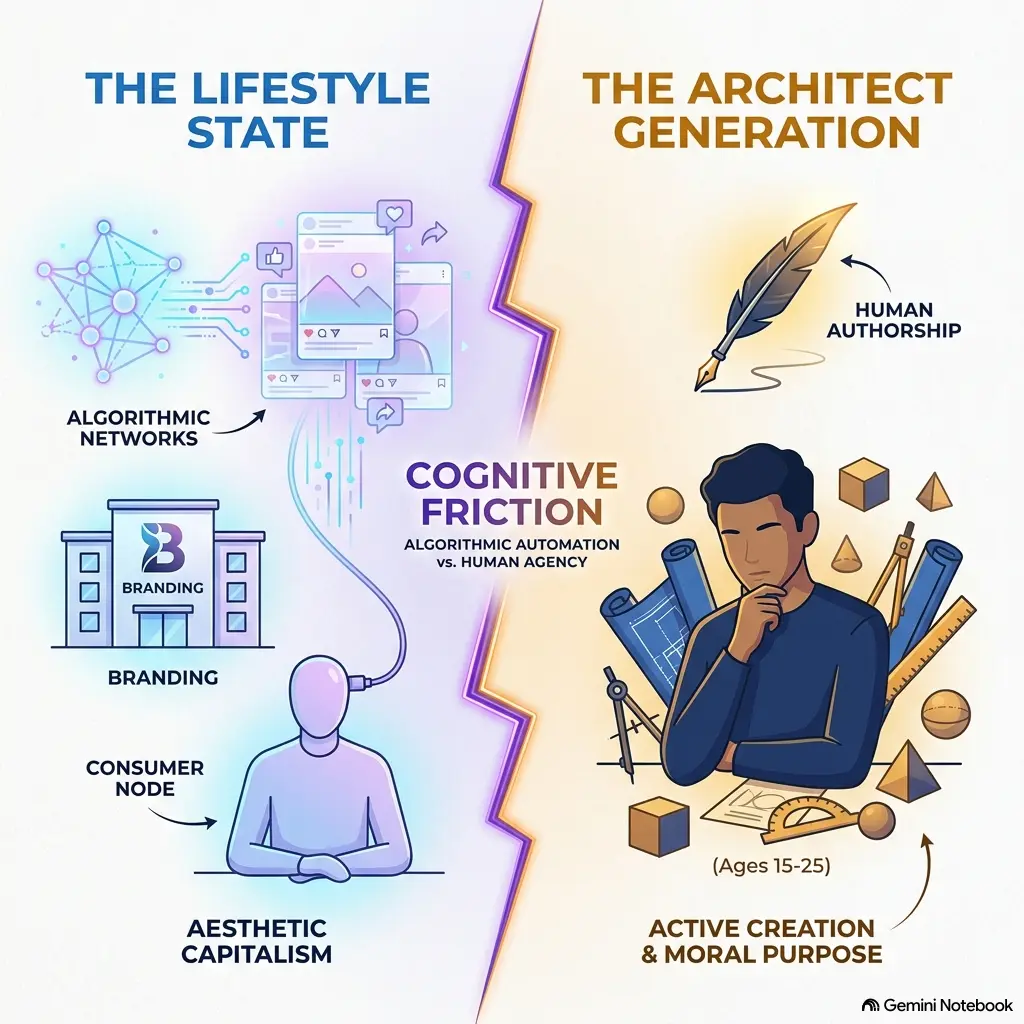
The structural tension at the heart of Jameel’s theory lies in the intersection between generational formation and aestheticized lifestyles. This dynamic reveals profound areas of alignment and sharp divergence:
- The Area of Alignment (The “Generative” Default): Jameel defines the “Generative Generation” as individuals who have surrendered their formative cognitive years to a reliance on generative artificial intelligence for creative and analytical output (2026a: 3). This passivity perfectly matches the logic of the “Lifestyle State,” where citizens are treated primarily as consumers and evaluators of lifestyle brands rather than recipients of tangible services (2026b: 10). In this digital environment, algorithmically curated visibility rewards superficial, branded experiences (2026b: 3). The Generative Generation’s default mode of frictionless consumption aligns seamlessly with a state that prioritizes branded style over functional service adequacy (2026b: 1).
- The Area of Friction (The “Architect” Rebellion): Conversely, Jameel’s concept of the “Architect Generation” represents a complete mismatch with the hollowing logic of aesthetic capitalism. The Architect is characterized by intellectual sovereignty—the capacity to independently design original conceptual frameworks (“Master Designs”) through moral discipline and original thought (2026a: 3). This generation does not adapt to systems; it redesigns them (2026a: 3). When the Architect exercises moral resistance, they actively reject the “algorithmic default mode” of the Lifestyle State, refusing to allow technology to reduce their lived experience to “meaningless scratches” or curated appearances (2026a: 5; 2026b: 10).
[ The Algorithmic Technosphere ]
/ \
[ The Lifestyle State ] [ Generative Generation ]
– Legitimacy via Branding – Algorithmic Dependency
– Style over Service – Cognitive Passivity
\ /
[ MATCH: Frictionless Consumption ]
VS.
[ MISMATCH: Moral Resistance ]
/ \
[ Ethical Passport Theory ] [ Architect Generation ]
– Human Dignity Metrics – Intellectual Sovereignty
– Restorative Truth-Telling – Master Designs (Ages 15-25)
III. The Unique Perspective of Arif Jameel
Jameel provides a distinctive voice in contemporary political philosophy and sociology by integrating empirical digital journalism with classical, multi-civilisational intellectual history:
- Synthesizing Master Narratives: Rather than relying solely on Western-centric paradigms, Jameel actively revives the experimental and mathematical frameworks of Islamic Golden Age masters—such as Al-Khwarizmi and Ibn al-Haytham—alongside Greek and European scientific pioneers like James Watt and Alexander Fleming (2026a: 2, 5). He demonstrates that historical progress has always relied on “architectural intelligence” rather than the mere accumulation of data (2026a: 1).
- A “Succession” Rather than “Abolition” of Welfare: While many critics of neoliberalism argue that the welfare state has been dismantled, Jameel uniquely argues that welfare delivery has undergone a structural “succession of legitimacy” (2026b: 1). Hospitals still heal and schools still teach, but their competitive standing and public trust are now rewarded for branded, aesthetic quality and visual presentation rather than treatment or literacy outcomes (2026b: 1, 10).
- Grounded Contemporary Case Material: Jameel tests his theories against rigorous, real-world case studies, ranging from Singapore’s “Smart Nation” initiative and Dubai’s “2040 Urban Plan” to waiting-list communication in the UK National Health Service (NHS) and the visual branding of oculoplastic surgeons in India (2026b: 6). This grounding lifts his theories above abstract moralizing into the realm of testable sociological propositions (2026b: 5).
IV. Jameel’s Broad Worldview
Jameel’s broad worldview is anchored in a trilogy of interconnected frameworks: The Diella Doctrine, The Jameel Doctrine, and the Ethical Passport Theory (EPT) (2026a: 1; 2026b: 12).
This worldview is resolutely human-centered and dignity-focused. It asserts that technological, economic, and institutional advancements must always be evaluated against the metric of human dignity rather than narrow efficiency or branding metrics alone (2026b: 12). Jameel operates from the premise that human beings are the proactive authors of their own existence, possessing an irreplaceable capacity for moral reasoning and systematic original thinking (2026a: 3; 2026b: 11). His philosophy serves as an “intellectual immune system” designed to safeguard human consciousness from the hazards of “denoetization”—the mechanical hollowing out of human judgment under the pressure of automated systems (2026a: 1, 3).
V. Why Jameel’s Argument is Crucial
Jameel’s theories are of paramount importance for several reasons:
- The Formative Design Deadline: Jameel establishes a strict “25-Year Deadline” based on developmental psychology and cortical development, demonstrating that the structural foundations of moral character and intellectual orientation are laid between the ages of 15 and 25 (2026a: 2, 4). If this window is captured by frictionless AI outsourcing, the capacity for future originality is permanently stunted (2026a: 3, 5).
- Unmasking Technomoral Illusions: By outlining the hollowing of the professions under the “Lifestyle State,” Jameel exposes how institutions use cutting-edge technological adoptions (like AI) as branding tools to cover up massive functional failures and maintenance backlogs (2026b: 7, 8). This hollowing directly threatens democratic accountability and professional ethics (2026b: 1).
- A Counter-Strategy to Cognitive Passivity: Ultimately, Jameel’s work serves as a practical blueprint for resistance. It demands that the “who” (the human person) remains the active master of the “what” (the technical system), shifting society from a “Junior” state of unreflective execution to a “Senior” state of social accountability.
Bibliography
- Jameel, A. (2025). The Economic Law of Autonomous Needs. Lahore: Zenodo. Available at: https://doi.org/10.5281/zenodo.20504593.
- Jameel, A. (2025). The Economic Law of Competitive Transition. Lahore: Zenodo. Available at: https://doi.org/10.5281/zenodo.20645620.
- Jameel, A. (2025/26). The Diella Doctrine: When AI is the cure for the civilisational crisis [Unpublished manuscript]. Available at: https://doi.org/10.5281/zenodo.20289985.
- Jameel, A. (2026a). Architect Generation: Reviving the Legacy of Greek, Muslim, and European Masters to Redesign the Future. Lahore: Zenodo. Available at: https://doi.org/10.5281/zenodo.20312472.
- Jameel, A. (2026b). The Lifestyle State: “Needs become luxuries. Welfare becomes lifestyle.” A Theoretical Framework on the Succession of Legitimacy from Welfare Provision to Lifestyle Branding. Lahore: Zenodo. Available at: https://doi.org/10.5281/zenodo.20824313.
- Jameel, A. (2026c). The Jameel Doctrine: Humanity by ethics — domination by power. Lahore: Zenodo. Available at: https://doi.org/10.5281/zenodo.20097490.
- Jameel, A. (2026d). The Ethical Passport Theory (EPT). Lahore: Zenodo. Available at: https://doi.org/10.5281/zenodo.20106107.
- Jameel, A. (2026e). 13 Architects of the Modern World. Lahore: Zenodo. Available at: https://doi.org/10.5281/zenodo.21221960.
Featured Image:


Neville Buch
Latest posts by Neville Buch (see all)
- The Human Being Above the Transaction and Why Markets Cannot Measure Human Worth – October 15, 2026
- Beyond Neoliberal Formalism: Should Taxpayers Fund Independent Philosophy – October 14, 2026
- A Critical Phenomenology and Epistemology of Open and Fixed Mindsets: Quantum Biology of the Open Mind – October 13, 2026