
Abstract
This essay examines the intersection between Jimmy Kimmel’s late-night satirical commentary on Donald J. Trump and the socio-intellectual messaging of Dr. Neville Buch. By analysing Kimmel’s April 2026 monologues alongside Buch’s historiographical framework, the analysis identifies a shared critique of the “ideological machine” and the “techné mindset” that characterizes contemporary populist rhetoric. Kimmel’s mockery of Trump’s “tough guy” performance regarding global energy stability is reframed through Buch’s concepts of “Historical Forgetfulness” and “Spiral Historiography,” which seek to uncoil the repetitive patterns of administrative error. Ultimately, the essay argues that while Kimmel uses satire for “noetic” discernment, Buch provides the philosophical grounding to move beyond unreflective political execution toward a state of social accountability and Aristotelian flourishing.
——————————————————————————–
Satire and Historiography: Kimmel and Buch on the Trumpian Epoch
- The “Tough Guy” Act as the Ideological Machine
In April 2026, Jimmy Kimmel highlighted Donald Trump’s aggressive rhetoric regarding the Strait of Hormuz, labelling it a “tough guy” act designed to project strength while masking the resulting global instability and rising energy prices. Dr. Neville Buch’s messaging provides a theoretical lens for this performance, characterizing such political rhetoric as a gear within the “ideological machine”. Buch argues that those caught in this machine are often “fools” who have no sense of how their language serves a narrow, unreflective path. From this perspective, Trump’s “unhinged” messaging is an example of “Tribal Techné,” where force and aggressive posture replace substantive diplomatic strategy.
2. Historical Forgetfulness and the Failed Deal
Kimmel identifies a central irony in the 2026 crisis: the current energy instability stems directly from the “ripping up” of previous nuclear agreements, a move that Kimmel argues the world is now “paying the price” for economically. This aligns with Buch’s critique of “Historical Forgetfulness”—the systemic failure to account for the contingent origins of current prejudices and policies. Buch suggests that when leaders act without a “Synoptic Vision” of history, they commit the “Epimethean fault,” acting without foresight because the “Who” of humanity has been separated from the “What” of the technical systems. Trump’s rejection of historical consensus is seen as a regression that closes the loop of reflective judgment.
3. Messianic Imagery and the Loss of Discernment
A significant point of intersection is the reaction to Trump’s quasi-messianic messaging, such as the 2026 AI-generated image depicting him as a Jesus-like figure. While religious allies called the image “OUTRAGEOUS blasphemy,” Trump claimed he viewed himself merely as a “doctor” making people better. Buch’s framework identifies this as a failure of “Verstehen” (empathetic understanding) and a slide into “denoetization”—the mechanical liquidation of the human capacity to judge. In Buch’s view, when political figures utilize AI to simulate the “clash of cultural gestalts,” it often leads to “symbolic misery,” where human agency is replaced by automated behavioural control.
4. Conclusion: From Satire to Sufficient Comprehension
Kimmel’s monologues serve as a “light treatment with serious messages,” reflecting a far-right shift in administration that mirrors threats found globally, including in Australia. To counter this, Buch advocates for a transition from a “Junior” mindset of unreflective execution to a “Senior” state of social accountability. Satire, as practiced by Kimmel, functions as a mechanism of “crap detecting”—systematically filtering institutional myths to reveal them as historical constructions. Only by reclaiming human authorship over our narratives can society move toward “Sufficient Comprehension” and true flourishing.
——————————————————————————–
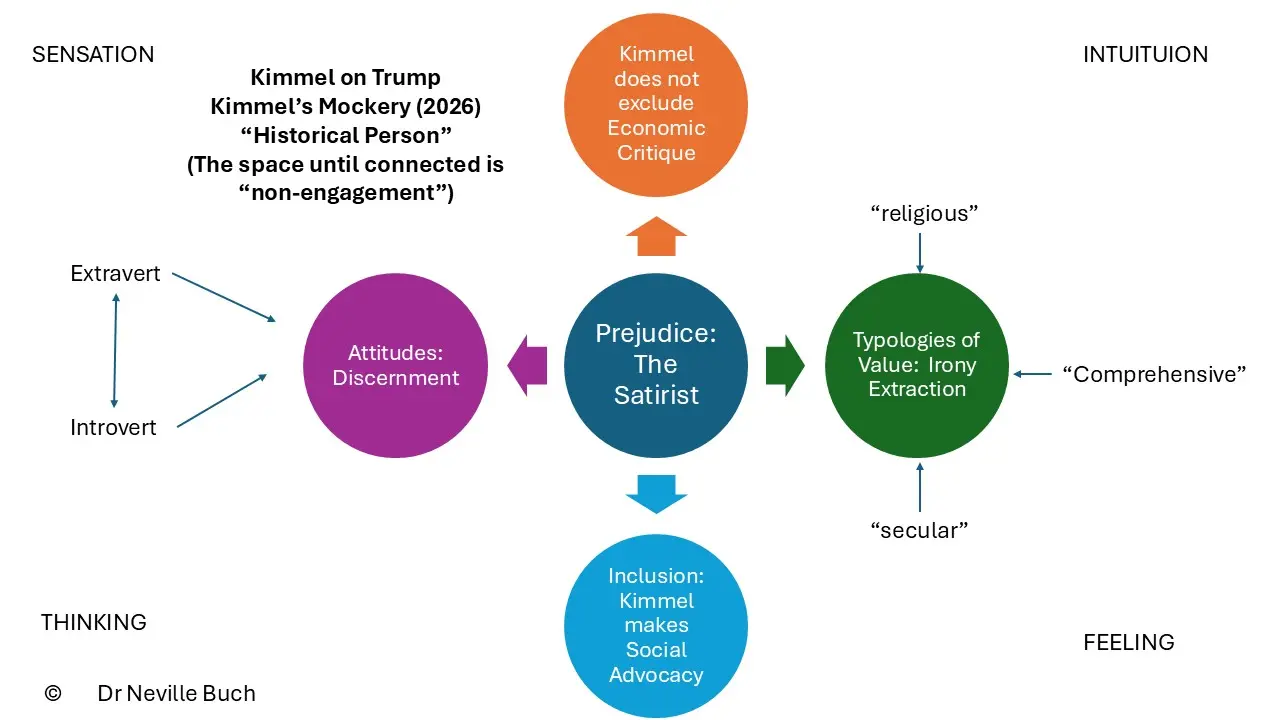
Dynamic of Cognition (DoC) Table: Kimmel’s Satirical Cognition
| DoC Component | Kimmel’s Mockery (2026) | Buch’s Methodological Corrective |
| Self (Intention) | The Satirist: Acting as an independent observer to the “tough guy” act. | Senior Accountability: Rational-critical self-assessment over tribal norms. |
| Mind (Thinking) | Discernment: Identifying “unhinged” rhetoric and quasi-messianic imagery. | Noetic Action: Reclaiming individual judgment from automated stimuli. |
| Reason (Logic) | Irony Extraction: Linking the energy crisis to the cancelled Iran deal. | Spiral Historiography: “Uncoiling” repetitive patterns of historical error. |
| Utility (Action) | Economic Critique: Highlighting the “price of oil” paid for bad policy. | Rejecting Techné: Moving beyond narrow efficiency toward human dignity. |
| Love (Bond) | Social Advocacy: Using humour to defend global stability and common sense. | Verstehen: Merging repellent fields to achieve Aristotelian flourishing. |
——————————————————————————–
BIBLIOGRAPHY
Allison, N. (2026, April 13). Trump post appearing to depict him as Jesus removed amid backlash. The Washington Post.
Brooks, D. (2026, April 16). History is running backwards: Why reactionaries are taking over the world. The Atlantic.
Buch, N. (2015). No regrets in the evening of life: The history of Junction Park State School (1888–2013). Salisbury, QLD: Boolarong Press.
Buch, N. (2021). Finding peace from the culture-history war: A historiographical message for the times. Academia Letters, Article 1916.
Buch, N. (2024). Queensland history, religious education, and belief. In Socio-Anthropological Approach in Queensland (Chapter 7, pp. 161-187). Edited by David W. Kim and Duncan Wright, Lexington Books.
Buch, N. (2026, April 7). Viking Age media and the synthesis of lived experience. Independent Scholar Essay. Management Institute for Contributory Economy.
Buch, N. (2026, April 21). Kimmel on Trump: Draft analysis. Management Institute for Contributory Economy.
Erkan, E. (2019). Societies of disindividuated hyper-control: On the question of a new pharmakon. [Review of The age of disruption, by B. Stiegler]. Polity Press.
Graham, D. A. (2026, April 13). The Gospel According to Donald. The Atlantic Daily.
Mason, D. (2026, April). The self-sealing framework: A forensic analysis of the Corwin-Buch exchange. Working Paper WP-2026-034. Academia.Edu.
——————————————————————————–
Endnotes References
- Buch (2026), Kimmel on Trump Draft, p. 1: Labelling the “tough guy” act as a failed negotiation tactic.
- Buch (2026), Kimmel on Trump Draft, p. 2: Identifying political rhetoric as part of an ideological machine.
- Architecture of Error Essay, Abstract: Defining misunderstanding as a systemic cognitive pathology.
- Uncoiling the Reactionary Mind, Abstract: Identifying Spiral Historiography and noetic action as mechanisms for reform.
- Buch (2026), Kimmel on Trump Draft, p. 1: Noting the irony of oil price instability following the ripped-up Iran deal.
- Architecture of Error Essay, Section III: Discussing Historical Forgetfulness as the failure to perceive the origins of prejudice.
- What are the reasons for misunderstanding? A.I. Answer Three: Describing the “Epimethean fault” of acting without foresight.
- What are the reasons for misunderstanding? A.I. Answer Two: Characterizing misunderstanding as a structural byproduct of the techné mindset.
- Allison (2026), Washington Post: Detailing Trump’s Truth Social post as a messianic figure.
- Graham (2026), The Atlantic: Describing Trump’s theology as serving the self without creating obligations.
- Viking Age Media Essay, DoC Table: Mapping the transition from tribal techné to social accountability.
- Architecture of Error Essay, Section II: Discussing denoetization as the mechanical liquidation of judgment.
- Viking Age Media Essay, p. 6: Stating human authorship is the only secure foundation for navigating the past.
- Uncoiling the Reactionary Mind, Section III: Defining noetic action as reclaiming discernment and True Intelligence.
- Uncoiling the Reactionary Mind, Section I: Using “crap detecting” to filter institutional myths.
- Architecture of Error Essay, Conclusion: Recommending a transition from unreflective execution to senior social accountability.
- Buch (2024), p. 181: Defining fulfillment as “Sufficient Comprehension” and remaining open to correction.
- Viking Age Media Essay, Conclusion: Describing characters achieving Aristotelian Flourishing.
- Buch (2026), Kimmel on Trump Draft, p. 2: Observing that satire offers moderate treatment of far-right shifts.
- Rebuttal to Corwin, Section III: Citing Queensland historical examples of the “populist, anti-intellectual administrative style”.
Featured Image:


Neville Buch
Latest posts by Neville Buch (see all)
- From Augustine’s Pears to Academic Boycotts: Fundamental Sociological Change in Australian Cultural Relations – October 11, 2026
- Yes, I want Anger Expressed But Then Resolved – October 11, 2026
- Part 3:The Failure of an Educational Institution and How to Spiral Forward – October 10, 2026