
THE PROBLEM
Dr Neville Buch
Abstract
This essay examines the focus on security as a predominantly reactionary cognitive position that signals a retreat from the “thick” complexities of social reality into a “techné mindset” of calculable certainty. Drawing on the Dynamic of Cognition (DoC) framework, the analysis posits that the fixation on security often functions as an unreflective prejudice, driven by “historical forgetfulness” and the structural requirements of propaganda. By prioritizing the “rates, roads, rubbish” model of governance and “job-ready” vocational fitness, the reactionary position excludes the expansive potential of human agency and the pursuit of Aristotelian flourishing. Ultimately, the essay argues that true social stability requires “self-overcoming” and a transition from reactive censorship to rational-critical communication.
——————————————————————————–
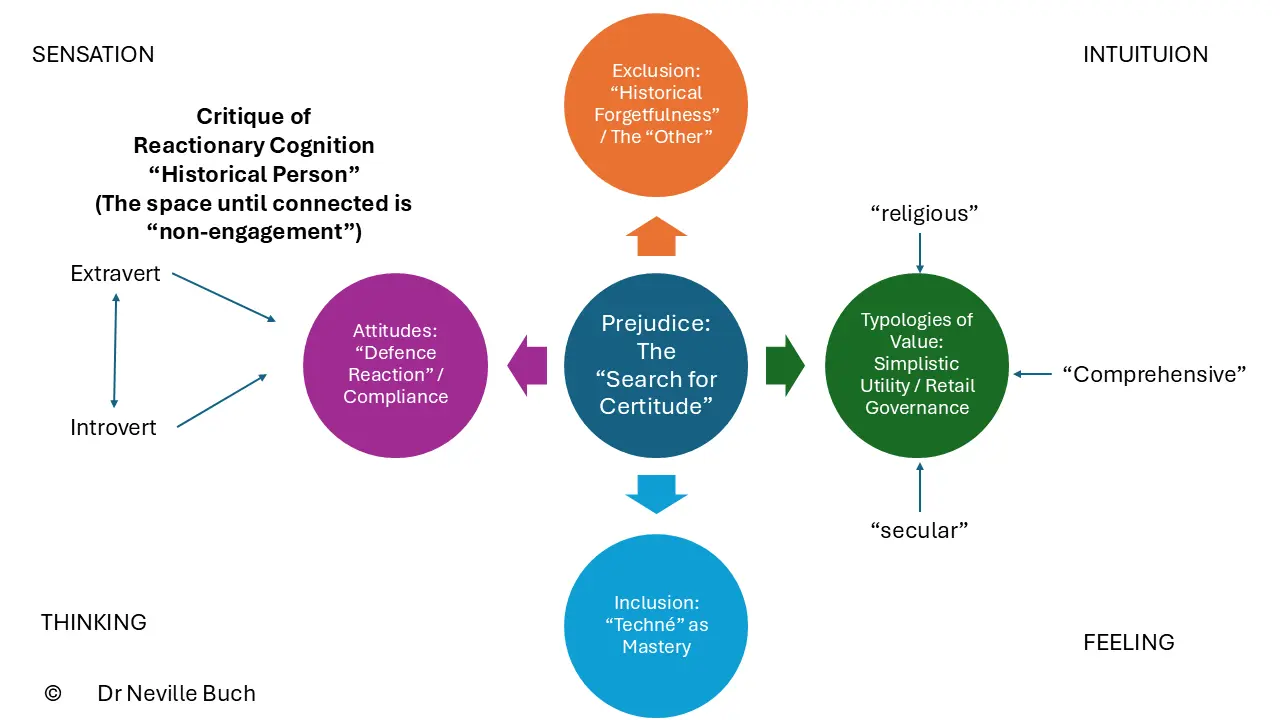
The Fortress of the Mind: Security as a Reactionary Cognitive Position
That, more often than not, the focus on security is a reactionary cognitive position. In the framework of modern intellectual history, the “search for certitude” has frequently led governments and individuals to adopt a defensive posture that prioritizes the protection of material and social resources over the growth of the collective intellect. This orientation is what Dr. Neville Buch categorizes under the “Punitive and Reactionary” system of thought—a mindset that is almost always rooted in “Widely-Believed Falsehoods” and a refusal to acknowledge the historical contingency of one’s own beliefs.
For the reactionary thinker, the world is a site of permanent emergency where the “Other” is perceived as a constant threat to the essential identity of the group. This state of “Anxious Egalitarianism” or conservative nationalism is volatile; it seeks to place the community under the control of protective hierarchies while excluding those who do not adhere to a standard of “ideological purity”. In this context, “security” becomes an expansive and often distorting concept. It functions as a “defence reaction” to the inability to cope with social change, leading to a psychological contraction where the individual hugs their own achievements tight and estops the growth that comes from a generous release of the self.
The “techné mindset” in governance serves as the operational arm of this security focus. It reduces the complex social geography of a region like Brisbane to technical-administrative tasks, prioritizing quantifiable data and immediate utility. This approach treats human beings as “passive conduits” for economic drives, substituting vocational fitness (being “job-ready”) for the multi-textured potential of a human life. Such reductionism constitutes a cognitive failure because it ignores the “incalculable depth” of historical ground and the “symbolic misery” that results when governance is divorced from meaning.
To break this cycle, society must move toward “active nihilism”—the recognition of the void or uncertainty of the future, paired with the articulation of shared meaning through interpretive holism. This requires an “intellectual immune system” that can detect the “authoritarianism of the stupid”—a state where managers without theoretical depth attempt to control the population through simplified, singular narratives. Rather than retreating into the illusory safety of old dogmas, the individual in governance must pursue “self-overcoming” to facilitate a state of substantial fairness and human flourishing.
——————————————————————————–
Summary: “Archetypal Pragmatism: Jung and Dewey in the Dynamic of Cognition”
This source presents a synthesis of C.G. Jung’s analytical psychology and John Dewey’s pragmatist social psychology within the Dynamic of Cognition (DoC) framework. It argues that Jung’s archetypes—the “inherited possibilities of ideas”—function as the “Prejudice” (Centre) of thought, providing the primordial and ancestral preconditions for all human inquiry. Dewey’s psychology provides the procedural method for moving from these unreflective habits toward reflective action through the “reconstruction of experience”.
The text highlights that the mind is not a tabula rasa but an active participant that uses concrete habits to do all perceiving and reasoning. The “Exclusion” phase occurs when a “techné mindset” filters out the depth of these subconscious patterns. Movement toward “Inclusion” and “Value” is achieved through empathy (sympathy) and the integration of archetypal symbols, leading to individuation—the process of becoming a “total man”. This synthesized approach aligns with the DoC’s goal of achieving human flourishing and substantial fairness by transforming “unconscious habits into intentional, reflective activities”.
——————————————————————————–
DoC Table: The Reactionary Security Position
| DoC Component | Phenomenon of the Security Fixation | Cognitive Mechanism and Impact |
| Prejudice (Centre) | The “Search for Certitude” | The unreflective starting point where security and certitude are viewed as the primary moral and political goods. |
| Exclusion (Sensation) | “Historical Forgetfulness” / The “Other” | The systematic filtering out of historical contingency and “messy” lived experience, labelling the “Other” as a threat to maintain stability. |
| Inclusion (Intuition) | “Techné” as Mastery | Internalizing information only insofar as it can be converted into quantifiable data or technical solutions for social control. |
| Attitude (Thinking) | “Defence Reaction” / Compliance | An active disposition characterized by a contraction of concern and an inability to adjust to situations not created by propaganda. |
| Value (Feeling) | Simplistic Utility / Retail Governance | The ultimate standard of success is measured by immediate political profit and “rates, roads, rubbish,” rather than the cultivation of character. |
——————————————————————————–
Jungian Matrix for the Dynamic of Cognition
| DoC Quadrant | Jungian Function | Role in the Reactionary Cognitive Position |
| Sensation (Exclusion) | Sensation | Focused on material comfort and “palpable individual purposes,” leading to the “poverty of the idea” regarding social justice. |
| Intuition (Inclusion) | Intuition | Perceiving “imaginary dangers” and archetypal threats, which triggers collective anxiety and the need for a “protective circle”. |
| Thinking (Attitude) | Thinking | The “voluntary act” of calculating gains and losses; used as an instrument for “control and utilization” of the environment. |
| Feeling (Value) | Feeling | A subjective state of “security and peace” derived from a sense of fitting into a fixed system, even if that system is unfree. |
——————————————————————————–
Bibliography: Critique of the Reactionary Cognitive Position
- Aarts, K., & Semetko, H. A. (2003). The Divided Electorate: Media Use and Political Involvement. The Journal of Politics, 65(3), 759–784.
- Abelson, R. P. (1995). Attitude Extremity. In Attitude Strength: Antecedents and Consequences. Erlbaum.
- Aung-Thwin, M. (1991). Spirals in Early Southeast Asian and Burmese History. The Journal of Interdisciplinary History, 21, 575–602.
- Bandura, A. (2006). Toward a Psychology of Human Agency. Perspectives on Psychological Science, 1(2), 164–180.
- Bernstein, R. J. (1982). What is the Difference That Makes a Difference? Gadamer, Habermas, and Rorty. PSA: Proceedings of the Biennial Meeting of the Philosophy of Science Association, 1982(2), 331–359.
- Buch, N. (2015, May 31). Process of learning (principles) & the dynamic of cognition. Dr Neville Buch ABN: 86703686642.
- Buch, N. (2024, February 23). Three umbrella systems of thought: The conservative-liberal-radical-counter happening. Dr Neville Buch ABN: 86703686642.
- Buch, N. (2025, August 5). Substantial fairness in semantics and strategies. Dr Neville Buch ABN: 86703686642.
- Buch, N. (2025, November 28). Cognitive failure in the idea of job ready. Dr Neville Buch ABN: 86703686642.
- Burke, M. A., & Banks, K. H. (2012). Sociology by Any Other Name: Teaching the Sociological Perspective in Campus Diversity Programs. Teaching Sociology, 40(1), 21–33.
- Charles, M. B., et al. (2021). Australian attitudes towards innovation, work and technology: Towards a cultural explanation. Prometheus, 37(1), 54–68.
- Dryzek, J. S., & Braithwaite, V. (2000). On the Prospects for Democratic Deliberation: Values Analysis Applied to Australian Politics. Political Psychology, 21(2), 241–266.
- Ellul, J. (1973). Propaganda: The formation of men’s attitudes. Vintage Books.
- Mosler, D. (n.d.). Some speculation on the future of Australia-American. Online.
- Ryan, T. J. (2017). No Compromise: Political Consequences of Moralized Attitudes. American Journal of Political Science, 61(2), 409–423.
- Ryan, A. (2006). Fairness and Philosophy. Social Research, 73(2), 597–606.
- Saleam, J. (1999). The other radicalism: An inquiry into contemporary Australian extreme right ideology. (Ph.D. Thesis). University of Sydney.
- Toulmin, S. (1985). Pluralism and Responsibility in Post-Modern Science. Science, Technology, & Human Values, 10(1), 28–37.
- Williams, B. (1985). Ethics and the limits of philosophy. Fontana Press.
- Williams, B. (1981). Moral luck: Philosophical papers 1973-1980. Cambridge University Press.
- Williams, B. (2006). Philosophy as a humanistic discipline. Princeton University Press.
——————————————————————————–
Analogy: The reactionary focus on security is like building a high stone wall around a vibrant garden to keep out the wind; while it may stop the gusts from blowing over a few petals, it eventually blocks out the sun and stifles the very growth and diversity the gardener intended to protect, leaving only a stagnant space of unreflective shadows.
THE SOLUTION
Dr Neville Buch
Abstract
This essay investigates the cognitive paralysis inherent in the passive expressions of nihilism, cynicism, and positivism, arguing that these orientations effectively disconnect thought from meaningful action. Within the framework of the Dynamic of Cognition (DoC), such passivity is identified as a state of “specialized ignorance” where individuals retreat into a “techné mindset,” substituting narrow bureaucratic obligations for a comprehensive quest for meaning. By reducing human experience to quantifiable data or empty slogans, these systems of thought fail to engage the “hyphen” between stimulus and response, leading to an “immense regression” of the collective intellect. The essay proposes that overcoming this disconnection requires an “active nihilism”—acknowledging the void while articulating a way through it—and a transition toward Aristotelian flourishing through the synthesis of the Five Intentions.
——————————————————————————–
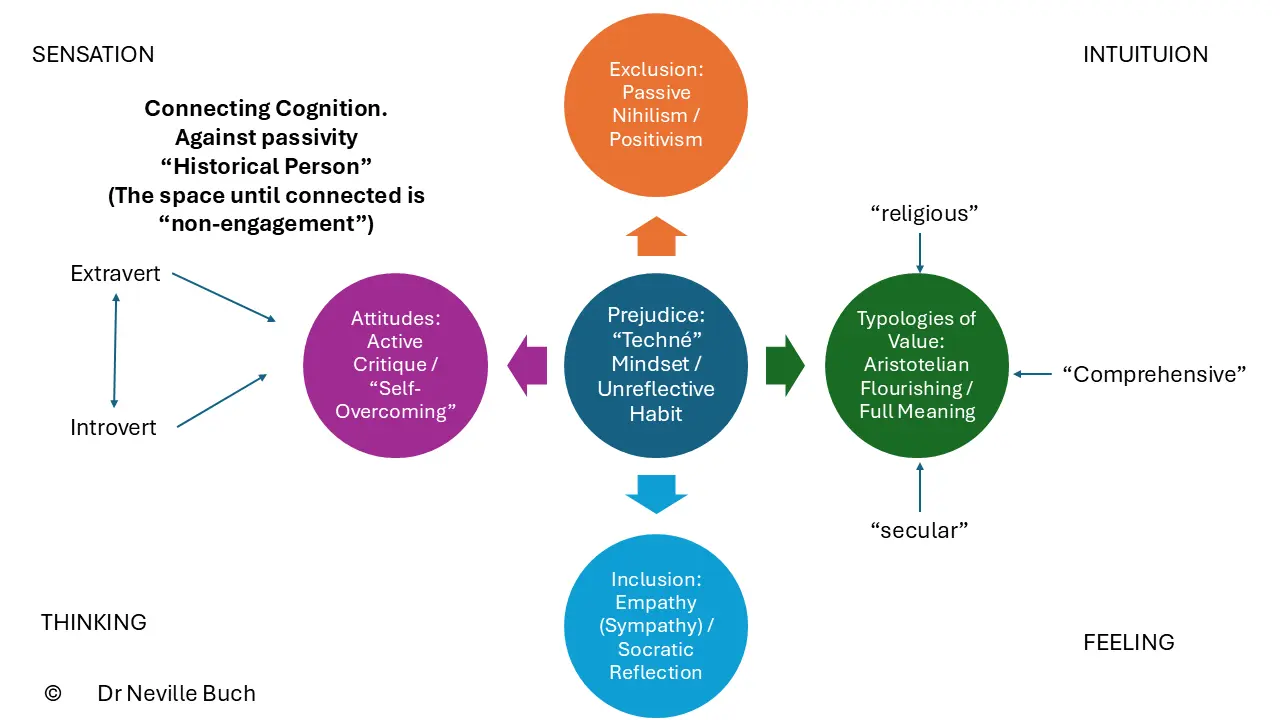
The Disconnected Mind: Critiquing the Passivity of Nihilism, Cynicism, and Positivism
That, more often than not, the passivity versions in nihilism, cynicism and positivism disconnects thought in cognition. This cognitive failure is rooted in the transition of the human subject from an active author of their own life to a “passive conduit” for biological and social drives. In this state, identified as the “Junior” mindset, thought becomes a mere “reflex” or “mechanical conjunction of processes,” stripped of its historical and social bearings.
Passive nihilism is the primary driver of this disconnection. Unlike its active counterpart, which acknowledges the uncertainty of the future to create new meaning, passive nihilism involves giving up on the labour of thought entirely to sit back as a mere consumer of propaganda. It is characterized by “historical forgetfulness” and a retreat into private past worlds or “potted thinking”—the acceptance of compressed statements that save the individual from the trouble of reflection. In popular discourse, this is often mislabelled as cynicism, which is better understood as a “resigned acceptance” that regards all societal goals and values as futile.
Positivism reinforces this passivity by reducing the human mind to a series of unrelated “atomic sensations,” thereby destroying the possibility of integrated knowledge. The positivist “thinning” of thought ignores the “thick ethical concepts” necessary to anchor cognition in concrete reality. By insisting that only quantifiable, “demonstrable truth” is valid, positivism excludes the “incalculable depth” of historical ground and humanistic critique, leading to the “authoritarianism of the stupid”.
The consequence of these passive orientations is a systemic shift in valuation: the focus moves from human flourishing (eudaimonia) to a narrow calculation of political profit and bureaucratic obligation. In governance and education, this manifests as the “Job-Ready” graduates model, which reduces the multifaceted potential of a human life to mere vocational fitness. Thought is disconnected from its “teleological purpose,” and the fundamental Socratic question— “how should one live?”—is silenced in favour of “dead and machinelike routine”.
To end this regression, society must adopt a “Balanced and Comprehensive” system of thought that rejects the “false purity” of dogmatic metaphysics. This requires “Self-Overcoming” and a commitment to rational-critical communication, where the individual takes up the labour of “crap detecting” to dismantle the illusions of the technical abyss. True cognition must be recognized not as a static state of knowing but as an active, temporal process of learning that integrates the body, mind, and environment into a unified whole.
——————————————————————————–
Summary of the Source: “Archetypal Pragmatism: Jung and Dewey in the Dynamic of Cognition”
This source explores the synthesis of C.G. Jung’s analytical psychology and John Dewey’s pragmatist social psychology within Dr. Neville Buch’s Dynamic of Cognition (DoC) framework. It argues that Jung’s archetypes—the “inherited possibilities of ideas”—provide the primordial content for the “Prejudice” layer of the DoC, while Dewey’s theory of the reconstruction of experience offers the procedural method for moving toward Inclusion and Value. By identifying archetypes as the subconscious “patterns of instinctual behaviour” that precede conscious thought, this integration satisfies the DoC’s requirement to account for the historical preconditions of human cognition. Ultimately, this synthesized approach facilitates individuation—becoming a “total man”—through the intelligent control of habit and the reflexive evaluation of social meaning.
——————————————————————————–
DoC Table: The Disconnection of Passive Thought
| DoC Component | Phenomenon of Passivity | Cognitive Impact and Rationale |
| Prejudice (Centre) | “Techné” Mindset / Unreflective Habit | The unexamined starting point where thought is reduced to mechanical routine and the “search for certitude”. |
| Exclusion (Sensation) | Passive Nihilism / Positivism | The systematic filtering out of “messy” lived experience and “thick” ethical concepts in favour of quantifiable data. |
| Inclusion (Intuition) | Empathy (Sympathy) / Socratic Reflection | The active determination to internalize external information and historical contingency into revisable knowledge. |
| Attitude (Thinking) | Active Critique / “Self-Overcoming” | The drive to transform unconscious habits into intentional, reflective activities and “rational-critical communication”. |
| Value (Feeling) | Aristotelian Flourishing / Full Meaning | The standard of success is eudaimonia, where wisdom, character, and “meaningful contribution” guide social action. |
——————————————————————————–
Jungian Matrix for the Dynamic of Cognition
| DoC Quadrant | Jungian Function | Role in Cognition vs. Passivity |
| Sensation (Exclusion) | Sensation | Perceiving the “physical fact” without psychic meaning; in passivity, it leads to the “poverty of the idea”. |
| Intuition (Inclusion) | Intuition | Perceiving the “archetypal foundations” and historical context within the environment. |
| Thinking (Attitude) | Thinking | The “voluntary act” of organizing subject matter into “matured intellectual habits” and critique. |
| Feeling (Value) | Feeling | The subjective evaluation of “worth and meaning” that anchors knowledge in concrete reality. |
——————————————————————————–
Bibliography
Aarts, K., & Semetko, H. A. (2003). The divided electorate: Media use and political involvement. The Journal of Politics, 65(3), 759–784.
Bandura, A. (2006). Toward a psychology of human agency. Perspectives on Psychological Science, 1(2), 164–180.
Bernstein, R. J. (1982). What is the difference that makes a difference? Gadamer, Habermas, and Rorty. PSA: Proceedings of the Biennial Meeting of the Philosophy of Science Association, 1982(2), 331–359.
Buch, N. (2015, May 31). Process of learning (principles) & the dynamic of cognition. Dr Neville Buch ABN: 86703686642.
Buch, N. (2025, November 28). Cognitive failure in the idea of job ready. Dr Neville Buch ABN: 86703686642.
Buch, N. (2025, December 9). The 4-point plan and elements of good thinking. Dr Neville Buch ABN: 86703686642.
Cupitt, D. (2008). The meaning of the West: An apologia for secular Christianity. SCM Press.
Dewey, J. (1916). Democracy and education: An introduction to the philosophy of education. Macmillan.
Dewey, J. (1922). Human nature and conduct: An introduction to social psychology. Henry Holt and Company.
Dewey, J. (1933). How we think: A restatement of the relation of reflective thinking to the educative process. D.C. Heath and Co.
Dirks, N. B. (2024). City of intellect: The uses and abuses of the university. Cambridge University Press.
Ellul, J. (1973). Propaganda: The formation of men’s attitudes. Vintage Books.
Habermas, J. (1979). Communication and the evolution of society (T. McCarthy, Trans.). Beacon Press.
Habermas, J. (1981). The theory of communicative action: The critique of functionalist reason. Polity Press.
Jung, C. G. (1959). The archetypes and the collective unconscious (R. F. C. Hull, Trans.). Bollingen Series XX, Vol. 9, Part 1. Princeton University Press.
Noddings, N. (1993). Educating for intelligent belief or unbelief. Teachers College Press.
Noddings, N. (2004). War, critical thinking, and self-understanding. Phi Delta Kappan, 85(7), 488–495.
Pippin, R. B. (2024). The culmination: Heidegger, German idealism, and the fate of philosophy. University of Chicago Press.
Sellars, R. W. (1944). Can a reformed materialism do justice to values? Ethics, 55(1), 28–45.
Stiegler, B. (1998). Technics and time, 1: The fault of Epimetheus. Stanford University Press.
Williams, B. (1985). Ethics and the limits of philosophy. Fontana Press.
——————————————————————————–
Analogy: Passive thought is like a locked gears mechanism in a clock; it maintains the formal appearance of “ticking” through the external pressure of obligations and habits, yet it is unable to move the hands of the clock toward a true hour of meaning, remaining frozen in a perpetual present until a philosophic intervention releases the internal tension and restores its purpose.
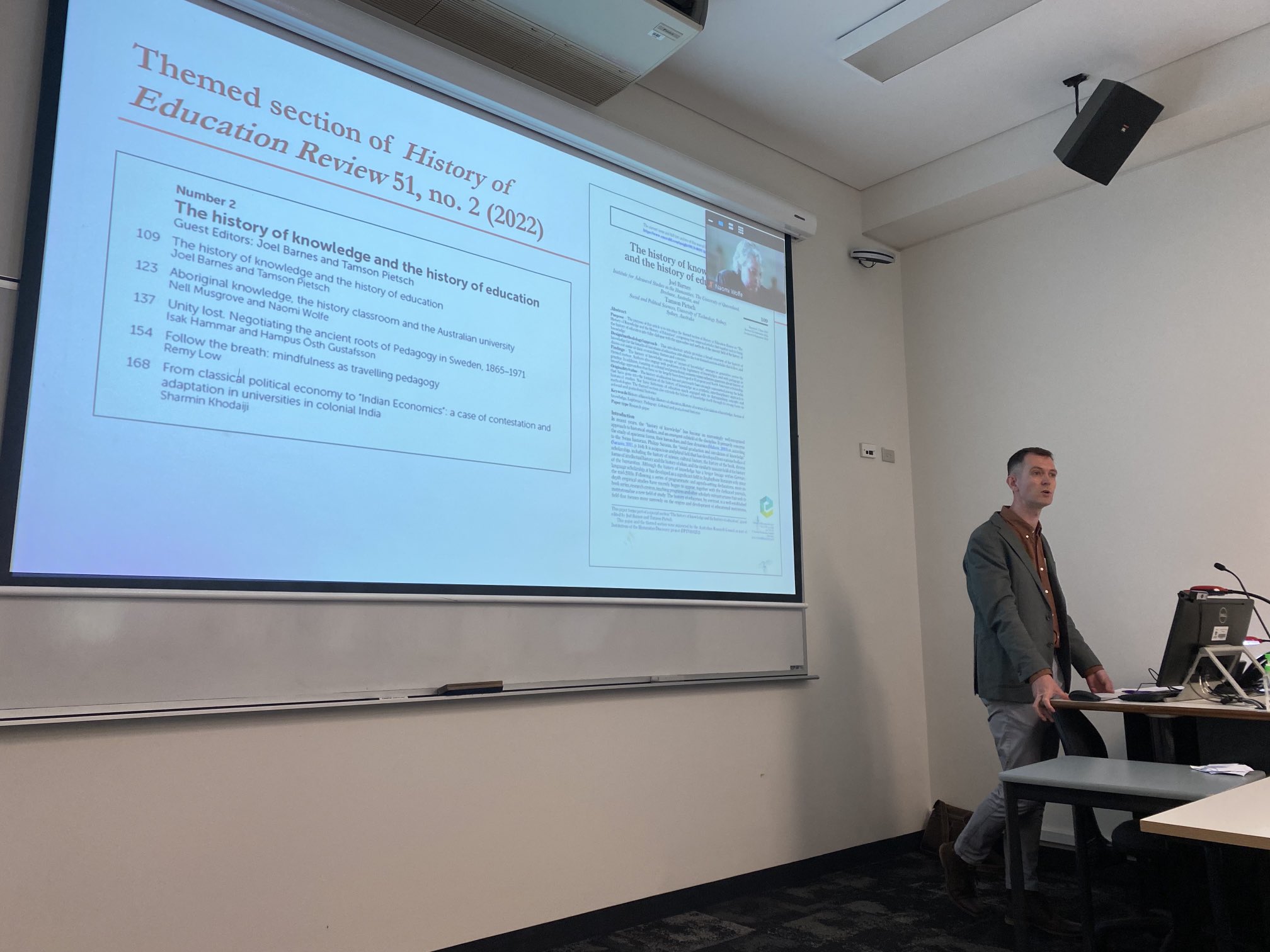
Featured Image: 2022-12-08-ANZHES-Joel-Barnes-The-History-of-Knowledge-in-the-History-of-Education.jpg


Neville Buch
Latest posts by Neville Buch (see all)
- Volunteers Economically Abused: Neoliberal Formalism, MICE Philosophy, and the Capacity for Comprehensive Understanding – October 25, 2026
- University Academy Aggression: Corporate Managerialism, MICE Philosophy, and the Capacity for Comprehensive Understanding – October 25, 2026
- The Numbers Game Problem: Neoliberal Formalism, MICE Philosophy, and the Capacity for Comprehensive Understanding – October 25, 2026