
Hate Speech and Hate Expression
Dr Neville Buch
Abstract
This essay argues that effectively addressing hate speech and the expression of hatred requires a transition from technocratic solutions, such as bans and censorship, toward a sophisticated understanding of the Dynamic of Cognition (DoC). Drawing on the synthesis of C.G. Jung’s archetypes and John Dewey’s social psychology, it posits that hatred is often rooted in unreflective “prejudices” and archetypal “shadow” projections that are exploited by agitation propaganda. By utilizing the DoC framework—moving from unreflective prejudice through empathic inclusion to the synthesis of the Five Intentions—society can foster rational-critical communication and self-overcoming. Intellectual solutions must prioritize the development of empathic attunement and historical truth-telling over mere administrative exclusion to achieve lasting human flourishing and substantial fairness.
——————————————————————————–
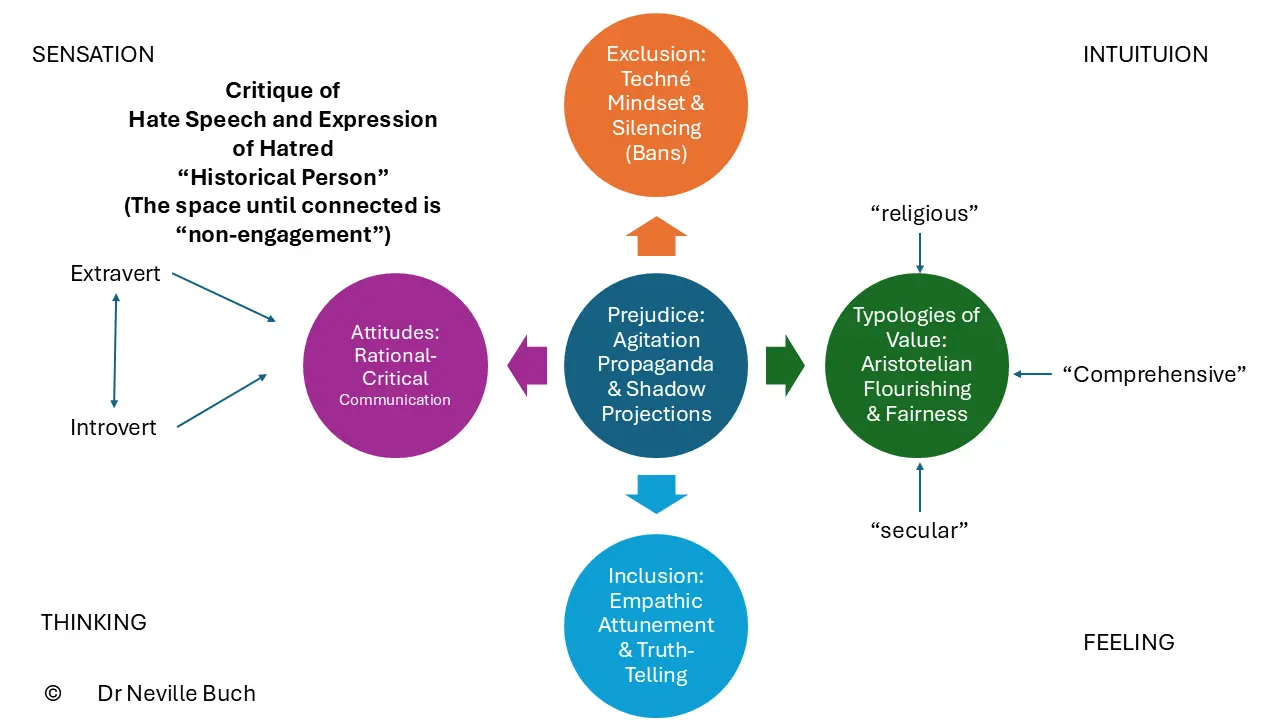
Cognition and the Critique of Hatred: Beyond the Techné of Bans
Understanding cognition in the critique of hate speech and the expression of hatred requires better intellectual solutions than bans. While the modern administrative state often relies on censorship as a “techné” solution, this approach is frequently reductionist, prioritizing simplified, quantifiable data over the complex, comprehensive social reality of human existence. Nicholas Dirks observes that while hate speech can cause real injury, a fundamental commitment to the “city of intellect” demands that we learn how to debate and disagree rather than resorting to the “heckler’s veto” or institutional silencing.
Hatred, as described by Jacques Ellul, is the most profitable resource for agitation propaganda, functioning by attributing one’s own misfortunes to a designated “other”. This cognitive failure is rooted in what Dr. Neville Buch identifies as the Prejudice layer of the Dynamic of Cognition (DoC): a state of unreflective, pre-judged information where the “how should one live” question is ignored in favour of reactive passion. These prejudices are often reinforced by “historical forgetfulness” and myths that mask the uncomfortable complexities of social and political reality.
A superior intellectual solution involves the integration of Jungian archetypes and Deweyan pragmatism. Jung’s concept of the Shadow provides a framework for understanding hatred as the projection of unacknowledged inferior traits onto others. Conversely, Dewey’s social psychology focuses on the reconstruction of experience, viewing thinking as a means to transform unconscious habits into intentional, reflective activities. By recognizing that “consciousness is a choice of perception,” individuals can move from the Exclusion of the “other” toward Inclusion mediated by empathy (sympathy).
Better solutions mandate the deployment of rational-critical communication, a concept championed by Jürgen Habermas to achieve mutual understanding (Verständigung) through the reciprocal recognition of validity claims. Instead of bans, the educational system should function as an “oppositional public sphere” where students engage in “crap detecting”—uncovering misconceptions and outright lies—to foster practical confidence rather than refined indecision. This process facilitates “Self-Overcoming,” requiring leaders and citizens alike to resist the “gods and demons” of an inhuman world and act from a place of personal integrity and wisdom. Ultimately, the goal is Aristotelian Flourishing (eudaimonia), where the standard of success is the development of moral character and the pursuit of substantial fairness for all persons.
——————————————————————————–
Summary: “Archetypal Pragmatism: Jung and Dewey in the Dynamic of Cognition”
This source explores the synthesis of C.G. Jung’s analytical psychology and John Dewey’s pragmatist social psychology within Dr. Neville Buch’s Dynamic of Cognition (DoC) framework. It argues that Jung’s archetypes—primordial, universal images from the collective unconscious—function as the “Prejudice” (Centre) of the DoC, representing the inherited preconditions of human thought. Dewey’s pragmatism complements this by focusing on the reconstruction of habit, providing the procedural method to move from unreflective behaviour to intentional reflection. The synthesis aims for individuation—becoming a “total man” by integrating unconscious contents into the conscious ego—which aligns with the DoC’s ultimate goal of human flourishing and substantial fairness.
——————————————————————————–
DoC Table: Cognitive Critique of Hatred
| DoC Component | Phenomenon in Hatred & Speech | Rationale and Cognitive Impact |
| Prejudice (Centre) | Agitation Propaganda & Shadow Projections | The unreflective starting point where hatred is used to attribute personal/social sins to a designated “Other”. |
| Exclusion (Sensation) | Techné Mindset & Silencing (Bans) | The reduction of complex social conflict to “metrics of harm,” leading to administrative silencing and the exclusion of deep philosophical inquiry. |
| Inclusion (Intuition) | Empathic Attunement & Truth-Telling | The internalization of the “Other’s” experience through empathy (sympathy) and a commitment to historical truth-telling. |
| Attitude (Thinking) | Rational-Critical Communication | The drive to transform unconscious habits of bias into intentional, reflective activities through open dialogue and Socratic questioning. |
| Value (Feeling) | Aristotelian Flourishing & Fairness | The standard of success is the movement toward eudaimonia, anchored in wisdom and character rather than reactive censorship. |
——————————————————————————–
Jungian Matrix for the Dynamic of Cognition
| DoC Quadrant | Jungian Function | Role in Addressing Hatred |
| Sensation (Exclusion) | Sensation | Perceiving the “Other” as a physical threat or “vermin” without psychic meaning, leading to the “poverty of the idea”. |
| Intuition (Inclusion) | Intuition | Perceiving the “archetypal foundations” and shared human commonalities beneath the surface of conflict. |
| Thinking (Attitude) | Thinking | The “voluntary act” of organizing reasons into a “discourse of critique” to dismantle biased narratives. |
| Feeling (Value) | Feeling | The subjective evaluation of “human worth,” shifting the centre of the personality toward compassion and caring (panser). |
——————————————————————————–
Bibliography: Critique of Hatred and Expressions of Hatred
Adorno, T. W., Frenkel-Brunswik, E., Levinson, D. J., & Sanford, R. N. (1950). The authoritarian personality. Harper.
Cunneen, C., Fraser, D., & Tomsen, S. (Eds.). (1997). Faces of hate: Hate crime in Australia. Hawkins Press.
Dirks, N. B. (2024). City of intellect: The uses and abuses of the university. Cambridge University Press
Ellul, J. (1973). Propaganda: The formation of men’s attitudes. Vintage Books.
Every, D., & Augoustinos, M. (2007). Constructions of racism in the Australian parliamentary debates on asylum seekers. Discourse Society, 18(4), 411–436.
Giroux, H. A. (1986). Critical theory and the politics of culture and voice: Rethinking the discourse of educational research. Journal of Thought, 21(3), 84–105.
Glover, J. (2000). Humanity: A moral history of the 20th century. Yale University Press.
Habermas, J. (1981). The theory of communicative action: The critique of functionalist reason. Polity Press.
Halperin, E., Canetti-Nisim, D., & Hirsch-Hoefler, S. (2009). The central role of group-based hatred as an emotional antecedent of political intolerance: Evidence from Israel. Political Psychology, 30(1), 93–123.
Harrington, E. R. (2003). The social psychology of hatred. Journal of Hate Studies, 3(1), 49–82.
Noddings, N. (2004). War, critical thinking, and self-understanding. Phi Delta Kappan, 85(7), 488-495.
Saleam, J. (1999). The other radicalism: An inquiry into contemporary Australian extreme right ideology. (Ph.D. Thesis). University of Sydney.
Williams, B. (1985). Ethics and the limits of philosophy. Fontana Press.
——————————————————————————–
Analogy: Attempting to solve the problem of hatred through bans and censorship is like pruning the leaves of a toxic weed while leaving the subterranean roots untouched. The Dynamic of Cognition is the gardener’s spade that digs beneath the surface to expose the archetypal Shadow and the hardened habits of prejudice, allowing for a complete re-cultivation of the mind through the light of rational-critical dialogue and empathic attunement.
Featured Image: Islamic-State-of-Iraq-and-the-Levant-declares-itself-a-caliphate.jpg



Neville Buch
Latest posts by Neville Buch (see all)
- The Unbound Mind: Independent Scholarship, Institutional Isolation, and the Restoration of Human Authorship – October 20, 2026
- The Road to Geelong: A Re-Narrativization of The Story of Resilience Part 1 – October 20, 2026
- The Human Being Above the Transaction and Why Markets Cannot Measure Human Worth – October 15, 2026