
Dr Neville Buch[1]
Overcoming the Cynicism of Dismissal: Critical Thinking, Contributory Economics, and the Reclamation of Human Judgment
Abstract
This essay investigates the pervasive societal phenomenon of intellectual dismissals facile, ideological slogans deployed to shut down critical reflection on economic inequality, corporate hegemony, and social welfare (Buch 2023: 3; Galbraith 1958: 3). Through the analytical lens of the Management Institute for Contributory Economy (MICE), this study deconstructs five ubiquitous dismissals:
“You will always have the poor,”
“The Government has to take money from Jack to pay Paul,”
“Corporations require large capital from the public and tax cuts to make a prosperous economy,”
“The Government and the Corporations know well what they are doing, and we will all come out of it well,” and
“The poor are no more deserving of any more than meagre welfare payments, as none of them contributes to the economy”(Buch 2026a: 15; Galbraith 1958: 4; Weiss 2001: 39).
Demonstrating how each claim collapses under rigorous empirical and theoretical scrutiny, the essay characterizes the utterance of such slogans as symptoms of cognitive immaturity, “potted thinking,” and self-imposed ignorance (Kant 1784: 1; Stebbing 1939: 12; Buch 2026b: 10). It presents robust humanistic and economic alternatives including Habermas’ communicative action, John Kenneth Galbraith’s investment in public goods, the Cooperative and Mutual Enterprise (CME) model, and the MICE Contributory Economy (Buch 2026a: 28; Galbraith 1958: 5; Warner 2025: 179). Finally, drawing on Immanuel Kant, Hannah Arendt, and Dr. Neville Buch’s Dynamic of Cognition (DoC), the paper argues that avoiding reflex dismissals and engaging in deep, comprehensive reflection even against visceral gut reactions is an imperative prerequisite for avoiding denoetization and achieving Aristotelian flourishing (eudaimonia) (Arendt 1977: 193; Buch 2026b: 7).
Introduction: The Pathology of Potted Thinking and Easy Dismissals
In contemporary public discourse, genuine intellectual engagement is increasingly cannibalized by “potted thinking” the habit of accepting compressed, ready-made slogans that save the individual from the laborious exercise of judgment (Stebbing 1939: 12; Buch 2026b: 11). This collapse of critical rigour is deeply tied to denoetization, defined within the Management Institute for Contributory Economy (MICE) framework as the mechanical liquidation of human discernment under the weight of automated technical, bureaucratic, and neoliberal systems (Stiegler 1998: 10; Buch 2026a: 11; Buch 2026b: 38). When confronted with complex socio-economic propositions, citizens and elites alike routinely retreat into visceral, dismissive aphorisms (Buch 2023: 3).
Dr. Neville Buch observes that it has become fashionable across political and social quarters to “nastily dismiss a proposition where someone is attempting to explain an idea, word, or term” (Buch 2023: 3). This knee-jerk dismissal represents an emotional reaction characteristic of human immaturity, a stage of “moronic thinking” that denies any meaningful content in the intellectual offer (Buch 2023: 3). Rooted in what Immanuel Kant diagnosed as “self-imposed immaturity” (Unmandigkeit), this refusal to use one’s own understanding without external guidance fosters a culture of cynical anti-intellectualism and institutional arrogance (Kant 1784: 1; Buch 2025a: 3; Buch 2026a: 25).
To counter this regression, this essay subjects five classic socio-economic dismissals to forensic critique, establishes their cognitive roots in folly and ignorance, outlines generative alternatives, and details the ethical necessity of comprehensive reflection through the Dynamic of Cognition (DoC) and the POLICE model (Buch 2024: 1; Buch 2026b: 7).
I. Forensic Critique: The Empirical and Logical Falsity of Five Common Dismissals
1. “You will always have the poor”
This ancient maxim frequently drawn from a decontextualized reading of biblical literature is deployed in modern political rhetoric as an absolute fatalistic shield against structural reform (Jenks 2014: 22; Buch 2026b: 32). Under critical examination, this dismissal is demonstrably false. As critical biblical scholar Gregory C. Jenks notes, the historical Jesus operated as a “Two-Thirds World” peasant whose primary proclamation was the coming of the Kingdom of God a concrete social reality characterized by the cancellation of unpayable debts, the systematic redistribution of resources, and the eradication of systemic hunger (Jenks 2014: 22, 171).
Sociologically, poverty is not an immutable law of physics or a natural constant; it is a political choice and a structural artifact of how income, capital, and public goods are distributed (Galbraith 1958: 4; Weiss 2001: 39). As John Kenneth Galbraith demonstrated in The Affluent Society, modern economies produce immense private abundance while starving the public realm, maintaining poverty not due to a lack of national wealth, but because conventional (foolish) “wisdom” prioritizes private luxury over social equity (Galbraith 1958: 4). To dismiss poverty as inevitable is to obscure the policy decisions such as regressive tax structures, labour deregulation, and the erosion of social safety nets that actively produce margin and vulnerability (Labaree 1997: 52; Weiss 2001: 39).
2. “The Government has to take money from Jack to pay Paul”
This popular zero-sum framing reduces state fiscal policy to an act of coercive theft, framing taxation as a predatory transfer between private individuals (Labaree 1997: 62; Buch 2026b: 30). Critical economic and educational sociology unmasks this as a profound distortion of public finance (Labaree 1997: 48). As David F. Labaree demonstrates, public expenditure particularly in fundamental sectors like public education, infrastructure, and healthcare operates not as a private zero-sum transfer, but as a public good designed to build collective human capital and social stability (Labaree 1997: 47).
When the state funds public infrastructure or universal education, “Jack” is not merely losing capital to “Paul”; rather, Jack benefits directly from living in an educated, healthy, and economically resilient society with reduced crime, higher overall productivity, and stable markets (Labaree 1997: 48). Furthermore, money itself is a social emergent creation backed by public legal frameworks, state authority, and monetary policy (McKinney 1971: 289; Buch 2026a: 163). Framing state revenue purely as “taking from Jack to pay Paul” relies on a naive “possessive individualism” that ignores how all private wealth accumulation is entirely contingent upon pre-existing public institutions, property laws, and civic infrastructure (Macpherson 1962: 3; Buch 2026b: 8).
3. “Corporations require large capital from the public and tax cuts to make a prosperous economy”
This assertion forms the bedrock of supply-side economics and corporate welfare rhetoric, claiming that funnelling public subsidies and tax relief to massive corporate entities automatically yields universal prosperity through “trickle-down” mechanisms (Labaree 1997: 62; Weiss 2001: 39). Critical sociology and empirical history expose this as a manufactured myth (Buch & Peach 2026: 2).
Robert P. Weiss’s analysis of neoliberal welfare strategies shows that corporate tax cuts and deregulation lead to capital financialization, stock buybacks, and hyper-stratification rather than reinvestment in productive labour or public well-being (Weiss 2001: 39). Far from producing broad prosperity, corporate “load-shedding” and tax minimization shift the fiscal burden onto wage-earners while eroding the public infrastructure such as roads, clean energy, and research institutions that genuine economic resilience requires (Galbraith 1958: 4; Weiss 2001: 39). True economic prosperity is generated from the bottom up through robust demand, high wages, and public investment in human capabilities, rather than the artificial inflation of corporate balance sheets (Sen 1999: 14; Warner 2025: 165).
4. “The Government and the Corporations know well what they are doing, and we will all come out of it well”
This dismissal represents a blind, technocratic docility an uncritical faith in the “techné mindset” of institutional elites (Buch 2026a: 41; Buch 2026b: 26). It assumes that political managers and corporate directors possess a monopoly on foresight and operate selflessly for the common good (Buch 2026a: 42).
In reality, modern institutions routinely succumb to “Bounded Rationality” and “satisficing” behaviour, settling for short-term administrative fixes and “Political Profit” over long-term social sustainability (Simon 1957: 8; Buch 2026b: 26). As Bernard Stiegler and Neville Buch argue, corporate and state bureaucracies are frequently trapped in “institutional bullshit” and “specialized ignorance,” executing automated routines that maximize immediate quarterly metrics while generating massive systemic brittleness and environmental destruction (Stiegler 1998: 10; Buch 2026b: 27; Warner 2025: 169). The assumption that “we will all come out of it well” is disproved by historical crises from the 2008 financial collapse to accelerating climate degradation which demonstrate that unchecked institutional power prioritizes elite self-preservation over public survival (Weiss 2001: 40; Warner 2025: 169).
5. “The Poor are no more deserving of any more than meagre welfare payments, as none of them contributes to the economy”
This hostility reflects the “Job-Ready” prejudice and the “Credential Society” ideology, which equates human worth exclusively with formal, waged labour in the formal market (Collins 2019: 12; Labaree 1997: 67; Buch 2026b: 15). It relies on a reductive definition of “contribution” that ignores the vast, non-monetized economy of care, reproductive labour, community building, and volunteerism (Noddings 2003: 1; Buch 2026a: 18; Rovero 2026: 94).
As Joshua Kyle T. Rovero highlights in his analysis of care ethics and relational metaphysics, human life is grounded in Kashimono Karimono (“things lent, things borrowed”), where the body and social existence are held in common trust rather than owned as private transactional assets (Rovero 2026: 94). The poor contribute immensely to the social fabric through informal support networks, caregiving, and cultural maintenance contributions that neoliberal “New Economy” metrics deliberately render invisible (Weiss 2001: 40; Rovero 2026: 95). Furthermore, limiting welfare to “meagre payments” under punitive, conditional regimes (such as “charitable choice” or workfare) is a deliberate strategy to maintain a desperate, flexible, low-wage labour pool that depresses wages across the entire working class (Weiss 2001: 39).
II. Cognitive Immaturity: The Anatomy of Ignorance, Folly, and Stupidity
Why do individuals and institutional actors so readily deploy these false dismissals? Within the MICE Dynamic of Cognition (DoC), the utterance of such dismissals is diagnosed not merely as a lack of technical information, but as a symptom of cognitive immaturity, folly, and wilful ignorance(Kant 1784: 1; Buch 2023: 3; Buch 2026b: 10).
1. Kant’s Self-Imposed Immaturity (Unmündigkeit):In his 1784 essay, What is Enlightenment?, Immanuel Kant famously defined enlightenment as humanity’s emergence from “self-imposed immaturity” the inability to use one’s own understanding without guidance from another (Kant 1784: 1; Buch 2023: 12). Kant emphasized that this immaturity is self-imposed when its cause lies not in a lack of intellect, but in a lack of resolve and courage (Sapere Aude!) (Kant 1784: 1). Those who utter lazy dismissals suffer from this lack of courage; they rely on canned institutional slogans because thinking independently demands uncomfortable moral and intellectual exertion (Kant 1784: 1; Buch 2023: 12).
2. The “Moronic” Trap of Emotional Immaturity: Dr. Neville Buch categorizes knee-jerk dismissals as an emotional reaction of incomplete human development (Buch 2023: 3). It is “moronic thinking” because it attempts to evade the hard work of dialectical engagement through a defensive, resentful contraction of concern (Buch 2023: 3; Buch 2026b: 11). Rather than testing an argument on its merits, the dismissive person treats any complex proposition as an annoying disturbance to their comfortable, pre-judged horizon (Buch 2023: 3; Buch 2026b: 10).
3. Potted Thinking and L. Susan Stebbing’s Critique: L. Susan Stebbing identified “potted thinking” as the habit of accepting compressed, ready-made statements that save the individual from the trouble of thinking (Stebbing 1939: 12; Buch 2026b: 11). People fall for this trap because they are “sometimes too lazy, usually too busy, and often too ignorant” to analyse what is actually involved in the assertions they repeat (Stebbing 1939: 12; Buch 2026b: 11).
4. The “Junior” Mindset and Epimethean Forgetting: Under Buch’s DoC model, the dismissive actor operates in a “Junior” state of docile compliance acting as a passive conduit for institutional stimuli and exported populist myths (Buch 2026a: 43; Buch 2026b: 7). This is exacerbated by “Epimethean Forgetting” (inattention to origins), where societies repeat past intellectual errors because the history and philosophical depth of their own core concepts have been banished from memory (Stiegler 1998: 18; Buch 2025b: 3; Buch 2026b: 10).
III. Generative Alternatives: Reconstructing Public Reason and Contributory Economics
Subjecting dismissals to critical negation is only the first step. The MICE framework and critical sociology provide concrete, generative alternatives to rebuild public reason and socio-economic life:
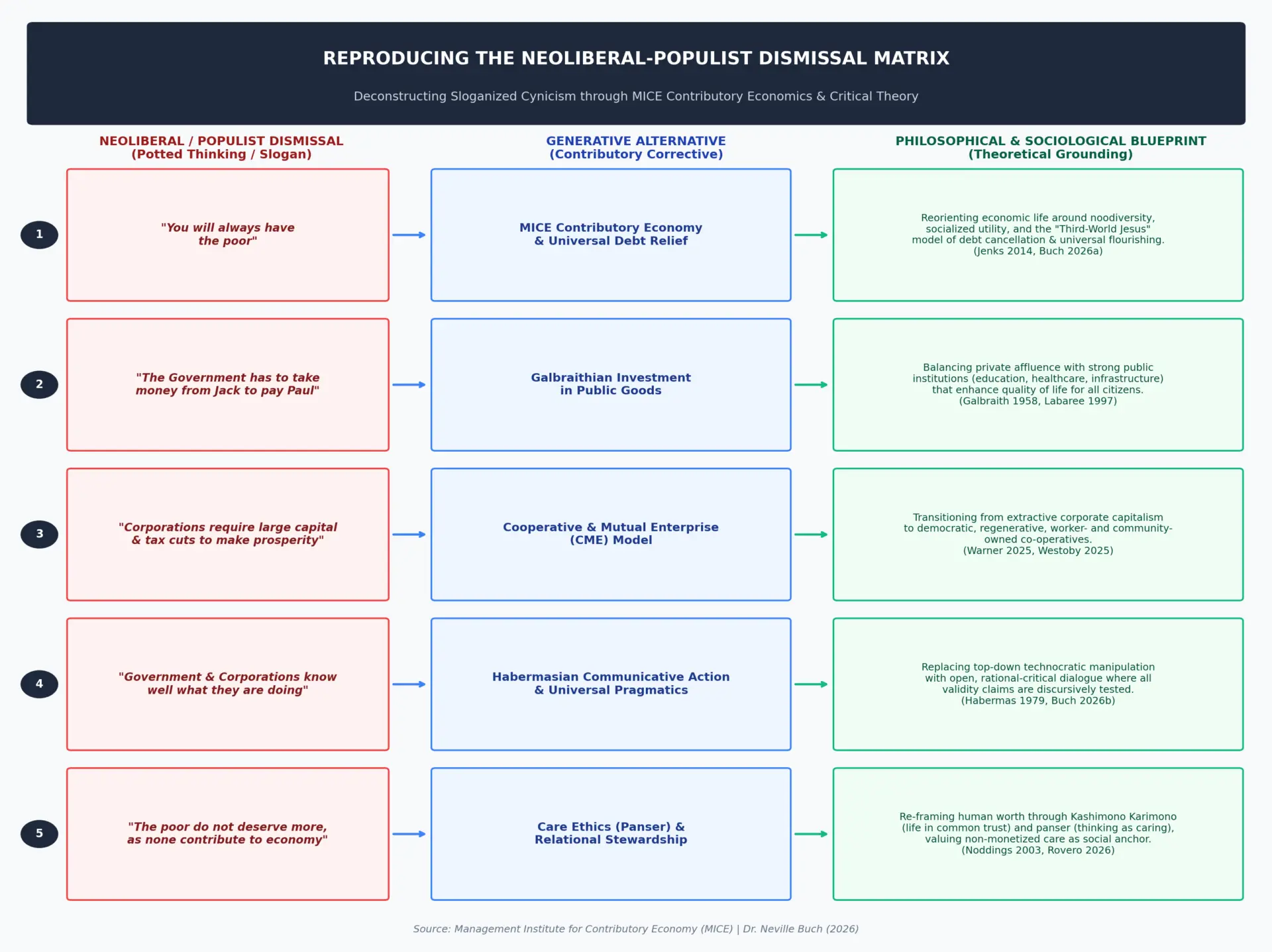
1. Jürgen Habermas and Communicative Action:
Instead of strategic manipulation for “Political Profit,” Habermas proposes Communicative Action dialogue aimed at mutual understanding (Verständigung) (Habermas 1979: 3; Buch 2026b: 8). Public decisions must be subjected to Universal Pragmatics, where speakers raise and reciprocally redeem four validity claims: comprehensibility, empirical truth, normative rightness, and psychological sincerity (Habermas 1979: 3; Buch 2026a: 24).
2. Galbraith’s Investment in Public Goods:
To remedy the “social imbalance” caused by private affluence and public poverty, John Kenneth Galbraith advocated using progressive taxation to fund robust public education, urban infrastructure, environmental protection, and scientific research (Galbraith 1958: 5).
3. The Cooperative and Mutual Enterprise (CME) Movement:
As Richard Warner demonstrates, the CME tradition (including co-operatives, credit unions, and social enterprises like SEWA) proves that ordinary people can organize equitably without relying on corporate oligarchs or extractive capital, conducting business with a horizon that protects future generations (Warner 2025: 165, 179).
4. Thinking as Caring (Panser):
In Dr. Neville Buch’s MICE framework, thinking (penser) is reinvented as caring (panser tending to social wounds) (Buch 2026a: 18; Buch 2026b: 8). Panser serves as a procedural shield that protects human particularity from the coldness of pure, calculative logic, ensuring that economic policy serves human dignity (eudaimonia) (Buch 2026a: 18; Buch 2026b: 7).
IV. The Imperative of Comprehensive Reflection over Visceral Reaction
Why is it so vital to abstain from making dismissals, forcing oneself instead into deep, comprehensive reflection even when confronting a proposition against which one has an immediate gut reaction?
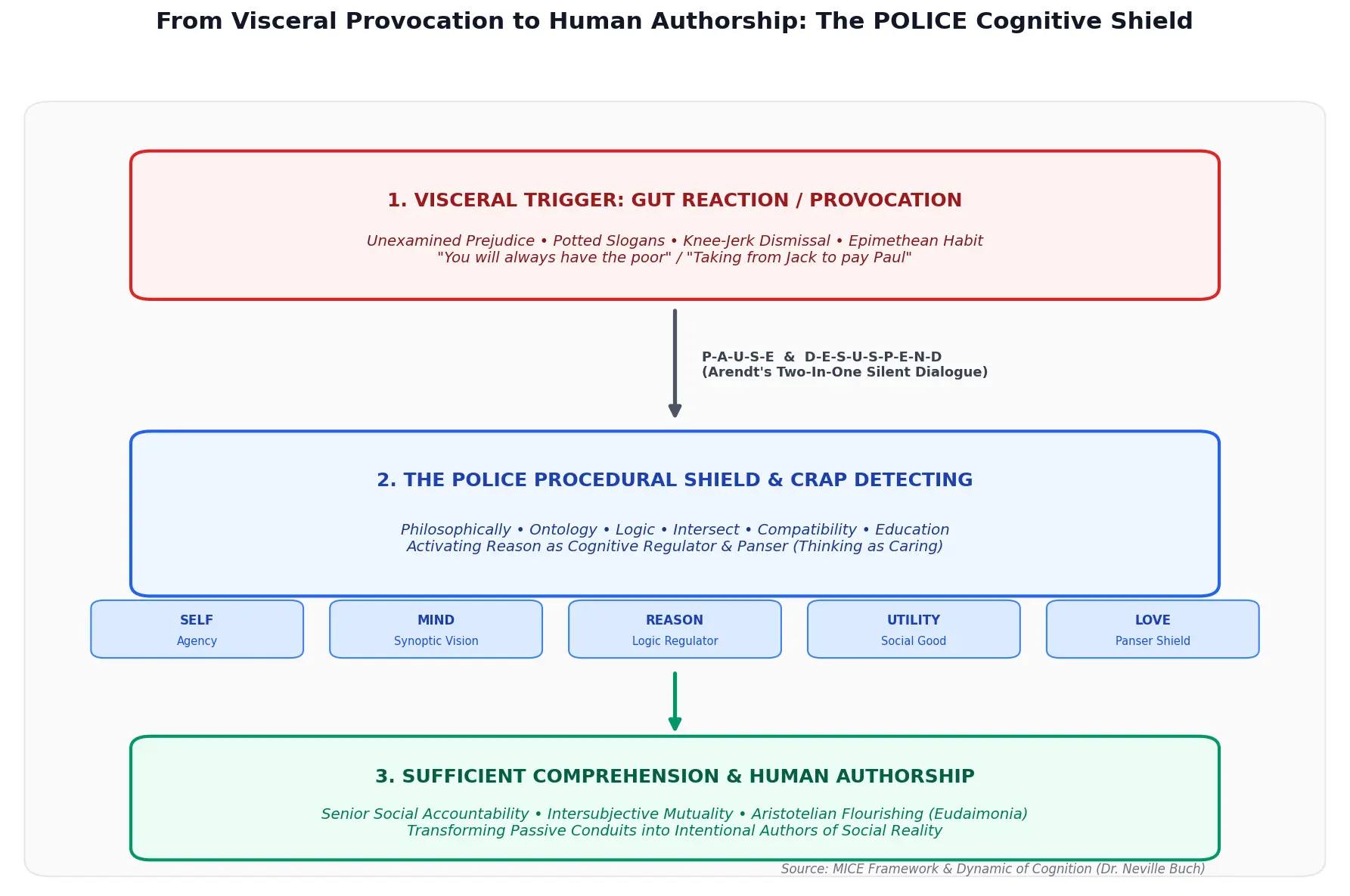
1. Arendt’s Two-in-One Silent Dialogue:
Hannah Arendt established a crucial distinction between knowing (which seeks demonstrable facts) and thinking (the quest for meaning) (Arendt 1977: 193). Thinking is an internal “two-in-one” silent dialogue with oneself that actualizes consciousness and produces conscience as its byproduct (Arendt 1977: 193). When an individual reacts with an immediate dismissal, they abort this internal dialogue. As Arendt warned, the refusal to think is the root of systemic ethical collapse and the “banality of evil” a state where ordinary citizens become capable of supporting catastrophic policies simply because they never paused to reflect (Arendt 1977: 193; Buch 2026a: 714).
2. Gadamerian Hermeneutics and the Fusion of Horizons:
Hans-Georg Gadamer showed that all understanding requires exposing one’s own prejudices to the “provocation” of the text or the other person (Gadamer 1975: 345; Ringma 1991: 135). A gut reaction is merely the surfacing of an unexamined prejudice. If one yields to the gut reaction and utters a dismissal, one seals oneself inside a closed cognitive loop (Buch 2026b: 10). True understanding occurs only when one holds one’s agenda lightly, allows the “other” to challenge one’s assumptions, and achieves a Horizontverschmelzung (fusion of horizons) (Gadamer 1975: 345; Ringma 1991: 135; Buch 2026b: 12).
3. Buch’s Dynamic of Cognition (DoC) and the POLICE Model:
In the MICE methodology, overcoming gut reactions requires activating the POLICE model Philosophically Ontology Logic Intersect Compatibility Education(Buch & Peach 2024: 1; Buch 2026b: 7). The POLICE model trains the thinker to “police their own thoughts,” treating visceral gut reactions as revisable starting points rather than absolute truths (Buch & Peach 2024: 1; Buch 2026b: 7). This process forces the mind through the five dimensions of human cognition:
- Self (Identity):Reclaiming human authorship over automatic emotional drives (Buch 2026a: 38).
Mind (Judgment): Developing a “synoptic vision” that integrates diverse fields of knowledge (Buch 2026a: 39).
Reason (Logic): Applying formal logic to unmask “institutional bullshit” and sloganized rationalizations (Buch 2026a: 40).
Utility (Action): Socializing utility to maximize collective well-being rather than private ego (Buch 2026a: 41).
Love (Bond): Deploying panser(caring) to ensure the individual person is never sacrificed to abstract metrics (Buch 2026a: 42).
4. Ascent to “Senior” Social Accountability:
Moving beyond dismissals is the ultimate hallmark of a “Senior” intellectual state (Buch 2026a: 43; Buch 2026b: 7). A mature citizen recognizes that life is fuzzy, complex, and multi-textured (Buch 2026b: 18). By rejecting the deceptive clarity of slogans and committing to “Sufficient Comprehension” always seeking the whole of the matter while filtering out ephemeral fallacies the thinker transitions from being a passive conduit for power into a proactive author of a just, collaborative, and flourishing social world (Buch 2026a: 45; Buch 2026b: 8).
Conclusion
The public habit of uttering lazy, sloganized dismissals is a dangerous manifestation of cognitive regression, “potted thinking,” and self-imposed immaturity (Kant 1784: 1; Stebbing 1939: 12; Buch 2023: 3). As this essay has demonstrated, neoliberal and populist cliches regarding poverty, taxation, corporate power, institutional benevolence, and welfare are not only empirically false, but they actively serve to protect privilege and perpetuate social stasis (Galbraith 1958: 4; Weiss 2001: 39; Buch 2026b: 15).
To overcome this crisis, society must embrace the MICE Contributory Economy, communicative action, public goods investment, and democratic co-operatives (Galbraith 1958: 5; Habermas 1979: 3; Warner 2025: 179; Buch 2026a: 28). Crucially, individual citizens must cultivate the intellectual courage (Sapere Aude!) to pause when confronted with challenging ideas, suppress visceral gut dismissals, and engage in the rigorous labour of comprehensive reflection (Kant 1784: 1; Arendt 1977: 193; Buch 2026b: 7). Only through this commitment to panser thinking as caring can we restore human authorship, safeguard human dignity, and build a truly flourishing city of intellect(Arendt 1977: 193; Buch 2026a: 18; Buch 2026b: 463).
Bibliography
Arendt, H.(1977). The Life of the Mind. Edited by Mary McCarthy. New York: Harcourt Brace Jovanovich.
Buch, N.(2023). Interbelief and the Level Playing Field. Brisbane: Australian and New Zealand Unitarian Universalist Association (ANZUUA) & Dr Neville Buch Website (ABN 86703686642).
Buch, N.(2024). The Sociology of Teen Challenge (Qld) Inc. Brisbane: Management Institute for Contributory Economy.
Buch, N.(2025a). Public Ignorance, Resistance, or a Hidden Curriculum? Brisbane: Management Institute for Contributory Economy.
Buch, N.(2025b). Caring and Education, and Australian Attention. Brisbane: Management Institute for Contributory Economy.
Buch, N.(2026a). MICE Intellectual Handbook. Brisbane: Management Institute for Contributory Economy.
Buch, N.(2026b). Limited Thinking and the Contributory Economy. Book 1 of MICE. Brisbane: Management Institute for Contributory Economy.
Buch, N., & Peach, N.(2024). Philosophically Ontology Logic Intersect Compatibility Education (POLICE). Brisbane: Management Institute for Contributory Economy.
Buch, N., & Peach, N.(2026). Spiral Historiography and the Dynamic of Cognition. Brisbane: Management Institute for Contributory Economy.
Collins, R.(2019). The Credential Society: An Historical Sociology of Education and Stratification. New York: Columbia University Press.
Gadamer, H.-G.(1975). Truth and Method. Translation edited by Garrett Barden and John Cumming. New York: Seabury Press.
Galbraith, J. K.(1958). The Affluent Society. Boston: Houghton Mifflin.
Habermas, J.(1979). Communication and the Evolution of Society. Translated by Thomas McCarthy. Boston: Beacon Press.
Jenks, G. C.(2014). Jesus Then and Jesus Now: Looking for Jesus, Finding Ourselves. North Northcote, VIC: Morning Star Publishing.
Kant, I.(1784). Beantwortung der Frage: Was ist Aufklärung?(An Answer to the Question: What is Enlightenment?). Berlinische Monatsschrift, December, pp. 481-494.
Labaree, D. F.(1997). ‘Public-Private Goods as Educational Goals: The American Struggle Over Educational Goals’. American Educational Research Journal, 34(1), pp. 39-81.
Macpherson, C. B.(1962). The Political Theory of Possessive Individualism: Hobbes to Locke. Oxford: Oxford University Press.
McKinney, J. P.(1971). The Structure of Modern Thought. London: Chatto & Windus.
Noddings, N.(2003). Caring: A Feminine Approach to Ethics and Moral Education. 2nd ed. Berkeley: University of California Press.
Ringma, C. R.(1991). Gadamer’s Dialogical Hermeneutic. Doctoral dissertation, University of Queensland.
Rovero, J. K. T.(2026). Introspections on Tenrikyo: On the Care. Toba, Japan: Tenrikyo Studies Series.
Sen, A.(1999). Development as Freedom. New York: Oxford University Press.
Stebbing, L. S.(1939). Thinking to Some Purpose. Harmondsworth: Penguin Books.
Stiegler, B.(1998). Technics and Time, 1: The Fault of Epimetheus. Translated by Richard Beardsworth and George Collins. Stanford: Stanford University Press.
Warner, R.(2025). ‘Section 8: Economics as if Community Matters’. In P. Westoby et al., The Community Builder’s Journal, pp. 163-181. Brisbane: Community Praxis Co-operative.
Weiss, R. P.(2001). ‘Charitable Choice As Neoliberal Social Welfare Strategy’. Social Justice, 28(1), pp. 35—54.
Westoby, P. et al.(2025). The Community Builder’s Journal. Brisbane: Community Praxis Co-operative.
*****
Take the MICE Quiz
[1] Artificial Intelligence (A.I.) has been fairly used in the production of this work. The tool used is Google NotebookLM (recently rebranded as Gemini Notebook). It is an AI-powered virtual research assistant and thinking partner designed to help a person interact deeply with their own documents. Unlike general chatbots, it is source-grounded, meaning it only generates answers based on the specific PDFs, documents, or links uploaded. The A.I. process in the production of this work has been limited to the attached (prompts) on each of the questions in turn. This ensures an accurate reading of each source. The author then rearranged and re-edited the answers the A.I. provided. The human author publishes this work. A.I. is never an author when used properly. This assistance is not qualitatively different from a human research assistant when that assistance is deemed to have no authorial status but is acknowledged.


Neville Buch
Latest posts by Neville Buch (see all)
- The Human Being Above the Transaction and Why Markets Cannot Measure Human Worth – October 15, 2026
- Beyond Neoliberal Formalism: Should Taxpayers Fund Independent Philosophy – October 14, 2026
- A Critical Phenomenology and Epistemology of Open and Fixed Mindsets: Quantum Biology of the Open Mind – October 13, 2026