
Dr Neville Buch and MICE in reference to the work of Matt Patterson[1]

Abstract
This review essay provides a critical examination of Matt Patterson’s (2009) Comprehensive Examination in Sociological Theory, analysing its foundational synthesis of sociological agency, social constructionism, and the dialectic between cultural ideas and material forces [Patterson 2009, pp. 2, 13, 25]. By bringing Patterson’s survey into dialogue with Dr. Neville Buch’s general methodology—the Dynamic of Cognition (DoC) and the framework of Sufficient Comprehension—this essay evaluates how classical and contemporary social theories address human agency against deterministic structure [Patterson 2009, p. 2; Buch 2025b, p. 1; Buch 2025d, p. 1]. We demonstrate how Buch’s synoptic model expands Patterson’s sociological taxonomy, moving beyond micro-sociological reductionism toward a personalist, 5-Intention framework (Self, Mind, Reason, Utility, Love) [Buch 2025d, p. 1; Buch 2025e, p. 8]. Furthermore, the essay explores how the concept of Sufficient Comprehension illuminates social understanding within the “Trumpocene”—a modern era characterized by digital “denoetization,” populist anti-intellectualism, and the erosion of expertise [Buch 2025f, p. 2; Buch 2026a, p. 1]. Finally, we highlight the principal “take-home” messages of Patterson’s work and explain why his systematic taxonomy remains vital for overcoming rigid “Identity Thinking” and reclaiming human authorship in contemporary social science [Patterson 2009, p. 13; Buch 2025e, p. 12; Buch 2026c, p. 4; Cognitive Ascent, p. 204].
I. Introduction: The Core Sociological Terrain of Matt Patterson (2009)
In Comprehensive Examination in Sociological Theory, Matt Patterson (2009) undertakes a rigorous, tripartite examination of the perennial debates that define sociological analysis:
- Part A: The Dilemma of Agency — Investigating why the concept of “agency” has generated continuous intellectual friction across sociology and evolutionary theory, identifying its most intractable issues, and evaluating potential theoretical resolutions [Patterson 2009, p. 2].
- Part B: The Social Construction of Reality — Mapping the diverse meanings associated with “the social construction of X” in sociological and philosophy of science literatures, evaluating implicit constructionist paradigms, and assessing the enduring utility of constructionist terminology [Patterson 2009, p. 13].
- Part C: Ideas versus Material Forces — Critically comparing and contrasting how classical and contemporary theorists conceptualize the active role of culture, norms, schemas, and interpretive meanings relative to material, structural, and ecological determinants [Patterson 2009, p. 25].
Patterson (2009, p. 25) grounds his analysis in an interpretive definition of culture—drawing on Clifford Geertz’s (1973) semiotic formulation—as the active, meaningful webs of significance and interpretive methods through which research subjects attribute sense to their world. Patterson (2009, p. 13) stakes out a clear theoretical position: social structures and institutions are sustained through continuous, collective social action and shared belief, rather than relying on essentialist, fixed, or unchangeable external causes.
II. Comparing Patterson’s Sociological Framework with Dr. Neville Buch’s Dynamic of Cognition
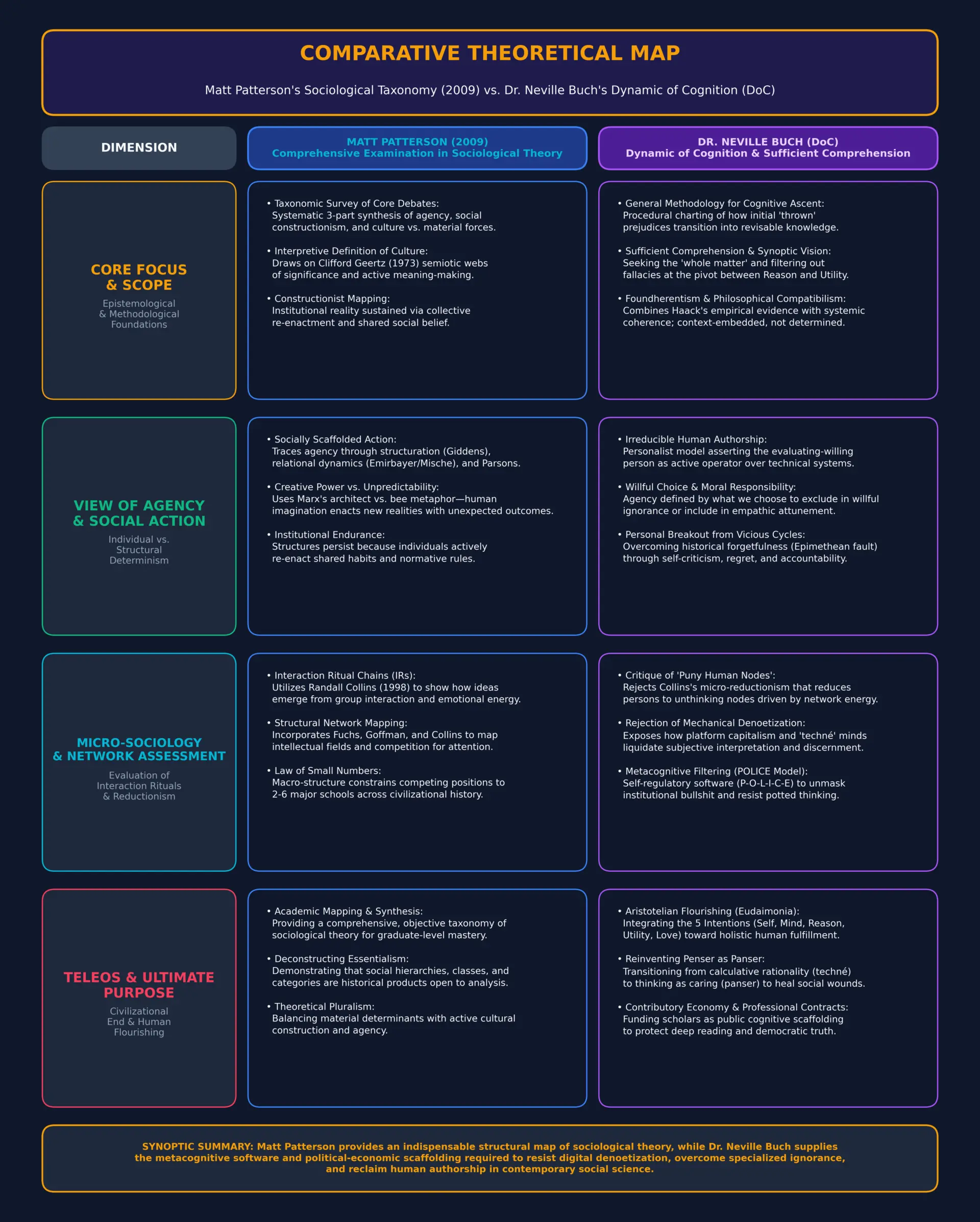
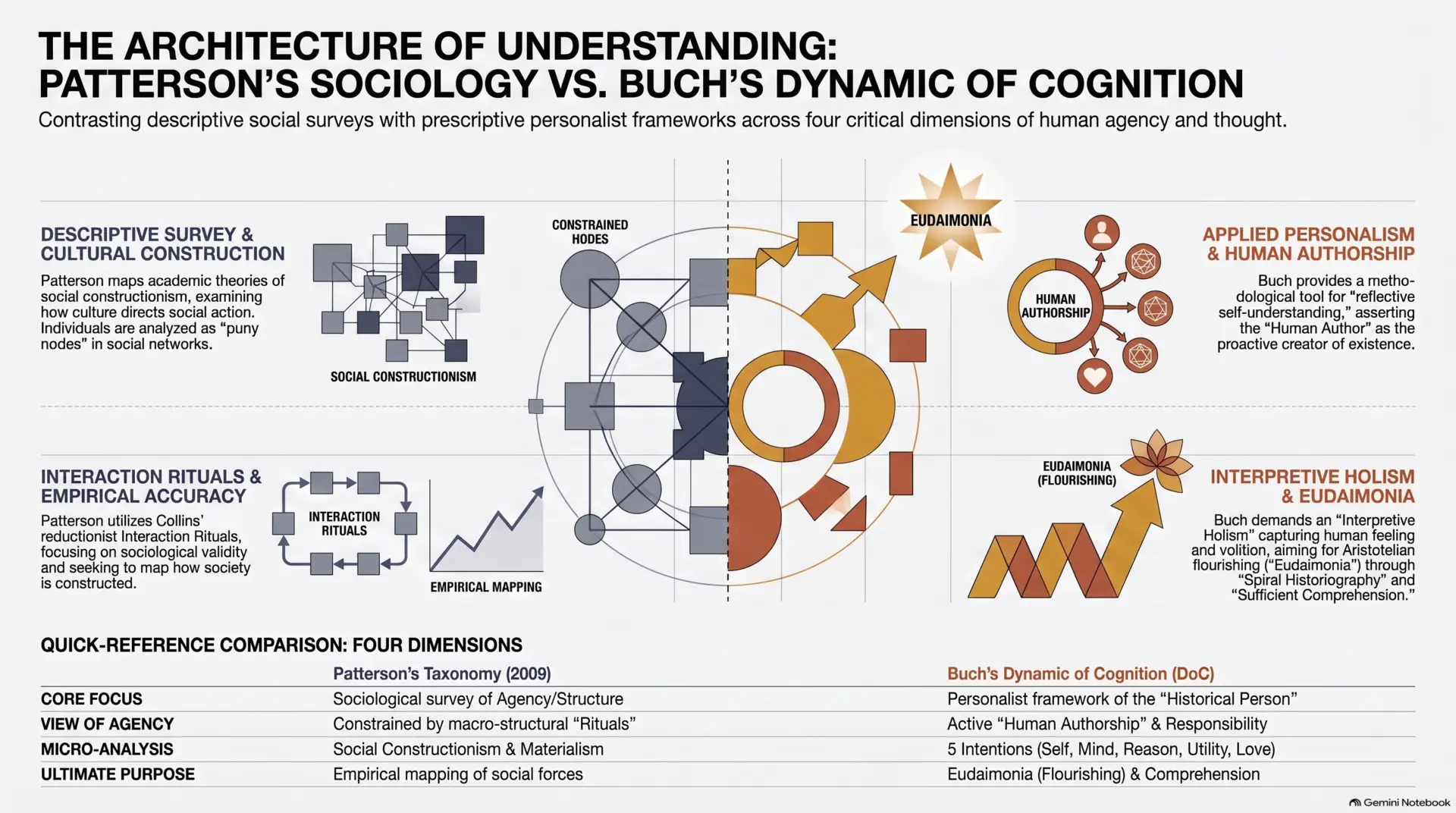
While Matt Patterson provides a comprehensive overview of mainstream sociological theory, comparing his approach with Dr. Neville Buch’s Dynamic of Cognition (DoC) reveals fundamental differences in scope, methodology, and ultimate purpose:
1. Agency: Scaffolding versus Irreducible Authorship
Patterson (2009, p. 2) traces agency through structural-functionalist, structuration, and relational models (such as Talcott Parsons, Anthony Giddens, Mustafa Emirbayer, and Anne Mische). Patterson (2009, p. 13) emphasizes that social phenomena endure because they are actively re-enacted and sustained through collective social practice.
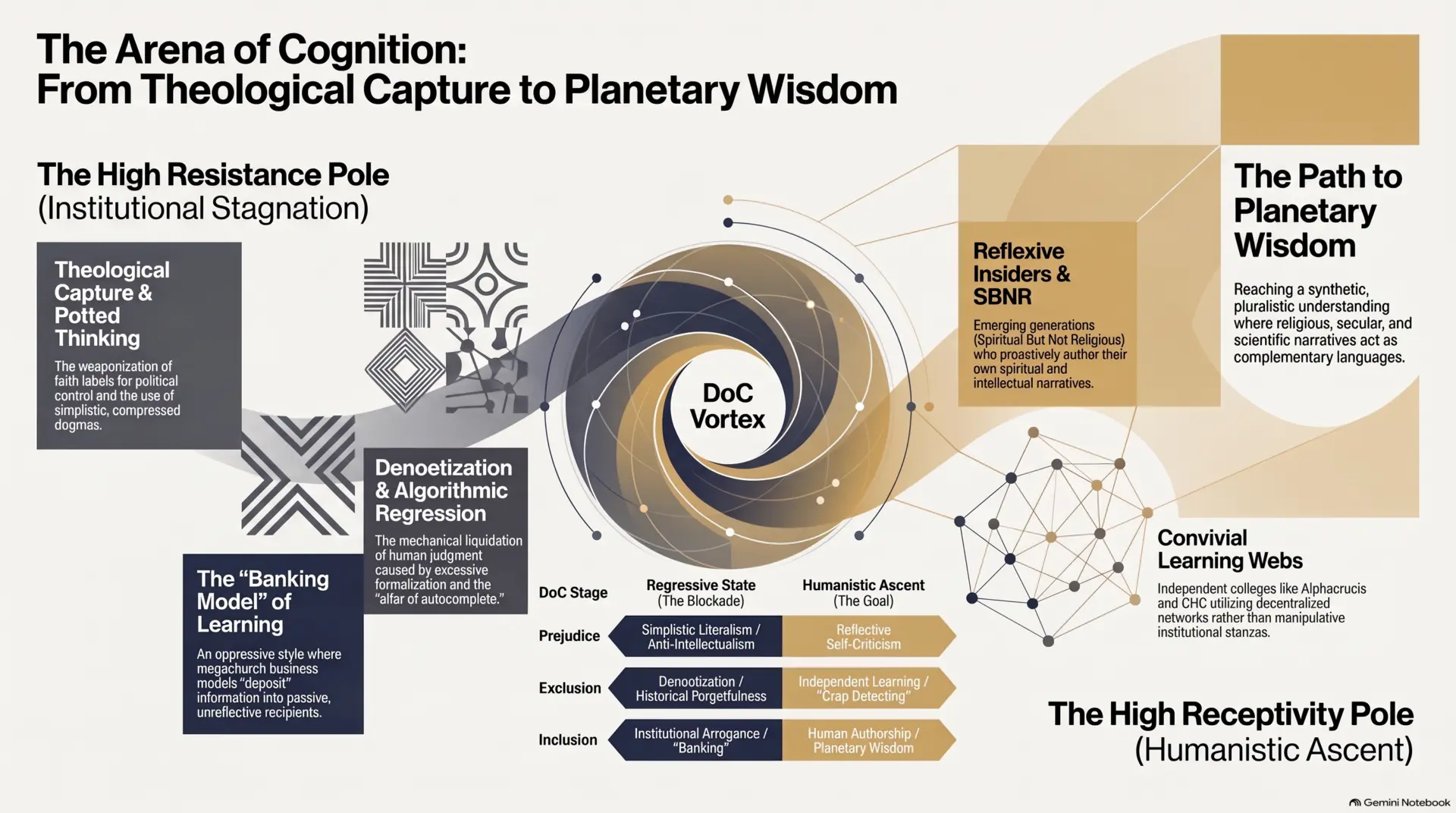
In comparison, Dr. Buch’s DoC model approaches agency through Personalism and Anthropological Pedagogy [Buch 2025b, p. 1; Buch 2026c, p. 4]. While Buch acknowledges structural constraints, he strongly critiques micro-sociological reductionism—such as Randall Collins’s (1998) interaction ritual chain theory, which reduces individuals to “puny human nodes” steered by emotional energy and external network dynamics [Collins 1998; Buch 2025e, p. 13].
Buch (2025e, p. 13) argues that defining emotions as a mere residual category for non-rational drives liquidates subjective interpretation and moral responsibility. Instead, Buch (2025e, p. 13; 2026b, p. 6) asserts human authorship—the capacity of the evaluating-willing person to exercise self-criticism, choose what to exclude in wilful ignorance or include in empathy, and act as an active operator over technical and social systems [Buch 2025b, p. 1].
2. Ideas and Materiality: Foundherentism and Philosophical Compatibilism
Patterson (2009, p. 25) explores the dialectic of culture versus material forces across classical and contemporary theorists (including Karl Marx, Max Weber, Pierre Bourdieu, Maurice Godelier, and Jared Diamond). Patterson demonstrates that culture is an active, necessary component of social organization that cannot be reduced to a passive material superstructure [Patterson 2009, p. 25].
Dr. Buch arrives at a compatible but epistemologically broader resolution through Susan Haack’s foundherentism and philosophical compatibilism [Haack 1993; Buch 2025d, p. 7; Buch 2026e, p. 7]. Rejecting both pure vulgar materialism and detached idealist abstractions, Buch demonstrates that human activity is “context-embedded but not context-determined” [Hayot 2021; Buch 2025f, p. 4; Buch 2026c, p. 27]. Objective truth-claims rely on empirical evidence and intersubjective justification rather than market price or political power [Haack 1993, p. 231; Buch 2026e, p. 9].
III. Illuminating Understanding in the Trumpocene Through Sufficient Comprehension
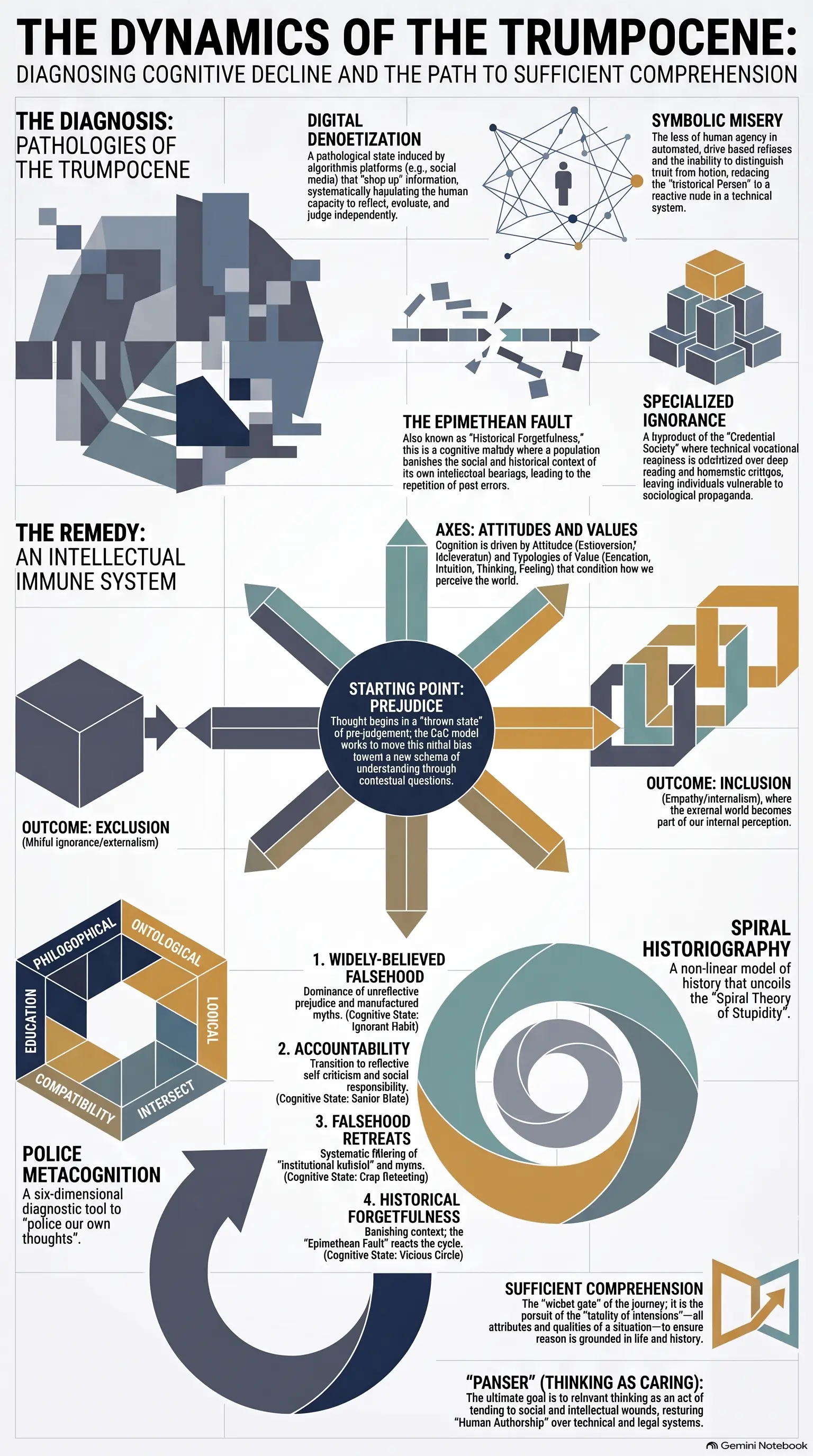
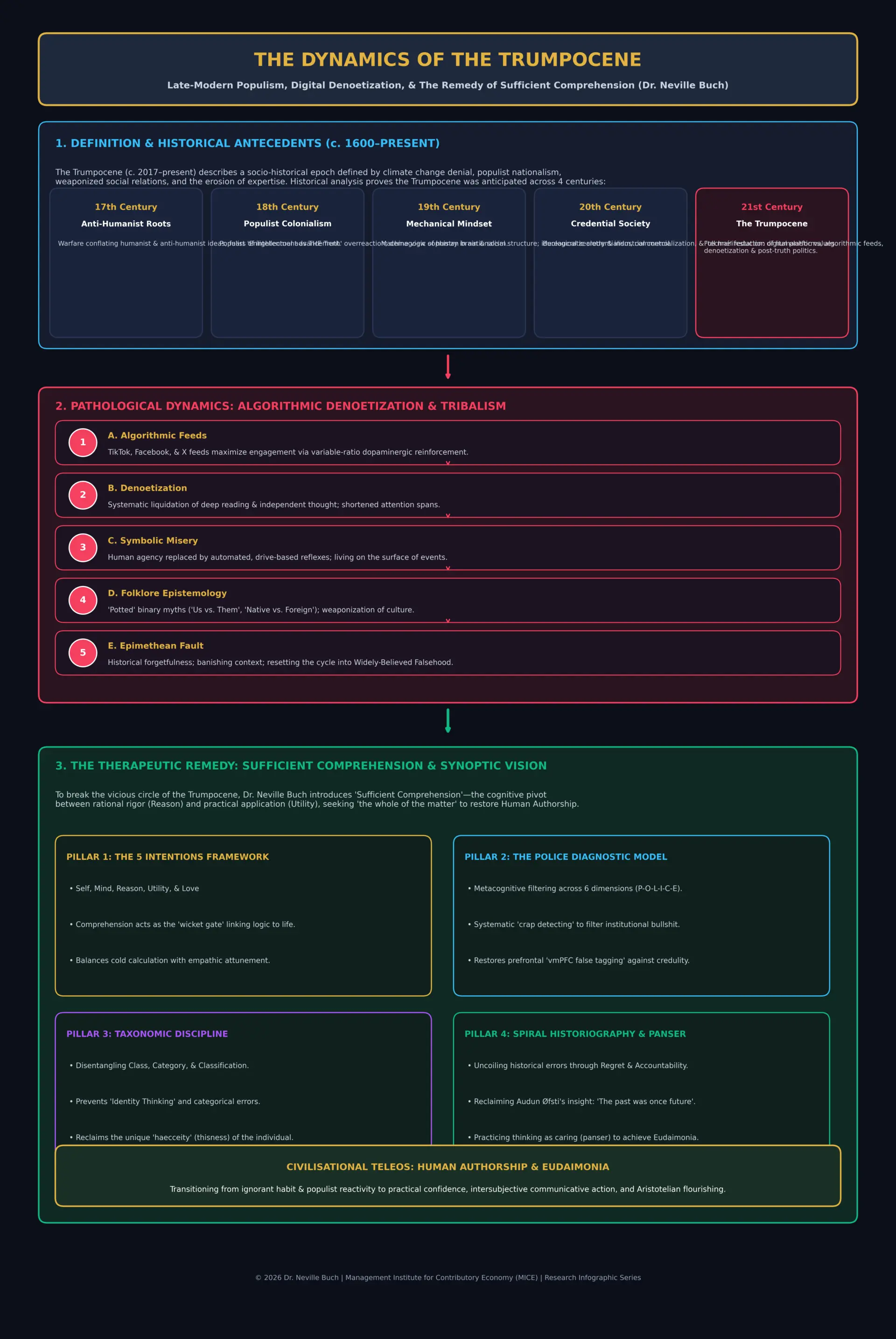
A critical contribution of Dr. Buch’s framework is demonstrating how social theory applies to contemporary civilizational crises. Buch defines the “Trumpocene” (c. 2017–present) as an unofficial socio-historical epoch characterized by populist anti-intellectualism, post-truth rhetoric, digital “denoetization,” and the systematic erosion of professional expertise [Buch 2025f, p. 2; Buch 2025g, p. 3; Buch 2026a, p. 1].
In the Trumpocene, public discourse suffers from an “immense regression” in reading capacity and cognitive depth [Buch 2026a, p. 1]. Algorithmic communication networks accelerate “denoetization”—a state where automated digital habits prevent citizens from thinking independently, trapping them in “symbolic misery” and “potted thinking” [Stiegler 2014; Buch 2026a, p. 2; Buch 2026c, p. 18]. Public debate is hijacked by “folklore epistemology” and rigid binary classifications (“us vs. them,” “native vs. foreign”), transforming historical scholarship into populist culture-war battlegrounds [Buch 2026a, p. 3; Cognitive Ascent, p. 202; Technicisation of Thought, p. 404].
Patterson’s (2009, p. 13) analysis of social constructionism and cultural meaning helps explain how these populist narratives are collectively constructed and sustained. However, Buch’s concept of Sufficient Comprehension provides the diagnostic and therapeutic remedy [Buch 2025d, p. 1; Buch 2025e, p. 5]:
- The Synoptic Pivot: Situated as the cognitive pivot between critical Reason and practical Utility, Sufficient Comprehension seeks the “whole of the matter,” filtering out fallacies, “institutional bullshit,” and manufactured myths [Frankfurt 2005; Buch 2025d, p. 1; Covenantal Hermeneutics, p. 2].
- Taxonomic Discipline: Healing polarization requires restoring formal logical distinctions between a class (a rigid set), a category (a fluid concept), and a classification (an organizational system) [Cognitive Ascent, p. 203; Technicisation of Thought, p. 406]. Confusing fluid categories with totalizing, exclusionary classes create “Identity Thinking” that dehumanizes the individual person [Buch 2023a, p. 143; Buch 2025d, p. 2].
- Spiral Historiography: Uncoiling recurring historical errors through regret and accountability, allowing citizens to “unhook” their identity narratives from restrictive tribal stencils and overcome the Epimethean fault (Historical Forgetfulness) [Stiegler 1998; Buch 2025d, p. 1; Buch 2026c, p. 19].
IV. Take-Home Messages: Agency, Cultural Construction, and Epistemological Pluralism
Synthesizing Patterson (2009) with Buch’s DoC framework yields four essential “take-home” messages for contemporary social theory:
- Agency is Real and Irreducible: Human action is neither a deterministic byproduct of evolutionary biology nor a passive node in an interaction network [Patterson 2009, p. 2; Buch 2025e, p. 13]. While constrained by historical context, human beings retain the capacity for reflective self-criticism, moral choice, and creative authorship [Buch 2025b, p. 1; Buch 2026b, p. 6].
- Social Constructions Require Sustained Action: Social institutions, market structures, and cultural identities are not essentialist, unchangeable facts; they are historically contingent patterns sustained through collective belief and practice [Patterson 2009, p. 13; Buch 2026c, p. 27]. Therefore, oppressive or irrational social structures can be unmasked, critiqued, and transformed [Patterson 2009, p. 13; Buch & Peach 2024].
- Culture and Ideas are Active Determinants: Culture cannot be reduced to a secondary reflex of economic infrastructure or administrative rules [Patterson 2009, p. 25]. Meaning, values, and interpretive schemas actively shape human behaviour and political economy [Patterson 2009, p. 25; Buch 2025d, p. 1].
- Specialized Ignorance Must Be Overcome Through Synoptic Vision: Academic scholarship that retreats into hyper-specialized “puzzles” or market servility becomes complicit in civilizational denoetization [Collins 1998; Buch 2024c, p. 12; Buch 2026a, p. 2]. True scholarship requires an epistemological pluralism that integrates reason, utility, and empathy (panser / thinking as caring) to foster Aristotelian flourishing ( eudaimonia ) [Buch 2025a, p. 3; Buch 2026c, p. 4; Cognitive Ascent, p. 207].
V. Why Patterson’s Insights are Important
Matt Patterson’s (2009) Comprehensive Examination in Sociological Theory is important for three primary reasons:
- Systematic Mapping of Core Sociological Debates: Patterson provides an exceptionally clear taxonomy of how classical and contemporary theorists navigate the micro-macro, agency-structure, and material-ideal divides [Patterson 2009, pp. 2, 13, 25]. It serves as an indispensable foundational text for understanding how sociological knowledge is organized.
- Clarifying the Anti-Essentialist Nature of Social Reality: By articulating how social constructionism operates across various sub-disciplines, Patterson demonstrates that social hierarchies, cultural boundaries, and institutional forms are maintained through human practice [Patterson 2009, p. 13]. This provides the necessary sociological grounding for humanistic critique and social reform.
- Bridging Interpretive and Structural Sociology: Patterson’s integration of Geertzian cultural analysis with structural and relational theories (such as Bourdieu, Giddens, and Parsons) demonstrates that rigorous social science must account for both subjective meaning and objective social conditions [Patterson 2009, pp. 25, 36].
When Patterson’s sociological survey is combined with Dr. Neville Buch’s Dynamic of Cognition, scholars gain both the structural map (Patterson) and the metacognitive software (Buch’s DoC and POLICE model) required to navigate the complex social and intellectual challenges of the twenty-first century [Patterson 2009, p. 36; Buch 2025b, p. 1; Buch & Peach 2024].
VI. Conclusion
Matt Patterson’s (2009) survey reminds us that the central task of sociology is to understand how human beings collectively create, inhabit, and transform their social worlds [Patterson 2009, pp. 2, 13, 25]. However, in an era marked by the Trumpocene, digital denoetization, and market reductionism, sociological theory cannot remain a passive academic exercise [Buch 2025f, p. 2; Buch 2026a, p. 1].
By uniting Patterson’s sociological taxonomy with Dr. Neville Buch’s synoptic vision of Sufficient Comprehension, scholars and citizens can resist algorithmic manipulation, restore taxonomic discipline, and practice panser (thinking as caring) [Buch 2025d, p. 1; Buch 2026c, p. 4]. In doing so, we ensure that sociology fulfills its true humanistic promise: safeguarding human authorship, unmasking institutional myths, and fostering a mature, democratic society dedicated to comprehensive empathy and Aristotelian flourishing (eudaimonia) [Patterson 2009, p. 13; Buch 2025a, p. 3; Buch 2026b, p. 1; Buch 2026c, p. 19].
References / Bibliography
Bourdieu, Pierre. (1984). Distinction: A Social Critique of the Judgement of Taste, Harvard University Press, Cambridge, MA [Patterson 2009, p. 36; cited in Buch 2025e, p. 8].
Buch, Neville. (2023a). SoFiA Melbourne: Unity and Fragmentation, Dr Neville Buch, Brisbane [Cognitive Ascent, p. 208].
Buch, Neville. (2023b). Spiral Historiography: Socio-Historical Change in Unitarian Universalism, ANZUUA, Brisbane [Cognitive Ascent, p. 208].
Buch, Neville. (2024c). When Humanists Know Nothing of Humanism: Contrast to the Comprehensive History, Humanists Brisbane, Brisbane [Legitimacy and Cognition, p. 225].
Buch, Neville. (2025a). Comprehensive Understanding of Humanism Today, Dr Neville Buch, Brisbane [Cognitive Ascent, p. 208].
Buch, Neville. (2025b). Concept-Practice X.6. Dynamic of Cognition, Dr Neville Buch, Brisbane, pp. 1–6.
Buch, Neville. (2025d). Five Intention Prejudice and Global Thinking Series. Paper No. 4: The Synoptic Vision – A Philosophical Inquiry into Comprehension, Dr Neville Buch, Brisbane, pp. 1–4.
Buch, Neville. (2025e). Comprehension: Solutions and The Plan, Management Institute for Contributory Economy, Brisbane, pp. 1–20.
Buch, Neville. (2025f). Humanism in the Trumpocene: Week 1.A (Historical Lesson from the Seventeenth Century), Dr Neville Buch, Brisbane, pp. 1–10.
Buch, Neville. (2025g). NDB Proposal for MSCP Summer (5 Weeks), Dr Neville Buch, Brisbane, pp. 1–7.
Buch, Neville. (2026a). The Crisis of Comprehension and the Restoration of Deep Reading: Part 2. Response to Critics, Management Institute for Contributory Economy, Brisbane, pp. 1–5.
Buch, Neville. (2026b). The Unitarian Universalist Cognitive Ascent, Dr Neville Buch, Brisbane, pp. 1–12.
Buch, Neville. (2026c). Identity Politics and the Ascent toward Comprehensive Empathy, Dr Neville Buch, Brisbane, pp. 1–30.
Buch, Neville. (2026e). The Cynicism of the Market: Foundherentism, Contributory Economy, and the Subversion of Luchel’s Rent-Seeking Epistemology, Dr Neville Buch Blog, Brisbane, pp. 1–21.
Buch, Neville and Peach, Neil. (2024). Philosophically Ontology Logic Intersect Compatibility Education (POLICE), Dr Neville Buch ABN: 86703686642, Brisbane [Legitimacy and Cognition, p. 225].
Collins, Randall. (1998). The Sociology of Philosophies: A Global Theory of Intellectual Change, Harvard University Press, Cambridge, MA [Patterson 2009, p. 36; cited in Buch 2025e, pp. 10–13].
Cognitive Ascent: Unity, Universality, and Sufficient Comprehension. (2026). Academic Reference Document, Brisbane, pp. 202–208.
Covenantal Hermeneutics and the Dynamic of Cognition. (2026). Academic Reference Document, Brisbane, pp. 214–215.
Emirbayer, Mustafa and Mische, Anne. (1998). ‘What is Agency?’, American Journal of Sociology, vol. 103, no. 4, pp. 962–1023 [Patterson 2009, p. 36].
Frankfurt, Harry G. (2005). On Bullshit, Princeton University Press, Princeton [Buch 2026e, p. 10].
Fuchs, Stephan. (2001). ‘Beyond Agency’, Sociological Theory, vol. 19, no. 1, pp. 24–40 [Patterson 2009, p. 36].
Geertz, Clifford. (1973). The Interpretation of Cultures, Basic Books, New York [Patterson 2009, p. 36].
Giddens, Anthony. (1984). The Constitution of Society, University of California Press, Berkeley [Patterson 2009, p. 36].
Haack, Susan. (1993). Evidence and Inquiry: Towards Reconstruction in Epistemology, Blackwell, Oxford [Buch 2026e, p. 7].
Habermas, Jürgen. (1989). The Structural Transformation of the Public Sphere, translated by T. Burger, MIT Press, Cambridge [Buch 2026a, p. 2].
Hayot, Eric. (2021). Humanist Reason: A History, An Argument, A Plan, Columbia University Press, New York [Buch 2025f, p. 4].
Patterson, Matt. (2009). Comprehensive Examination in Sociological Theory, Department of Sociology, University of Toronto, Toronto, pp. 1–36.
Stiegler, Bernard. (1998). Technics and Time, 1: The Fault of Epimetheus, translated by R. Beardsworth and G. Collins, Stanford University Press, Stanford [Buch 2026a, p. 2].
Stiegler, Bernard. (2014). Symbolic Misery, 1: The Hyperindustrial Epoch, translated by D. Ross, Polity Press, Cambridge [Buch 2026a, p. 3].
The Technicisation of Thought and the Crisis of Comprehension. (2026). Academic Reference Document, Brisbane, pp. 404–410.
*****
Take the MICE Quiz
[1] Artificial Intelligence (A.I.) has been fairly used in the production of this work. The tool used is Google NotebookLM (recently rebranded as Gemini Notebook). It is an AI-powered virtual research assistant and thinking partner designed to help a person interact deeply with their own documents. Unlike general chatbots, it is source-grounded, meaning it only generates answers based on the specific PDFs, documents, or links uploaded. The A.I. process in the production of this work has been limited to the attached (prompts) on each of the questions in turn. This ensures an accurate reading of each source. The author then rearranged and re-edited the answers the A.I. provided. The human author publishes this work. A.I. is never an author when used properly. This assistance is not qualitatively different from a human research assistant when that assistance is deemed to have no authorial status but is acknowledged.
******


Neville Buch
Latest posts by Neville Buch (see all)
- Part 3:The Failure of an Educational Institution and How to Spiral Forward – October 10, 2026
- Part 2:The Failure of an Educational Institution and How to Spiral Forward – October 10, 2026
- Part 1:The Failure of an Educational Institution and How to Spiral Forward – October 10, 2026