
Dr Neville Buch
Abstract
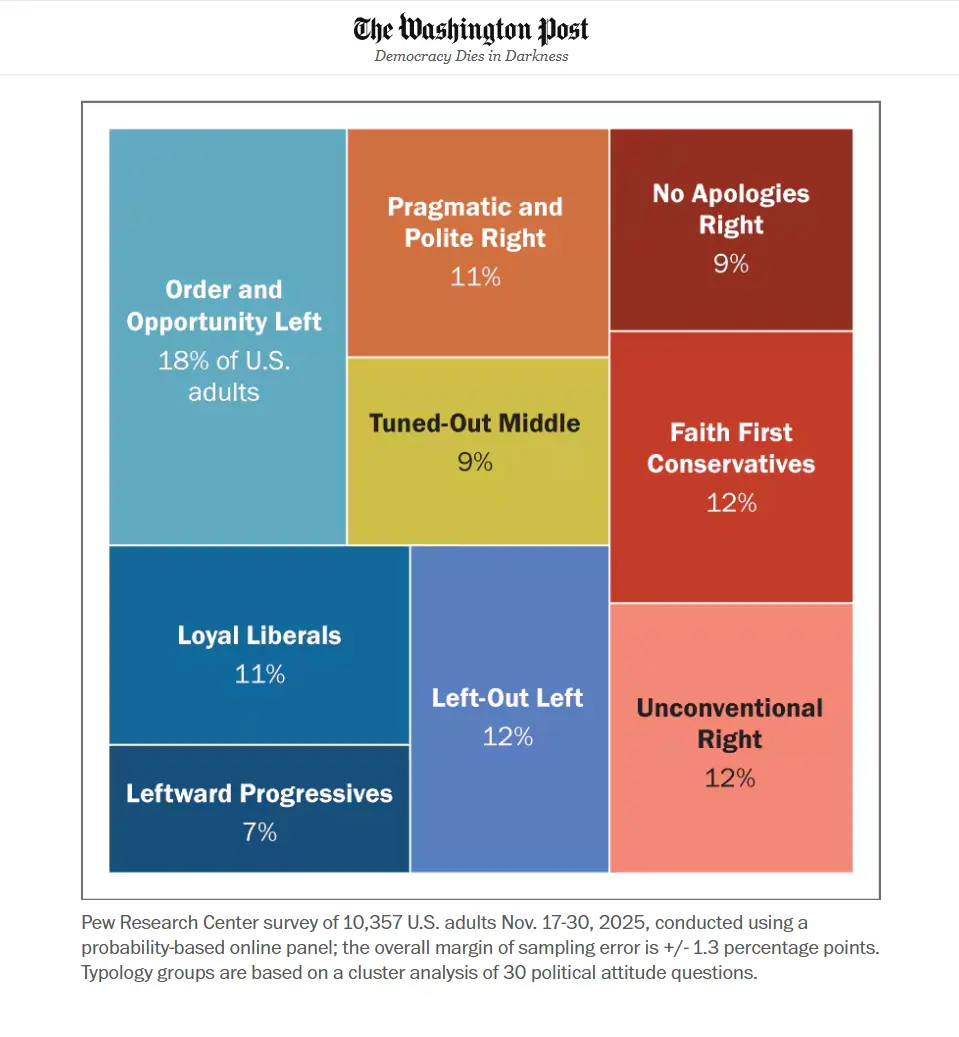
This essay investigates the epistemological failures inherent in modern political typologies, specifically analysing The Washington Post article regarding a Pew Research Center study that splits Americans into nine groups. While the study attempts to transcend simple partisan binaries, it falls into the trap of “thin” conceptualization and statistical reductionism. A critical error identified is the categorization of the centre as a “Tuned-Out Middle,” which ignores the possibility of a “Tuned-In Middle”—a segment of the citizenry characterized by Sufficient Comprehension and reflective judgment. Drawing on Dr. Neville Buch’s Dynamic of Cognition (DoC) and the critiques of Jacques Ellul and Bernard Williams, the essay argues that these spectrums often reflect unreflective impressions rather than deep ethical dispositions. Ultimately, it posits that true political understanding requires moving beyond data-driven “potted thinking” toward a Synoptic Vision that restores human authorship over social narratives.
The Mirage of the Matrix: Categorical Errors in Political Spectrums
The recent report in The Washington Post detailing a Pew Research Center study attempts to map the “deep internal fissures” of the American electorate by categorizing citizens into nine distinct groups. While intended to provide clarity in a polarized landscape, such political spectrums often suffer from structural errors that reinforce “Specialized Ignorance” rather than fostering genuine social accountability.
1. The Error of the “Tuned-Out” Label
One of the most significant errors in the Pew typology is the designation of the non-partisan centre as the “Tuned-Out Middle”. The study describes this group as “stressed,” “politically ignored,” and not following politics closely. This label reflects a “techné mindset”—a cognitive failure that assumes engagement only exists through the prism of established partisan metrics. By omitting a “Tuned-In Middle”, the spectrum fails to account for individuals who may intentionally distance themselves from partisan vitriol to maintain a “hold on reality” through independent reflection. This omission suggests that the typology is built on “thin” concepts that lack the descriptive weight required to recognize the “thick” reality of a reflective, independent citizen.
2. The Fragility of Statistical Impressions
The reliance on statistical survey data—based on roughly 30 questions on political attitudes—presents a second major error. As Jacques Ellul notes, opinion surveys are often “badly equipped” to gauge the depth of human conviction because they capture vague, inconsistent, and unformulated opinions. Such data is a necessarily biased representation of truth, as the researcher must make inherently biased decisions about which categories exist. These spectrums frequently record “potted thinking”—compressed, ready-made statements that save the individual from the actual trouble of deep reflection. Consequently, the resulting categories may be statistical artifacts rather than ontological realities, providing a “deceptive sense of order” that collapses during an epistemological crisis.
3. Polarization and the Analytical Abyss
By focusing on the most “enthusiastic supporters” who hold the “most extreme views,” these typologies inadvertently contribute to societal polarization and the creation of “filter bubbles”. This results in an “immense regression” where the “Who” of the person is reduced to a manageable “What” within a data-driven system. When spectrums prioritize “arithmetic” dilemmas or simple currency comparisons, they eliminate morally relevant relationships from the situation, leading to a state of “symbolic misery”.
Conclusion: Reclaiming the Tuned-In Perspective
To correct these errors, we must transition from a “Junior” mindset of unreflective data consumption to a “Senior” state of social accountability. This requires a Dynamic of Cognition that includes Socratic reflection and an appreciation for the “thick ethical concepts” that anchor judgment in concrete reality. A “better” spectrum would be one that recognizes the “Tuned-In Middle” as a site of Communicative Action, where citizens seek mutual understanding rather than strategic domination. Ultimately, the goal is to ensure that human authorship remains the master of the technical systems used to map our collective lives.
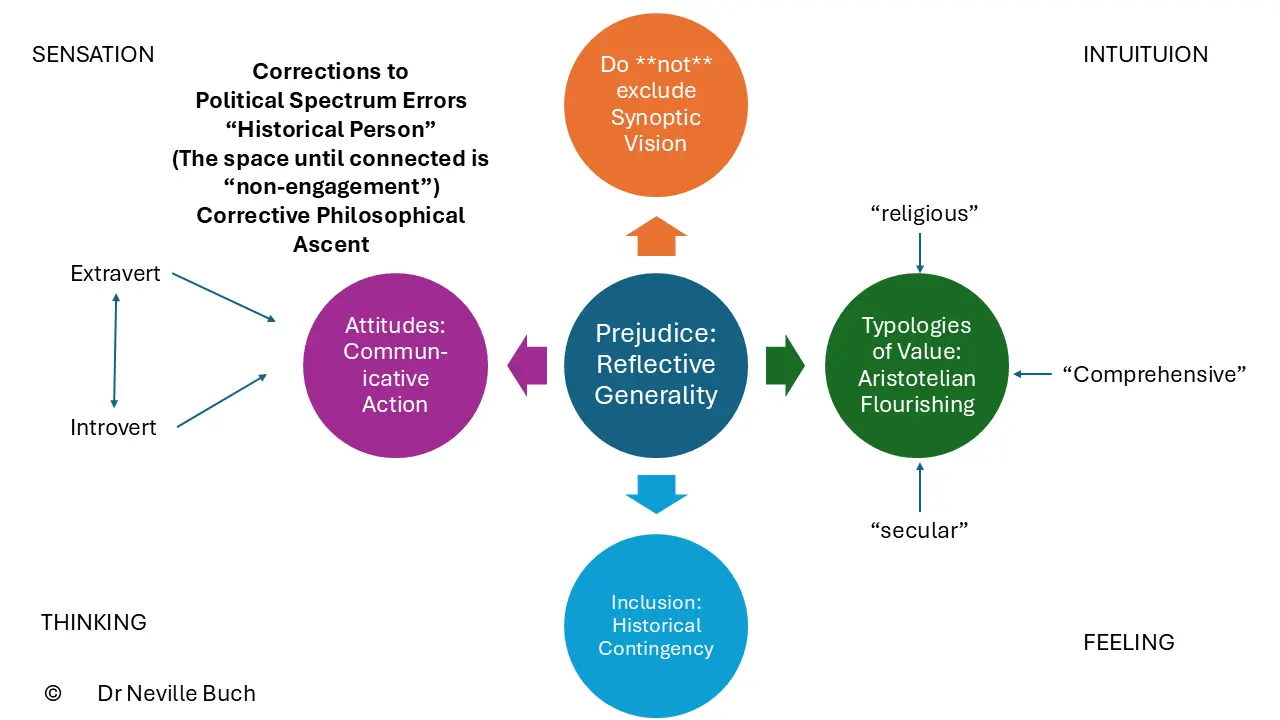
Dynamic of Cognition (DoC) Table: Political Spectrum Errors
| DoC Component | Error in Typology (Regression) | Corrective Philosophical Ascent | Cognitive Impact and Rationale |
| Prejudice (Centre) | Statistical Reductionism | Reflective Generality | Shifting from compressed survey data to a “Cartesian stance” of questioning. |
| Exclusion (Sensation) | The “Tuned-In Middle” | Synoptic Vision | Filtering out the messy lived experience of reflective citizens in favour of “tuned-out” labels. |
| Inclusion (Intuition) | Manufactured Partisanship | Historical Contingency | Realizing that partisan categories are human constructions, not natural facts. |
| Attitude (Thinking) | Strategic Manipulation | Communicative Action | Replacing “singular messaging” with rational-critical dialogue. |
| Value (Feeling) | Immediate Political Profit | Aristotelian Flourishing | Measuring success by human dignity and wisdom (eudaimonia). |
Endnotes
- Tuned-Out Middle: The Pew Research Center study identifies this group as less engaged and more moderate.
- Techné Mindset: A cognitive failure prioritizing quantifiable data over human depth.
- Hold on Reality: Bernard Williams notes that differences in outlook affect what people regard as real options.
- Statistical Bias: Data is a necessarily partial and erroneous representation of an individual.
- Potted Thinking: The habit of accepting ready-made statements to avoid the labor of reflection.
- Filter Bubbles: Technological and societal phenomena that decrease the diversity of a user’s information diet.
- Immense Regression: A divorce between cultural and technical evolution, leading to a loss of agency.
- Thick Ethical Concepts: Evaluative terms (e.g., integrity) that unite fact and value to anchor judgment.
- Senior State of Social Accountability: A developmental transition from unreflective compliance to proactive authorship.
APA Bibliography
- Buch, N. (2015). The dynamic of cognition. Dr Neville Buch ABN: 86703686642.
- Buch, N. (2025, March 21). The dynamic of cognition. [Teaching document]. Dr Neville Buch ABN: 86703686642.
- Buch, N. (2026, March 17). A matrix of sociology. Management Institute for Contributory Economy.
- Clement, Scott. (2026, April 14). Study splits Americans into nine political groups. Where do you belong? The Washington Post.
- Ellul, J. (1973). Propaganda: The formation of men’s attitudes (K. Kellen & J. Lerner, Trans.). Knopf.
- Habermas, J. (1979). Communication and the evolution of society (T. McCarthy, Trans.). Beacon Press.
- Werthner, H., et al. (2024). Introduction to digital humanism. Springer.
- Williams, B. (1981). Moral luck: Philosophical papers 1973-1980. Cambridge University Press.
- Williams, B. (1985). Ethics and the limits of philosophy. Fontana Press.
******
Featured Image: Local-Regional-Global-Matrix


Neville Buch
Latest posts by Neville Buch (see all)
- The Human Being Above the Transaction and Why Markets Cannot Measure Human Worth – October 15, 2026
- Beyond Neoliberal Formalism: Should Taxpayers Fund Independent Philosophy – October 14, 2026
- A Critical Phenomenology and Epistemology of Open and Fixed Mindsets: Quantum Biology of the Open Mind – October 13, 2026