
Dr Neville Buch
Abstract
This essay explores how Gregory C. Jenks’ book, “Jesus Then and Jesus Now: Looking for Jesus, Finding Ourselves” (2014), serves as a theological and intellectual synthesis that could bind together a “Jesus intellectual community.” Drawing on the historical trajectories of the House of Freedom (HOF), Teen Challenge (Qld) Inc., and the Waiters Union, the essay argues that Jenks’ methodology—merging archaeology, history, and personal reflection—provides the “connective tissue” for these radical and progressive Christian groups. By reclaiming the human Jesus and the Kingdom of God as a current social reality rather than a future apocalyptic event, Jenks’ work validates the “courageous hope” of these communities. Ultimately, the essay posits that this intellectual community is anchored in the archetype of the “Person,” utilizing the “0-1-3 method” of relational formation to resist institutional denoetization and foster Aristotelian flourishing.
——————————————————————————–
The Jesus Intellectual Community: Synthesis and Solidarity in Jenks’ Vision
- The Intellectual Foundation: Jenks’ “Jesus Book”
Gregory C. Jenks’ work is defined by an eclectic methodology that refuses to privilege the Bible over other ancient data, treating religious texts as subject to the same critical scrutiny as any other historical artifact. For a sustainable intellectual community, this approach is vital because it moves from “unreflective habit” toward a “rigorously scientific” study of tradition. Jenks focuses on “Jesus then”—the Palestinian Jew indigenous to the land—to inform “Jesus now”—a spiritual companion whose mission was to transform the world through justice and compassion. This framework provides a shared language for groups like HOF, Teen Challenge, and the Waiters Union, who all sought a “faith for grown-ups” that is “holy and true” rather than merely doctrinally correct.
- The House of Freedom: Radical Discipleship on “The Road”
The House of Freedom (HOF), established by Dr. Athol Gill, was a pioneering experiment in “radical discipleship” that rejected “middle-class” denominationalism in favour of following a “living presence” on “the Road”. Jenks’ book echoes this HOF spirituality by emphasizing the revolutionary lordship of Jesus over the totality of life, including politics and social action. Like Jenks, the HOF refused to “drive a wedge” between evangelism and social justice, viewing their Peace Ministry and Aboriginal solidarity as spiritual duties. The HOF’s transition from a mission into a “focusing group” for long-term members mirrors Jenks’ own goal: not imitation of Jesus, but the creative application of his values in new situations.
- Teen Challenge: From Dogma to Sufficient Comprehension
Founded by Charles Ringma, Teen Challenge (Qld) Inc. began as a response to the “Jesus Movement” but faced a constant struggle against fundamentalism, which Ringma identified as the “antithesis of faith”. Jenks’ book provides a corrective to this by offering a tradition “not centered on certainty” but on “living with the questions”. Within the “Matrix of Sociology,” Teen Challenge represents a movement toward “Sufficient Comprehension”—seeking the whole of a matter while remaining open to correction. This aligns with Jenks’ belief that the future of the Jesus tradition depends on its capacity to transform from an exclusive religion into an inclusive spiritual movement.
- The Waiters Union: Friendship with Christ and Signification
Led by Dave Andrews, the Waiters Union embodies Jenks’ focus on the “humanity of Jesus” through their commitment to the marginalized in Brisbane’s West End. Andrews’ concept of the “signification of the gospel” involves working with non-Christians on the basis of commonsense and consensus, only later making explicit the connection to Jesus’ teachings. This mirrors Jenks’ “Palestinian Jesus,” who practiced “open table” fellowship that transgressed purity codes. The Waiters Union’s focus on “friendship with Christ” rather than a “philosophy about Christ” provides the practical enactment of the “Person” archetype that Jenks’ scholarship seeks to restore.
- Binding the Community: The Relational and Structural “Fit”
The “Jesus intellectual community” is bound together not by a central bureaucracy, but by interaction ritual chains and the 0-1-3 method.
- Relational Stability: The 0-1-3 method ensures that if one relationship breaks down, the community remains stable, preventing the “domination of one person by another”.
- Structural Resistance: Utilizing Dr. Neville Buch’s “Matrix of Sociology,” these groups occupy “Row 4” (the Basic Individual-Collective), where Charismatic Authority (Holy Spirit) is rooted in specialized expertise and an inner calling to truth.
- Crap Detecting: This community uses Jenks’ “disturbing questions” as a tool for “crap detecting,” filtering out “institutional bullshit” and manufactured myths of the political class.
Conclusion
Gregory Jenks’ book provides the intellectual validation for a community that identifies as “Easter People”—those for whom the resurrection is a cosmic transformation of all creation rather than a “fire insurance” policy for the individual. By integrating the diverse legacies of the House of Freedom, Teen Challenge, and the Waiters Union, Jenks demonstrates that a small group of thinkers, committed to the “ क्रांतिकारी [revolutionary] lordship of Jesus,” can forge lifelong bonds on “the Road” and serve as a catalyst for a Christian Counter Culture.
——————————————————————————–
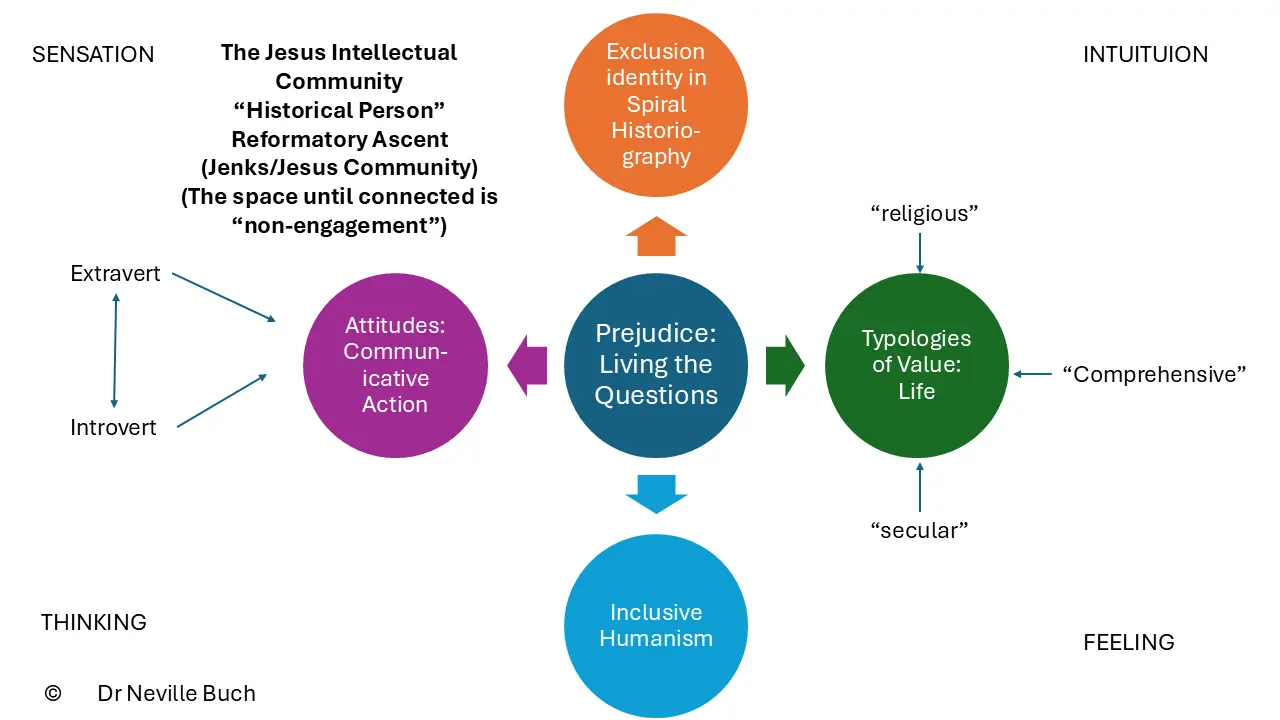
Dynamic of Cognition (DoC) Table: Synthesis of Jenks and the Jesus Community
| DoC Component | Pathological Regression (Institutional) | Reformatory Ascent (Jenks/Jesus Community) | Intellectual Rationale |
| Prejudice (Centre) | Dogmatic Certainty: Gripping answers to avoid the “abyss of freedom.” | Living the Questions: Faith as an act of trust amidst gaps in knowledge. | Moves from “mindless habit” to active authorship. |
| Attitudes (Thinking) | Mechanical Techné: Reducing faith to a “vocation” or “service approach”. | Communicative Action: Dialogue aimed at mutual understanding (Verständigung). | Replaces strategic manipulation with noetic action. |
| Exclusion (Sensation) | Historical Forgetfulness: Treating the Jesus story as a timeless “fairytale”. | Spiral Historiography: Reclaiming the “Palestinian Jew” in his 1st-century roots. | Filters out manufactured myths and “controlling images”. |
| Inclusion (Intuition) | Symbolic Misery: Loss of agency to automated or hegemonic stimuli. | Inclusive Humanism: Reclaiming authorship as proactive creators of the “We”. | Restores individual power as the capacity for new beginnings. |
——————————————————————————–
Bibliography
- Andrews, D. (1996). And now for the Good News from the “Waiters’ Union”. Transformation, 13(3), 17-21.
- Arendt, H. (1977). The Life of the Mind. Harcourt Brace Jovanovich.
- Buch, N. (2024). The Sociology of Teen Challenge (Qld) Inc. Management Institute for Contributory Economy.
- Buch, N. (2026). House of Freedom (HOF) History (First Draft).
- Buch, N. (2026). A Matrix of Sociology. Management Institute for Contributory Economy.
- Jenks, G. C. (2014). Jesus Then and Jesus Now: Looking for Jesus, Finding Ourselves. Morning Star Publishing.
- Ringma, C. (2025). Participating in Communities of Resistance and Hope.
- Westoby, P., et al. (2025). The Community Builder’s Journal. Practical Action Publishing.
——————————————————————————–
Endnotes
- Gregory Jenks owns his book as a journey to “discover” Jesus and his better self.
- The HOF was inspired by Athol Gill’s lectures on “radical discipleship” and the Gospel of Mark.
- Teen Challenge sought to transcend theological traditions through the “Jesus Movement” and charismatic experience.
- The Waiters Union emphasizes “acceptance not agreement,” following Jesus’ model.
- Jenks argues that the humanity of Jesus is a “forgotten Jesus” that must be recovered.
- The “0-1-3 method” serves as the primary building block for sustainable groups.
- Buch’s matrix identifies the “Person” as the archetype for scholarly intellectual communities.
- “Denoetization” is the mechanical liquidation of discernment that these groups resist.
- Jenks’ “Kingdom of God” is a community where debts are cancelled and all are fed.
- The HOF archives (13 boxes) preserve the community’s legacy of “courageous hope”.
- Charles Ringma emphasizes the “0-1-3” relational nuclear start for communities.
- Fulfillment is found in “Sufficient Comprehension”—seeking the whole while remaining open.
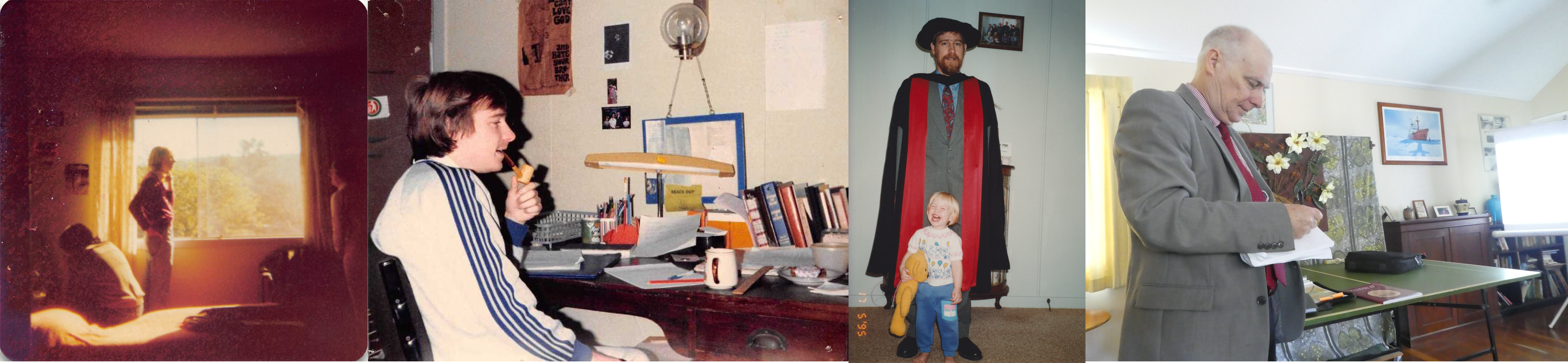
Featured Image: Neville’s academic career


Neville Buch
Latest posts by Neville Buch (see all)
- Part 3:The Failure of an Educational Institution and How to Spiral Forward – October 10, 2026
- Part 2:The Failure of an Educational Institution and How to Spiral Forward – October 10, 2026
- Part 1:The Failure of an Educational Institution and How to Spiral Forward – October 10, 2026