
Abstract
This review essay offers a friendly, constructive analysis of Joshua Kyle T. Rovero’s The Perennialist (2026), evaluating its ambitious attempt to re-enchant modern thought by synthesizing Eastern and Western sacred traditions with Heideggerian ontology. Through the analytical lens of Bernard Williams’s Ethics and the Limits of Philosophy and Dr. Neville Buch’s framework of Spiral Historiography, the essay explores the epistemological boundary between abstract metaphysical universalism and lived historical experience. While traditional Perennialism risks collapsing into static, ahistorical dogma—a danger highlighted by Williams’s critique of foundationalist ethical theories—Rovero successfully navigates this limit by framing truth as a dynamic, temporal disclosure of Being (Aletheia). By applying Spiral Historiography, Rovero’s thesis is shown not as a regressive nostalgia, but as a progressive, cyclical learning process that uncoils historical forgetfulness. The ultimate importance of Rovero’s message lies in its capacity to restore human authorship and Aristotelian flourishing ( eudaimonia ) in an era increasingly threatened by technological reductionism and “denoetization.”
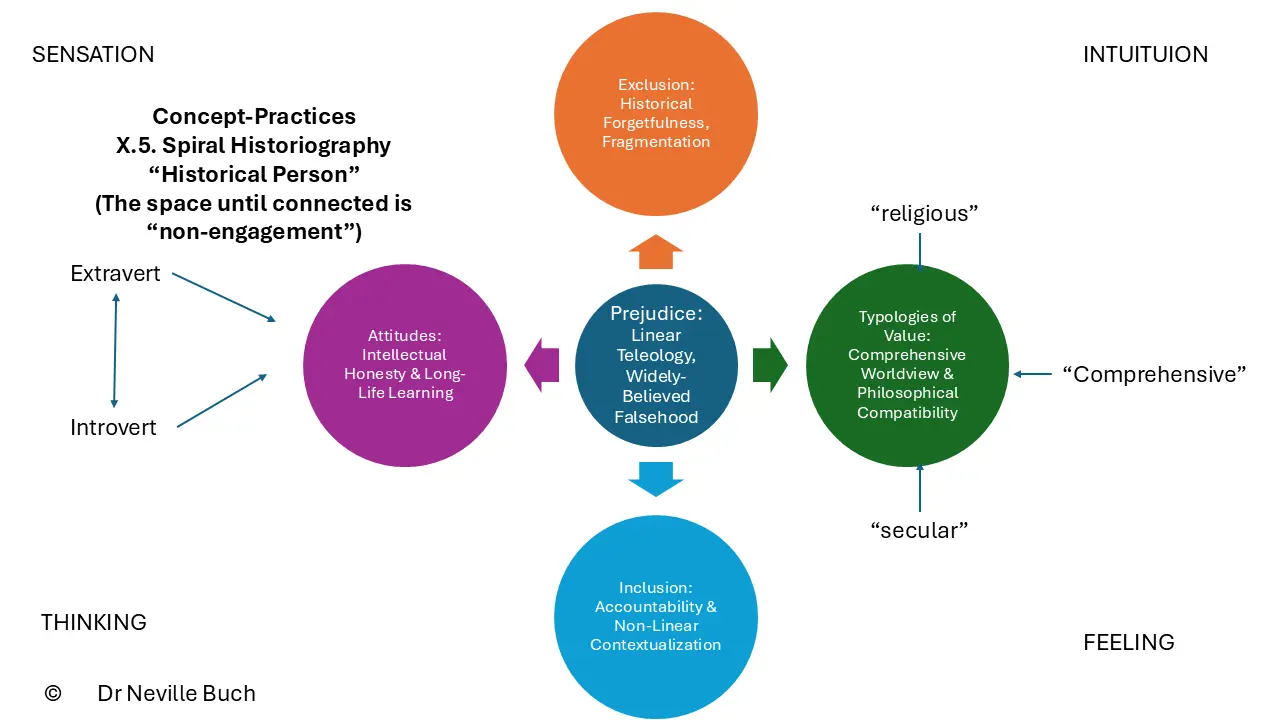
Featured Image: Concept-Practice-X.5.-Spiral-Historiography


Neville Buch
Latest posts by Neville Buch (see all)
- What Happened to Ross Johnston? – October 9, 2026
- Thank you, Richard: Knowing the message but then acting – October 8, 2026
- The Desiccation of the Common Well: Identity Politics, Algorithmic Assessment, and the Crisis of Adult Responsibility – October 6, 2026