
Abstract
This essay presents a comparative critical analysis of Bevin Luchel’s (2026a, 2026b, 2026c) series of market-reductionist polemics—The Desperation of Derivation, The Illusion of the Non Market Panacea, and The Mirage of the Subsidized Mind—against Kåre S. Fuglseth’s (2026) phenomenological framework of educational values and virtues. We demonstrate that Luchel’s reliance on Carl Menger’s subjective theory of value, public choice theory, and market price mechanisms reduces education and scholarly knowledge to consumable commodities, evaluating pedagogical worth strictly through immediate consumer preferences and vocational utility [Luchel 2026b, p. 136; Luchel 2026c, p. 155]. In contrast, Fuglseth’s Husserlian lifeworld phenomenology demonstrates that moral values, virtues, and educational formation (Bildung) cannot be captured by transactional metrics or static curriculum headings, but can ultimately only be understood through sequential, polythetic narrative structures and historical reenactment [Fuglseth 2026, p. 56]. By drawing on Audun Øfsti’s principle that “the past was once future” and Wolfgang Klafki’s categorical formation, Fuglseth establishes an open horizon of human action that directly subverts Luchel’s deterministic market dogmatism [Fuglseth 2026, pp. 58–59]. Ultimately, this essay shows why Fuglseth’s narrative-phenomenological approach aligns with Dr. Neville Buch’s call for Sufficient Comprehension and human authorship, providing a vital educational shield against digital denoetization, vocational credentialism, and neoliberal market reductionism [Buch 2025e, p. 10; Buch 2026a, p. 48; Fuglseth 2026, p. 56].
I. Luchel’s Neoliberal Polemics and the Marketized Lifeworld
Across his 2026 trilogy of polemical essays—The Mirage of the Subsidized Mind, The Illusion of the Non Market Panacea, and The Desperation of Derivation—Bevin Luchel constructs a comprehensive defence of neoliberal market allocation applied to intellectual labour and education [Luchel 2026a, p. 111; Luchel 2026b, p. 131; Luchel 2026c, p. 154]. Grounding his analysis in Carl Menger’s subjective theory of value, William Stanley Jevons’ marginal utility, and James Buchanan’s public choice theory, Luchel contends that intellectual production possesses no intrinsic economic value independent of what voluntary exchangers are willing to pay in the market [Luchel 2026b, p. 136; Luchel 2026c, p. 155].
1. The Attack on Voluntarism and the Charge of “Noetic Protectionism”
In The Mirage of the Subsidized Mind, Luchel (2026c, p. 154) targets Dr. Neville Buch’s assertion that “in the twenty-first century, voluntarism does not work” to sustain deep humanistic scholarship [Buch 2025e, p. 10; Luchel 2026c, p. 154]. Luchel argues that Dr. Buch adheres to an outdated, labour-based theory of intellect, assuming that because a scholar expends immense cognitive effort, society incurs a moral obligation to fund that labour through public contracts [Luchel 2026c, p. 155]. Applying Mengerian economics, Luchel (2026c, p. 155) asserts that if consumers, students, or civic institutions do not voluntarily purchase an intellectual work, the market has not committed an ethical failure; rather, it has delivered an accurate price signal reflecting absent public demand. Luchel dismisses Dr. Buch’s proposal for “professional contractualism” as an archaic plea for “noetic protectionism” and guild-like rent-seeking, pointing to open-source software, Wikipedia, and open-access publishing as proof that voluntary peer production flourishes in the knowledge economy [Luchel 2026c, pp. 155–157].
2. The “Magic Surplus” Fallacy and the Veto of the Marketplace
In The Illusion of the Non Market Panacea, Luchel (2026b, p. 131) extends his critique to political economy, arguing that any non-market resource allocation is an illusion. Luchel (2026b, p. 136) accuses Dr. Buch of committing the “Magic Surplus” fallacy by assuming that societal capital currently spent on corporate marketing, advertising, and administrative bloat can simply be reallocated to fund historians and philosophers. Luchel (2026b, p. 137) contends that this surplus is generated exclusively by capitalist market engines, and abolishing market price signals destroys the very mechanism that produces surplus wealth. Furthermore, Luchel (2026b, p. 141) attacks Habermasian communicative action, alleging that democratic community assemblies in the lifeworld would act as a populist veto, voting to fund tangible physical necessities (childcare, roads, health) while starving esoteric historical scholarship.
3. Dismissing the Sociology of Deregulation
In The Desperation of Derivation, Luchel (2026a, p. 111) attempts to dismantle Dr. Buch’s invocation of sociologist Steve Bruce. Luchel claims that Bruce’s critique of Rational Choice Theory (RCT) applies strictly to the sociology of religious commitment and has zero relevance to scholarly knowledge production [Bruce 2002; Luchel 2026a, p. 113]. Luchel (2026a, p. 118) asserts that market competition in ideas does not cause cognitive paralysis or skepticism, but generates an “extraordinary expansion of knowledge” and democratization of access.
4. The Cognitive Pathology of Luchel’s Model
However, Luchel’s entire framework suffers from a catastrophic category error, confusing economic price (what a consumer pays) with epistemic and educational value (whether a proposition is justified by evidence or fosters human development) [Haack 1993, p. 231; Buch 2026a, p. 48; Luchel 2026c, p. 155]. Luchel’s model exemplifies what Dr. Buch diagnoses as “denoetization”—the systematic liquidation of independent thought—and the “techné mindset,” which reduces students and scholars to “puny human nodes” in automated market networks [Collins 2019; Buch 2026a, p. 48; Buch 2026c, p. 32; Luchel 2026c, p. 154]. By reducing education to immediate market demand, Luchel enforces a neoliberal Credential Society that replaces deep reflection with vocational “job-ready” training, inducing widespread “noetic desertification” and “symbolic misery” [Stiegler 2014; Buch 2025b, p. 22; Buch 2026a, p. 49; The Technicisation of Thought 2026].
[LUCHEL’S TRANSACTIONAL REDUCTION]
Education / Knowledge ➔ Subjective Market Price
│
▼
“Job-Ready” Training & Credential Commodification
│
▼
Denoetization & Loss of Human Historical Agency
II. Fuglseth’s Phenomenological Alternative: Lifeworld, Narrative, and Reenactment
A profound counterweight to Luchel’s transactional dogmatism is found in Kåre S. Fuglseth’s (2026) study, The Past Was Once Future: Reenactment of Values and Virtues on Historical Grounds in Education. Operating within Husserlian lifeworld phenomenology, Fuglseth addresses the fundamental question of how values and virtues are taught, experienced, and comprehended in education [Fuglseth 2026, p. 56].
Fuglseth’s insights systematically dismantle the marketized, technocratic view of education across four key dimensions:
[FUGLSETH’S PHENOMENOLOGICAL STRUCTURE]
Lived Polythetic Experience (Husserlian Lifeworld)
│
▼
Narrative Sequential Reenactment (Values & Virtues)
│
▼
Abstract Titles / Headings / Metrics (Asymmetric Function)
1. The Primacy of Narrative over Conceptual Headings
Fuglseth (2026, p. 56) argues that contrary to the common assumption that narratives are merely illustrative tools used to clarify abstract concepts, values and virtues can ultimately only be understood in narrative ways. Drawing on Husserl’s phenomenology of subjective time-consciousness and action theory, Fuglseth (2026, p. 56) defines “narrative” as a sequential time or polythetic structure of lived experience. Abstract terms, curriculum headings (such as Section 1-1 of the Norwegian Education Act), and static categories are secondary, asymmetric analytical typifications of underlying narrative experience [Fuglseth 2026, pp. 56, 58]. To reduce education to static headings, test scores, or market price signals—as Luchel’s model implicitly does—is to mistake the superficial “title” for the lived reality of human consciousness [Fuglseth 2026, p. 56; Luchel 2026c, p. 155].
2. Avoiding Didactic Moralism and Market Commodification
In educational practice, teachers must adopt a narrative approach to help students reenact or remodel accepted cultural values [Fuglseth 2026, p. 56]. Without this narrative reenactment, value education collapses into “didactic moralism” or administrative indoctrination [Fuglseth 2026, p. 56]. Marketized education systems treat values as pre-packaged compliance units or branding accessories. Fuglseth (2026, p. 56) demonstrates that genuine moral and civic learning requires students to re-experience the temporal unfolding of human choices, making values meaningful through personal interpretation rather than mechanical imposition.
3. “The Past Was Once Future”: Reclaiming Open Horizons of Action
Citing philosopher Audun Øfsti, Fuglseth (2026, p. 59) emphasizes the vital epistemological insight that “the past was once future” (historien var engang fremtid). Historical agents did not act under deterministic laws or closed market calculations; they faced open horizons and uncertain choices [Fuglseth 2026, p. 59]. In education, presenting historical grounds through reenactment allows students to see that human choices shape destiny [Fuglseth 2026, p. 56]. This directly connects to Wolfgang Klafki’s theory of categorical formation (kategoriale Bildung), where the general principles of culture and the personal horizons of the learner dynamically unlock one another [Klafki 1964, cited in Fuglseth 2026, p. 58].
4. Bildung and Holistic Learning Outcomes
Fuglseth (2026, p. 59) grounds his pedagogy in the European tradition of Bildung (personal development and human formation), contrasting it with narrow vocationalism. Referencing the European Qualifications Framework (EQF) and OECD Education 2030, Fuglseth (2026, p. 59) notes that complete learning outcomes require a synthesis of theoretical knowledge, practical skills, and responsibility and autonomy. Responsibility and autonomy cannot be generated through algorithmic testing or market pricing; they require the cultivation of human judgment within a lived social environment [Fuglseth 2026, pp. 56, 59].
III. Synthesis: Didactic Marketism versus Lifeworld Formation
When we compare Bevin Luchel’s trilogy of polemics with Kåre S. Fuglseth’s phenomenology, the fundamental flaws in Luchel’s critique of non-market education become clear:
| Comparative Dimension | Bevin Luchel’s Marketized Model | Kåre S. Fuglseth’s Phenomenological Model | Educational & Epistemic Impact |
| Ontological Foundation | Mengerian Utility & Price: Value is determined by subjective consumer preference [Luchel 2026c, p. 155]. | Husserlian Lifeworld: Experience is structured through sequential, polythetic time [Fuglseth 2026, p. 56]. | Luchel reduces human consciousness to market data; Fuglseth honours the concrete depth of lived experience. |
| View of Values & Knowledge | Commodity / “Job Ticket”: Intellectual output is a product for market exchange [Luchel 2026c, p. 155]. | Narrative Reenactment: Values exist as temporal actions requiring active remodelling [Fuglseth 2026, p. 56]. | Luchel induces “symbolic misery”; Fuglseth fosters authentic personal formation (Bildung). |
| Historical Agency | Deterministic Market Order: Scholars must adapt to consumer demand or starve [Luchel 2026b, p. 141]. | “The Past Was Once Future”: Historical agents face open horizons of possibility [Fuglseth 2026, p. 59]. | Luchel enforces “Historical Forgetfulness”; Fuglseth restores historical responsibility. |
| Pedagogical Goal | Vocational Utility: Training “job-ready” nodes for the platform economy [Luchel 2026c, p. 154]. | Autonomy & Responsibility: Reconciling theoretical knowledge with moral judgment [Fuglseth 2026, p. 59]. | Luchel promotes “potted thinking”; Fuglseth cultivates Sufficient Comprehension. |
[THE DUAL EDUCATIONAL CHOICE]
Luchel’s Marketized Model Fuglseth’s Phenomenological Model
– Subjective Consumer Price – Husserlian Lifeworld Narrative
– Vocational “Quick-to-Job” – Bildung (Autonomy & Responsibility)
– Denoetization & Symbolic Misery – Reenactment & Open Horizons
Luchel’s assertion in The Desperation of Derivation that Steve Bruce’s sociology of religion cannot apply to scholarly knowledge is exposed as a narrow, reductionist manoeuvre [Bruce 2002; Luchel 2026a, p. 113]. Bruce demonstrated that unconstrained market deregulation corrodes plausibility and commitment by fragmenting shared social scaffolding [Bruce 2002, cited in Buch 2026d, p. 57]. Fuglseth’s (2026, p. 56) research confirms this exact principle in education: when values and knowledge are stripped of their narrative lifeworld contexts and reduced to transactional “headings” or market prices, educational coherence collapses into didactic moralism and cognitive fragmentation.
Furthermore, Luchel’s claim in The Illusion of the Non Market Panacea that non-market education is a “wish, not a mechanism” is subverted by Fuglseth’s demonstration of how real-world European educational frameworks (such as the EQF and Scandinavian curricula) operate [Fuglseth 2026, pp. 58–59; Luchel 2026b, p. 146]. Public education does not function to maximize short-term pecuniary profit; it exists to preserve human dignity, civic heritage, and democratic autonomy [Fuglseth 2026, p. 59]. As Dr. Buch argues in his defence of the Contributory Economy, societal surplus must be allocated as “critical cognitive scaffolding” through professional contractualism to protect human judgment against mechanical liquidation [Buch 2025e, p. 10; Buch 2026a, p. 48; Buch 2026b, p. 12].
IV. Conclusion: Reclaiming Human Authorship in Education
Bevin Luchel’s 2026 series of rants represents the logical endpoint of neoliberal market fundamentalism applied to the mind: a cynical system where truth is subordinated to consumer demand, intellectual precarity is celebrated as “voluntary exchange,” and education is reduced to vocational compliance [Luchel 2026b, p. 141; Luchel 2026c, p. 155].
Kåre S. Fuglseth’s phenomenological insights provide the necessary theoretical antidote. By demonstrating that human values, virtues, and historical knowledge can only be truly comprehended through narrative reenactment within the lifeworld, Fuglseth vindicates Dr. Neville Buch’s insistence that “understanding history is philosophy in practice” [Buch 2025d, p. 23; Fuglseth 2026, p. 56]. Education is not a market commodity to be bought and sold; it is the process of personal development (Bildung) through which each generation learns to reenact past virtues, evaluate open horizons, and exercise genuine moral agency [Fuglseth 2026, pp. 56, 59].
By rejecting Luchel’s market servility and embracing Fuglseth’s narrative phenomenology, educators and scholars can resist digital denoetization and “institutional bullshit” [Buch 2026c, p. 34; Fuglseth 2026, p. 56]. Through this interdisciplinary synthesis, we restore human authorship over our technical and social systems, ensuring that education remains dedicated to practical confidence, comprehensive empathy, and true Aristotelian flourishing (eudaimonia) [Buch 2025a, p. 10; Buch 2026b, p. 30; Fuglseth 2026, p. 59].
Image: Since Bevin Luchel is local.
Bibliography
Bruce, Steve. (2002). Choice and Religion: A Critique of Rational Choice Theory, Oxford University Press, Oxford.
Buch, Neville. (2023a). SoFiA Melbourne: Unity and Fragmentation, Dr Neville Buch, Brisbane.
Buch, Neville. (2023b). Spiral Historiography: Socio-Historical Change in Unitarian Universalism, ANZUUA, Brisbane.
Buch, Neville. (2025a). Comprehensive Understanding of Humanism Today, Dr Neville Buch, Brisbane.
Buch, Neville. (2025b). Comprehensive Background Today on so-called Religion and Secularity, Dr Neville Buch, Brisbane.
Buch, Neville. (2025c). The Dynamic of Cognition, Dr Neville Buch, Brisbane.
Buch, Neville. (2025d). Five Intention Prejudice and Global Thinking Series. Paper No. 4: The Synoptic Vision – A Philosophical Inquiry into Comprehension, Dr Neville Buch, Brisbane.
Buch, Neville. (2025e). Comprehension: Solutions and The Plan, Dr Neville Buch, Brisbane.
Buch, Neville. (2026a). The Crisis of Comprehension and the Restoration of Deep Reading: Part 2. Response to Critics, Management Institute for Contributory Economy, Brisbane.
Buch, Neville. (2026b). The Unitarian Universalist Cognitive Ascent, Dr Neville Buch, Brisbane.
Buch, Neville. (2026c). Identity Politics and the Ascent toward Comprehensive Empathy, Dr Neville Buch, Brisbane.
Buch, Neville. (2026d). Steve Bruce on Rational Choice theory, Dr Neville Buch Blog, Brisbane.
Collins, Randall. (2019). The Credential Society: An Historical Sociology of Education and Stratification, Columbia University Press, New York.
Difference between a class, a category and a classification. (2026). Academic Reference Document.
Fuglseth, Kåre S. (2026). ‘The Past Was Once Future: Reenactment of Values and Virtues on Historical Grounds in Education’, in Nangeroni Project Research Series, Bodø, pp. 79–92 [56–59].
Haack, Susan. (1993). Evidence and Inquiry: Towards Reconstruction in Epistemology, Blackwell, Oxford.
Jameel, Arif. (2026). The Lifestyle State: A Theoretical Framework on the Succession of Legitimacy from Welfare Provision to Lifestyle Branding, Global Governance Research & Publications, Lahore.
Luchel, Bevin. (2026a). The Desperation of Derivation: Buch’s Misapplication of Steve Bruce and the Failure of His Latest Rejoinder, Management Institute for Contributory Economy, Brisbane [111–130].
Luchel, Bevin. (2026b). The Illusion of the Non Market Panacea: A Formal Refutation of Dr. Neville Buch’s Reply and Vindication of The Prophet at the Food Bank, Management Institute for Contributory Economy, Brisbane [131–153].
Luchel, Bevin. (2026c). The Mirage of the Subsidized Mind: A Critique of Professional Contractualism, Rent-Seeking, and Noetic Protectionism, Academia.edu, Brisbane [154–159].
Menger, Carl. (1871/1981). Principles of Economics, Wilhelm Braumüller, Vienna.
Stiegler, Bernard. (2014). Symbolic Misery, 1: The Hyperindustrial Epoch, Polity, Cambridge.
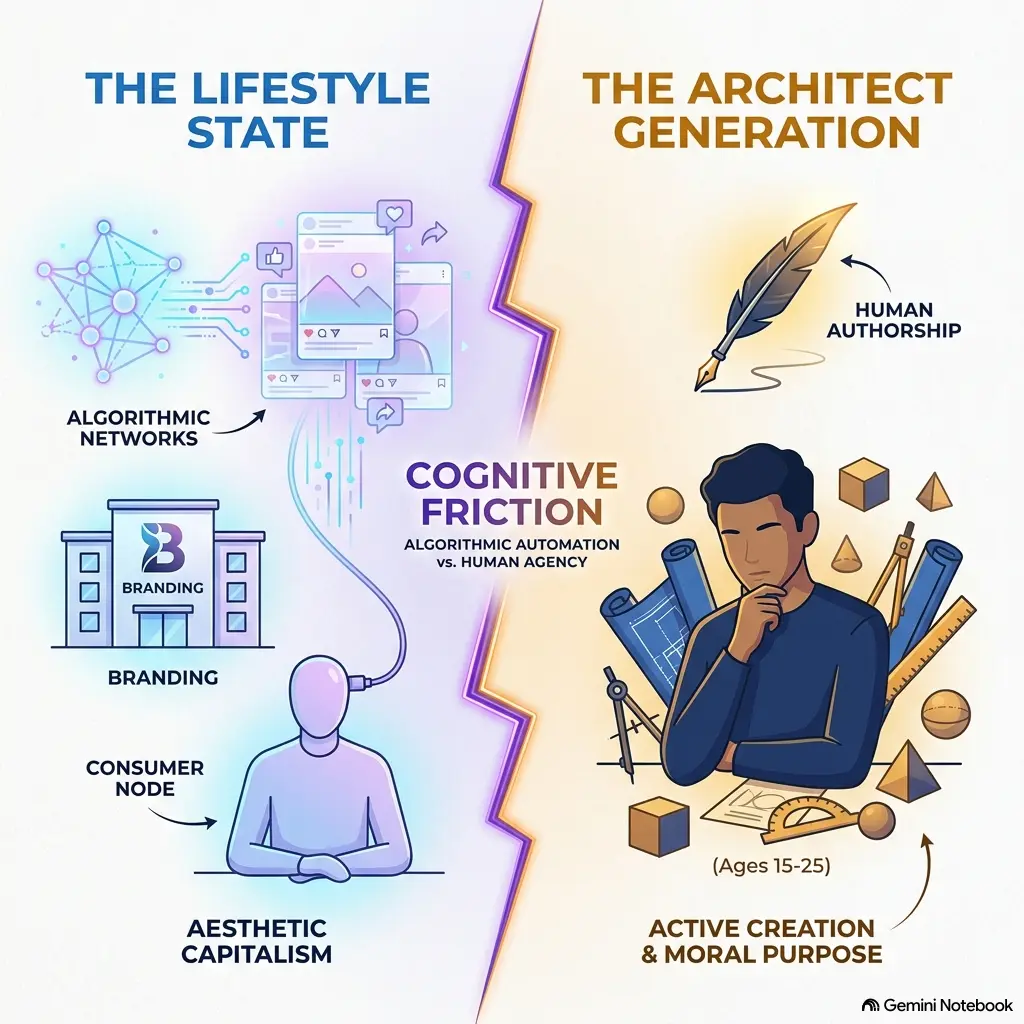
Featured Image: From Jameel, Arif. (2026). The Lifestyle State: A Theoretical Framework on the Succession of Legitimacy from Welfare Provision to Lifestyle Branding, Global Governance Research & Publications, Lahore.


Neville Buch
Latest posts by Neville Buch (see all)
- The Unbound Mind: Independent Scholarship, Institutional Isolation, and the Restoration of Human Authorship – October 20, 2026
- The Road to Geelong: A Re-Narrativization of The Story of Resilience Part 1 – October 20, 2026
- The Human Being Above the Transaction and Why Markets Cannot Measure Human Worth – October 15, 2026