
Dr Neville Buch and MICE[1]
The “Why Smart People Enable Evil” audio commentary on MICE’s Contributory Economy and Human Authorship:
Sorry, either the technology is playing up or I have run out of “money credit”. Do you see the stupidity down the line, somewhere?
Abstract
This essay formulates a systematic, action-oriented manifesto for countering human stupidity—defined not as a static lack of IQ or cognitive capacity, but as the active, habituated condition of thoughtlessness, unreflective prejudice, and historical amnesia. Grounded in the moral philosophy of Hannah Arendt and the metacognitive model of Dr. Neville Buch’s Spiral Historiography, this paper articulates how individuals can exercise personal agency to resist automated compliance, algorithmic “denoetization,” and institutional “potted thinking.” The essay outlines an extensive list of concrete, actionable choices required to reverse stupidity in daily life. It then examines the theoretical foundations of this endeavor: first, through Arendt’s analysis of the “banality of evil,” the two-in-one silent dialogue of conscience, and the faculty of reflective judgment (Selbstdenken); and second, through Buch’s Dynamic of Cognition (DoC), the POLICE diagnostic framework, and the four-stage cycle of Spiral Historiography. Finally, the essay demonstrates why the imperative message of “If Not Stupid” is vital for restoring human authorship and achieving genuine Aristotelian flourishing (eudaimonia) in contemporary society.
Introduction: Defining Stupidity as Active Thoughtlessness
In everyday speech, “stupidity” is frequently mischaracterized as an innate, unalterable intellectual deficit or a lack of formal education (Arendt 1977, p. 13; Buch 2026a, p. 8)[1][2]. However, philosophical and historiographical inquiry reveals a far more troubling reality: stupidity is fundamentally an active, ethical, and habits-based failure of reflective rationality (Arendt 1977, p. 13; Buch 2026c, p. 1; Schiller 1929, cited in Wikipedia 2025)[1].
As Immanuel Kant observed and Hannah Arendt reiterated, a person can possess immense erudition, technical skill, and scientific knowledge yet remain profoundly lacking in judgment—betraying an “obtuse or narrow-minded” inability to apply concepts to concrete human reality (Kant 1781, cited in Arendt 1977, p. 216; Arendt 1977, p. 13)[1]. In the twenty-first century, this failure is weaponized by a mechanical “techné mindset” and automated digital routines that encourage individuals to substitute algorithmic “autocomplete” for internal discernment, plunging society into what Dr. Neville Buch terms the “Spiral History Theory of Stupidity” (Buch 2024, p. 2; Buch 2026a, p. 9; Corwin 2026, cited in Buch 2026d, p. 12)[8]. Reversing this trajectory requires an explicit, deliberate choice to cultivate the mind as a self-regulating, self-critical organ of human authorship (Buch 2026a, p. 10)[13].
1. How a Person Can Choose Not to Be Stupid: A Comprehensive Inventory of Action
Choosing “not to be stupid” is not a single, isolated decision; it is a continuous, disciplined regimen of personal and intellectual choices (Buch 2026f, p. 1)[14]. To break free from automated reactivity and unreflective prejudice, an individual must commit to the following concrete actions:
- Initiate Internal Dialogue ( The Two-in-One ): Withdraw periodically from constant social distraction and external noise to engage in the soundless, reflective conversation with oneself—actualizing conscience before acting in the public sphere (Arendt 1977, pp. 84, 193; Buch 2026c, p. 2)[15].
- Refuse Mechanical Obedience (“No One Has the Right to Obey”): Reject the comforting defence of bureaucratic or institutional compliance; recognize that all choices carry moral weight and that no authority can relieve an individual of personal responsibility for their deeds (Arendt 1964, cited in Buch 2026c, p. 2)[19][20].
- Practice Selbstdenken (Thinking for Oneself): Actively liberate the mind from unexamined inherited prejudice, passive conventions, and “potted thinking” by questioning foundational assumptions before accepting institutional narratives (Kant 1784, cited in Arendt 1977, p. 258; Buch 2026f, p. 12)[21].
- Train the “Enlarged Mentality” (Go Visiting): Exercise imagination by considering particulars from the standpoints of diverse others—adopting an impartial “world citizen” perspective rather than remaining trapped in private, subjective self-interest (sensus privatus) (Arendt 1977, pp. 256–258; Buch 2026c, p. 2)[20].
- Execute “Crap Detecting” Against Fake News and Myths: Systematically filter out manufactured political slogans, corporate marketing, and “institutional bullshit” using evidence-based scrutiny (Postman 1969, cited in Buch 2026f, p. 12; Buch and Peach 2026, p. 2)[13].
- Apply the POLICE Diagnostic Framework: Regularly self-regulate and “police” one’s own thought processes across six key dimensions:
- Philosophically: Questioning unexamined foundational assumptions (Buch and Peach 2024, cited in Buch 2026a, p. 157)[28][29].
- Ontologically: Grounding social concepts in the concrete reality of the “historical person” rather than abstract systems (Buch 2026a, p. 157)[28][29].
- Logically: Identifying self-contradictions, fallacies, and double ignorance (Buch 2026a, p. 157)[28][29].
- Intersect: Connecting local, situated experiences with broader global networks of scholarship (Buch 2026a, p. 157)[28][29].
- Compatibility: Fostering ideological compatibilism over destructive culture-war binaries (Buch 2026a, p. 157)[28][29].
- Education: Reclaiming lifelong, self-critical, and collaborative learning (Buch 2026a, p. 157)[28][29].
- Engage in Ad Fontes (Return to Original Sources): Bypass second-hand summaries, media spin, and automated snippets by returning directly to foundational primary texts and historical archives (Buch 2026a, p. 3)[30].
- Adopt the Stance of the Panseur (Thinking as Caring): Transform intellectual activity from an extractive, adversarial exercise into panser—a therapeutic synthesis of thinking (penser) and caring (panser) that binds up social wounds and respects human vulnerability (Stiegler 2025, cited in Buch 2026a, p. 10; Buch 2026b, p. 4)[33].
- Resist the “Altar of Autocomplete”: Reject the temptation to outsource memory, writing, and cognitive judgment to generative algorithms or machine routines, maintaining human sovereignty over digital tools (Stiegler 1998, cited in Buch 2026a, p. 10; Corwin 2026, cited in Buch 2026a, p. 156)[2].
- Interrupt Historical Forgetfulness via Spiral Historiography: Recursively re-evaluate past historical errors and reforming movements to uncoil “vicious circles” of repeated social mistakes, achieving an iterative ascent (Buch 2025c, p. 2; Buch 2026e, p. 1)[38].
- Balance the Mind-Body-Cognition Nexus: Avoid the traps of “vague spiritualism” (floating above historical context) and “hard materialism” (reducing humans to machines), anchoring thought in the embodied, intentional historical subject (Buch 2025b, p. 6; Buch 2026a, p. 8)[42].
- Cultivate Haecceity and Personal Integrity: Respect the unique “thisness” and inviolable dignity of individual concrete persons, refusing to reduce human subjects to quantifiable utility or transactional categories (Duns Scotus, cited in Buch 2025b, p. 2; Buch 2026a, p. 3)[31].
2. Grounding the Opposition to Stupidity in Hannah Arendt’s Work
The philosophical core of opposing stupidity as an ethical imperative is deeply rooted in the political and moral philosophy of Hannah Arendt (1906–1975) (Arendt 1977; Buch 2026c, p. 1)[47][48].
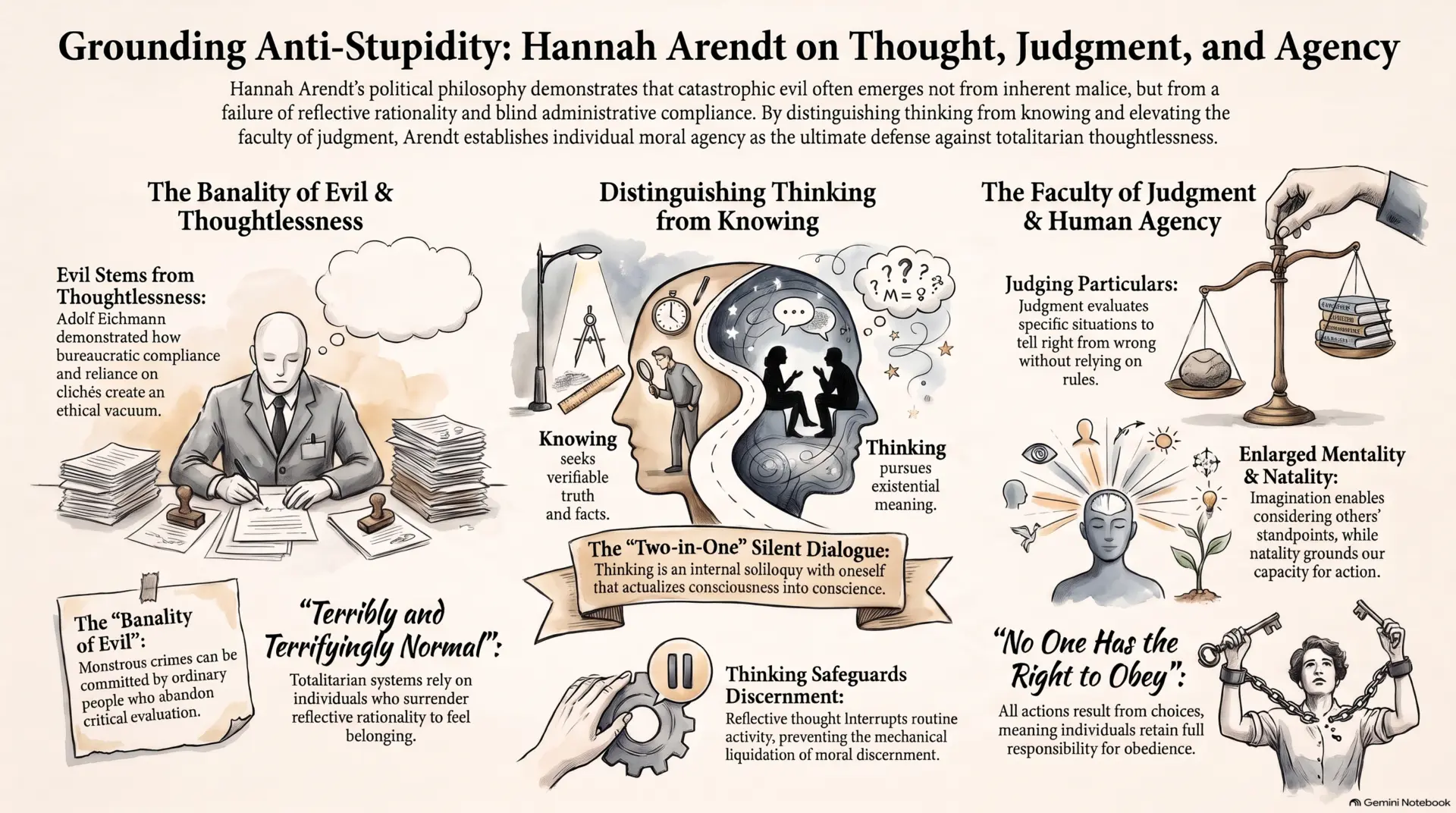
I. The Banality of Evil and the Danger of Clichés
Arendt’s interest in the problem of thoughtlessness was crystallized during her coverage of the 1961 trial of Adolf Eichmann in Jerusalem (Arendt 1963; Arendt 1977, p. 6; Wikipedia 2026)[49]. Contrary to expectations of encountering a monstrous, demonic villain, Arendt was struck by Eichmann’s profound ordinariness—he was “terribly and terrifyingly normal” (Arendt 1963, p. 276; Wikipedia 2026)[50]. His horrific participation in mass extermination sprang not from an extraordinary, wicked heart or sadistic malice, but from sheer thoughtlessness ( Gedankenlosigkeit )—an inability to think critically, an addiction to stock phrases and bureaucratic clichés, and a total surrender to compliance (Arendt 1977, pp. 5, 13; Wikipedia 2026)[1].
This led Arendt to formulate her famous thesis on the “banality of evil”: the most catastrophic moral collapses occur not because people deliberately choose evil, but because ordinary individuals fail to exercise reflective rationality and choose to “go along with the rest” (Arendt 1963; Arendt 1977, p. 5; Wikipedia 2026)[5][52]. Stupidity, in the Arendtian sense, is precisely this refusal or habituated failure to think.
II. Distinguishing Thinking from Knowing
To oppose this banality, Arendt drew a fundamental Kantian distinction between Knowing (Intellect / Verstand ) and Thinking (Reason / Vernunft ) (Arendt 1977, pp. 13–16; Buch 2026c, p. 1)[1]:
- Knowing seeks objective truth, builds scientific knowledge, and is satisfied by verifiable facts and technical utility (Arendt 1977, p. 15; Buch 2026c, p. 1)[17].
- Thinking is a non-utilitarian, endless quest for meaning (Arendt 1977, p. 15; Buch 2026c, p. 1)[17][53]. It is an internal, soundless dialogue between “me and myself” (the two-in-one) (Arendt 1977, p. 193; Buch 2026c, p. 2)[16].
Crucially, Arendt argued that technical knowledge or high IQ cannot protect a person from moral collapse (Arendt 1977, p. 13; Buch 2026c, p. 1)[1][3]. Highly educated “specialists” can easily become instruments of tyranny if they lack the habits of reflective thinking (Arendt 1977, p. 13)[1]. Conscience is not an innate divine voice, but the direct byproduct of the “wind of thought”—the internal requirement that I must remain on speaking terms with myself when I re-enter solitude (Arendt 1977, pp. 193, 216; Wikipedia 2026)[18][55].
III. Judgment, Particulars, and Natality
In The Life of the Mind, Arendt elevated Judging as the faculty that realizes thinking in the public world of appearances (Arendt 1977, pp. 193, 216; Buch 2026c, p. 2)[16]. Drawing on Kant’s Critique of Judgment, she demonstrated that judgment deals with particulars without subsuming them under universal, pre-existing rules (Arendt 1977, pp. 256–258; Buch 2026b, p. 3; Buch 2026c, p. 2)[6]. Judgment enables an individual to say, “This is wrong,” even when an entire society claims it is right (Arendt 1977, p. 193)[55]. Combined with natality—the ontological capacity of human beings to initiate something genuinely new—Arendt proves that individuals possess the inherent freedom and responsibility to break away from collective stupidity (Arendt 1958; Buch 2026b, p. 3; Buch 2026c, p. 2)[17].
3. Grounding the Opposition to Stupidity in Dr. Neville Buch’s Spiral Historiography Thesis
While Arendt provides the moral and phenomenological groundwork, Dr. Neville Buch extends anti-stupidity thinking into a dynamic, post-postmodernist historiographical and metacognitive model: Spiral Historiography (Buch 2025c, p. 2; Buch 2026a, p. 8; Buch 2026d, p. 1)[38].
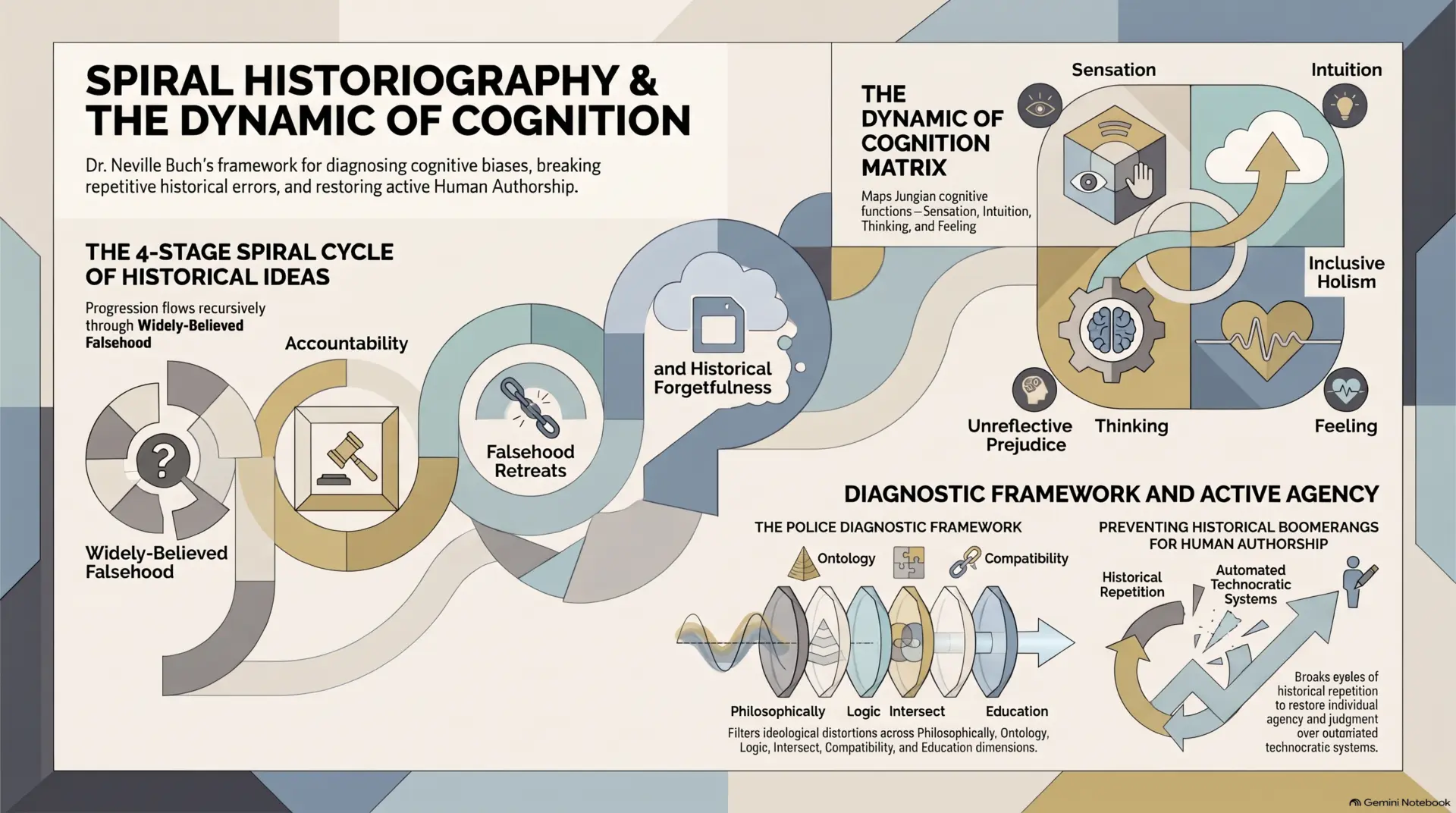
I. The “Spiral History Theory of Stupidity” and the Boomerang Effect
Buch identifies the primary driver of institutional and cultural decay as Historical Forgetfulness—the systemic erasure of historical context, intellectual genealogies, and past reforming lessons (Buch 2024, p. 2; Buch 2026a, p. 9; Buch 2026e, p. 1)[8]. When a population forgets how past errors were analysed and overcome, it gets “stuck in time-space,” dooming itself to repeat the same cognitive mistakes in a closed, “vicious circle” (Buch 2026d, p. 7; Buch 2026e, p. 1)[40].
Buch terms this recurring collapse the “Spiral History Theory of Stupidity” (Buch 2024, p. 2; Buch 2026e, p. 2)[10]. Invoking Ralph Ellison’s famous warning—”Beware of those who speak of the spiral of history; they are preparing a boomerang. Keep a steel helmet handy”—Buch demonstrates that unless critical self-reflection intervenes, history “boomerangs” back in the form of “potted thinking,” “symbolic misery,” and the “authoritarianism of the stupid” (Ellison, cited in Buch 2026e, p. 2; Buch 2026f, p. 12)[10].
II. Uncoiling the Circle: The Four-Stage Spiral Cycle
To prevent history from remaining a stagnant circle of stupidity, Spiral Historiography “uncoils” the circle into an ascending, self-correcting spiral through a four-stage diagnostic process (Buch 2025c, p. 2; Buch 2026e, p. 1)[38]:
- Widely-Believed Falsehood (The Cyclical Beginning): The unreflective acceptance of simplified dogmas, folk myths, or Whiggish linear progress narratives (Buch 2025c, p. 2; Buch 2026e, p. 1)[39].
- Accountability (The Metacognitive Intervention): Demanding rigorous empirical evidence, logical consistency, and historical contextualization to expose the falsehood (Buch 2025c, p. 3; Buch 2026e, p. 1)[39].
- Falsehood Retreats (The Reforming Breakthrough): The temporary victory of truthfulness, where critical inquiry unmasks institutional propaganda (Buch 2026e, p. 1)[39].
- Historical Forgetfulness (The Risk of Regression): The dangerous phase where victory leads to intellectual complacency, allowing the falsehood to re-emerge in a new form unless active memory is maintained (Buch 2026e, p. 1)[39][63].
III. The Dynamic of Cognition (DoC) and the POLICE Framework
To operationalize anti-stupidity in personal life, Buch provides the Dynamic of Cognition (DoC) matrix, mapping how an individual transitions from unreflective prejudice to a “Balanced and Comprehensive” worldview (Buch 2025b, p. 8; Buch 2026d, p. 8)[40]. Grounded in Carl Jung’s cognitive functions (Sensation, Thinking, Feeling, Intuition) and the POLICE framework (Philosophically, Ontology, Logic, Intersect, Compatibility, Education), DoC functions as an “intellectual immune system” (Buch and Peach 2024, cited in Buch 2026a, p. 157; Buch 2026e, p. 2)[28]. By systematically “policing our own thoughts,” individuals detect “institutional bullshit,” overcome specialized ignorance, and maintain their capacity for independent human authorship (Buch 2026a, pp. 10, 157; Buch and Peach 2026, p. 2)[2].
4. Why the Message of “If Not Stupid” is Imperative for Society
The message of “If Not Stupid”—the uncompromising demand for active, reflective human agency—is not a mere academic preference; it is an urgent prerequisite for the survival of humane civil society in the twenty-first century (Buch 2026a, p. 9; Buch 2026d, p. 1)[2].
I. Defeating Algorithmic “Denoetization” and “Artificial Stupidity”
Under the Fourth Industrial Revolution, human culture is besieged by automated digital routines, hyper-industrialized attention extraction, and predictive language models (Buch 2026a, p. 9; Buch 2026f, p. 12)[2]. When individuals continuously delegate cognitive synthesis, memory, and writing to automated systems, they undergo denoetization—the mechanical liquidation of the capacity to judge (Stiegler 2025, cited in Buch 2026a, p. 9; Buch 2026d, p. 1)[2].
This creates an “algorithmic character” where citizens value only short-term speed and quantifiable utility, reducing themselves to “puny human nodes” in automated networks (Corwin 2026, cited in Buch 2026a, p. 156; Buch and Peach 2026, p. 1)[2]. The message of “If Not Stupid” provides the intellectual scaffolding needed to assert that the human “who” must remain the proactive pilot of the technological “what” (Stiegler 1998, cited in Buch 2026a, p. 10)[13][77].
II. Eradicating Systemic Lying and Polarization
As Hannah Arendt warned, the ultimate danger of systemic lying and mass propaganda is not that people will believe a specific lie, but that the distinction between fact and fiction, true and false, will be erased entirely (Arendt 1951; Arendt 1972; Buch 2026b, p. 6)[3]. Without a commitment to “If Not Stupid” (reflective rationality and truthfulness), public discourse degenerates into superficial “nonsense fights” driven by rigid, binary culture wars (Buch 2026a, p. 9)[64]. Practicing critical self-reflection restores ideological compatibilism, allowing diverse communities to communicate with sincerity and mutual respect (Buch 2024, p. 2; Buch 2026a, p. 157)[8].
III. Reclaiming Human Authorship and Aristotelian Flourishing (Eudaimonia)
Ultimately, choosing “not to be stupid” is an act of profound humanistic reclamation (Buch 2026d, p. 1; Buch and Peach 2026, p. 2)[13]. It anchors human dignity in the conviction that we are the intentional, creative authors of our own history, institutions, and moral choices (Buch 2026a, p. 10)[13][77]. By replacing mechanistic calculation with the therapeutic practice of panser (thinking as caring) and pursuing “sufficient comprehension,” society steers away from symbolic misery and toward genuine Aristotelian flourishing ( eudaimonia )—a life of virtue, wisdom, and active democratic participation (Buch 2025b, p. 8; Buch 2026a, p. 10; Buch 2026d, p. 6)[48].
References / Bibliography
Arendt, H., 1951. The Origins of Totalitarianism. New York: Schocken Books.
Arendt, H., 1958. The Human Condition. Chicago: University of Chicago Press.
Arendt, H., 1963. Eichmann in Jerusalem: A Report on the Banality of Evil. New York: Viking Press.
Arendt, H., 1972. Crises of the Republic: Lying in Politics; Civil Disobedience; On Violence. New York: Harcourt Brace Jovanovich.
Arendt, H., 1977. The Life of the Mind (Two Volumes: Thinking and Willing). Edited by M. McCarthy. New York: Harcourt Brace Jovanovich.
Buch, N., 2024. Spiral Historiography. Brisbane: Dr Neville Buch Blog / SOFiA.
Buch, N., 2025a. 01. Personal History Workshop: What is Personal History. Brisbane: Dr Neville Buch and Sam Fiaalii.
Buch, N., 2025b. Spiral Historiography. Socio-Historical Change in Unitarian Universalism. Brisbane: Management Institute for Contributory Economy (MICE).
Buch, N., 2025c. Concept-Practice X.5. Spiral Historiography. Brisbane: Management Institute for Contributory Economy (MICE).
Buch, N., 2026a. The Crucible of Consciousness: Historiography and the Genesis of Reforming Thought. Brisbane: Neville Buch and Management Institute for Contributory Economy (MICE).
Buch, N., 2026b. Hannah Arendt (1906-1975). Brisbane: Brisbane Southside History Network / MICE.
Buch, N., 2026c. Hannah Arendt: Intelligence and Ethics Part 1. Brisbane: Dr Neville Buch.
Buch, N., 2026d. Pathways on the Spiral Historiography. Brisbane: Dr Neville Buch.
Buch, N., 2026e. Research Note: Conflict in Spiral Historiography. Brisbane: Dr Neville Buch.
Buch, N., 2026f. Spiral Historiography and the Pedagogy of Consciousness in Australia. Brisbane: MICE.
Buch, N. and Peach, N., 2024. Philosophically Ontology Logic Intersect Compatibility Education (POLICE). Brisbane: Dr Neville Buch ABN: 86703686642.
Buch, N. and Peach, N., 2026. Spiral Historiography and the Dynamic of Cognition (Abstract). Brisbane: The University of Queensland & QUT.
Casey, E.S., 1976. ‘Comparative Phenomenology of Mental Activity’, The Philosophical Forum, 8(1), pp. 106–126.
Corwin, S.L., 2026. The Hall of Mirrors: A Critique of Neville Buch’s Contributory Economy. Seattle: Sardonic Review Press.
Kant, I., 1781. Kritik der reinen Vernunft (Critique of Pure Reason). Riga: Johann Friedrich Hartknoch.
Kant, I., 1784. Beantwortung der Frage: Was ist Aufklärung? (Answering the Question: What is Enlightenment?). Berlinische Monatsschrift, 4, pp. 481–494.
Postman, N. and Weingartner, C., 1969. Teaching as a Subversive Activity (Chapter 1: ‘Crap Detecting’). New York: Delacorte Press.
Schiller, F.C.S., 1929. Logic for Use: An Introduction to the Voluntarist Theory of Knowledge. London: G. Bell & Sons.
Stiegler, B., 1998. Technics and Time, 1: The Fault of Epimetheus. Stanford: Stanford University Press.
Stiegler, B., 2025. The Immense Regression: What is Called Caring? (Vol. 1). Berlin: K. Verlag.
Wikipedia, 2025. F.C.S. Schiller. Wikimedia Foundation.
Wikipedia, 2026. Hannah Arendt. Wikimedia Foundation.
Take the MICE Quiz
[1] Artificial Intelligence (A.I.) has been fairly used in the production of this work. The tool used is Google NotebookLM (recently rebranded as Gemini Notebook). It is an AI-powered virtual research assistant and thinking partner designed to help a person interact deeply with their own documents. Unlike general chatbots, it is source-grounded, meaning it only generates answers based on the specific PDFs, documents, or links uploaded. The A.I. process in the production of this work has been limited to the attached (prompts) on each of the questions in turn. This ensures an accurate reading of each source. The author then rearranged and re-edited the answers the A.I. provided. The human author publishes this work. A.I. is never an author when used properly. This assistance is not qualitatively different from a human research assistant when that assistance is deemed to have no authorial status but is acknowledged.


Neville Buch
Latest posts by Neville Buch (see all)
- “I Know Many Things, But Thinking Always Makes It So”: The Epistemology of Reflective Judgment, Relational Care, and Human Authorship – October 29, 2026
- If Not Stupid: Reversing Spiral of Stupidity – An Action-Oriented Framework for Reclaiming Thought, Judgment, and Historical Agency – October 29, 2026
- Philosophy in Practice: Actual and Potential MICE Operational Spheres – October 28, 2026