
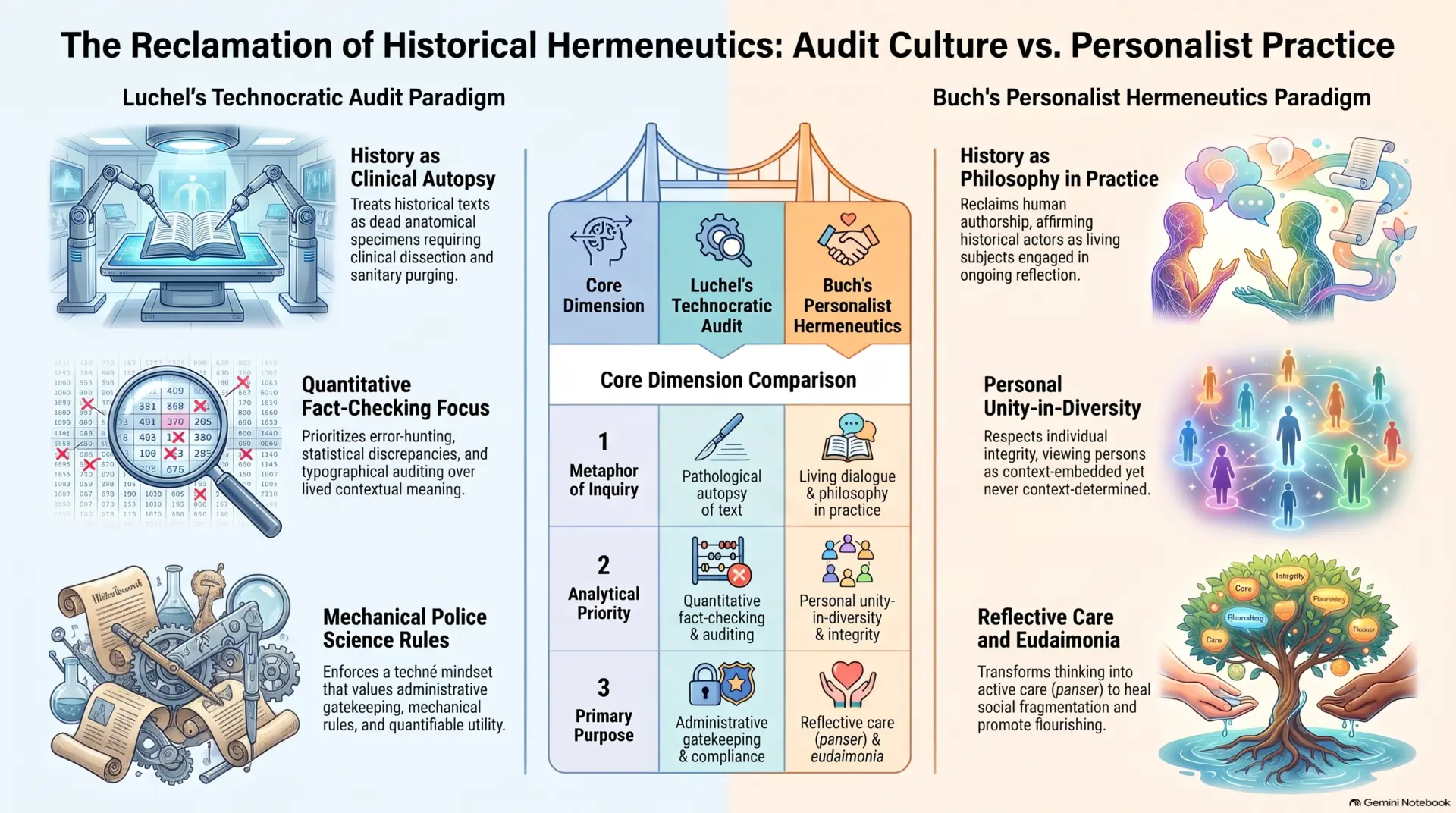
This essay presents a critical, personalist evaluation of Bevin Luchel’s forensic historiographical review, What Can We Learn from a Thirty-Year-Old Thesis? A Forensic Historiographical Review of Neville Douglas Buch’s American Influence on Protestantism in Queensland since 1945 (Luchel 2026, pp. 277–296). Grounded in historical methodology, post-analytic philosophy of mind, and Dr. Neville Buch’s framework of Personalism and Spiral Historiography, this paper analyses the epistemological, psychological, and institutional dimensions of Luchel’s critique. First, the essay acknowledges Luchel’s upfront positive feedback, specifically his recognition of Buch’s monumental archival legwork, primary source inventory, and the value of the 1994 thesis as an extraordinary “pedagogical laboratory” for studying postgraduate research craft. Second, the paper identifies Luchel’s five core negative criticisms—historiographical amnesia regarding control groups, conceptual overstretch of “American influence,” quantitative discrepancies, insider positionality, and mechanical errors—and provides a comprehensive, point-by-point rebuttal. Third, the essay constructs a psychological profile of Luchel based on his text, revealing a mindset defined by hard positivist scientism, a medicalized view of historical inquiry as clinical autopsy, an administrative “police science” gatekeeping complex, and a technocratic disengagement from the personalist dignity of the historical actor (esprit incarné). Finally, the essay concludes that while quantitative auditing has its place, historical understanding remains fundamentally “philosophy in practice”—a reflective, care-filled (panser) synthesis of lived experience, critical theory, and human authorship.
Featured Image:


Neville Buch
Latest posts by Neville Buch (see all)
- The Autopsy of an Audit: A Personalist Rebuttal to Bevin Luchel’s Critique of Neville Buch’s Doctoral Thesis – November 21, 2026
- Buch, Neville (2026). Intellectual Sovereignty and the Sociological Legacy of Jack McKinney – November 21, 2026
- Human Designed A.I. in Present – November 21, 2026