
PODCAST
1. “The Moving Image” (1946) — The World-as-Construction & Time
- Theme in Buch: The direct transmutation of McKinney’s epistemological theories of time, space, and human authorship into poetry[1].
- Philosophical Match: Buch notes that The Moving Image was deeply shaped by McKinney’s Original Synthesis of Experience[1]. In the poem, Wright explores time not as an abstract Newtonian tick, but as a human-constructed continuum woven through memory and consciousness. It reflects McKinney’s insistence that reality is not an independent “thing-in-itself” sitting outside us, but a World-as-Construction generated through shared human cognition[1][2].
2. “Bullocky” (1944) — Subverting the “Queensland Character” Myth
- Theme in Buch: Dismantling the agrarian legend and “Historical Forgetfulness”[1][4].
- Philosophical Match: Buch’s paper centers on McKinney’s resistance to the populist myth that framed Queenslanders as unreflective, simple-minded “innocent fools” or tough bush larrikins[4]. In “Bullocky”, Wright initially appears to celebrate the pioneer drover, but reframes his solitary endurance as religious delirium and mental disintegration[1]. By depicting the bullocky isolated in his own mind rather than connected to a shared community, Wright exposes the tragedy of being cut off from interpersonal dialogue and critical reflection[1][4].
3. “Nigger’s Leap, New England” (1945) & “Bora Ring” (1944) — Restorative Truth-Telling & Moral Inquiry
- Theme in Buch: Reclaiming historical bearings and enacting “philosophy in practice”[1][5].
- Philosophical Match: Buch argues that for McKinney and Wright, **”understanding history is philosophy in practice”**[5]. These early poems directly confront the violence of Australian frontier colonization. Rather than allowing society to retreat into comfortable amnesia (“Historical Forgetfulness”), Wright uses poetic imagery to force a moral accounting with the past, laying the groundwork for what Buch terms her later restorative truth-telling[1].
4. “Woman to Man” (1949) & “The Two Fires” (1955) — Interpersonal Epistemology & “Thinking as Caring”
- Theme in Buch: The Five Intentions (Self, Mind, Reason, Utility, Love) and knowledge as an interpersonal creation[2][6].
- Philosophical Match: Buch defines “Love” in the McKinney-MICE framework as “thinking as caring” ( panser )—a procedural shield that protects human particularity from abstract, calculating logic[6]. In “Woman to Man”, Wright explores the relational, embodied creation of new life and shared meaning. The poem dramatizes McKinney’s core thesis: that no individual exists in Cartesian isolation, and that reality, meaning, and human consciousness are brought forth through interpersonal union[2][7].
1. The Crucible of Experience (1915–1935)
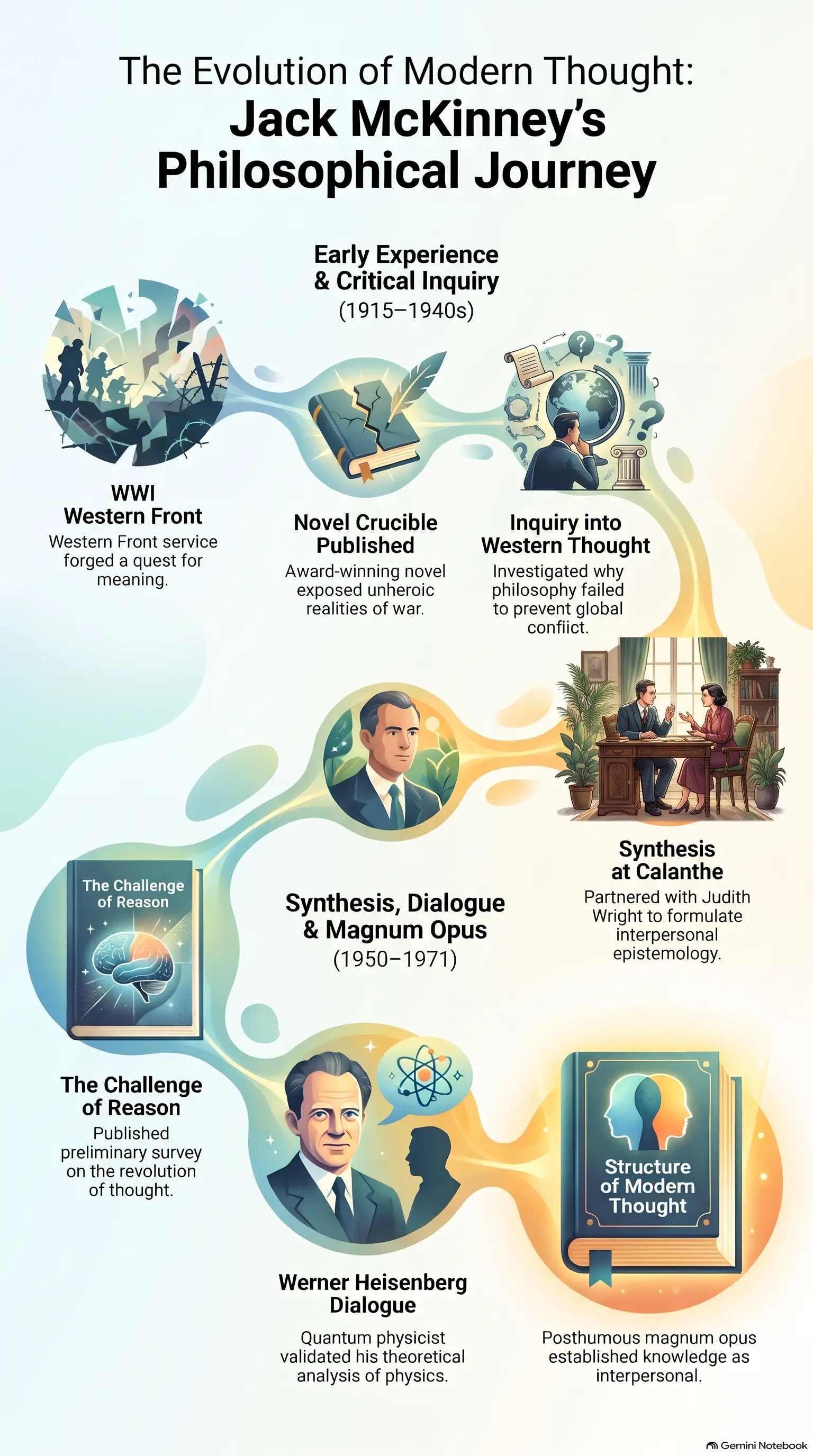
- 1915–1920 (WWI Service & War Trauma): Enlisted in 1915 and served on the Western Front[1]. Discharged in 1920 suffering from shell-shock and gastric illness, his wartime experiences dismantled romantic notions of glory and planted the seeds for his critique of Western social structures[1].
- 1926 (“The Big Chance”): Authored the short story “The Big Chance,” utilizing a boxing metaphor where the “Western Philosopher” defeats the unreflective folklore populist through reason, signaling his early rebellion against parochial anti-intellectualism[2][3].
- 1935 ( Crucible Published): Won the Returned Sailors and Soldiers Imperial League (RSL) prize for his novel Crucible[4]. Grounded in his front-line experiences, the book rejected tall tales of heroism to expose war as an unheroic ordeal of filth and futility[1][4].
2. The Philosophical Catalyst & “Calanthe” Partnership (1939–1950)
- 1939–1943 (WWII & The Search for Origins): Deeply disturbed by the outbreak of World War II, McKinney began an untutored, self-taught study of philosophy starting with the ancient Greeks, seeking to explain why advances in Western thought had failed to prevent global conflict[5].
- 1943 (Meeting Judith Wright & Towards the Future ): Met poet Judith Wright at the Meanjin office in Brisbane[8]. Wright read his unpublished manuscript, Towards the Future, recognizing its intellectual significance and establishing their lifelong romantic and philosophical partnership[7][8].
- 1946 (Settling at “Calanthe”): Moved to “Calanthe” on Tamborine Mountain, establishing a domestic laboratory for “thinking and writing” where his developing philosophy became central to Wright’s landscape poetry[9][10].
- 1950 ( The Challenge of Reason Published): Released his preliminary book The Challenge of Reason (subsidized with help from friends and Wright) to survey the modern revolution of thought, though he soon withdrew it after realizing academic philosophers were uncommitted to open inquiry[5].
3. International Engagement & The Original Synthesis (1953–1962)
- 1953–1958 (Journal Campaign): Published targeted essays in leading international journals—including Philosophy East and West (1953), The Journal of Philosophy (1955), and Mind (1958)—critiquing logical analysis and advancing his core theory of the Original Synthesis of Experience[11].
- June 1955 (Heisenberg Correspondence): Received a letter from Nobel laureate Werner Heisenberg, who validated McKinney’s analysis in “The Modern Revolution of Thought” regarding classical concepts in quantum mechanics[13][14].
- June 13, 1962 (Marriage at Registry Office): Married Judith Wright in Brisbane after years of personal and financial hardship[15][16].
4. Final Synthesis & Posthumous Legacy (1963–1971)
- 1963 (Naming the Magnum Opus): Renamed his primary manuscript The Structure of Modern Thought (previously The Natural History of Human Culture), focusing on overturning Ludwig Wittgenstein’s ban on metaphysical inquiry[17].
- December 6, 1966 (Death at Greenslopes): Died in Brisbane, leaving behind a completed manuscript embodying a lifetime of free thought[15].
- 1971 Posthumous Publication: The Structure of Modern Thought was published in London by Chatto & Windus[5]. Renowned philosopher J.J.C. Smart praised the work for its “fresh and original” presentation of the thesis that knowledge is fundamentally an interpersonal thing[5][21].
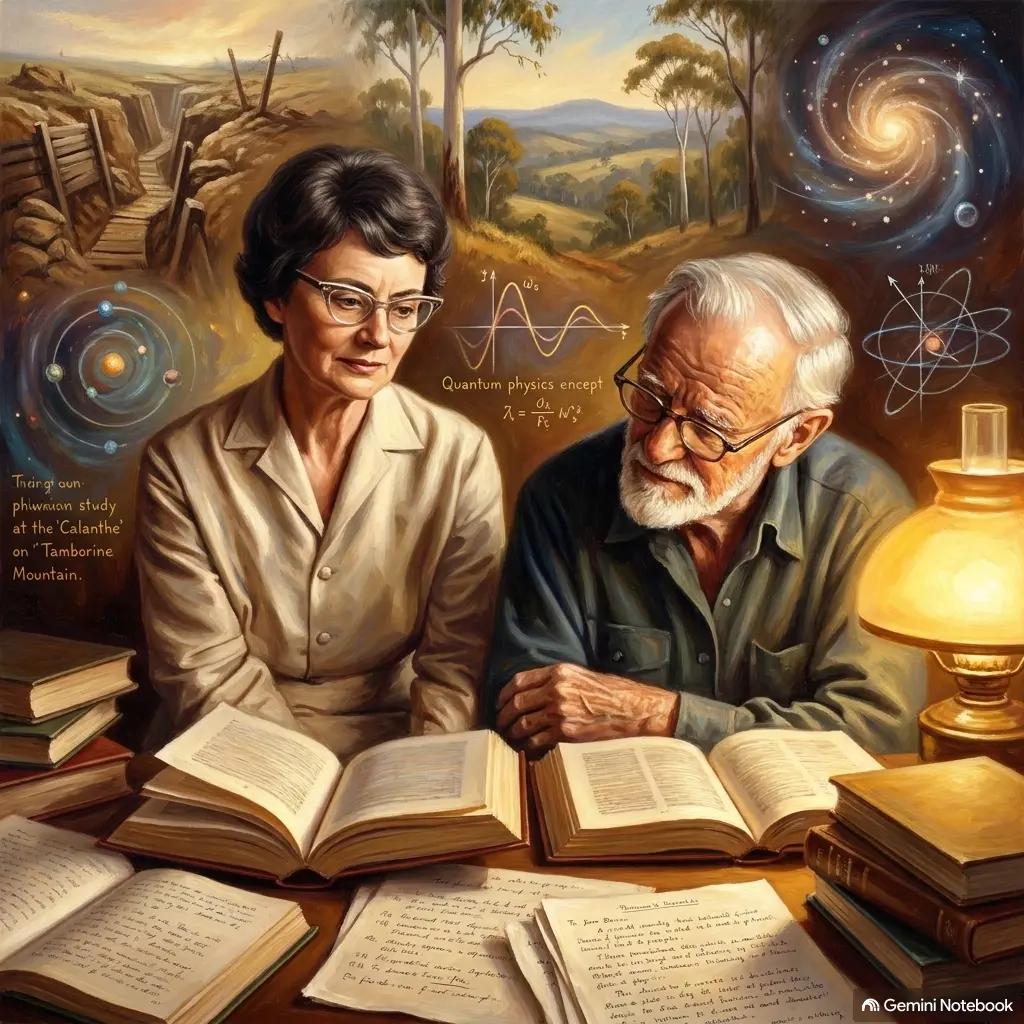
Featured Image:
The following two tabs change content below.


Neville Buch
Professional Historian at Professional Historians Association (Queensland) Inc.
Neville Buch (Pronounced Book) Ph.D. is a certified member of the Professional Historians Association (Queensland). Since 2010 he has operated a sole trade business in history consultancy. He was a Q ANZAC 100 Fellow 2014-2015 at the State Library of Queensland. Dr Buch was the PHA (Qld) e-Bulletin, the monthly state association’s electronic publication, and was a member of its Management Committee. He is the Managing Director of the Brisbane Southside History Network.
Latest posts by Neville Buch (see all)
- The Autopsy of an Audit: A Personalist Rebuttal to Bevin Luchel’s Critique of Neville Buch’s Doctoral Thesis – November 21, 2026
- Buch, Neville (2026). Intellectual Sovereignty and the Sociological Legacy of Jack McKinney – November 21, 2026
- Human Designed A.I. in Present – November 21, 2026