
Dr Neville Buch and MICE[1]
Abstract
This essay examines the epistemological, psychological, and ethical consequences of “the destructive art of deflection”—a pervasive social pathology characterized by the refusal to grant even a minimal measure of thoughtful consideration to written communication, whether an email, an article, or a book[1]. Grounded in the personalist care ethics of Louis Janssens, Joseph Selling, and Nel Noddings, Hannah Arendt’s phenomenology of thoughtlessness, Bernard Stiegler’s critique of denoetization, and Dr. Neville Buch’s Spiral Historiography and Mind-Body-Cognition model, this study analyses how deflective practices degrade human communication into transactional utility[1]. First, the paper demonstrates how withholding attention from texts functions as an active posture of “un-care” (disengagement) that reduces living discourse (sermo) to passive auditing and message fatigue[1]. Second, it reveals how deflection erodes cognitive architecture by triggering “wilful ignorance,” enforcing “simplistic literalism,” and blinding the “Mind’s Eye”[10]. Third, the essay illustrates how habitual deflection destroys the capacity for a full life (eudaimonia), isolating the individual in solipsistic sensus privatus and severing relational trust[2]. Finally, the paper articulates why resisting deflection through the practice of panser (thinking as caring) is imperative for restoring active human authorship in an era of automated digital routines[15].
1. The Micropolitics of Un-Care: Deflection in Reading Emails, Articles, and Books
In contemporary administrative, corporate, and digital environments, human interaction is increasingly governed by what social theorists term the “exchange world”—an economic pattern where all communications are treated as transactional utility, designed to solicit approval or dismissal[2][3]. Within this system, a widespread yet profound ethical failure occurs in daily life: the refusal to give even a small, conscientious consideration when reading an email, an article, or a book[1]. This habit of hasty dismissal, skimming, or unread filtering is not a harmless byproduct of modern busyness; it is a primary, active manifestation of the destructive art of deflection[1][2].
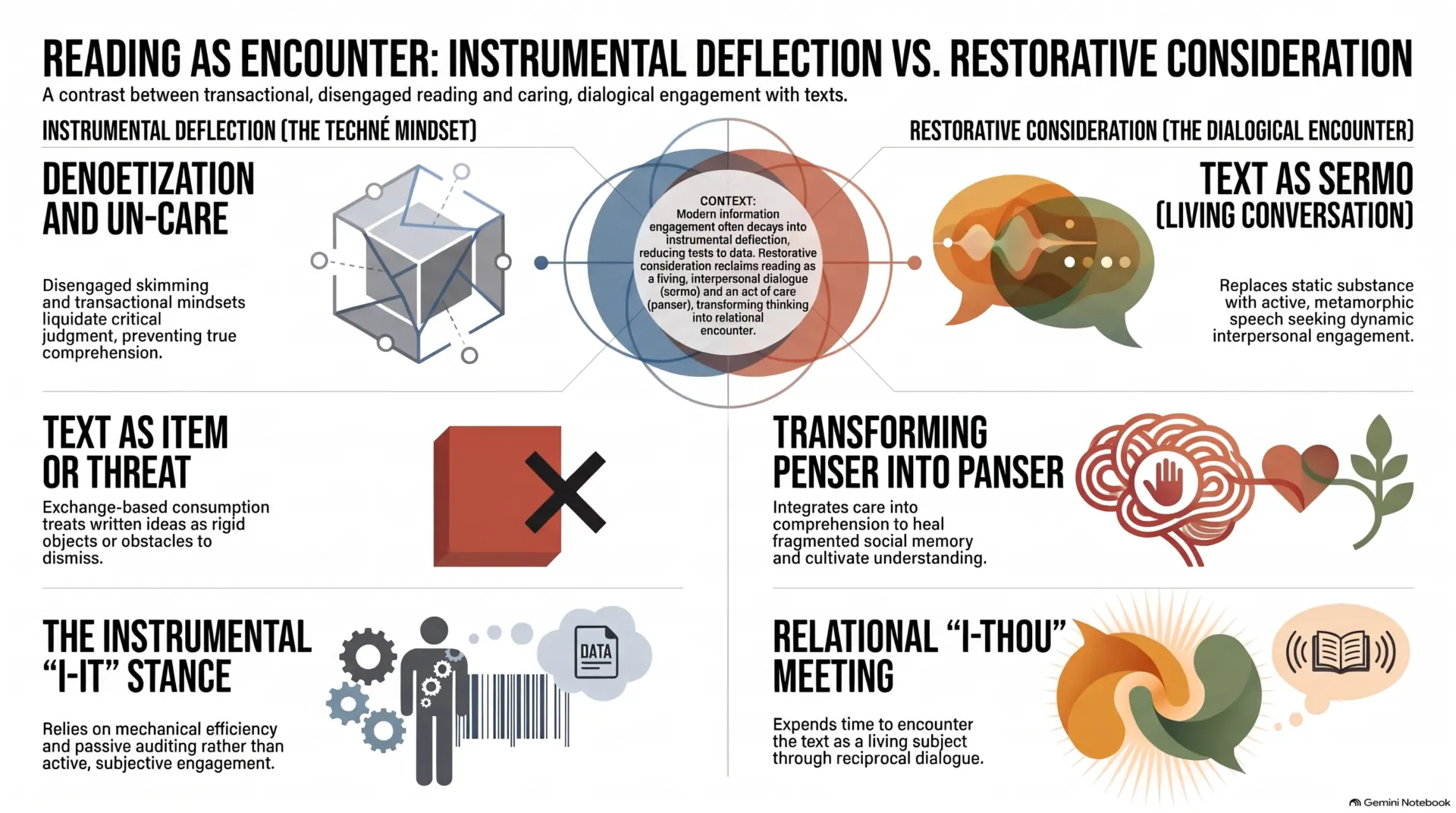
I. Reading as an Act of Relational Giving (Adorno’s Gift Critique)
As Theodor Adorno famously observed in Minima Moralia, genuine human relationship requires an orientation that is the exact opposite of distraction: “It means choosing, expending time, going out of one’s way, thinking of the other as a subject: the opposite of distraction. Just this hardly anyone is now able to do”[2]. When an individual receives an email, an article, or a manuscript from another person and deflects it—refusing to invest the time required to understand its context or intent—they treat the sender not as a conscious human subject, but as an inconvenient source of noise[2].
In Nel Noddings’ ethics of care, as integrated into Neville Buch’s historiography, this deflective posture represents the dangerous state of “disengagement” and “un-care”[1][19]. Noddings establishes a fundamental epistemological principle: “If you are not caring in the comprehension, you are not learning, and what you think you might know, you do not”[1][19]. Deflecting a written message is an assertion that the recipient already “knows” enough without needing to listen, thereby shutting down the possibility of genuine cognitive growth and mutual understanding[1][3].
II. The Degradation of Sermo into Passive Auditing
In Renaissance humanism, Desiderius Erasmus translated logos in John 1:1 not as the static, metaphysical verbum (Word), but as sermo —Speech, dynamic interpersonal conversation, and transformative dialogue[7]. A written text (whether a personal email or an academic book) is an extension of sermo, an invitation from an absent author to engage in an “inner affecting an inner”[7][20].
Deflection rhetorically kills sermo by reducing the recipient to a passive “consumer-auditor” who evaluates communications purely through binary metrics: delete or save, agree or disagree, click or scroll[2][3]. In communication psychology, this triggers message fatigue and defensive avoidance[8][9]. When people perceive incoming texts as demands or physical/social threats, they deploy deflection as a shield, convincing themselves through the “third-person effect” that the message is relevant only to others[8]. Consequently, language loses its metamorphic capacity to transform character, collapsing into decontextualized, transactional noise[2].
2. What Happens to Cognition in the Destructive Art of Deflection
Deflection is not merely a social slight; it actively re-engineers and degrades the human cognitive apparatus[5]. Within the NDB Mind-Body-Cognition model and the Dynamic of Cognition (DoC) framework, human thought depends on a self-regulating synthesis of Sensation, Intuition, Thinking, and Feeling[22]. Deflection operates as a systematic disruption of this synthesis[5].
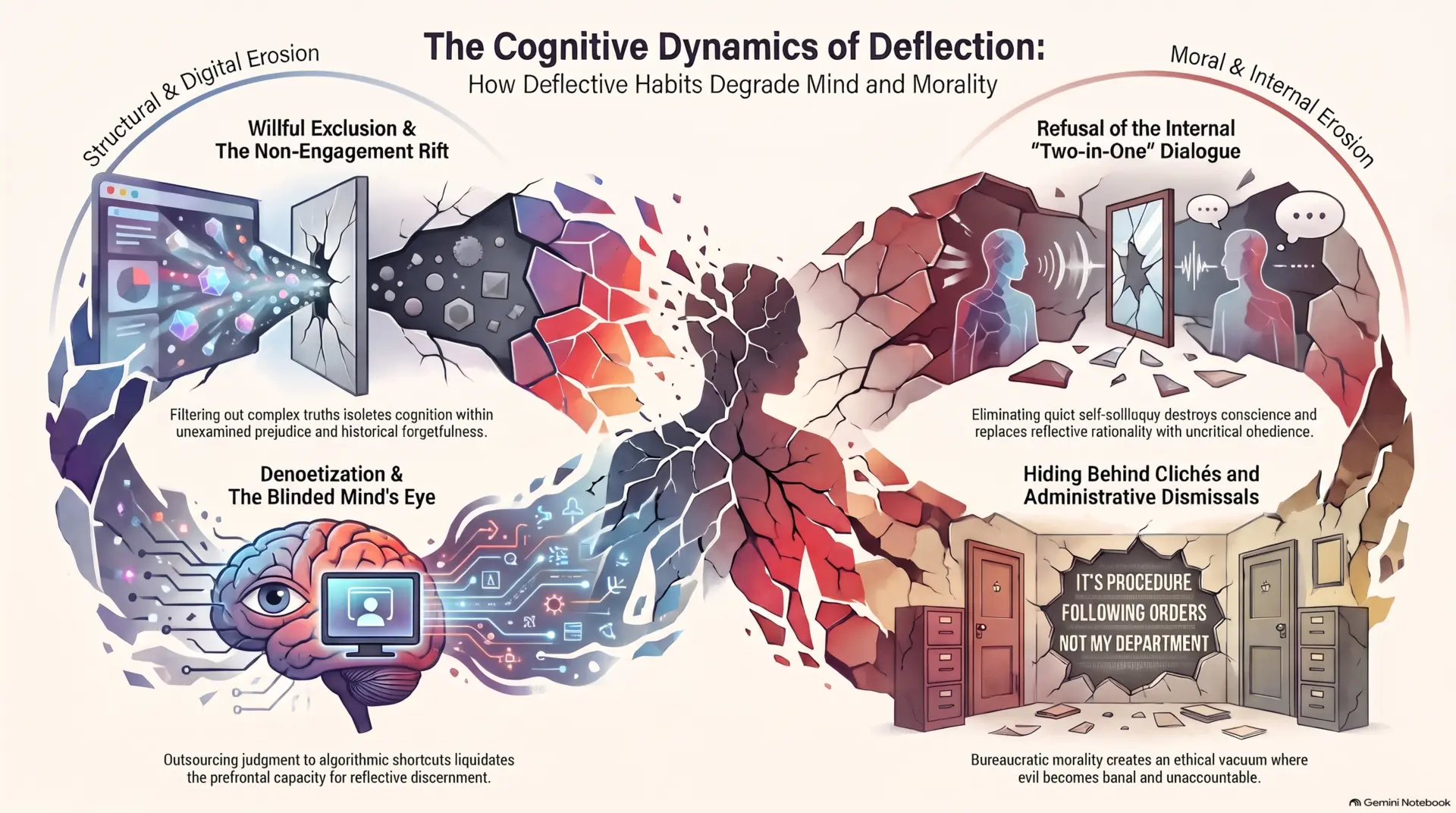
I. Willful Exclusion and the “Non-Engagement” Rift
In Buch’s Dynamic of Cognition, cognitive agency is determined by the dual states of Inclusion and Exclusion[10]. Inclusion requires an empathetic effort to make the external internal—to allow the thoughts and perceptions of another person to enter and modify one’s own cognitive schema[10][25].
Deflection is the active execution of Exclusion through “wilful ignorance”[10]. When a person deflects a book, article, or email, they build an epistemic barrier that filters out complexity[10]. This creates a cognitive gap known as non-engagement: a state where abstract sensory data is received by the brain but is never processed, integrated, or internalized into revisable knowledge[23]. The deflecting mind retains its initial “unreflective prejudice,” trapping itself in a “cyclical beginning” that dooms it to repeat past intellectual errors[26].
II. Denoetization and the Blinded “Mind’s Eye”
At a deeper level, habitual deflection accelerates what Bernard Stiegler and Neville Buch identify as denoetization—the mechanical liquidation of the human capacity to reflect, evaluate, and judge[5]. In an era dominated by hyper-industrialized digital technics and automated routines, deflection is the path of least resistance[12]. When individuals continuously deflect deep reading in favour of quick summaries or algorithmic previews, they outsource their cognitive synthesis to what Buch terms the “altar of autocomplete”[12].
This reliance on automated shortcuts creates a dangerous “rift” in the human brain, severing the active, investigative mind from the passive consumer[34][35]. Metacognitive monitoring and control—localized in the prefrontal cortex—are disengaged[36]. The inner “Mind’s Eye” is blinded, causing a “loss of memory of originary eidetic intuitions”[12]. The deflecting individual develops an “algorithmic character,” valuing only short-term speed, simplified data, and superficial agreement, ultimately succumbing to “potted thinking” and “simplistic literalism”[11].
III. Arendtian Thoughtlessness and the Banality of Deflection
In Hannah Arendt’s philosophical psychology, deflection is the primary mechanism of thoughtlessness ( Gedankenlosigkeit )[4]. Arendt established that thinking requires a temporary withdrawal from immediate physical tasks to engage in the silent, two-in-one dialogue of conscience[4]. Deflection is an active refusal to withdraw; it is the choice to remain on the surface of appearances, hiding behind stock phrases, bureaucratic clichés, and administrative dismissals[4]. By deflecting the claim of the text, the individual evades the “wind of thought,” rendering themselves incapable of exercising independent moral judgment (Selbstdenken) when faced with institutional wrongdoing[40].
3. How Deflection Erodes the Capacity to Live a Full Life
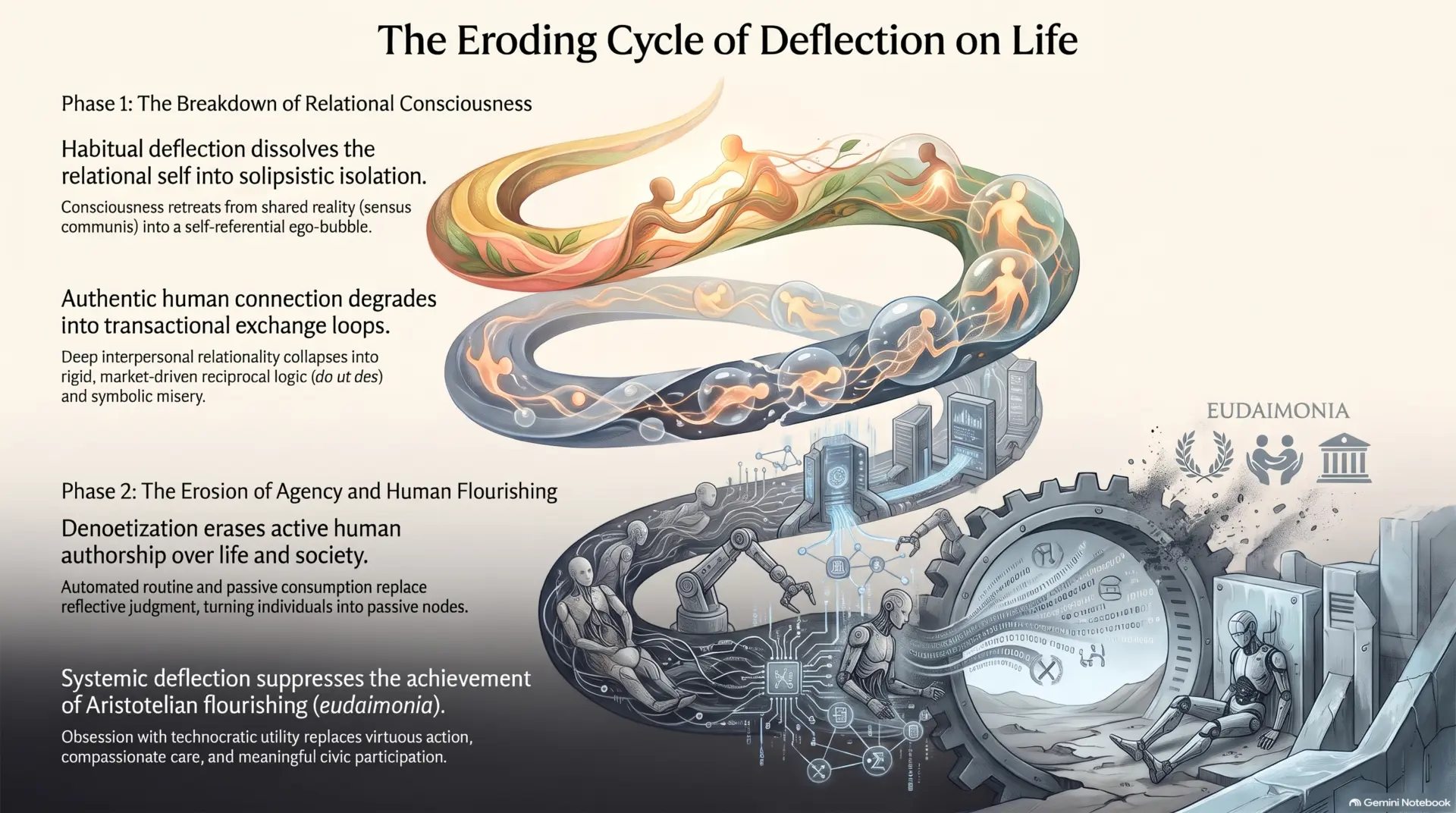
A “full life” in the personalist and classical tradition is conceptualized as Aristotelian flourishing ( eudaimonia )—a state of virtuous action, deep relational communion, and meaningful participation in a democratic community[15]. The destructive art of deflection systematically hollows out the anthropological foundations required for this flourishing[6].
I. Dissolving the Relational Self (Esprit Incarné)
According to Louvain personalism (Louis Janssens, Joseph Selling), the human person is not an isolated Cartesian ego, but a corporeal subject ( esprit incarné ) who is fundamentally and irreducibly person-in-relation[6]. Human beings do not develop personhood in isolation; the “I” emerges only through reciprocal, dialogical contact with a “Thou”[47][48]. As idealist personalists such as T.H. Green and Edward Caird argued, a person in total isolation or continuous disengagement has their personality “eroded to the point of nil”[49].
Deflection is a direct attack on this relational structure[2]. When an individual deflects the written thoughts, appeals, or research of another, they reject the intersubjective bond[3]. By refusing to engage with the “Other” as a unique subject, the deflecting person traps themselves in sensus privatus ( logical Eigensinn )—a private, solipsistic bubble that severs them from the shared human world (sensus communis)[6]. Over time, this habit breeds a “discontinuous personality,” leaving the individual incapable of sustaining long-term relational trust, empathy, or moral integrity[3].
II. Symbolic Misery and the Loss of Care
When deflection becomes a dominant social habit, society descends into what Bernard Stiegler terms “symbolic misery” and “the immense regression”[5]. In a deflective culture, human interactions revert to the cold, legalistic scheme of do ut des (“I give so that you might give”)[55]. Education is reduced to “job-ready” vocational training, scholarly inquiry is forced into quantifiable metrics, and personal correspondence is replaced by automated templates[3].
Without care (panser) in our cognitive dealings, human existence loses its depth and meaning[1]. As Linus Vanlaere and Chris Gastmans emphasize, human life cannot flourish in the absence of caring relationships[45][56]. By deflecting the vulnerability and intellectual labour of others, the deflecting individual deprives themselves of the “fountainhead of worth”—the experience of witnessing and conferring dignity through attentive, respectful engagement[57][58].
4. Why This Message Is Imperative for Contemporary Society
Unmasking the destructive art of deflection is not an academic exercise in etiquette; it is an urgent prerequisite for preserving democratic civility, intellectual freedom, and human agency in the twenty-first century[5].
I. Reclaiming Human Authorship Against the “Techné Mindset”
As the Fourth Industrial Revolution accelerates, human culture is increasingly enveloped by a “techné mindset”—a managerial rationality that privileges speed, administrative efficiency, and quantifiable data over multi-textured human understanding[5]. Generative AI and predictive algorithms hyper-industrialize deflection, encouraging users to summarize, automate, and bypass the actual labour of reading and writing[12].
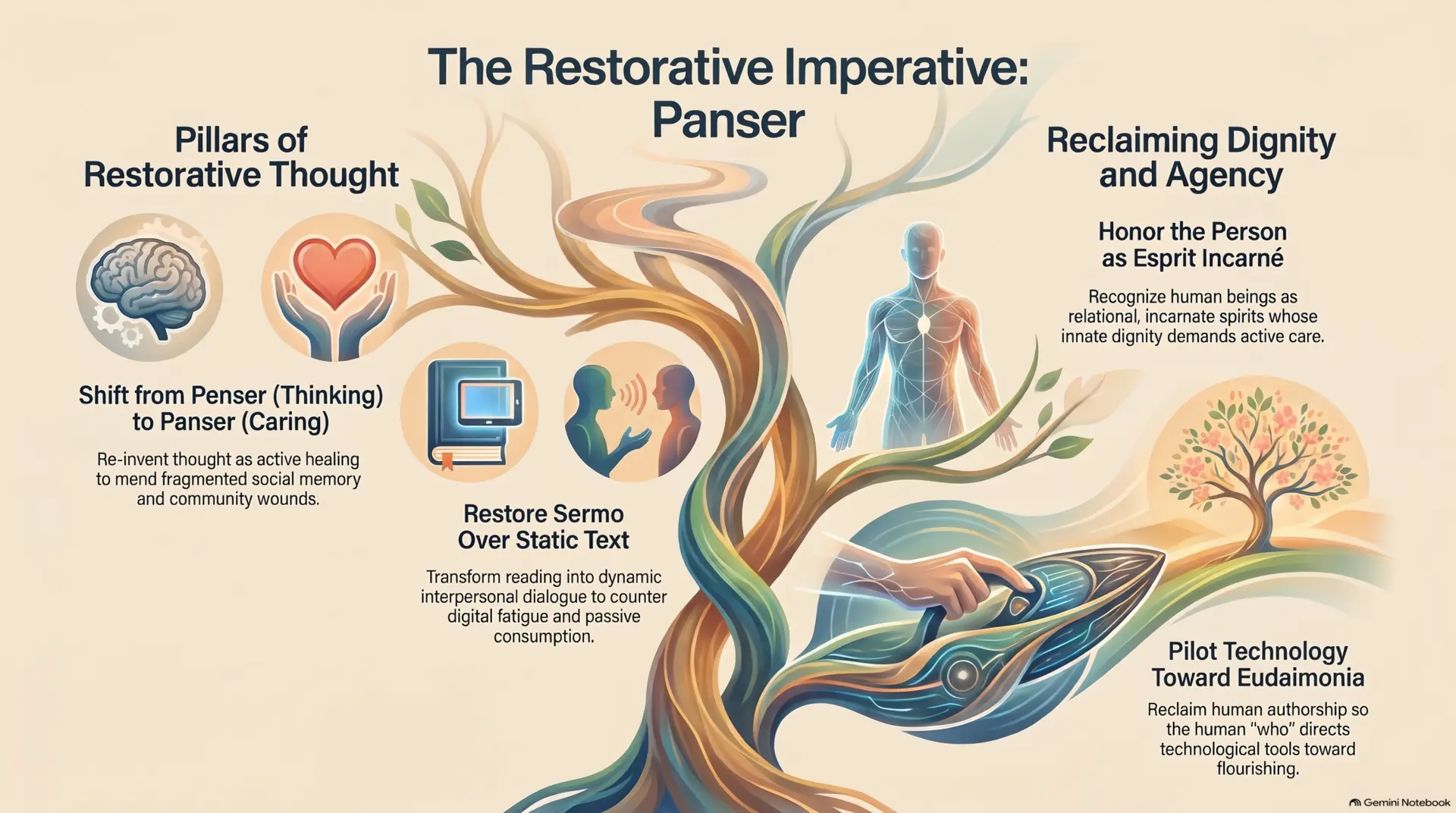
The message opposing deflection provides the vital “intellectual scaffolding” required to resist this reductionism[62]. It asserts the foundational principle of Digital Humanism: the human “who” must remain the proactive pilot of the technological “what”[15]. Technical artifacts should serve as prostheses that support the “long circuits” of deep reflection, rather than shortcuts that justify deflective thoughtlessness[61].
II. Eradicating “Historical Forgetfulness” Through the POLICE Framework
Deflection on a societal scale produces Historical Forgetfulness—the systematic banishment of historical context and intellectual genealogies[11]. Deprived of historical depth, public discourse collapses into superficial, polarized “nonsense fights” driven by rigid, binary slogans[68].
To counter this, society requires an “intellectual immune system”: the POLICE diagnostic framework (Philosophically, Ontology, Logic, Intersect, Compatibility, Education)[71]. By systematically “policing our own thoughts,” individuals can spot deflective fallacies, detect “institutional bullshit,” and demand accountability before accepting simplified narratives[71].
III. Practicing Panser: Transforming Thinking into Caring
Ultimately, the message is essential because it offers a concrete pathway for cultural renewal: adopting the stance of the panseur —one who reinvents thinking ( penser ) as active caring ( panser )[15].
When an individual chooses not to deflect—when they open an email, an article, or a book and grant it their full, considerate attention (avoir une pensée pour)—they perform a quiet act of intellectual healing[15]. They restore language to its true calling as sermo, honor the inviolable dignity of the human author (esprit incarné), and re-anchor society in the pursuit of genuine Aristotelian flourishing ( eudaimonia )[7].
References / Bibliography
Adorno, T., 1951. Minima Moralia: Reflections on Damaged Life. Translated by E.F.N. Jephcott, 1974. London: New Left Books. Cited in C. Hoevel, 2008. ‘Gift and Market Relations: A Personalist Approach’, Journal of Markets & Morality, 11(2), p. 1[2].
Arendt, H., 1963. Eichmann in Jerusalem: A Report on the Banality of Evil. New York: Viking Press[4][76].
Arendt, H., 1977. The Life of the Mind (Two Volumes: Thinking and Willing). Edited by M. McCarthy. New York: Harcourt Brace Jovanovich [1–24, 68, 152, 458–460].
Buber, M., 1923. Ich und Du (I and Thou). Leipzig: Insel Verlag. Cited in L. Vanlaere and C. Gastmans, 2011, p. 165[48].
Buch, N., 2023. Spiral Historiography. Socio-Historical Change in Unitarian Universalism. Brisbane: Management Institute for Contributory Economy (MICE) [25–28].
Buch, N., 2024. Spiral Historiography. Brisbane: Dr Neville Buch Blog / SOFiA [40–43].
Buch, N., 2025a. 01. Personal History Workshop: What is Personal History. Brisbane: Dr Neville Buch and Sam Fiaalii[77][78].
Buch, N., 2025b. Spiral Historiography of Unitarian Universalism. Brisbane: Management Institute for Contributory Economy (MICE) [29–36].
Buch, N., 2025c. Concept-Practice X.5. Spiral Historiography. Brisbane: Management Institute for Contributory Economy (MICE) [40–43].
Buch, N., 2025d. Personal Intellectual History of Queensland (Chapter 4). Brisbane: Dr Neville Buch [44–45].
Buch, N., 2025e. The Worldview of Personalism: How We Got to the Misunderstanding of ‘Persons’. Brisbane: Management Institute for Contributory Economy (MICE) [54–63].
Buch, N., 2026a. The Crucible of Consciousness: Historiography and the Genesis of Reforming Thought. Brisbane: Neville Buch and Management Institute for Contributory Economy (MICE) [124–295].
Buch, N., 2026b. Notes on Bengtsson. Personal Unity-in-Diversity. Brisbane: Dr Neville Buch [76–96].
Buch, N., 2026c. Hannah Arendt: Intelligence and Ethics Part 1. Brisbane: Dr Neville Buch[65].
Buch, N., 2026d. Pathways on the Spiral Historiography. Brisbane: Dr Neville Buch [97–105].
Buch, N., 2026e. Research Note: Conflict in Spiral Historiography. Brisbane: Dr Neville Buch [106–109].
Buch, N. and Peach, N., 2024. Philosophically Ontology Logic Intersect Compatibility Education (POLICE). Brisbane: Dr Neville Buch ABN: 86703686642[71].
Corwin, S.L., 2026. The Hall of Mirrors: A Critique of Neville Buch’s Contributory Economy. Seattle: Sardonic Review Press [314–322].
Erasmus, D., 1519. Novum Testamentum Omne. Basel: Johann Froben. Cited in N. Buch, 2026a, p. 72[7].
Flavell, J.H., 1979. ‘Metacognition and Cognitive Monitoring: A New Area of Cognitive-Developmental Inquiry’, American Psychologist, 34(10), pp. 906–911[36][37].
Hoevel, C., 2008. ‘Gift and Market Relations: A Personalist Approach’, Journal of Markets & Morality, 11(2), pp. 1–20 [323–326].
Janssens, L., 1980. ‘Artificial Insemination: Ethical Considerations’, Louvain Studies, 8, pp. 3–29. Cited in L. Vanlaere and C. Gastmans, 2011, pp. 164–166 [389–396].
Lewis, I., Watson, B. and Tay, R., 2007. ‘Examining the Effectiveness of Physical Threats in Road Safety Advertising’, Transportation Research Part F, 10(1), pp. 48–60 [330–340].
Noddings, N., 1984. Caring: A Feminine Approach to Ethics and Moral Education. Berkeley: University of California Press. Cited in N. Buch, 2023, p. 5[1][19].
Pinder, D., 2026. ‘In a World Run by Function Systems’, Aargh! Substack Publication, pp. 1–6 [365–369].
Selling, J., 1998. ‘The Human Person’. In: B. Hoose, ed. Christian Ethics: An Introduction. London: Cassell, pp. 95–109. Cited in L. Vanlaere and C. Gastmans, 2011, pp. 165–166 [397–402].
So, J., Kim, S. and Cohen, H., 2017. ‘Message Fatigue: Conceptual Definition, Operationalization, and Correlates’, Communication Monographs, 84, pp. 5–29[9].
Stiegler, B., 1998. Technics and Time, 1: The Fault of Epimetheus. Stanford: Stanford University Press[61].
Stiegler, B., 2025. The Immense Regression: What is Called Caring? (Vol. 1). Berlin: K. Verlag. Cited in N. Buch, 2026a, p. 10[17].
van den Berg, J., ed., 2020. Engaging the Fourth Industrial Revolution: Perspectives from Theology, Philosophy and Education. Stellenbosch: SUN MeDIA[35][54].
Vanlaere, L. and Gastmans, C., 2011. ‘A Personalist Approach to Care Ethics’, Nursing Ethics, 18(2), pp. 161–173 [370–441].
Take the MICE Quiz
[1] Artificial Intelligence (A.I.) has been fairly used in the production of this work. The tool used is Google NotebookLM (recently rebranded as Gemini Notebook). It is an AI-powered virtual research assistant and thinking partner designed to help a person interact deeply with their own documents. Unlike general chatbots, it is source-grounded, meaning it only generates answers based on the specific PDFs, documents, or links uploaded. The A.I. process in the production of this work has been limited to the attached (prompts) on each of the questions in turn. This ensures an accurate reading of each source. The author then rearranged and re-edited the answers the A.I. provided. The human author publishes this work. A.I. is never an author when used properly. This assistance is not qualitatively different from a human research assistant when that assistance is deemed to have no authorial status but is acknowledged.


Neville Buch
Latest posts by Neville Buch (see all)
- Dr. Neville Buch and the Evolution of Australian Religion-Secular Historiography – October 29, 2026
- The Destructive Art of Deflection: Cognitive Erosion, Un-Care, and the Loss of Human Authorship – October 29, 2026
- “I Know Many Things, But Thinking Always Makes It So”: The Epistemology of Reflective Judgment, Relational Care, and Human Authorship – October 29, 2026