
Dr Neville Buch and MICE[1]
Abstract
This research essay examines the intellectual trajectory, reception history, core theoretical messages, and contemporary significance of Dr. Neville Buch’s pioneering work in Australian religion-secular historiography. Spanning over four decades of scholarly activity, Buch’s oeuvre represents a major synthetic effort to bridge Australian-American intellectual history, sociology of education, and philosophical non-religion. Beginning with his foundational 1994 University of Queensland doctoral thesis on the American Revivalist Tradition (ART), Buch established the primary historical framework for analysing how imported American religio-cultural models transformed Australian mainstream Protestantism and public education. The essay investigates Buch’s academic prominence across professional history associations, his complex reception history—including institutional gatekeeping, engagement by evangelical historians, friction with secularist and corporate educational models, and the “Corwin critique” regarding synthetic historiography—and his core theoretical contributions. These key messages include the Dynamic of Cognition (DoC) four-stage model, Spiral Historiography, the policy distinction between neutral secularity and political secularism, the diagnosis of theological capture and digital denoetization, and the formulation of the Liberal (Post) Christian Horizon. Finally, the essay demonstrates why Buch’s work is essential for contemporary humanities: it provides a vital “intellectual immune system” against “potted thinking” and algorithmic formalization, reclaiming Human Authorship and Planetary Wisdom in an automated age.
1. Establishing Prominence in the Fields of Learning
Dr. Neville Buch has established a distinguished position within Australian intellectual history, sociology of education, and the public study of religion over a career spanning more than forty-one years (Buch 2023b, p. 2). Operating as a professional historian, independent scholar, and community educator, Buch’s prominence was inaugurated by his landmark 1994 University of Queensland doctoral thesis, American Influence on Protestantism in Queensland since 1945 (awarded April 1995), which broke virgin territory in Australian religio-cultural historiography (Buch 1995, p. 10; Buch 2024b, p. 18).
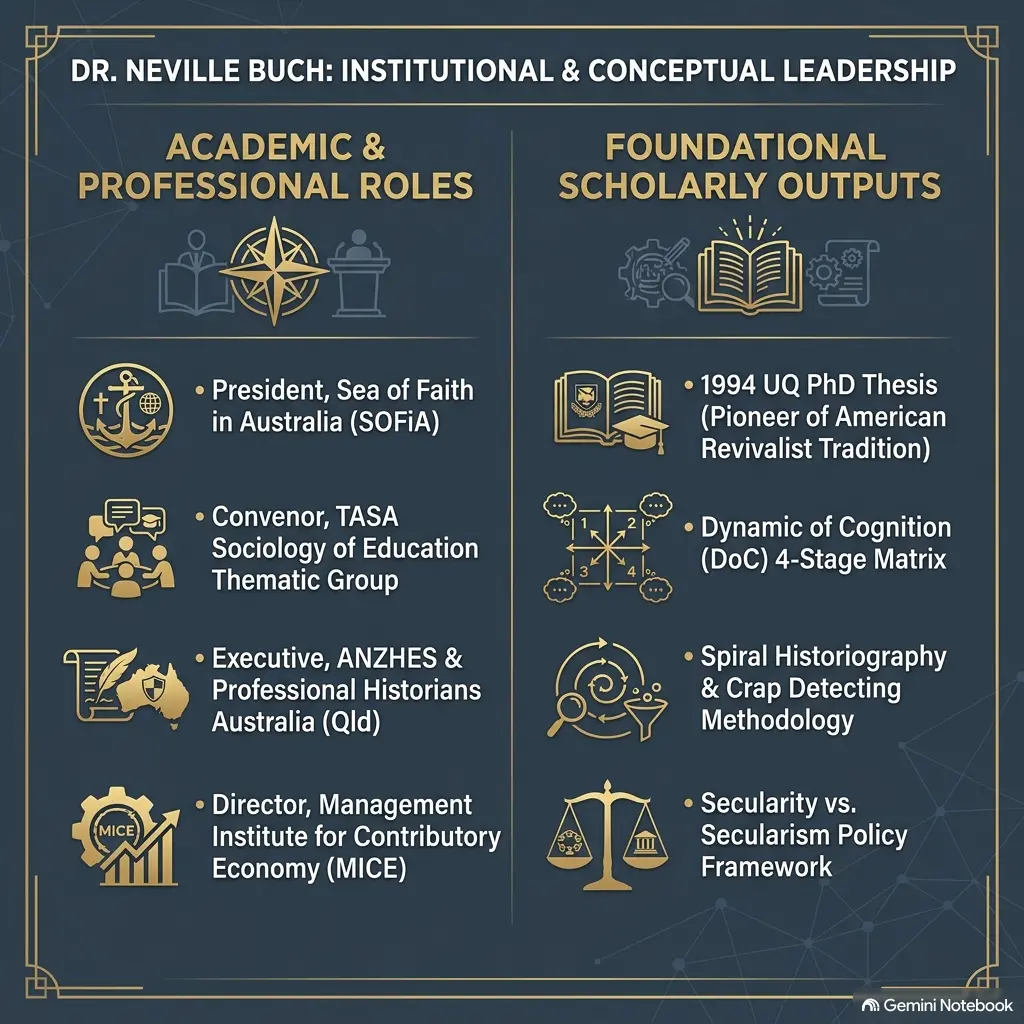
Before Buch’s doctoral research, Australian church history was largely written within denominational silos or framed as an unbroken continuation of British imperial traditions (Buch 1995, pp. 9–10; Piggin and Linder 2020, cited in Buch 2025b, p. 23). Buch demonstrated that World War II marked a watershed transition in Australian culture, wherein British Protestant influences were systematically displaced by an imported American Revivalist Tradition (ART) (Buch 1995, p. 9). By establishing that thirty-six major American religious publishing houses, alongside US film, radio, music, and youth rally models (such as the YPD under Ivan Alcorn), restructured Australian church life, Buch provided the primary historiographical baseline for understanding how American subcultures altered Australian civil religion (Buch 1995, pp. 9–10; Buch 2023a, p. 1).
Beyond his foundational thesis, Buch built prominence through continuous leadership across national academic associations and public philosophy networks:
- Professional Associations: Convenor of the Sociology of Education Thematic Group within The Australian Sociological Association (TASA), executive contributor to the Australian and New Zealand History of Education Society (ANZHES), and active member of Professional Historians Australia (Queensland) (Buch 2025a, p. 240).
- Public Philosophy & Independent Institutions: President of the Sea of Faith in Australia (SOFiA), Director of the Management Institute for Contributory Economy (MICE), Director of the Brisbane Southside History Network (BSHN), and regular facilitator at the Philosophy Café Brisbane Meetup (Buch 2023b, p. 2; Buch 2025a, p. 240).
- Curriculum & Synthetic Historiography: Author of major institutional histories (such as No Regrets in the Evening of Life: Junction Park State School, 2015) and international curricular packages in Lebensphilosophie and Wissenschaft in collaboration with the Free Thinker Institute in New York City (Buch 2023b, p. 2; Buch 2025b, p. 24).
Through this multi-tiered involvement, Buch positioned his work midway between elite university faculties and grassroots community education, embodying C. Wright Mills’ “craftsmanship of the reflexive insider” (Mills 1959, cited in Buch 2026a, p. 17).
2. Reception Histories of Buch’s Work
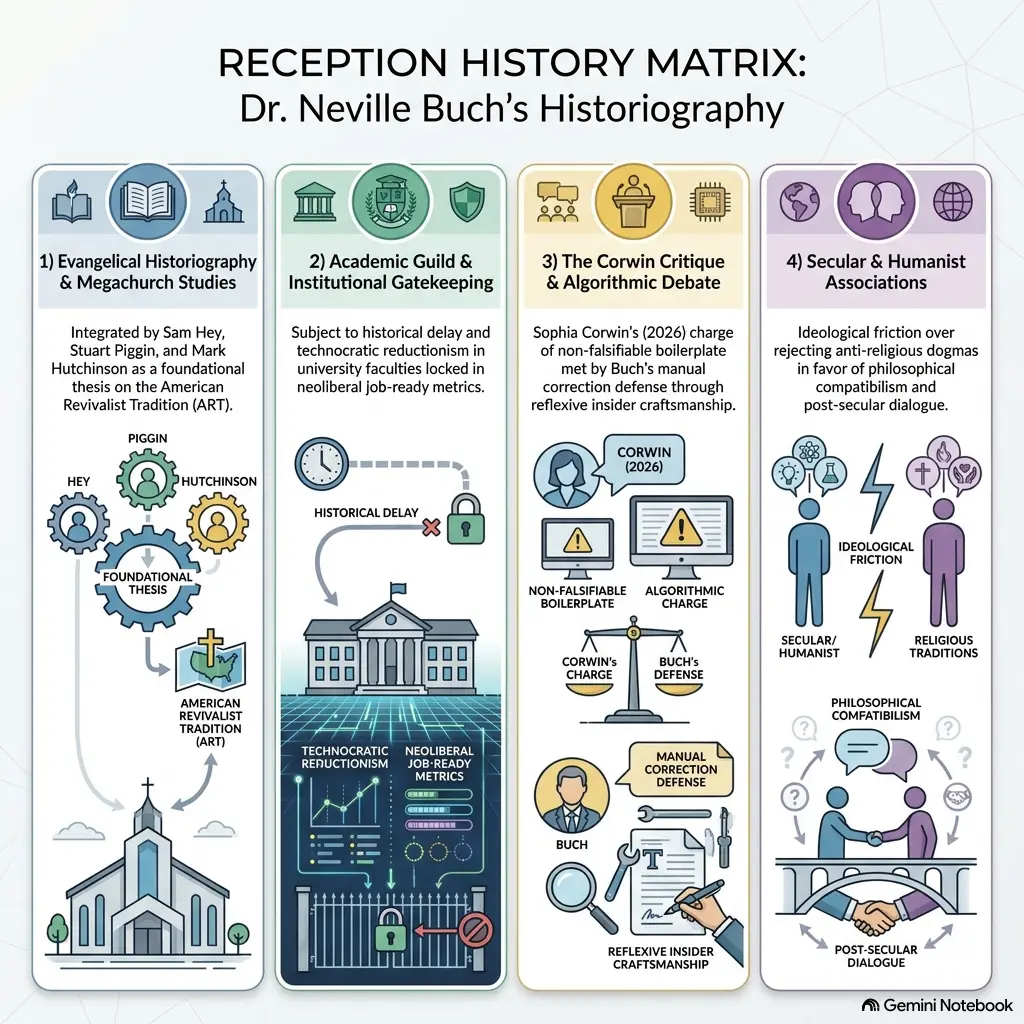
The reception history of Neville Buch’s scholarship reflects a complex dynamic characterized by early historiographical recognition, ongoing integration by evangelical sociologists, institutional gatekeeping, and sharp debate over his synthetic methods.
2.1 Recognition in Evangelical Historiography and Sociology of Religion
Within the academic study of Australian evangelicalism and Pentecostalism, Buch’s thesis was recognized as an indispensable landmark. Sociologist Sam Hey explicitly drew upon Buch’s 1994 thesis to contextualize the emergence of Australian megachurches, acknowledging Buch’s demonstration of how local assemblies imported American corporate and revivalist structures (Hey 2011, cited in Buch 2024c, pp. 161–162). Similarly, historians of Australian Christianity—including Stuart Piggin, Mark Hutchinson, and Charles Ringma—have engaged Buch’s findings regarding the historical tension between academic theology and popular revivalist “folklore epistemology” (Hutchinson 2017, cited in Buch 2025b, p. 25; Buch 2025c, pp. 1–2).
2.2 Institutional Gatekeeping and “Historical Delay”
Conversely, Buch’s work encountered significant resistance within institutional university faculties—such as the UQ School of Historical and Philosophical Inquiry—and state educational bureaucracies (Buch 2026a, pp. 28, 46). Buch diagnoses this resistance as a manifestation of “historical delay” and “parochial gatekeeping” (Buch 2026a, pp. 28, 31). As neoliberal education policies in Australia systematically reduced humanities funding and replaced broad history curricula with “job-ready” technocratic training, university leadership largely ignored the critical historiographical insights of the 1970s and 1980s (Collins 2019, cited in Buch 2024a, p. 15; Buch 2026a, p. 28). Consequently, Buch’s critique of state-level curriculum censorship—such as the Bjelke-Petersen government’s banning of the inquiry-based MACOS and SEMP social science programs in 1978–1979—was frequently marginalized by administrative gatekeepers seeking market-aligned quietism (Buch 2024c, p. 159; Buch 2026a, p. 26).
2.3 The “Corwin Critique” and the Defence of Synthetic Historiography
In 2026, critic Sophia L. Corwin launched a sharp polemic against Buch’s recent works (2021–2026), characterizing his broad synthesis of continental philosophy, general organology, and local Queensland history as “non-falsifiable boilerplate” or “Buchshit” (Corwin 2026, cited in Spiral Historiography 2026, pp. 399, 412). Corwin argued that Buch’s use of structured AI models to map his Dynamic of Cognition risked producing an “altar of autocomplete” that obscured concrete political realities beneath cosmic philosophical terminology (Corwin 2026, cited in Spiral Historiography 2026, p. 400).
Buch directly countered this critique by executing a “manual correction” through the “craftsmanship of the reflexive insider” (Buch 2026a, p. 5; Spiral Historiography 2026, p. 399). Buch demonstrated that his synthetic historiography is not an automated boilerplate, but a rigorous, post-postmodern methodology (Spiral Historiography) specifically constructed to uncoil human consciousness from algorithmic traps (Buch 2026a, pp. 5, 41–42; Spiral Historiography 2026, pp. 399–400). Far from ignoring local history, Buch re-anchored his grand theoretical models directly in concrete empirical case studies: the 1994 ART thesis, the Radford and ROSBA assessment reforms (1971–1989), the 1986 Pentecostal political gathering, and Alphacrucis College’s “marketplace pedagogy” (Buch 2024a, p. 3; Buch 2026a, pp. 26, 43; Spiral Historiography 2026, p. 405).
2.4 Friction with Secularist and Institutional Arenas
Buch’s reception among secularist organizations has been similarly contentious. During his tenure as Communities Program Manager for Humanists Australia, Buch authored official policy statements distinguishing neutral secularity from political secularism (Buch 2024d, p. 1; Buch 2024e, p. 1). However, his insistence that humanism must remain philosophically compatibilist—respecting religious heritage and embracing Don Cupitt’s “secular theology”—led to ideological friction with members who favoured ad hoc anti-religious polemics, resulting in Buch’s departure from the organization (Cupitt 2008, cited in Buch 2025b, p. 4; Buch 2026a, p. 20).
Despite these institutional frictions, Buch’s framework achieved major formal synthesis at the joint 2025 TASA-AASR Non-Religion Symposium at the University of Sydney, establishing his Dynamic of Cognition model as a leading framework for evaluating non-religion in the public square (Buch 2025b, p. 3; Buch 2026a, p. 31).
3. Key Messages of Buch’s Historiography
Neville Buch’s scholarship is united by several core theoretical messages that challenge dominant assumptions in history, sociology, and studies-in-religion:
3.1 The Dynamic of Cognition (DoC) Four-Stage Model
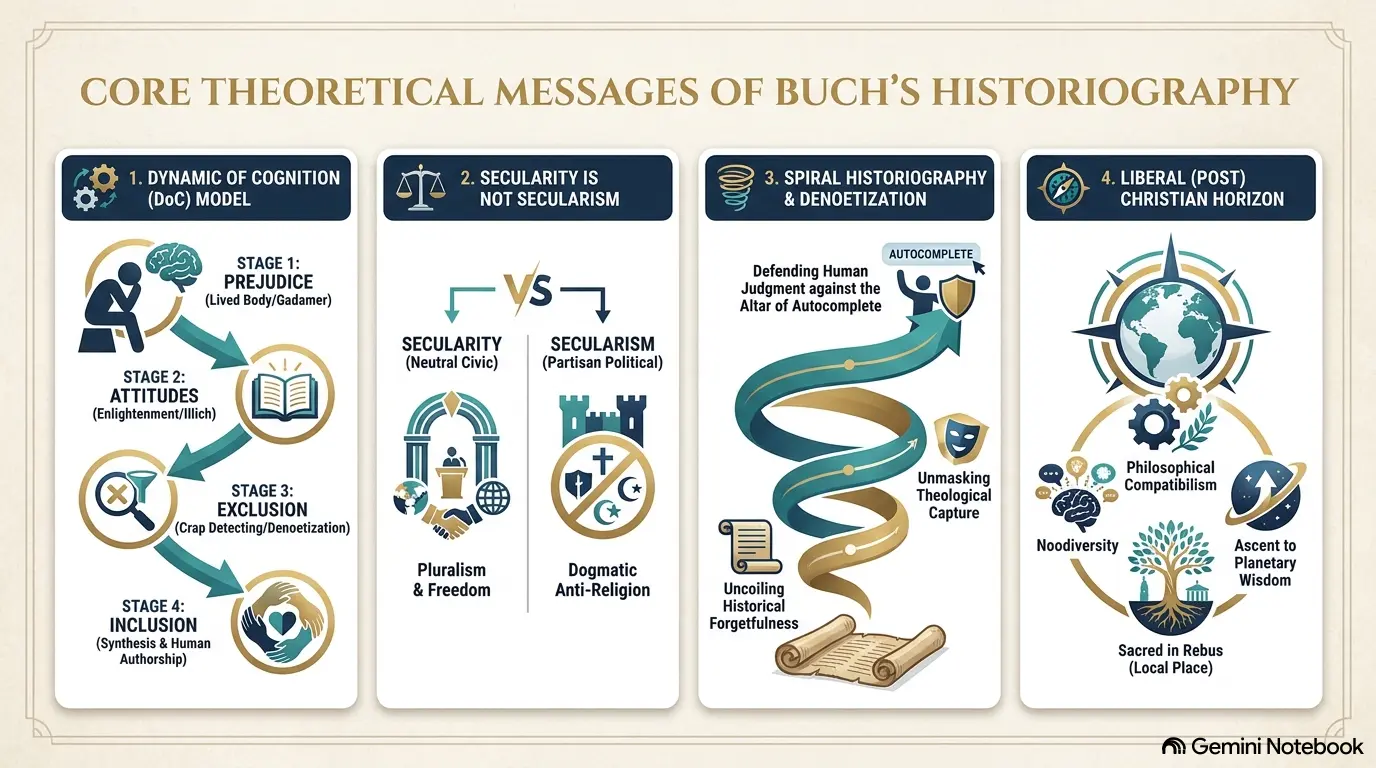
At the centre of Buch’s late scholarship is the Dynamic of Cognition (DoC)—a systematic, four-stage matrix designed to map evolving paradigms in belief, non-religion, and education (Buch 2025a, p. 1; Buch 2026a, pp. 1–2):
- Stage 1: Prejudice (The Centre of Cognition): The unavoidable, “thrown” starting point of human experience, rooted in Merleau-Ponty’s lived body (corps propre) and Gadamer’s pre-understanding (Merleau-Ponty 1945, cited in Buch 2026a, pp. 2–3). In its regressive form, it manifests as “simplistic literalism” and anti-intellectual “potted thinking” (Hofstadter 1963, cited in Buch 2026a, pp. 9–10).
- Stage 2: Attitudes (The Thinking Axis): The forcefulness of ideas used to interpret the world. It maps the Enlightenment transition from divine natural law to universal human rights (Pagden 2003, cited in Buch 2026a, pp. 11–13), deploying Ivan Illich’s “convivial tools” and C. Wright Mills’ “sociological imagination” to resist technocratic reductionism (Illich 1973 and Mills 1959, cited in Buch 2026a, pp. 15–17).
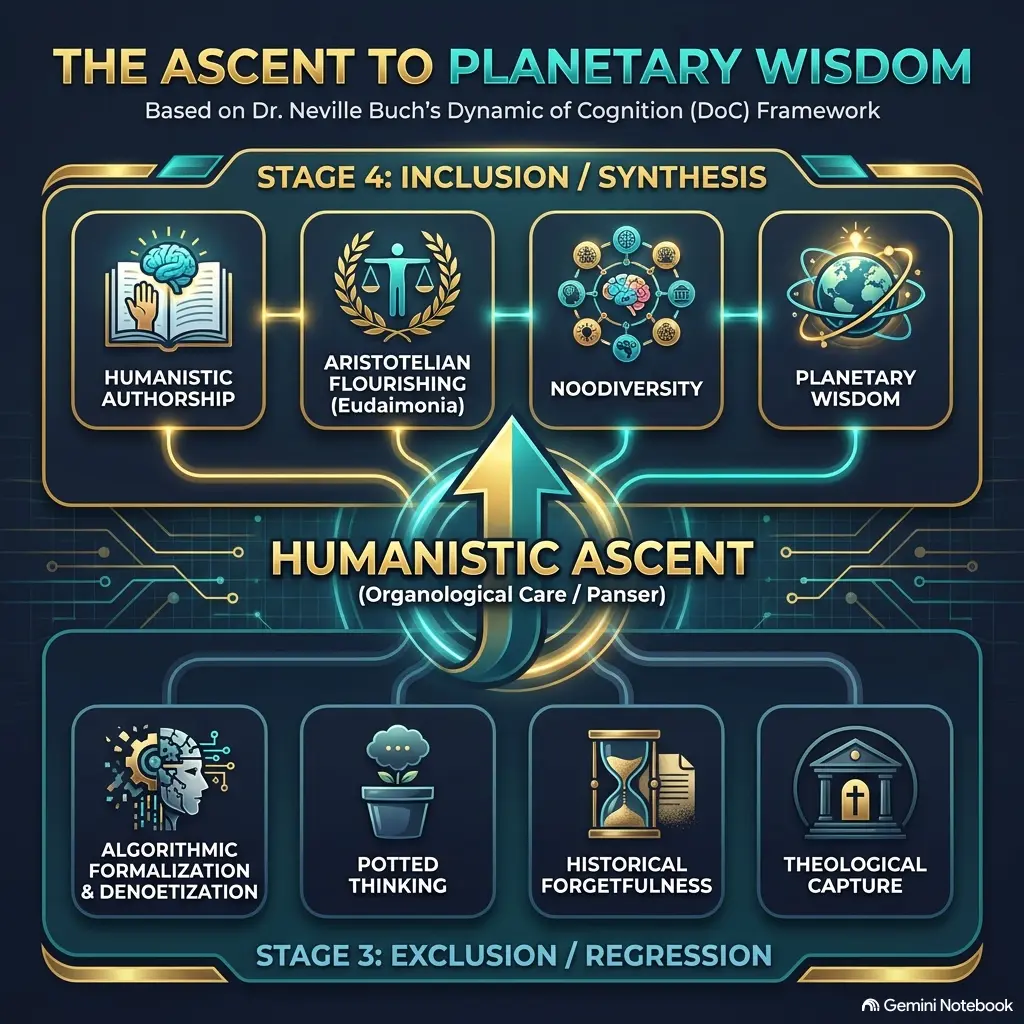
- Stage 3: Exclusion (The Procedural Filter): The diagnostic stage for cognitive regression. It analyses how algorithmic online education (Serdyukov 2021) and hyperindustrial platform capitalism cause denoetization—the mechanical liquidation of human judgment—and “symbolic misery” (Stiegler 2014, cited in Buch 2026a, pp. 21–23). Constructively, Exclusion functions as “crap detecting”—filtering out institutional propaganda and “theological masks” (Postman and Weingartner 1969, cited in Buch 2026a, p. 24).
- Stage 4: Inclusion (The Stage of Synthesis): The realization of holism, intersubjective communication (Habermas 1984), and scholarly network synthesis (Collins 1998), restoring Human Authorship and guiding society toward Planetary Wisdom (Habermas 1984 and Collins 1998, cited in Buch 2026a, pp. 34–40).
3.2 Secularity is Not Secularism
Buch establishes a vital policy distinction between secularity and secularism:
- Secularity is a neutral, descriptive sociological category indicating the absence of religious coercion in public spaces, serving as an essential safeguard for pluralism, freedom of belief, and democratic coexistence (Buch 2024d, p. 1; Buch 2024e, p. 1).
- Secularism is a specific, partisan political ideology or attitude that often seeks to eradicate religious expression from the public square, collapsing into an anti-religious dogmatism no less rigid than the fundamentalism it opposes (Buch 2024e, pp. 1–2).
3.3 American Revivalist Tradition (ART) and “Theological Capture”
Buch argues that modern Australian conservative evangelicalism is heavily infected by “Evangelical a-Historicism” imported via the American Revivalist Tradition (Buch 2025b, p. 3; Buch 2026a, p. 27). ART substitutes deep theological hermeneutics with a “folklore epistemology,” biblical literalism, and a mechanistic view of faith (Buch 1995, p. 9; Buch 2026a, pp. 10, 28). This produces “theological capture”—the decoupling of religious symbols from their ethical traditions and their reassembly as “theological masks” or “memeable religiosity” to serve corporate interests, right-wing populism, and state power (Buch 2021, p. 1; Buch 2026a, pp. 20, 32).
3.4 Spiral Historiography and Resisting Denoetization
To counteract “historical forgetfulness”—the condition wherein societies repeat past errors because they lose the historical context of their conceptual schemas—Buch formulates Spiral Historiography (Buch 2024a, p. 12; Buch 2026a, p. 41). The spiral represents a non-linear movement “forward, backward, and forward again” through time, enabling the “Mind’s Eye” to retrieve abandoned critical frameworks (such as Freirean conscientization and Illichian learning webs) to solve contemporary crises (Freire 1970 and Illich 1971, cited in Buch 2026a, pp. 5, 34; Spiral Historiography 2026, p. 403). This methodology serves as an “intellectual immune system” against digital denoetization and the “altar of autocomplete” (Buch 2026a, pp. 15, 22–24).
3.5 The Liberal (Post) Christian Horizon and Planetary Wisdom
Synthesizing Don Cupitt’s Sea of Faith antirealism, Jürgen Habermas’s post-secular translation, and Bernard Stiegler’s organology, Buch outlines the Liberal (Post) Christian Horizon (Cupitt 2008 and Habermas 2006, cited in Buch 2025b, pp. 4, 14; Buch 2026a, pp. 38–40). This horizon dissolves the “blunt binary” between religion and secularity, recognizing that meaning originates in rebus (in concrete local placement) (Buch 2026b, p. 1). It promotes Philosophical Compatibilism—allowing an individual to be simultaneously rational, skeptical, faithful, and humanist—prioritizing Aristotelian flourishing (eudaimonia), noodiversity (diversity of knowledge), and Planetary Wisdom over dogmatic compliance (Buch 2026a, pp. 3, 41–46).
4. Why Buch’s Work is Important
Neville Buch’s historiographical and sociological synthesis is of critical importance for contemporary humanities, public policy, and educational theory for four fundamental reasons:
4.1 Providing an Intellectual Immune System Against “Potted Thinking”
In an era dominated by sensationalist journalism, social media echo chambers, and political demagoguery, public discourse is increasingly governed by “potted thinking”—compressed, unexamined slogans that bypass critical reflection (Buch 2026a, pp. 10, 24). Buch’s framework provides an “intellectual immune system” that equips citizens to perform “crap detecting,” unmasking institutional propaganda and resisting the “authoritarianism of the stupid” (Ellul 1973, cited in Buch 2026a, p. 19; Buch 2026a, p. 24).
4.2 Reclaiming Human Authorship in the Age of Generative AI
As automated algorithms, generative AI models, and computational capitalism formalize education, human cognition faces widespread denoetization—the mechanical liquidation of the capacity to exercise independent judgment (Stiegler 2014, cited in Buch 2026a, p. 22; Non-Religion PowerPoint 2025). Buch’s Spiral Historiography and Dynamic of Cognition model insist that machine tools must remain subordinate to human agency. By dismantling the “altar of autocomplete,” Buch restores Human Authorship, ensuring that the individual remains the proactive, moral author of their own intellectual and spiritual narrative (Buch 2026a, pp. 1, 15, 42).
4.3 Uncoiling the Destructive Binary of Religion vs. Secularity
By demonstrating that secularity is not secularism, Buch provides a vital policy framework for pluralistic democratic governance (Buch 2024d, p. 1; Buch 2024e, p. 1). His work uncoils the destructive “culture war” binary that pits religious fundamentalism against militant secularism. Through Philosophical Compatibilism and Habermasian post-secular dialogue, Buch shows how religious and secular citizens can cooperate in the public square, grounding policy in reason, evidence, and biospheric care without stripping away lived spiritual meaning (Habermas 2006, cited in Buch 2025b, p. 14; Buch 2026a, pp. 36–38).
4.4 Re-Anchoring Learning in Convivial Place (In Rebus)
Finally, Buch offers a radical alternative to bureaucratic, market-driven educational monopolies. Integrating Ivan Illich’s “convivial learning webs” and Michael Macklin’s “lifelong educational entitlements,” Buch advocates for funding individuals directly rather than stagnant institutions (Illich 1973 and Macklin 1976, cited in Buch 2026a, pp. 34–35). By re-anchoring learning in concrete local environments (in rebus) and Indigenous philosophies of “Country,” Buch’s historiography transforms history from a passive academic exercise into philosophy in practice—a diagnostic tool used to tend to social fragmentation with empathy (panser) and foster Planetary Wisdom (Stiegler 2018, cited in Buch 2025c, p. 1; Buch 2026b, p. 3; Buch 2026a, p. 46).
5. Conclusion
Dr. Neville Buch’s contribution to Australian religion-secular historiography represents a monumental synthesis of empirical local history and global philosophical sociology. From his groundbreaking 1994 doctoral thesis on the American Revivalist Tradition to his mature 2026 Dynamic of Cognition model, Buch has consistently exposed the mechanisms of historical forgetfulness, theological capture, and technocratic reductionism in Australian education and religious life.
Despite encountering institutional gatekeeping and academic skepticism, Buch’s deployable tools—Spiral Historiography, the policy distinction between secularity and secularism, the craftsmanship of the reflexive insider, and the Liberal (Post) Christian Horizon—provide an indispensable roadmap for contemporary scholarship. In an automated world threatened by algorithmic denoetization, Neville Buch’s work stands as a profound defence of the investigative mind, restoring Human Authorship and guiding society toward Planetary Wisdom.
Bibliography
Armitage, D. and Guldi, J. (2014). The History Manifesto. Cambridge: Cambridge University Press.
Becker, M. L. (2024). Fundamental Theology: A Protestant Perspective. London: Bloomsbury T&T Clark.
Buch, N. (1994). American Influence on Protestantism in Queensland since 1945. Ph.D. Thesis, Department of History, University of Queensland. [Awarded April 1995].
Buch, N. (1995). ‘Americanizing Queensland Protestantism’. Paper presented at the Studying Australian Christianity 1995 Conference, Robert Menzies College, Macquarie University, July.
Buch, N. (1997). ‘Many Distractions Confronting the Church: The Responses of Protestant Religion to Popular Culture in Queensland 1919–1969’. Paper presented at the Everyday Wonders Popular Culture Conference, Brisbane, June.
Buch, N. (2015). No Regrets in the Evening of Life: The History of Junction Park State School (1888–2013). Salisbury: Boolarong Press.
Buch, N. (2021). Politics, “ScoMo’s Pentecostalism”, and Indigenous ATSI/Tribal Philosophy. Brisbane: Sea of Faith Brisbane CBD Group.
Buch, N. (2023a). Fuller View for Telling the Story of Australian Evangelical History (Full Paper). Brisbane: Management Institute for Contributory Economy.
Buch, N. (2023b). Ph.D. Preamble. Brisbane: Management Institute for Contributory Economy.
Buch, N. (2024a). Rethinking School: Queensland Education 1971–1989. Brisbane: Management Institute for Contributory Economy.
Buch, N. (2024b). School Thinkers and Cognition History in our Schools. Brisbane: Management Institute for Contributory Economy.
Buch, N. (2024c). ‘Queensland History, Religious Education, and Belief’. In D. W. Kim and D. Wright (eds.) Socio-Anthropological Approaches to Religion: Environmental Hope. London: Lexington Books, pp. 157–172.
Buch, N. (2024d). Secular, Secularity, and Secularism Policy Statement. Draft Policy Statement for Humanists Australia Limited.
Buch, N. (2024e). Secularity is Not Secularism. Position Paper, Management Institute for Contributory Economy.
Buch, N. (2025a). Non-Religion PowerPoint Framework and the Dynamic of Cognition (DoC) Model. Brisbane: Management Institute for Contributory Economy.
Buch, N. (2025b). What Happened to Secular Theology? European (including UK) and American Contributions to Non-Religion 1967–2025. Paper presented at the TASA-AASR Non-Religion Symposium, University of Sydney, 3 October.
Buch, N. (2025c). Letter: Amos Yong (2010). In the Days of Caesar: Pentecostalism and Political Theology. Brisbane: Management Institute for Contributory Economy.
Buch, N. (2026a). Non-Religion and Dynamic of Cognition. Draft Academic Article.
Buch, N. (2026b). Thinking Religion in Place: Religion is Not What It Was. Brisbane: Management Institute for Contributory Economy.
Buch, N. (2026c). The Idea of Religion Today. Brisbane: Management Institute for Contributory Economy.
Byrne, C. (2014). Religion in Secular Education: What Everybody Needs to Know. Leiden: Brill.
Collins, R. (1998). The Sociology of Philosophies: A Global Theory of Intellectual Change. Cambridge, MA: Harvard University Press.
Collins, R. (2019). The Credential Society: An Historical Sociology of Education and Stratification. New York: Columbia University Press. [Cited in Buch 2024a, p. 15].
Corwin, S. L. (2026). The Altar of Autocomplete and Buch’s Synthetic Historiography. Sardonic Review Press. [Cited in Spiral Historiography 2026, pp. 399, 412].
Cupitt, D. (2008). The Meaning of the West: An Apologia for Secular Christianity. London: SCM Press. [Cited in Buch 2025b, p. 4].
Ellul, J. (1973). Propaganda: The Formation of Men’s Attitudes. New York: Vintage Books. [Cited in Buch 2026a, p. 19].
Freire, P. (1970). Pedagogy of the Oppressed. New York: Seabury Press. [Cited in Buch 2026a, p. 5].
Gadamer, H.-G. (1960 / 1989). Truth and Method. 2nd rev. edn. Trans. J. Weinsheimer and D. G. Marshall. New York: Crossroad. [Cited in Buch 2026a, p. 3].
Habermas, J. (1984). The Theory of Communicative Action, Volume 1: Reason and the Rationalization of Society. Boston: Beacon Press.
Habermas, J. (2006). ‘On the Relations Between the Secular Liberal State and Religion’. In H. de Vries and L. E. Sullivan (eds.) Political Theologies: Public Religions in a Post-Secular World. New York: Fordham University Press, pp. 251–260. [Cited in Buch 2025b, p. 14].
Hey, S. (2011). God in the Suburbs and Beyond: The Emergence of an Australian Megachurch and Denomination. Ph.D. thesis, School of Humanities, Griffith University. [Cited in Buch 2024c, pp. 161–162].
Hofstadter, R. (1963). Anti-Intellectualism in American Life. New York: Alfred A. Knopf. [Cited in Buch 2026a, pp. 9–10].
Hutchinson, M. P. (2017). ‘Australasian Charismatic Movements and the “New Reformation”’. Australasian Pentecostal Studies, 19, pp. 1–22. [Cited in Buch 2025b, p. 25].
Illich, I. (1971). Deschooling Society. New York: Harper & Row. [Cited in Buch 2026a, p. 34].
Illich, I. (1973). Tools for Conviviality. New York: Harper & Row. [Cited in Buch 2026a, p. 15].
Macklin, M. (1976). When Schools Are Gone: A Projection of the Thought of Ivan Illich. St. Lucia: University of Queensland Press. [Cited in Buch 2026a, pp. 34–35].
Maddox, M. (2014). Taking God to School: The Incidental Christianization of Public Education. Sydney: Allen & Unwin. [Cited in Buch 2024b, p. 16; Buch 2025b, p. 11].
Merleau-Ponty, M. (1945 / 2012). Phenomenology of Perception. Trans. D. A. Landes. London: Routledge. [Cited in Buch 2026a, pp. 2–3].
Mills, C. W. (1959). The Sociological Imagination. New York: Oxford University Press. [Cited in Buch 2026a, p. 17].
Pagden, A. (2003). ‘Human Rights, Natural Rights, and Europe’s Imperial Legacy’. Political Theory, 31(2), pp. 171–199. [Cited in Buch 2026a, pp. 11–13].
Piggin, S. and Linder, R. D. (2020). Attending to the National Soul: Evangelical Christians in Australian History, 1914–2014. Melbourne: Monash University Publishing. [Cited in Buch 2025b, p. 23].
Possamai, A. (2008). ‘A Revisionist Perspective on Secularisation’. Social Compass, 55(4), pp. 430–441.
Postman, N. and Weingartner, C. (1969). Teaching as a Subversive Activity. New York: Delacorte Press. [Cited in Buch 2026a, p. 24].
Serdyukov, P. (2021). ‘A Growing Formalization of Contemporary Online Education’. Academia Letters, Article 22396. [Cited in Buch 2026a, p. 21].
Stiegler, B. (2014). Symbolic Misery, 1: The Hyperindustrial Epoch. Cambridge: Polity Press. [Cited in Buch 2026a, p. 22].
Stiegler, B. (2018). Qu’appelle-t-on panser? 1. L’immense régression. Paris: Éditions Les Liens qui Libèrent. [Cited in Buch 2025c, p. 1].
Take the MICE Quiz
[1] Artificial Intelligence (A.I.) has been fairly used in the production of this work. The tool used is Google NotebookLM (recently rebranded as Gemini Notebook). It is an AI-powered virtual research assistant and thinking partner designed to help a person interact deeply with their own documents. Unlike general chatbots, it is source-grounded, meaning it only generates answers based on the specific PDFs, documents, or links uploaded. The A.I. process in the production of this work has been limited to the attached (prompts) on each of the questions in turn. This ensures an accurate reading of each source. The author then rearranged and re-edited the answers the A.I. provided. The human author publishes this work. A.I. is never an author when used properly. This assistance is not qualitatively different from a human research assistant when that assistance is deemed to have no authorial status but is acknowledged.


Neville Buch
Latest posts by Neville Buch (see all)
- Dr. Neville Buch and the Evolution of Australian Religion-Secular Historiography – October 29, 2026
- The Destructive Art of Deflection: Cognitive Erosion, Un-Care, and the Loss of Human Authorship – October 29, 2026
- “I Know Many Things, But Thinking Always Makes It So”: The Epistemology of Reflective Judgment, Relational Care, and Human Authorship – October 29, 2026