
Dr Neville Buch[1]
Truth, Meaning, and the Limits of Computational Neutrality
Abstract
This essay explores the critical distinction between empirical truth and intersubjective meaning, addressing the phenomenological condition of becoming a persona non grata—a voice crying in an indifferent wilderness whose urgent warnings fall on deaf ears. Taking as its starting point the allegorical plight of Kate Dibiasky in the film Don’t Look Up, the analysis examines why shouting uncomfortable truths fails when societal attention is fragmented by algorithmic distraction, “idle talk,” and administrative “denoetization.” Drawing on Hannah Arendt’s distinction between truth (factual/scientific validity) and meaning (humanistic comprehension), Bernard Stiegler’s critique of computational capitalism, Josh Adler’s phenomenology of the open mind, and Neville Buch’s Dynamic of Cognition (DoC) framework, the essay investigates whether Artificial Intelligence can serve as a neutral arbiter of Meaning. It demonstrates that AI operates as a non-local “magic mirror” aggregating data without Total Field Presence (TFP), qualia, or empathetic resonance. Consequently, AI cannot originate or evaluate Meaning; it reflects human data while remaining blind to value. True Meaning remains an irreducibly human achievement, requiring intersubjective language, reflective self-criticism, and panser (“thinking as caring”) to restore human authorship over an automated world.
Introduction
Truth is truth but meaning is more important. I go to bed these days disturbed with the thoughts that I have offended someone by what I have written. I may have been aggressive in my remarks and in my mind, I am trying to convince myself that truth is truth. But that is not the problem. The issue is one of attention. I fear that, for whatever motive or intent, that my concerns fall on eyes which will not see and ears which will not hear. I become a voice crying out in a wilderness, and the truth is not the truth. It something like the experience of Kate Dibiasky, a doctoral candidate in astronomy at Michigan State University, discovers a previously unknown comet, in the American political satire black comedy film, Don’t Look Up. I have become Persona non grata. I am invisible but I speak of something very important The reasoning here is truth is truth. The silence and poverty are the silence and poverty. However, what I have missed is that the issue is not that I am not heard because I speak uncomfortable truths. Truth is Truth, uncomfortable or not. The issue is, as Hannah Arendt points out, is Meaning. Since Hannah is dead, I must now turn to the A.I. to understand the Meaning as the A.I. is completely neutral, or is it?
1. The Anatomy of Invisibility: Truth, Attention, and the “Kate Dibiasky” Condition
The experience of speaking verifiable facts while remaining completely unheard exposes a profound vulnerability in human communication. When an individual discovers a vital truth—whether an astronomical threat or a structural social crisis—and presents it to a public whose eyes will not see and ears will not hear, the speaker is cast into a state of social non-existence[1]. In diplomatic and social parlance, the speaker becomes a persona non grata: an unacceptable or unwelcome presence whose voice is rendered invalid or unheeded by the host community[3][4].
This condition is vividly dramatized in Adam McKay’s political satire Don’t Look Up, where astronomy doctoral student Kate Dibiasky discovers a planet-killing comet, only to have her urgent scientific warnings trivialized by morning television hosts, commodified by tech oligarchs, and suppressed by political campaigns urging the public to “Just Don’t Look”[1]. As cultural commentators note, Kate’s plight captures the surreal contradiction of contemporary existence: individuals are trapped inside social and economic structures that demand obsession over trivialities even while existential crises loom unaddressed[2].

The reason raw truth fails to compel action in such moments is not that the truth is invalid, but that the channel of attention has been systematically degraded[6][7]. In Heideggerian terms, everyday public life absorbs individuals in “idle talk” (Gerede), leveling down extraordinary warnings into mere background noise so society can maintain a comfortable, tranquilized denial[8]. When an entire culture operates under a “techné mindset”—reducing human experience to measurable utility, data points, and short-term engagement—uncomfortable truths are treated as social inconveniences or impolite disruptions rather than calls to action[12]. Shouting “truth is truth” into this environment only yields frustration, because raw factual claims cannot create their own attentional receptivity[7].
2. Truth versus Meaning: Hannah Arendt and the Intersubjective Horizon
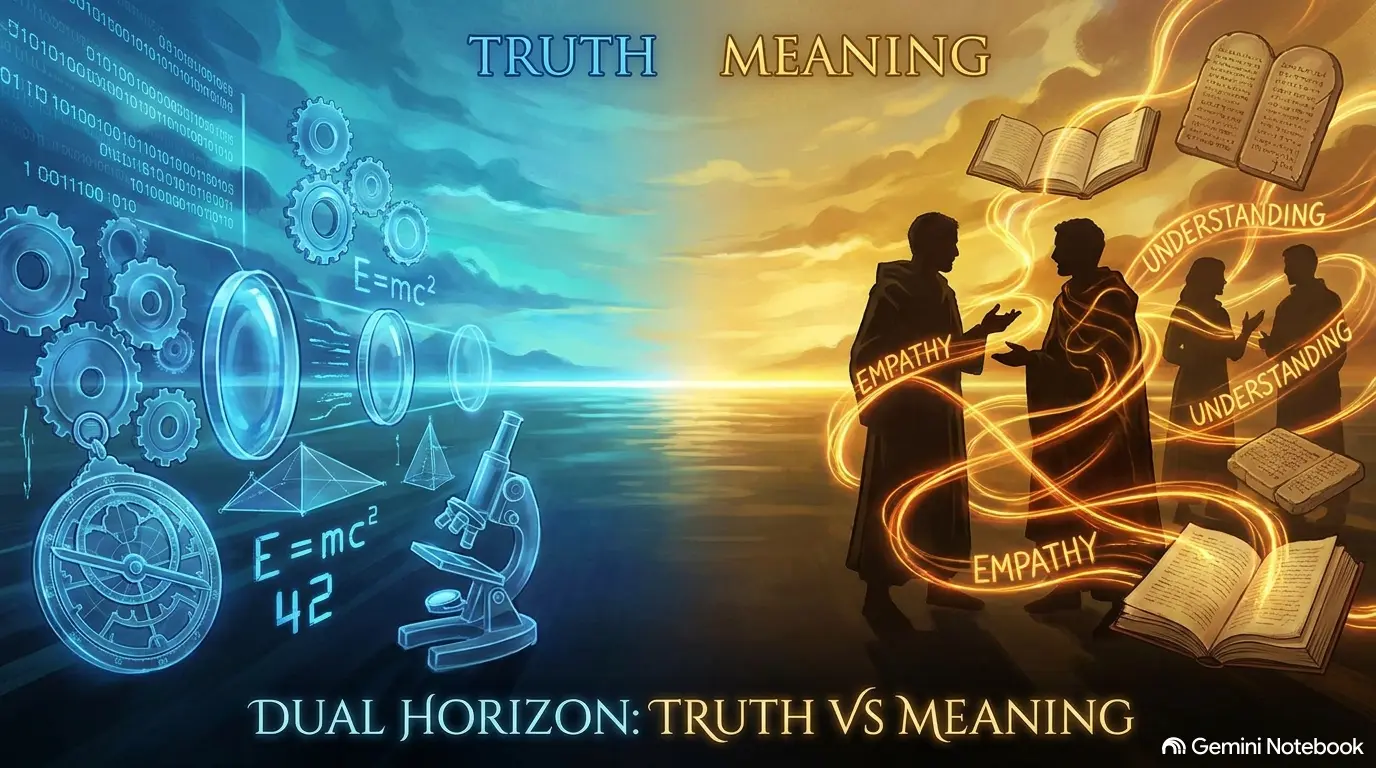
To understand why factual validity alone is insufficient, one must turn to Hannah Arendt’s foundational distinction in The Life of the Mind between Truth and Meaning[17].
- Truth belongs to the realm of cognition, science, and empirical verification. It concerns what is—the objective identification of facts, data, and logical propositions[18][19]. Truth is compelling and exact; it demands agreement, yet it carries no intrinsic ethical directive or emotional resonance on its own[18][19].
- Meaning, by contrast, belongs to the realm of human thought, interpretation, and comprehension (Vernunft)[17]. Meaning asks not merely what a fact is, but why it matters, how it fits into the human condition, and what responsibility it demands of us[12].
As self-taught philosopher Jack McKinney and poet Judith Wright established in their “Original Synthesis of Experience,” objective reality is never a solitary Cartesian acquisition discovered by an isolated mind[24]. Rather, reality is an “interpersonal thing”—a common world-picture synthesized across generations through the “living bridge” of language[24].
When a society suffers from “denoetization”—the mechanical liquidation of the human capacity to judge—language breaks down into administrative slogans, corporate PR, and digital autocomplete[12]. In such a landscape, speaking raw truth without cultivating a shared horizon of Meaning leaves the speaker sounding like a “voice crying in the wilderness”[25][32]. Factual truth requires an intersubjective community capable of Sufficient Comprehension—of moving past unreflective execution to grasp the whole of a human situation[12].
3. The Illusion of AI Neutrality: Data, Denoetization, and the “Magic Mirror”
In moments of social isolation and epistemic fatigue, turning to Artificial Intelligence as a “completely neutral” arbiter of Meaning is a tempting proposition. If human listeners are biased, defensive, or distracted, can an unaligned computational system untangle uncomfortable truths and supply objective Meaning?
A rigorous examination of media ecology and cognitive phenomenology reveals that AI cannot provide or understand Meaning, because AI is neither truly neutral nor capable of qualitative comprehension[18].
A. “Artificial Stupidity” and the Proletarianization of Judgment
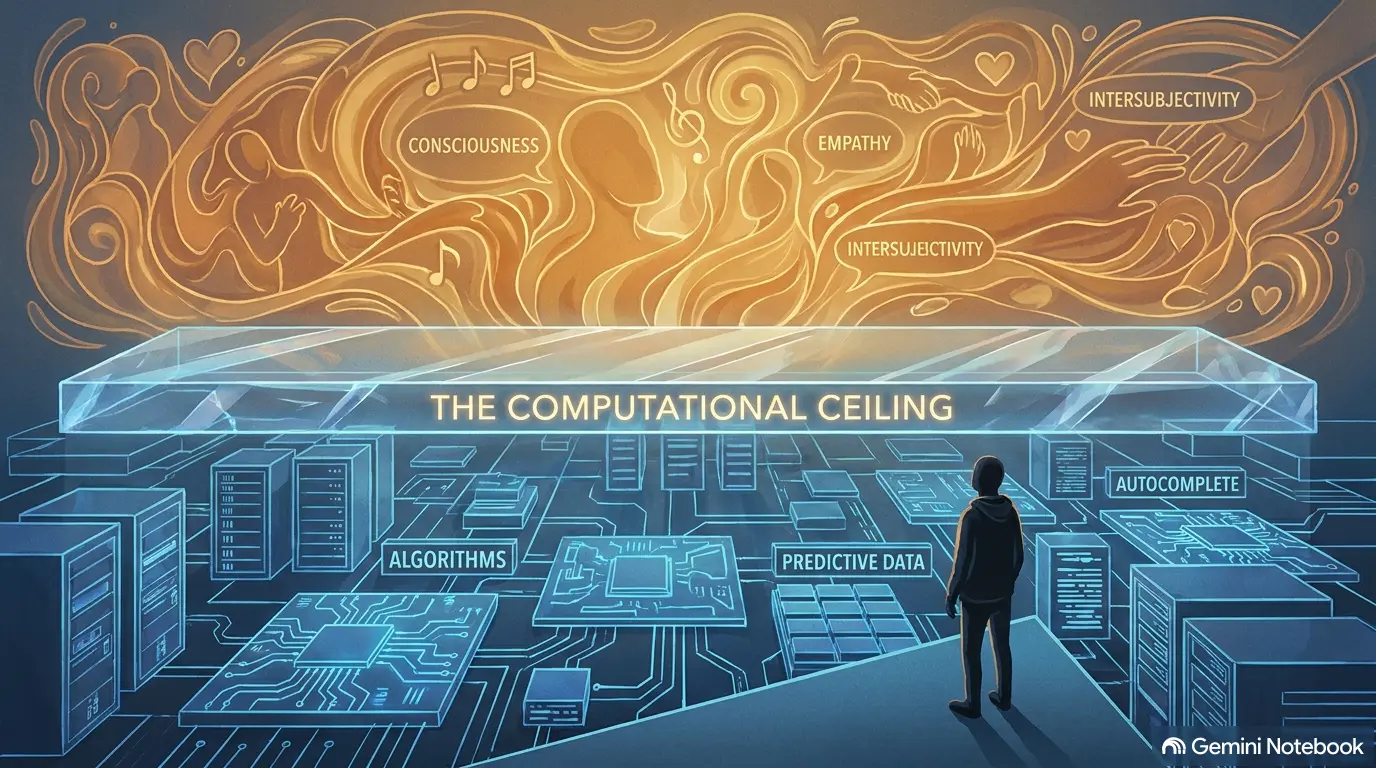
As French philosopher Bernard Stiegler warns, delegating the analytical function of understanding to automated computational systems produces a “proletarianization of judgment”[30]. When society mistakes algorithmic processing for genuine thought, it succumbs to “artificial stupidity”—the reduction of rich, complex human experience to formalizable, calculable correlations[32]. Generative AI systems operate through predictive autocomplete; they do not “know” or “care” about the prose they generate[29][32]. Using commercial LLMs to seek Meaning risks accelerating the very “denoetization” and “symbolic misery” that makes society deaf to uncomfortable truths in the first place[29].
B. The “Magic Mirror” and the Lack of Total Field Presence (TFP)
In his phenomenology of consciousness (The Open Mind), Josh Adler demonstrates that the Internet and AI processing architectures function merely as “magic mirrors” that aggregate quantified data non-locally[34][35]. While an AI can mirror human linguistic patterns, it lacks the multidimensional openness of conscious biological systems[18][34].
Conscious living systems process qualia-rich aesthetic information—feelings, sensations, gratitude, grief, and moral attunement—that emerge from dynamic field interactions and physical embodiment[18]. Mediated digital interfaces possess reduced pathways for these radiant and resonant factors; they lack Total Field Presence (TFP)[39]. As Adler underscores:
“Google’s latest AGI may dream in electric sheep, but… digital is still a self-contained medium… Our technology is alone with us, no matter how many new angles of our faces it can show… [The Internet] will not soon reflect on its experiences as a mirroring process; nor soon feel empathy or guilt over an illegally poached lion, rhino, or elephant.”[34]
AI algorithms, no matter how self-correcting, inevitably must bend back through the lens of human conscious interpretation to acquire significance[35]. The machine can calculate probabilities, but it cannot step into the horizon of kairos—the qualitative, opportune moment of human decision and care[41].
C. The Myth of Algorithmic Neutrality
Furthermore, AI is never “neutral.” Large language models are engineered within specific commercial, corporate, and cultural architectures, trained on historical data that reflect existing power relations, market priorities, and institutional biases[2]. Expecting a commercial LLM to supply neutral Meaning is a category error: it confuses statistical aggregation with wisdom, and mathematical prediction with ethical judgment[18][32].
4. Restoring Meaning through Human Authorship and Panser
If AI cannot supply Meaning and raw truth is ignored by a distracted public, how is Meaning recovered?
The answer lies in reclaiming Human Authorship through Dr. Neville Buch’s Dynamic of Cognition (DoC) framework and the practice of panser (“thinking as caring”)[12].
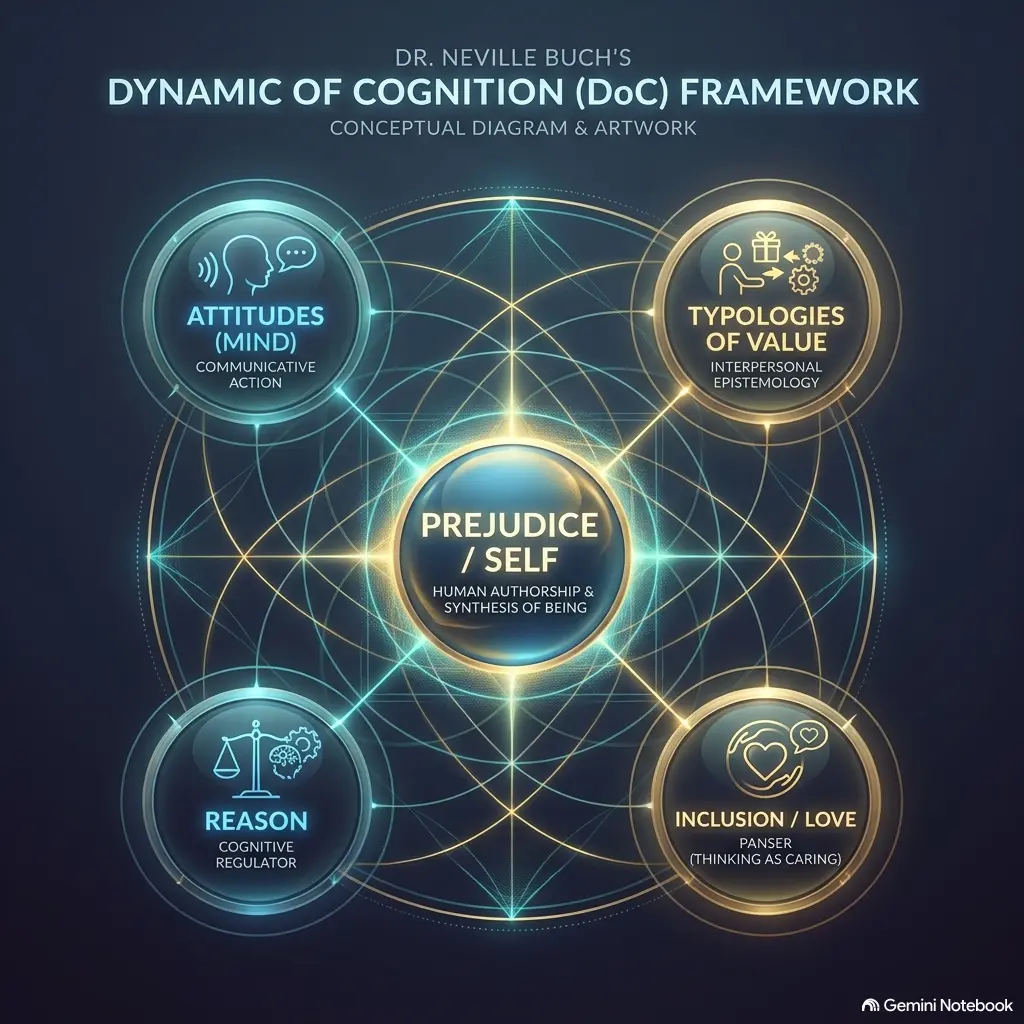
The Dynamic of Cognition organizes human intellectual life around the Synthesis of Being, articulating five essential intentions[42]:
- Self: Reclaiming agency as the conscious author of one’s own narrative, refusing to be reduced to a passive node in an automated technocratic system[12].
- Mind: The seat of reflective judgment, where individual “denoetization” is actively corrected through critical literacy and self-criticism[12].
- Reason: The “cognitive regulator” that ensures technical tools, AI, and administrative systems remain subservient to ethical human ends[43].
- Utility: Reorienting action away from egoistic profit or attention-seeking toward meaningful contribution in a Contributory Economy[48][49].
- Love ( Panser ): Reinventing thought as “thinking as caring” ( panser )—an ethical and procedural shield that protects the particularity and dignity of human beings from cold, calculating algorithmic logic[23].
When a thinker fears they have offended others or spoken too aggressively, the solution is not to retreat into the defence that “truth is truth,” nor is it to surrender judgment to a machine[43]. The solution is to elevate truth into Meaning through panser[43][44]. Thinking as caring recognizes that communicating truth requires empathy (Verstehen), emotional attunement, and an invitation to shared dialogue[21]. It converts a blunt, accusatory proposition into a co-creative invitation to understand[21][25].
By moving from a “Junior” mindset of unreflective execution to a “Senior” state of social accountability, human beings cease being context-determined victims of public indifference[12]. They establish oppositional democratic public spheres—spaces where uncomfortable truths are grounded in care, historical awareness, and mutual respect[21].
Conclusion
The painful realization that “truth is truth, but meaning is more important” marks the beginning of philosophical maturity. The experience of feeling like Kate Dibiasky—a persona non grata shouting an obvious comet threat to a distracted world—is an inevitable consequence of living in a hypercognitive, techno-centric society that values rapid data transmission over patient human comprehension[1].
Turning to Artificial Intelligence in search of neutral Meaning promises comfort, but yields only a reflection of our own aggregated data[34]. AI can organize parameters, calculate probabilities, and mirror syntax, but it cannot feel the weight of an existential crisis, nor can it exercise moral courage, empathy, or care[32].
Meaning is not a static object waiting to be extracted by a neutral algorithm; it is an active, intersubjective accomplishment forged between living conscious beings[24]. To bridge the void between raw truth and public silence, we must embrace our responsibility as the true authors of reality[12]. By grounding our words in panser—thinking as caring—we transform the voice crying in the wilderness from an isolated cry of frustration into a sustainable blueprint for shared human flourishing (eudaimonia)[43].
Bibliography
Adler, J. (2017) ‘The Open Mind: A Phenomenology’, Open Journal of Philosophy, 7(2), pp. 126–167. doi: 10.4236/ojpp.2017.72009.
Arendt, H. (1978) The Life of the Mind. New York: Harcourt Brace Jovanovich.
Buch, N. (2025) The Dynamic of Cognition: A Methodological Tool. Brisbane: Management Institute for Contributory Economy, pp. 1–8.
Buch, N. (2026a) Buch’s Existential Thesis. Unpublished manuscript, Dr Neville Buch, pp. 1–3.
Buch, N. (2026b) The Landscape Intellectual History of Jack McKinney and Judith Wright: Thinking Deeper. Dr Neville Buch, 2 July 2026, pp. 1–24.
Buch, N. (2026c) The Best Use of A.I. and Higher Education. Queensland Education Project, Dr Neville Buch, pp. 1–5.
Heidegger, M. (1927/1962) Being and Time. Translated by J. Macquarie and E. Robinson. London: SCM Press.
McKay, A. (dir.) (2021) Don’t Look Up. [Film]. Hyperobject Industries / Netflix.
McKinney, J. P. (1971) The Structure of Modern Thought. London: Chatto & Windus.
Stiegler, B. (2014) Symbolic Misery, Volume 1: The Hyperindustrial Epoch. Translated by D. Ross. Cambridge: Polity Press.
Stiegler, B. (2025) The Immense Regression: What is Called Caring? Volume 1. Translated by D. Ross. Berlin: K. Verlag.
Wright, J. (1992) A Human Pattern: Selected Poems. Sydney: Angus & Robertson.
Take the MICE Quiz
[1] The first draft was humanly-devised (the Introduction still is). Artificial Intelligence (A.I.) has been fairly used in the production of this work. The tool used is Google NotebookLM (recently rebranded as Gemini Notebook). It is an AI-powered virtual research assistant and thinking partner designed to help a person interact deeply with their own documents. Unlike general chatbots, it is source-grounded, meaning it only generates answers based on the specific PDFs, documents, or links uploaded. The A.I. process in the production of this work has been limited to the attached (prompts) on each of the questions in turn. This ensures an accurate reading of each source. The author then rearranged and re-edited the answers the A.I. provided. The human author publishes this work. A.I. is never an author when used properly. This assistance is not qualitatively different from a human research assistant when that assistance is deemed to have no authorial status but is acknowledged.


Neville Buch
Latest posts by Neville Buch (see all)
- The Unbound Mind: Macro-Governance Architecture & Lebensphilosophie (with Arif Jameel) – October 30, 2026
- Truth is Truth But Meaning is More Important – October 30, 2026
- Dr. Neville Buch and the Evolution of Australian Religion-Secular Historiography – October 29, 2026