

The “How Marketing Killed Genuine Human Communication” audio commentary on MICE’s Contributory Economy and Human Authorship:
Abstract
This essay critiques the systemic degradation of communicative discourse resulting from the triumph of modern marketing strategies and market fundamentalism. By prioritizing transactional exchange, market segmentation, and instrumental persuasion, marketing transforms human subjects into passive consumer-auditors, rendering society increasingly atomized, unreflective (“less comprehensive”), and indifferent (“less kind”)[1]. Examining the mechanics of this rhetorical “killing,” the paper reveals how marketing replaces dynamic, dialogical speech (sermo) with one-way promotional tactics, fear-based threat appeals, and decontextualized slogans[7]. In response, this paper formulates a restorative Personalist alternative: a message grounded in the irreducible dignity of the human person (esprit incarné), relational reciprocity (I-Thou), the logic of gift-relations, and grounded relationship quality[12]. Finally, the essay demonstrates why this message is urgent today—providing the intellectual scaffolding required to resist algorithmic “denoetization,” overcome historical forgetfulness, and defend active human authorship for genuine Aristotelian flourishing[17].
1. How Marketing Has Made Society Less Comprehensive and Less Kind
Throughout the twentieth and early twenty-first centuries, the discipline of marketing expanded from a managerial tool for distributing physical goods into an overarching social philosophy[6]. As market orientations colonized public discourse, higher education, healthcare, and civic governance, human society was restructured around the logic of the “exchange world”[1]. This structural shift has systematically coarsened human interaction, making society simultaneously less comprehensive (shallow, fragmented, and unreflective) and less kind (transactional, indifferent, and cynical)[3].
I. Degradation of Human Agency into Passive Audit (“Less Comprehensive”)
In a culture governed by traditional marketing orientations—whether product, selling, or consumer-centric models—the fundamental role offered to the human subject is that of a passive “receiver” or auditor[3]. Modern function systems operate on binary yes-or-no codes: buy or don’t buy, click or scroll, rate one-to-five stars[3]. This reduction of human choice to binary consumer responses eliminates the interpretive space where deep, critical reflection occurs[3][28].
When complex social, philosophical, and educational issues are forced through the apparatus of market research, target segmentation, and promotional packaging, their historical and conceptual context is stripped away[1]. Public education is reduced to narrow, “job-ready” vocational training, and scholarly inquiry is forced to justify itself through immediate economic utility or quantifiable metrics[1]. Deprived of historical depth and nuance, social discourse degenerates into superficial “nonsense fights” over pre-packaged binaries, leaving populations intellectually atomized and incapable of comprehensive systemic understanding[17].
II. Monetization and Decay of Mutual Care (“Less Kind”)
Concurrently, the encroachment of market logic into social relations erodes the capacity for genuine empathy and interpersonal kindness[25]. As Theodor Adorno observed in his critique of damaged life, when market principles govern personal life, even the act of giving presents degenerates into a calculated social function executed with “rational bad grace, careful adherence to the prescribed budget, [and] skeptical appraisal of the other”[25]. Market fundamentalism enforces the closed, self-interested scheme of do ut des (“I give so that you might give”) across all human domains[12].
When social interactions are framed strictly as commercial exchanges, relationships become contractual and conditional[14]. People are viewed not as unique, embodied subjects possessing inviolable dignity, but as functional instruments, target demographics, or potential competitors for scarce resources[7]. This structural instrumentalization breeds civic exhaustion, distrust, and indifference toward the vulnerable, as care is reframed as an inefficient financial burden rather than an essential human obligation[1].
2. How the Rhetorical “Killing” Works
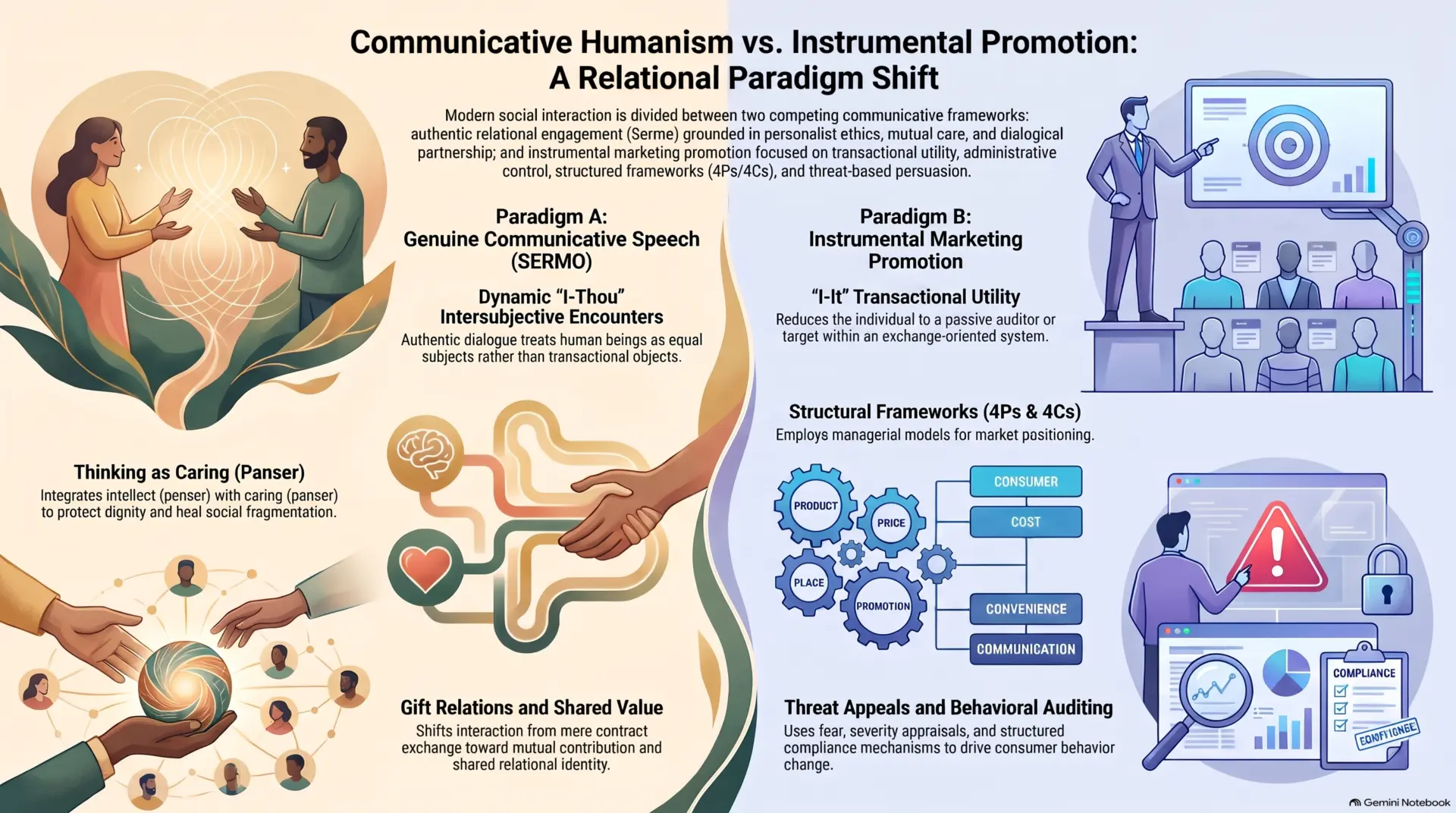
The rhetorical “killing” of the message occurs through a deliberate, systemic substitution: the replacement of genuine, transformative human speech (logos / sermo) with instrumental, one-way persuasive techniques designed exclusively to elicit behavioral compliance[6].
I. Displacing Sermo with Instrumental Persuasion
In Renaissance humanism and early Personalism, logos was understood not as a static, abstract proposition, but as sermo —dynamic, interpersonal conversation and eloquent dialogue[38][39]. The primary purpose of sermo is metamorphic: to move affections, cultivate moral integrity, expose double ignorance, and deepen mutual understanding between conscious subjects[39].
Marketing rhetorically kills this living message by re-engineering speech into an “inside-out” or “outside-in” delivery mechanism for transactional advantage[11][42]. Utilizing frameworks such as McCarthy’s 4Ps (Product, Price, Place, Promotion) or Lauterborn’s 4Cs (Consumer, Cost, Convenience, Communication), marketing treats language as a calculated stimulus intended to trigger an immediate, profitable response from target segments[6]. Communication is severed from truthfulness and subjective integrity, functioning instead as a tool for message management, brand positioning, and audience manipulation[8].
II. Fear Appeals, Threat Manipulations, and Message Fatigue
To achieve rapid compliance, social and commercial marketing frequently rely on threat appeals—deploying graphic physical threats, fear of social ostracism, or anxiety of loss to drive behaviour[9]. Psychological research demonstrates that while high-threat advertisements may capture fleeting attention, they frequently trigger defensive avoidance, message rejection, or “third-person effects,” where individuals perceive the message as relevant only to others rather than internalizing its moral substance[10].
Furthermore, the relentless saturation of mass media with promotional messages induces severe message fatigue[53]. When public communication is dominated by constant, repetitive appeals, recipients develop cognitive numbness and skepticism[50][53]. The message is “killed” because language loses its capacity to evoke genuine emotional resonance, moral seriousness, or reflective action, dissolving into background noise[50][53].
III. Commodification and Decontextualization
Finally, marketing kills the message by stripping ideas of their historical, philosophical, and material context, commodifying them into digital ephemera, catchphrases, and click-funnels[31]. Complex human struggles and ethical imperatives are co-opted as promotional aesthetics or corporate slogans[54]. When philosophy, care, or social justice is reduced to an online lifestyle survey or a promotional hashtag, the transformational power of the message is neutered, leaving behind only institutional mimicry and corporate compromise[31].
3. What is the Message to Create to Make Society More Comprehensive and More Kind?
To heal the fractures created by market fundamentalism, society requires a restorative message built on the core principles of Personalism, Care Ethics, and Grounded Relationship Quality[12].
I. Reclaiming the Human Person as Relational Subject (Person-in-Relation)
The foundation of the restorative message is the affirmation of “the human person adequately considered”[62]. Drawing on the Louvain personalist tradition of Louis Janssens and Joseph Selling, the human person must be recognized as an incarnate spirit ( esprit incarné )—an embodied, conscious subject who is fundamentally and irreducibly person-in-relation[15].
Human beings are neither isolated, utility-maximizing individuals (“outsiders of history”) nor entirely passive products of social systems (“dependent insiders”)[64]. The restorative message asserts that a person becomes fully human only in dialogical reciprocity with another—through the authentic I-Thou encounter[16]. By placing relationality prior to individualistic subjectivity, this message establishes that human value resides in our shared, vulnerable corporeal existence rather than in market productivity or consumer solvency[36].
II. Restoring Gift Relations and the Goodwill Market
To counteract the cynicism of the exchange world, the new message revives the logic of gift-relations and the Goodwill Market[12]. Following Emmanuel Levinas, the encounter with the suffering or vulnerable face of the other is a “saturated phenomenon” that cannot be calculated, commodified, or reduced to an object of market exchange[13].
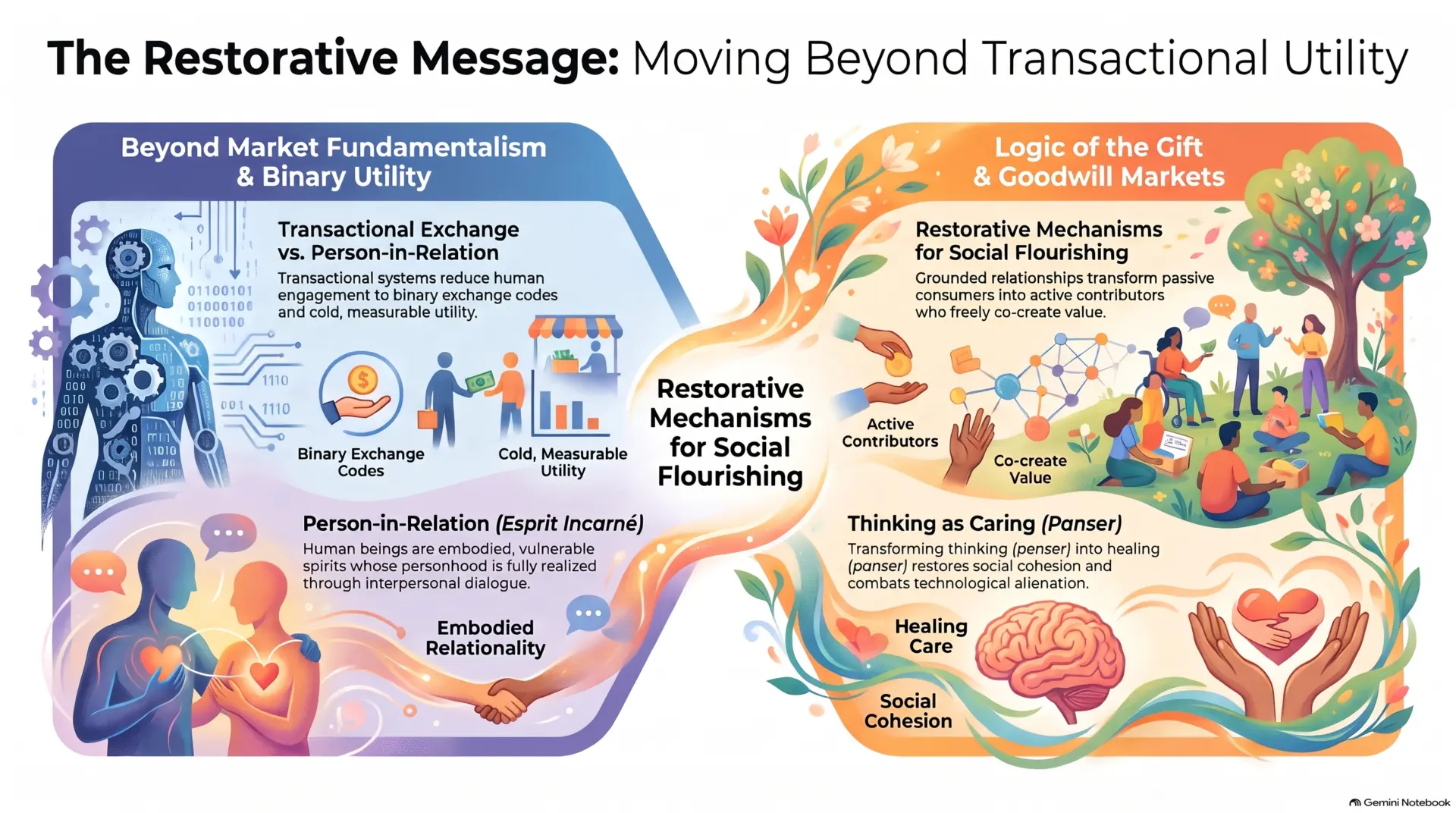
In contrast to commercial transactions that demand instant equivalence, a gift-relation creates a shared, intersubjective space where things become vehicles for genuine human communication[71][73]. In organizational and public life, this translates into fostering Grounded Relationship Quality—where individuals move from being passive “receivers” to active “givers” who contribute to a shared, co-owned community[14]. Loyalty and trust are not bought through promotional incentives; they emerge when people co-create and care for a shared world[14][74].
III. Practicing Panser: Thinking as Caring
Finally, the message must reframe intellectual discourse as an act of caring ( panser **)**[19]. Reinterpreting Bernard Stiegler’s concept, the thinker and communicator must act as a panseur—one who reinvents thought (penser) as a therapeutic practice to bind up and heal the wounds of fragmented social memory and civic alienation[19].
This requires adopting the Mind-Body-Cognition model, ensuring that discourse engages the whole person: aligning subjective interiority (Mind), somatic embodiment (Body), and rational discernment (Cognition)[52][75]. By employing diagnostic tools like the POLICE framework (Philosophically, Ontology, Logic, Intersect, Compatibility, Education), the restorative message dismantles ideological dogmas, fosters compatibilism over culture wars, and restores educational discourse as a lifelong, collaborative journey[75][76].
4. Why the Message is Important
Reclaiming the integrity of the message is not an academic exercise; it is an urgent requirement for preserving human dignity, moral agency, and democratic life in the twenty-first century[17].
I. Resisting Algorithmic “Denoetization”
As the Fourth Industrial Revolution and automated digital routines accelerate, human society faces unprecedented denoetization—the mechanical liquidation of the human capacity to reflect, evaluate, and exercise autonomous moral judgment[17]. When public and private communication is surrendered to automated algorithms, hyper-industrialized attention extraction, and the “altar of autocomplete,” individual consciousness is blinded, reducing the human subject to a passive, “puny human node” in a bureaucratic apparatus[17][77].
The Personalist message serves as a vital counter-strategy[18][79]. It insists that the human “who” must remain the proactive pilot of the technological “what,” ensuring that technological tools serve as prostheses for deep reflection rather than shortcuts that eliminate thought[19][80].
II. Eradicating Historical Forgetfulness and Restoring Human Authorship
Without a grounded, context-rich message, societies fall victim to Historical Forgetfulness—a state of collective amnesia induced by short-term marketing media that leaves populations vulnerable to cheap political propaganda and ideological manipulation[32][33]. Deprived of historical depth, public life degenerates into shallow, reactionary polarization[32][33].
The Personalist message restores Human Authorship—the uncompromising conviction that human beings are the intentional, creative authors of their lives, histories, and institutions[20]. It reminds us that while historical persons are context-embedded, they are never context-determined[19][20]. We possess the freedom, agency, and moral responsibility to write our own stories and shape our social structures[20][81].
III. Cultivating Inviolable Dignity and Aristotelian Flourishing (Eudaimonia)
Ultimately, the message is essential because it anchors social normativity in the inviolable dignity of the human person[70][82]. Care and respect are not external, transactional duties enforced by contract or market incentive; they are internal ethical calls that confirm our shared humanity[37][83]. By directing collective social energy away from quantifiable market utility and toward genuine Aristotelian flourishing ( eudaimonia ), the Personalist message preserves the public sphere as a sanctuary for moral reflection, compassionate care, and vibrant democratic life[19].
References / Bibliography
Adorno, T., 1991 . Minima Moralia: Reflections on Damaged Life. London: Verso. Cited in C. Hoevel, 2008. ‘Gift and Market Relations: A Personalist Approach’, Journal of Markets & Morality, 11(2), p. 1.
Blythe, J., 2002. Marketing Communication. Warszawa: PWE.
Buch, N., 2025a. 01. Personal History Workshop: What is Personal History. Brisbane: Dr Neville Buch and Sam Fiaalii.
Buch, N., 2025b. 04. Personal History Workshop: Perception and the Subject-Object Distinction. Brisbane: Dr Neville Buch.
Buch, N., 2025c. An Open Letter for Equity. Brisbane: Dr Neville Buch and Management Institute for Contributory Economy (MICE).
Buch, N., 2025d. Personal Intellectual History of Queensland (Chapter 4). Brisbane: Dr Neville Buch.
Buch, N., 2025e. The Worldview of Personalism: How We Got to the Misunderstanding of ‘Persons’. Brisbane: Management Institute for Contributory Economy (MICE).
Buch, N., 2026a. The Crucible of Consciousness: Historiography and the Genesis of Reforming Thought. Brisbane: Neville Buch and Management Institute for Contributory Economy (MICE).
Buch, N., 2026b. Notes on Bengtsson. Personal Unity-in-Diversity. Brisbane: Dr Neville Buch.
Corwin, S., 2026. The Hall of Mirrors: A Critique of Neville Buch’s Contributory Economy. Seattle: Sardonic Review Press.
Erasmus, D., 1519. Novum Testamentum Omne. Basel: Johann Froben. Cited in N. Buch, 2026a. The Crucible of Consciousness, p. 72.
Hernik, J. and Dziadas, A., 2026. The Effectiveness of Social Campaigns in the Eyes of Their Receivers, on Campaigns Promoting Safe Driving Example. Szczecin: West Pomeranian University of Technology.
Hoevel, C., 2008. ‘Gift and Market Relations: A Personalist Approach’, Journal of Markets & Morality, 11(2), pp. 1–20.
Janssens, L., 1998. ‘Personalism and Care’. In: L. Vanlaere and C. Gastmans, 2011. ‘A Personalist Approach to Care Ethics’, Nursing Ethics, 18(2), pp. 164–166.
Kotler, P., 1980. Principles of Marketing. Englewood Cliffs, NJ: Prentice-Hall.
Lauterborn, R.F., 1990. ‘New Marketing Litany: Four Ps Passé; C-Words Take Over’, Advertising Age, 61(41), p. 26.
Levinas, E., 1969. Totality and Infinity: An Essay on Exteriority. Pittsburgh: Duquesne University Press. Cited in C. Hoevel, 2008. ‘Gift and Market Relations’, p. 3.
Lewis, I. and Watson, B., 2007. Examining the Effectiveness of Physical Threats in Road Safety Advertising. Brisbane: Centre for Accident Research and Road Safety – Queensland (CARRS-Q).
McCarthy, E.J., 1960. Basic Marketing: A Managerial Approach. Homewood, IL: Irwin.
McKenzie, G., 2022. ‘A Thomistic Personalist Approach to Social Structure’, American Maritain Association Annual Meeting, pp. 1–16.
Pinder, D., 2026. ‘In a World Run by Function Systems’, Aargh! Substack Publication, pp. 1–6.
Selling, J., 1998. ‘The Human Person’. In: B. Hoose, ed. Christian Ethics: An Introduction. London: Cassell, pp. 95–109.
Stiegler, B., 2025. The Immense Regression: What is Called Caring? (Vol. 1). Berlin: K. Verlag. Cited in N. Buch, 2026a. The Crucible of Consciousness, pp. 10, 23.
Szakolczai, A., 2000. Political Anthropology. Routledge. Cited in N. Buch, 2025e. The Worldview of Personalism, p. 7.
Vanlaere, L. and Gastmans, C., 2011. ‘A Personalist Approach to Care Ethics’, Nursing Ethics, 18(2), pp. 161–173.
Wikipedia, 2026a. Marketing. Wikimedia Foundation.
Wikipedia, 2026b. Message. Wikimedia Foundation.
******


Neville Buch
Latest posts by Neville Buch (see all)
- The “Why Tech Makes Us Fear Forgetting” audio commentary and Comparative Analysis of Memory, Trauma, and Cultural Ideology in Unforgettable (2017), Unforgettable (US TV), and Unforgotten (UK TV): – October 27, 2026
- Marketing Killed the Message: Reclaiming Relational Dignity in an Age of Transactional Utility – October 27, 2026
- The Road to Home. A Re-Narrativization of The Story of Resilience Part 7 – October 26, 2026