
Dr Neville Buch
Abstract
This review assesses The American Crisis by the writers of The Atlantic from the perspective of the Management Institute for Contributory Economy (MICE). While the anthology provides an urgent diagnosis of a country in chaos, characterizing the “Age of Trump” as a radical departure from constitutional norms, this Australian assessment argues that the work’s primary value lies in its inadvertent mapping of “denoetization”—the mechanical liquidation of human judgment. By examining the book through the lens of Spiral Historiography, we reveal that the American pathologies identified—racial division, the devaluation of truth, and the rise of autocracy—mirror the “Historical Forgetfulness” and intellectual stasis seen in Australian regional history, particularly the “Queensland Character” myth. Ultimately, this review contends that a recovery from such a crisis requires more than just a return to “metaphorical” checks and balances; it demands a “Personal Breakout” toward Communicative Rationality and the restoration of Human Authorship over technical and social systems.
The American Mirror: An Australian Review of The American Crisis
1. Diagnosing the “Immense Regression”
The writers of The Atlantic have compiled a series of “timely, often prophetic” articles that frame the contemporary United States as a nation “falling apart”. From an Australian scholarly perspective, this “crisis” is a textbook case of what Dr. Neville Buch terms the “Academic Immense Regression”. Contributors like Ed Yong and Anne Applebaum describe a systemic collapse where “emergencies expose pathologies years in the making”. This aligns with the MICE diagnosis of “denoetization,” where the pressure of automated technical systems and unreflective bureaucratic governance leads to a state of “absolute non-knowledge”. The American experience of the pandemic and political dysfunction serves as a global pharmakon—a warning of how easily a society can forget its historical and ethical bearings.
2. The Buckleyan Passageway and the Paranoid Style
A critical theme in the anthology is the unique threat posed by Donald Trump and the “politics of fear”. However, Dr. Buch’s “Mark 2” American Revivalist Tradition model provides a deeper historical context that the anthology occasionally overlooks: the role of William F. Buckley Jr. as the intellectual “passageway” between traditional conservatism and modern populism. While The Atlantic focuses on Trump’s “radical” nature, the MICE framework recognizes this as part of a recurring cycle of collapse tracked back to the “Paranoid Style” identified by Richard Hofstadter. The American indictment of modern education and the rise of the “techné mindset”—which prioritizes “job readiness” over humanistic inquiry—has been exported to Australia, contributing to our own “humanities in crisis”.
3. Metaphors of Rule and the Queensland Parallel
David Frum’s seminal essay, “How to Build an Autocracy,” correctly identifies that constitutional checks and balances are a “metaphor, not a mechanism”. This resonates strongly with the history of the Nationalist regime in Queensland (1971–1989), which utilized the “Queensland Character” myth to bypass critical scrutiny and maintain a state of Historical Forgetfulness. Just as Frum warns that autocracy is built through the “slow, demoralizing process of corruption and deceit,” Queensland’s history shows how “bullying voices” can keep certain stories hidden to resist liberal influences. The anthology’s Section IV, “Becoming Citizens Again,” mirrors the MICE mandate for a “reflective ascent” to ensure the “who” (the human person) remains the master of the “what” (the political system).
4. Beyond Symbolic Misery: The Path to Recovery
The anthology concludes with a call for recovery and a return to national character. However, a truly “Balanced and Comprehensive” response requires more than just optimism; it requires “Sufficient Comprehension” and the uncoiling of repetitive errors. The path forward must bridge the “Analytical Abyss” where thoughts are disconnected from meaningful action. Drawing on the legacy of Australian thinkers like Jack McKinney and Judith Wright, who rebelled against the “senseless division of hearts and minds,” we must move from a “Junior” mindset of compliance to a “Senior” state of social accountability.
Conclusion
The American Crisis is a vital documentary of a civilization at a pivot point. For Australian readers, it serves as a mirror reflecting the dangers of adopting foreign “ideological patches” without critical reflection. By synthesizing the anthology’s insights with the Dynamic of Cognition (DoC), we can transform this “American crisis” into an opportunity for a “Personal Breakout,” reclaiming Human Authorship and directing our shared future toward Aristotelian flourishing.
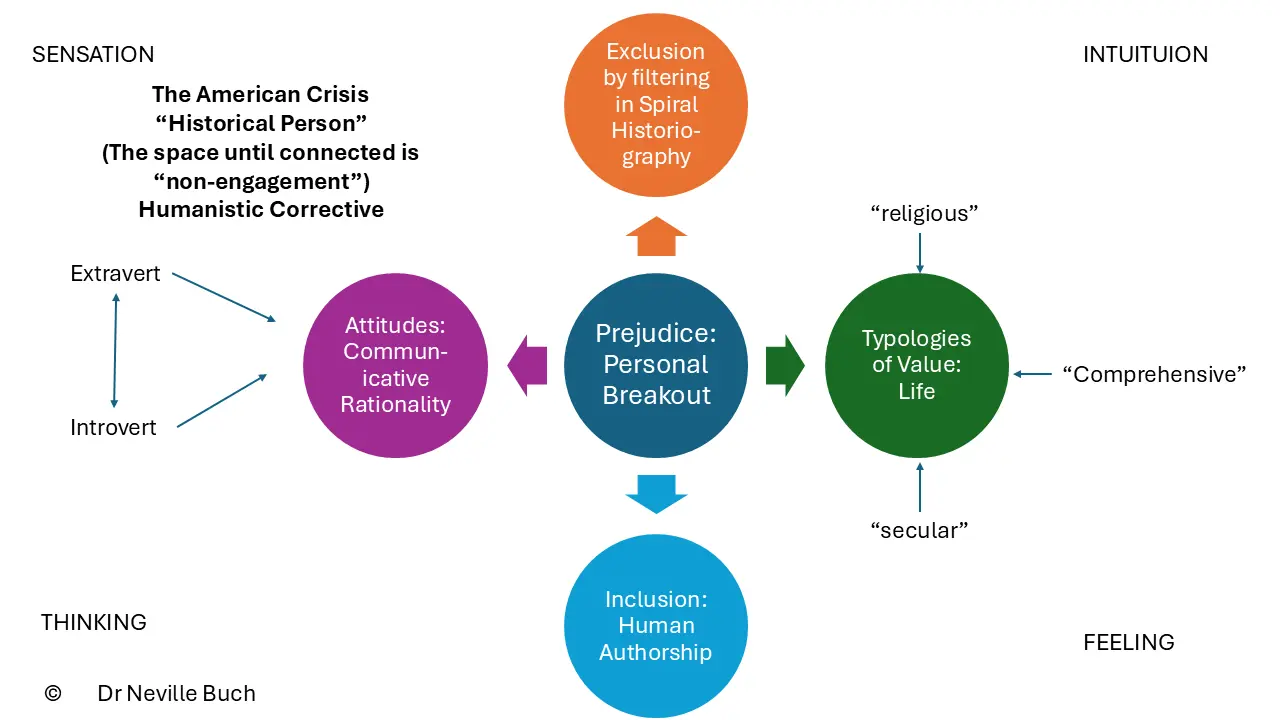
Dynamic of Cognition (DoC) Table: Denoetization and the American Mirror
The following table maps the cognitive movement from the pathologies of the contemporary United States, as diagnosed in The American Crisis, toward the “post-post-postmodernist” correctives proposed by the Management Institute for Contributory Economy (MICE).
| DoC Component | Pathological Regression (The American Crisis) | Humanistic Corrective (MICE Review) | Philosophical Rationale |
| Prejudice (Centre) | Techné Mindset: Reducing systemic collapse to problems of “job readiness” and quantifiable data. | Personal Breakout: Recognizing the crisis as a contingent historical event requiring active human choice. | Shifting from the “search for certitude” and mechanical routine to proactive choices based on logic. |
| Attitudes (Thinking) | Politics of Fear: Utilizing “singular messaging” and strategic manipulation to enforce institutional agendas. | Communicative Rationality: Engaging in rational-critical dialogue aimed at mutual understanding (Verständigung). | Replaces strategic manipulation and “Political Profit” with intersubjective mutuality. |
| Exclusion (Sensation) | Historical Forgetfulness: Banishing the origins and struggles of core concepts from communal memory. | Spiral Historiography: “Uncoiling” repetitive patterns of failure and “crap detecting” manufactured myths. | Reveals manufactured “natural facts” as contingent historical constructions. |
| Inclusion (Intuition) | Denoetization / Symbolic Misery: The mechanical liquidation of the human capacity to judge under technical pressure. | Human Authorship: Restoring the person as the proactive and intentional author of their shared social existence. | Restores the “who” (the human being) as the master of the “what” (technical and social systems). |
Philosophical Rationale Summary
The review identifies the American crisis not merely as a political failure but as a textbook case of the “Academic Immense Regression”. By framing the current “Trumpocene” through the techné mindset, society has substituted vocational fitness for human agency, leading to a state of absolute non-knowledge. The MICE framework utilizes Spiral Historiography to uncoil these repetitive patterns of error, moving the citizen from a “Junior” mindset of docile compliance to a “Senior” state of social accountability and Sufficient Comprehension. Ultimately, the goal is to bridge the “Analytical Abyss” to ensure that the individual remains the master of the technical and social systems they inhabit, directed toward Aristotelian flourishing.
Featured Image: American-Exceptionalism-Modernism



Neville Buch
Latest posts by Neville Buch (see all)
- Thank you, Richard: Knowing the message but then acting – October 8, 2026
- The Desiccation of the Common Well: Identity Politics, Algorithmic Assessment, and the Crisis of Adult Responsibility – October 6, 2026
- Academic Rigour, Epistemic Renewal, and the Crisis of Inquiry: A Scholarly Review of the Vanderbilt Commission Report on the State of Scholarship – October 5, 2026