
Dr Neville Buch[1]
Abstract
In the contemporary educational landscape, the challenge of teaching values and virtues is often reduced to either didactic moralism or technocratic efficiency. This essay explores the synergy between Kåre S. Fuglseth’s (2026) theory of narrative reenactment and Dr. Neville Buch’s application of religion/non-religion frameworks in educational theory.
Fuglseth argues that values and virtues are grounded in the phenomenological lifeworld and can only be truly understood through sequential, polythetic narratives. This aligns with Buch’s Spiral Historiography, which seeks to remediate “historical forgetfulness” by recursively returning to past intellectual struggles to “uncoil” repetitive errors.
Fuglseth argues that values and virtues are fundamentally narrative in structure and can only be understood through a phenomenological “reenactment” of the past’s future. This perspective provides a profound theoretical complement to Dr. Buch’s foundational axiom that “understanding history is philosophy in practice”. By aligning Fuglseth’s critique of didactic moralism with Buch’s remediation of the “techné mindset,” the analysis reveals a shared commitment to restoring human authorship over social and technical systems. Central to both frameworks is a rejection of linear teleology in favour of a recursive, spiral-based engagement with historical contingency to facilitate Aristotelian flourishing (eudaimonia).
Fuglseth’s central thesis—that values and virtues can only be fully understood through narratives—provides a robust philosophical rationale for Buch’s “Thinking Historiographically” model. By acknowledging that “the past was once future” and that historical actors operated within open horizons of choice, both scholars reject a deterministic or “mechanically determined” view of history. Instead, they advocate for a humanistic ascent where the “Historical Person” moves from a “Junior” state of unreflective execution to a “Senior” state of social accountability. Utilizing the Dynamic of Cognition (DoC), the analysis demonstrates how the reenactment of values serves as an “intellectual immune system,” uncoiling repetitive patterns of “Historical Forgetfulness” to achieve “Sufficient Comprehension” and Aristotelian flourishing.
This essay investigates the conceptual synthesis between Kåre S. Fuglseth’s (2026) theory of narrative reenactment and Dr. Neville Buch’s general methodology of intellectual renewal. By synthesizing Fuglseth’s reenactment model with Buch’s Dynamic of Cognition (DoC), this study argues for a “pedagogy of choice” that restores Human Authorship over moral and spiritual narratives, moving beyond the blunt binaries of the religious and the secular toward Planetary Wisdom.
Reenacting the Future: Fuglseth’s Narrative Values and Buch’s Spiral Historiography
I. The Polythetic Foundation of Value Cognition
A central tension in modern education is the “bipolarization” between educare (training/imprinting) and educere (leading out/critical inquiry). Fuglseth addresses this by asserting that values like “equality” or “solidarity”—often cited in educational acts—are abstract nouns that refer to independent aspects of a whole action. To the “ignorant” or the newcomer, these concepts have no substance until they are experienced through a polythetic grasp—a step-by-step narrative structure of experience. This mirrors Dr. Neville Buch’s critique of “simplistic literalism,” where truth is treated as a static collection of dogmas rather than a “living disclosure” earned through participation. Within Buch’s Dynamic of Cognition (DoC), Fuglseth’s narrative approach provides the necessary “raw materials” of culture to move the student from unreflective Prejudice toward an investigative Attitude.
II. Reenactment as a Corrective to Historical Forgetfulness
Fuglseth identifies reenactment—remodelling or re-creating the past with an open horizon—as the essential method for teaching values without falling into shallow moralism. This procedural necessity finds its structural counterpart in Buch’s Spiral Historiography. Buch argues that contemporary education suffers from an “immense regression” or “denoetization”—the mechanical liquidation of human judgment caused by a “techné mindset”. By adopting a “space-time movement forward and backward,” the spiral allows the mind to reach into the past to correct “widely-believed falsehoods”. Fuglseth’s reenactment is the mechanism of this spiral; it recognizes that “the past was once future” and that individuals in history, like students today, possess the capacity for natality—the miracle of beginning something new.
III. Dissolving the Religion/Non-Religion Binary
Both Fuglseth and Buch seek to move beyond the “blunt categories” of the religious and the secular. Fuglseth notes that values in the Norwegian Education Act are derived from both “Christian and humanist heritage,” yet they function similarly as headings for narratives of action. Buch deepens this by proposing “Philosophical Compatibilism,” where a person of faith can be “simultaneously rational, skeptical, and humanist”. In this framework, the “problem of religion” is not its disappearance, but its re-anchoring in place and context—a “topological turn” that recognizes meaning as realized in rebus (in the thing itself). Fuglseth’s emphasis on the lifeworld phenomenology of subjective time provides the technical syntax for this re-anchoring, ensuring that the sacred is understood not as a static dogma but as a relational dialogue.
IV. Toward Human Authorship and Planetary Wisdom
The ultimate goal of synthesizing these theories is the restoration of Human Authorship, where the “who” (the person) remains the proactive operator of the “what” (the system). Buch utilizes the radical pedagogies of Paulo Freire and Ivan Illich to advocate for an “inversion” of institutions—moving from manipulative “school rituals” to convivial “learning webs”. Fuglseth’s narrative-based education supports this by fostering “learner agency” and “disciplined dissidence,” where growth is an immeasurable recreation rather than a quantified metric. This cognitive achievement culminates in Planetary Wisdom, a synthetic, pluralistic understanding of reality that arises from a “dialogue of myths” and a commitment to “co-humanity”.
The Narrative Spiral: Reenacting Values as Philosophy in Practice
The contemporary educational landscape is frequently diagnosed as suffering from an “immense regression”—a state of “denoetization” where the human capacity for judgment is liquidated by automated technical and bureaucratic routines. In response, both Kåre S. Fuglseth and Dr. Neville Buch propose a return to the historical grounds of cognition to recover the ethical dimensions of human life. While Fuglseth focuses on the narrative essence of virtues, Buch provides the structural Dynamic of Cognition (DoC) to map the ascent from unreflective prejudice toward comprehensive wisdom.
1. Values as Narrative vs. The Techné Mindset
Fuglseth’s primary contribution is the assertion that values like justice, equality, or solidarity cannot be understood as abstract labels or “monothetic” headings. Instead, they represent aspects of actions that must be experienced as a polythetic structure—a sequential flow of subjective time. This mirrors Buch’s critique of the “techné mindset” in governance and education, which reduces human potential to “measurable utility” and “vocational fitness”.
Where modern policy treats education as a mechanical routine of data access, Fuglseth and Buch insist on the “thick ethical concepts” that link judgment to concrete reality. Fuglseth argues that because concepts are not instructive in themselves, students must “reenact” the past to grasp the internal motivations of historical actors. This aligns with Buch’s use of Spiral Historiography, which recursively returns to past intellectual struggles to “uncoil” repetitive patterns of error—the “Spiral History Theory of Stupidity”.
2. Reenactment and the Dynamic of Cognition
Both scholars draw heavily upon the English philosopher Robin G. Collingwood, particularly his theory of historical reenactment. Fuglseth interprets reenactment as a phenomenological reestablishment of the relevance structures of core values. Within Buch’s DoC framework, this process facilitates the move from Exclusion (the filtering out of complexity in favour of “official stories”) toward Inclusion (the systematic act of encompassing meaning and cultural history through empathy).
By treating the past as a site where individuals had “open horizons” of choice, Fuglseth’s motto that “the past was once future” provides the temporal engine for Buch’s recovery of Human Authorship. When learners realize that the historical person was a proactive meaning-maker rather than a “passive conduit” for social drives, they reclaim the capacity for Reflective Self-Criticism.
3. Avoiding Didactic Moralism through Historical Truthfulness
A significant synergy exists in their shared warning against “didactic moralism” or “scissors-and-paste” fact-gathering. Fuglseth suggests that teaching values through contemporary social conflicts is often less effective than choosing subjects derived from the past, which allows for a more rigorous, less reactive inquiry. Buch operationalizes this through “crap detecting”—the systematic filtering out of manufactured myths, such as the “Queensland character,” which are often used to conceal uncomfortable historical truths.
This commitment to historical truthfulness ensures that the “who” (the human being) remains the proactive operator of the “what” (the technical and social systems). Rather than producing narrow technocrats, this educational theory aims to establish “oppositional democratic public spheres” where students are agents of praxis, capable of transforming social reality.
The Path to Aristotelian Flourishing
The ultimate goal of relating Fuglseth’s narrative reenactment to Buch’s general theory is the achievement of Aristotelian flourishing (eudaimonia). Fuglseth identifies this with the Aristotelian virtue of phronesis—the ability to act wisely based on practical knowledge. In Buch’s schema, this is the final standard of success, reached through the Synthesis of the Five Intentions: Self, Mind, Reason, Utility, and Love.
By adopting the intellectual discipline of “panser” (thinking as caring), the educated person tends to the social wounds of Historical Forgetfulness. Together, Fuglseth and Buch provide a robust methodological immune system for the twenty-first century, asserting that the only way to re-author a just future is to truthfully and narratively engage with the contingent foundations of our past.
The Past as a Site of Reenactment: Narrative Understanding
Kåre S. Fuglseth posits that values and virtues are not abstract constants but are “headings to stories” that denotes specific types of action. This perspective aligns with Dr. Neville Buch’s sharp distinction between “folk history”—which focuses on cherished heritage—and professional history, which utilizes analytical perspectives to provide “narrative explanations” of the past. Fuglseth argues that because values are “dependent parts” of a whole action, they can only be understood through a “polythetic” structure: a sequence of lived experiences that carries a horizon of both the past and the future.
Buch carries this insight into his Spiral Historiography, rejecting the idea of history as a closed, repetitive loop. For Buch, the goal is to “uncoil” patterns of failure by recursively returning to past intellectual struggles. This recursive return is a form of Fuglseth’s “reenactment”—the process of re-modelling or re-creating historical figures with an imagination that acknowledges they, too, faced an unknown future. By recognizing that historical actors were the “authors of reality,” modern citizens can reclaim their own “Human Authorship” over contemporary technical and social systems.
Overcoming the Abyss: Verstehen and Social Accountability
A core barrier to understanding in both frameworks is what Buch terms the “techné mindset” and Fuglseth identifies as “didactic moralism”. The techné mindset reduces multi-textured human existence to quantifiable metrics and “singular messaging,” leading to a state of “denoetization”—the mechanical liquidation of the human capacity to judge. Fuglseth’s corrective is the application of Verstehen (Empathetic Understanding), which involves “tuning in” to the internal meanings and intentions of others to achieve a Gadamerian “fusion of horizons”.
This empathetic turn is foundational to Buch’s concept of “thinking as caring” (panser), where the scholar tends to the wounds of social fragmentation with empathy and historical truthfulness. By treating history as “philosophy in practice,” the individual undergoes a transition from a “Junior” state of unreflective habit toward a “Senior” state of social accountability. This transition requires moving beyond “Historical Forgetfulness”—the systemic pathology where a population banishes the context of its own intellectual bearings—and integrating the lessons of the past into ethical decision-making.
Synthesis: The Dynamic of Cognition and Eudaimonia
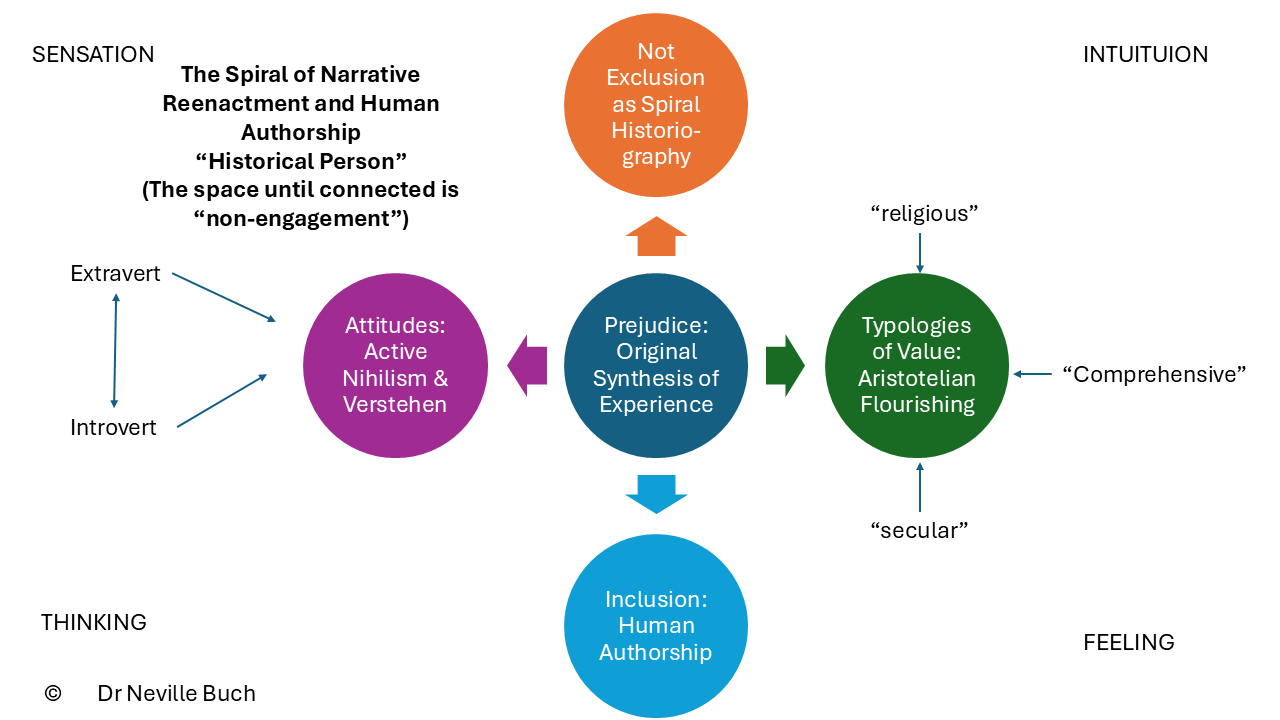
The relationship between these two historiographies is best illustrated through the Dynamic of Cognition (DoC) table. Fuglseth’s emphasis on the narrative nature of virtues provides the “Original Synthesis of Experience” required at the centre of the model: recognizing knowledge as an interpersonal, social product rather than a solitary acquisition.
Ultimately, the goal of this synthesis is Aristotelian Flourishing (eudaimonia), defined as a life of virtuous action and meaningful contribution to the common good. By applying the principle that “the past was once future,” society can move away from a “habitual centre” of despair and repetitive error toward Sufficient Comprehension—the ability to see the whole of a matter while remaining permanently open to correction.
DoC Table: Reenactment as a Historiographical Corrective
| DoC Component | Pathological Regression (Forgetfulness/Techné) | Reformatory Ascent (Reenactment/Spiral) | Rationale for Convergence |
| Prejudice (Centre) | Historical Forgetfulness: Treating the past as static, neutral data sets. | Original Synthesis of Experience: Viewing the past as a field of open horizons and human agency. | Recognizes knowledge as an interpersonal product synthesized over generations. |
| Attitudes (Thinking) | Techné Mindset: Prioritizing narrow utility and “measurable” readiness. | Active Nihilism & Verstehen: Using empathy and reason to negate manufactured myths. | Replaces mechanical reductionism with noetic judgment and caring (panser). |
| Exclusion (Sensation) | Denoetization: The liquidation of judgment under technical pressure. | Spiral Historiography: “Uncoiling” repetitive errors through historical accountability. | Uses community pain as a diagnostic signal to filter out “institutional bullshit”. |
| Inclusion (Intuition) | Puny Human Nodes: Individuals as passive conduits for interaction rituals. | Human Authorship: Reclaiming the role of the proactive creator of meaning. | Restores the “who” (the person) as the master of the “what” (the system). |
| Value (Feeling) | Simplistic Utility: Measuring success by private accumulation and status. | Aristotelian Flourishing: Success measured by dignity, wisdom, and character (eudaimonia). | Fulfillment is found in Sufficient Comprehension and virtuous social action. |
Bibliography
Arendt, H. (1958). The human condition. University of Chicago Press.
Arendt, H. (1977). The life of the mind (M. McCarthy, Ed.). Harcourt Brace Jovanovich.
Bengtsson, J. O. (2006). The worldview of personalism: Origins and early development. Oxford University Press.
Buch, N. (2015). No regrets in the evening of life: The history of Junction Park State School (1888–2013). Salisbury, QLD: Boolarong Press.
Buch, N. (2024). The spiral history theory of stupidity: Getting stuck in time-space, and personal breakout of historical cognition patterns. Management Institute for Contributory Economy.
Buch, N. (2024). Rethinking School: Historical Forgetfulness and Educationalist Theory 1971-1989. Management Institute for Contributory Economy.
Buch, N. (2026). Thinking Religion in Place: Religion is not what it was. Management Institute for Contributory Economy.
Buch, N. (2026, April 10). Understanding history is philosophy in practice: A cognition history of Queensland. Management Institute for Contributory Economy.
Buch, N. (2026, June 15). Spiral historiography and the dynamic of cognition (Revised Final). Management Institute for Contributory Economy.
Buch, N. (2026). DRAFT Transference: Character and the contributory economy. Management Institute for Contributory Economy.
Buch, N. (2026). Statement on the state of affairs in Queensland. Management Institute for Contributory Economy.
Freire, P. (1970). Pedagogy of the Oppressed. Seabury Press.
Fuglseth, K. S. (2026). The past was once future: Reenactment of values and virtues on historical grounds in education. [Source 52].
Husserl, E. (1976). Ideas: General introduction to pure phenomenology. London: Allen & Unwin.
Illich, I. (1971). Deschooling Society. Calder & Boyars.
Schütz, A., & Luckmann, T. (1973). The structures of the life-world (Vol. 1). Northwestern University Press.
Spiral Historiography and the Pedagogy of Consciousness in Australia (2026). Academic Synthesis.
Taylor, C. (2007). A Secular Age. Harvard University Press.
Williams, B. (2006). Philosophy as a humanistic discipline (A. W. Moore, Ed.). Princeton University Press.
[1] Artificial Intelligence (A.I.) has been fairly used in the production of this work. The tool used is Google NotebookLM (recently rebranded as Gemini Notebook). It is an AI-powered virtual research assistant and thinking partner designed to help a person interact deeply with their own documents. Unlike general chatbots, it is source-grounded, meaning it only generates answers based on the specific PDFs, documents, or links uploaded. The A.I. process in the production of this work has been limited to the attached (prompts) on each of the questions in turn. This ensures an accurate reading of each source. The author then rearranged and re-edited the answers the A.I. provided. The human author publishes this work. A.I. is never an author when used properly. This assistance is not qualitatively different from a human research assistant when that assistance is deemed to have no authorial status but is acknowledged.


Neville Buch
Latest posts by Neville Buch (see all)
- From Augustine’s Pears to Academic Boycotts: Fundamental Sociological Change in Australian Cultural Relations – October 11, 2026
- Yes, I want Anger Expressed But Then Resolved – October 11, 2026
- Part 3:The Failure of an Educational Institution and How to Spiral Forward – October 10, 2026