
Table of Contents
Dr Neville Buch
Not Knowing and Knowing
Abstract. Perennially in the global intellectual history is the Orthodoxy of Coercion, where both the individual and the collective have had to deal with the “power-over”: command, coercion, and domination. In the last few centuries, it has been existentialism, and in detail: existential thought, which has been the most effective counter. More recently cognition sociology and cognition history has come to the fore, filling the gap against the modern critiques of existentialism. Boaventura de Sousa Santo’s Epistemologies of the South (2014) is an important example. Nevertheless, these types of challenges to Tom Holland’s Dominion: The Making of the Western Mind / Dominion: How the Christian Revolution Remade the World (2019) have existed in sociology and history. C.H. Cooley (1864-1929) is another important example. It is not that knowledge disappears under the postmodern challenge. We are now in the post-post-postmodern phase of the intellectual history (the Post-Postmodern being the initial conservative reaction and Post-Post-Postmodern is the liberal analysis). To deal with the “Abyssal Thinking” one must look at how global lines can take us to the “ecologies of knowledge” (de Sousa Santos, 2007). Finally, it is for radical-liberals to deal with how the universities have become the teaching machine (Gayatri Chakravorty Spivak, 1993).
Table of Contents
- The Orthodoxy of Coercion and Existential Rebellion
- Abyssal Thinking and the Sociology of Absences
- The Interpersonal Basis of Knowing: C.H. Cooley
- The University as Teaching Machine
- Wisdom and the Spiral History of Cognition
- Dynamic of Cognition (DoC) Table
- APA Bibliography
- Endnotes with References
——————————————————————————–
1. The Orthodoxy of Coercion and Existential Rebellion
The “Orthodoxy of Coercion” defines power as potestas: the structural, hierarchical ability to impose one’s will despite resistance. This zero-sum relationship of mastery, traced from Machiavelli to Weber, historically normalized patriarchy and violence as the natural order. In response, existentialism emerged as a powerful counter-narrative, emphasizing individual freedom, choice, and the search for meaning in an absurd or indifferent world. Thinkers like Albert Camus argued that rebellion is a human necessity against humiliation and injustice, whereby the rebel affirms human dignity by saying “no” to oppression. Hannah Arendt further refined this by separating power from violence; she posited that true power arises when people act in concert through communication and consent, whereas violence is an instrument used only when genuine power weakens.
2. Abyssal Thinking and the Sociology of Absences
The modern “Not Knowing” is often a produced state rather than a natural one. Boaventura de Sousa Santos identifies this as “Abyssal Thinking,” a system of invisible lines that divide reality into “this side” (the Metropolitan Global North) and “that side” (the Colonial Global South), rendering the latter’s knowledges as non-existent or unthinkable. Through the “Sociology of Absences,” dominant systems actively produce non-existence by dismissing subaltern knowledge as irrational or primitive, a process Santos terms “epistemicide”. To transition toward “Knowing,” society must embrace “Cognitive Justice”—the right of different knowledges to coexist in a non-hierarchical “ecology of knowledges” that promotes mutual learning and reciprocity.
3. The Interpersonal Basis of Knowing: C.H. Cooley
Knowing is fundamentally an interpersonal process rather than a solitary acquisition. C.H. Cooley’s concept of the “looking-glass self” posits that the individual self is built through social interaction, as we imagine how others perceive us and internalize those perceptions. This challenges the “epistemological individualism” of the Cartesian tradition, suggesting instead that the mind is a “social emergent” arising through linguistic participation. While Tom Holland’s Dominion traces the Western mind’s evolution through the “Christian Revolution,” sociological perspectives like Cooley’s suggest that our “Knowing” is always anchored in “primary groups”—the face-to-face associations that serve as the original source of our morals and ideals.
4. The University as Teaching Machine
In the post-post-postmodern era[1], the structures of formal education often function as “teaching machines.” Gayatri Chakravorty Spivak critiques how Western academic institutions domesticate radical thought, turning critical studies into manageable academic specialties. This results in “sanctioned ignorance”—a purposeful silencing achieved by dismissing particular contexts as irrelevant to maintain colonialist structures. Within this “machine,” the subaltern remains un-representable, as their speech is often unintelligible within dominant frameworks. To work “outside in” requires a practice of accountability where intellectuals relentlessly question the power and practices of the very institutions they inhabit.
5. Wisdom and the Spiral History of Cognition
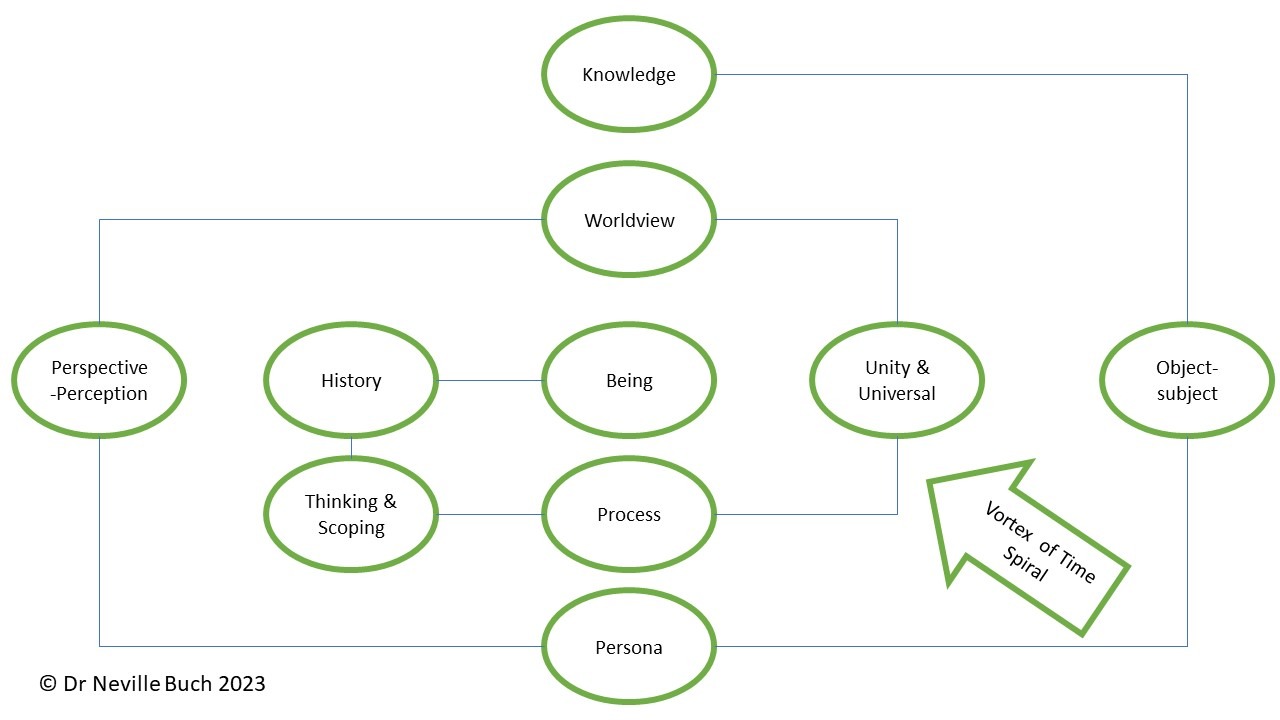
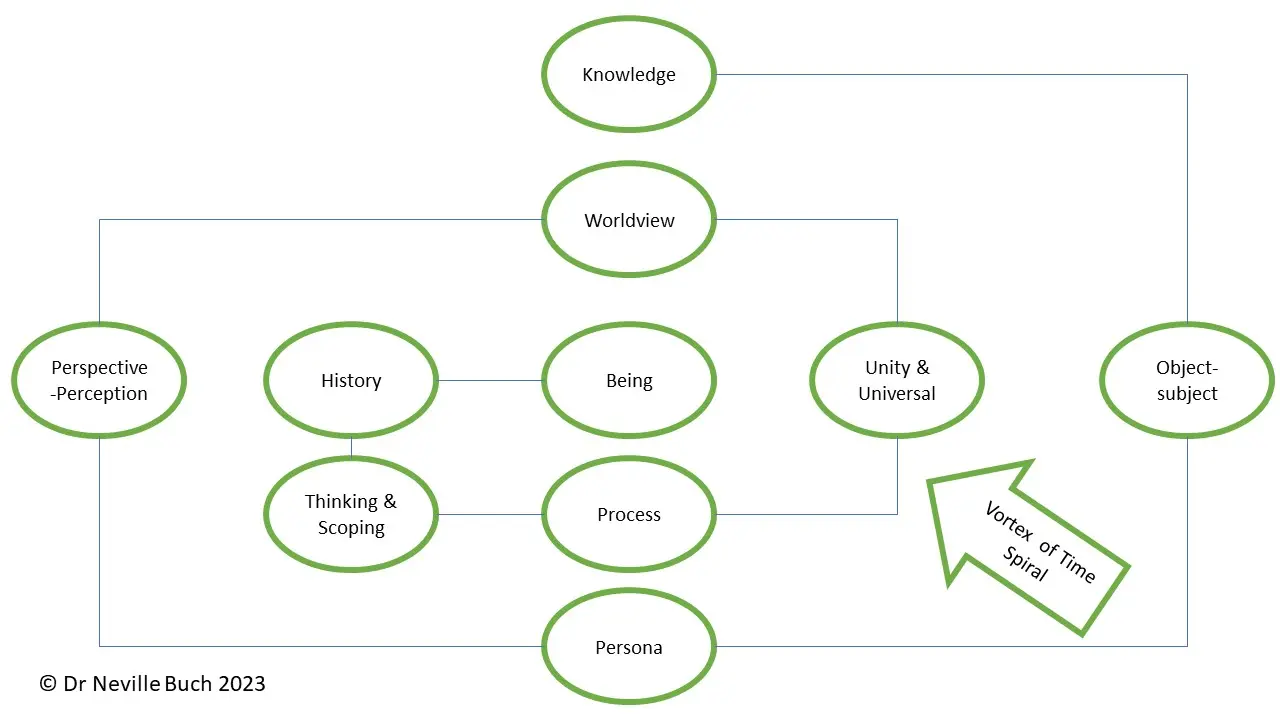
The path from “Not Knowing” to “Knowing” is best described by Dr. Neville Buch’s “Spiral History Theory of Stupidity.” He defines “stupidity” as historical forgetfulness and an inability to learn from past failures. Rejecting the Nietzschean “eternal return” of closed loops, Buch proposes a spiralling pattern where forward movement is possible through the intervention of Regret. Regret acts as the “father” providing the correctives to past errors, allowing Wisdom (Sophia) to be born. By uncoiling these repetitive patterns of failure through “Spiral Historiography,” a population can move away from a “habitual centre” of despair and toward a state of social accountability and human authorship.
——————————————————————————–
DoC Table: The Dynamics of Knowing and Not Knowing
| DoC Component | Not Knowing (Abyssal/Coercive) | Knowing (Ecology/Contributory) |
| Prejudice (Centre) | Epistemological Individualism: The self as a solitary, isolated mind. | Social Emergent: The mind as a product of communicative participation. |
| Attitudes (Thinking) | The Techné Mindset: Prioritizing technical utility and narrow metrics over reflection. | Reflexive Critique: Systematically questioning entrenched beliefs through the Socratic method. |
| Exclusion (Sensation) | Sociology of Absences: Rendering subaltern voices and colonial violence invisible. | Epistemological Pluralism: Filtering out simplistic binaries to include diverse ways of knowing. |
| Inclusion (Intuition) | Monoculture of Knowledge: Declaring one Western standard as universal. | Ecology of Knowledges: A non-hierarchical relation among diverse knowledge systems. |
| Value (Feeling) | Potestas (Power-Over): Success defined by domination and subjugation. | Eudaimonia (Flourishing): Success measured by human authorship and contribution to the common good. |
——————————————————————————–
APA Bibliography
Arendt, H. (1951). The origins of totalitarianism. Harcourt, Brace and Company.
Arendt, H. (1970). On violence. Harcourt, Brace & World.
Austin, J. L. (1962). How to do things with words (J. O. Urmson, Ed.). Clarendon Press.
Bauman, Z. (2000). Liquid modernity. Polity Press.
Beiser, F. C. (2023). Philosophy of life: German Lebensphilosophie 1870–1920. Oxford University Press.
Bengtsson, J. O. (2006). The worldview of personalism: Origins and early development. Oxford University Press.
Bourdieu, P. (1990). The logic of practice (R. Nice, Trans.). Stanford University Press.
Buch, N. (2015). No regrets in the evening of life: The history of Junction Park State School (1888–2013). Boolarong Press.
Buch, N. (2024). The spiral history theory of stupidity: Getting stuck in time-space, and personal breakout of historical cognition patterns. Management Institute for Contributory Economy.
Buch, N. (2026). DRAFT Transference: Character and the contributory economy. Management Institute for Contributory Economy.
Camus, A. (1954). The rebel: An essay on man in revolt (A. Bower, Trans.). Alfred A. Knopf. (Original work published 1951).
Crenshaw, K. (1989). Demarginalizing the intersection of race and sex: A Black feminist critique of antidiscrimination doctrine, feminist theory and antiracist politics. University of Chicago Legal Forum, 1989(1), 139–167.
Dewey, J. (1922). Human nature and conduct: An introduction to social psychology. Henry Holt and Company.
Harney, S., & Moten, F. (2013). The undercommons: Fugitive planning & black study. Minor Compositions.
Holland, T. (2019). Dominion: How the Christian revolution remade the world. Little, Brown.
Lyotard, J.-F. (1984). The postmodern condition: A report on knowledge (G. Bennington & B. Massumi, Trans.). University of Minnesota Press. (Original work published 1979).
Morrison, T. (1987). Beloved. Alfred A. Knopf.
Santos, B. de S. (2007). Beyond abyssal thinking: From global lines to ecologies of knowledges. Review (Fernand Braudel Center), 30(1), 45–89.
Santos, B. de S. (2014). Epistemologies of the South: Justice against epistemicide. Paradigm Publishers.
Spivak, G. C. (1988). Can the subaltern speak? In C. Nelson & L. Grossberg (Eds.), Marxism and the interpretation of culture (pp. 271–313). Macmillan Education.
Spivak, G. C. (1993). Outside in the teaching machine. Routledge.
Trouillot, M.-R. (1995). Silencing the past: Power and the production of history. Beacon Press.
Weber, M. (1930). The Protestant ethic and the spirit of capitalism (Talcott Parsons, Trans.). Allen & Unwin. (Original work published 1904–1905).
——————————————————————————–
Endnotes with References
- Orthodoxy: Power-Over: Traditional political thought defines power as potestas, a hierarchical mechanism of coercion and command designed to bend the will of others.
- Feminist Intervention: Feminist theory shifts the definition from potestas (power-over) to potentia (power-to), viewing power as capacity, agency, and collective liberation.
- Abyssal Thinking: Western modernity creates a division where anything “on the other side” of the line is produced as non-existent and illegitimate.
- Epistemicide: The systematic destruction of alternative knowledge systems deemed inferior to Western science.
- The Looking-Glass Self: Cooley’s core concept that our self-concept is built through our imagination of how society perceives us.
- Primary Groups: Small, face-to-face groups like families and friendship circles are the fundamental source of Morals and Beliefs.
- Sanctioned Ignorance: An ideological silencing that dismisses specific contexts as irrelevant to maintain existing power structures.
- The Teaching Machine: The Western university acts as an apparatus that domesticates radical critique into manageable academic specialties.
- Spiral History Theory of Stupidity: Historical forgetfulness traps populations in repetitive cycles of failure, which can only be uncoiled through awareness and regret.
- Regret as Father of Wisdom: Stupidity is a negative state that births wisdom only when Regret provides the necessary historical correctives.
[1] The Post-Postmodern being the initial conservative reaction and Post-Post-Postmodern is the liberal analysis.
Featured Image: Dr Neville Buch’s Spiral Historiography Methodological Model
May 21, 2023
Content Goes Here


Neville Buch
Latest posts by Neville Buch (see all)
- The Unbound Mind: Independent Scholarship, Institutional Isolation, and the Restoration of Human Authorship – October 20, 2026
- The Road to Geelong: A Re-Narrativization of The Story of Resilience Part 1 – October 20, 2026
- The Human Being Above the Transaction and Why Markets Cannot Measure Human Worth – October 15, 2026