
Dr Neville Buch[1]
The “How algorithms starve the human intellect” audio commentary on MICE’s Contributory Economy and Human Authorship:
The “Stop walking backward into digital sewer grates” audio commentary for lessons in Modern History for Queensland Education:
Abstract
This essay investigates the phenomenon of “cognitive ignorance” and the systemic breakdown of deliberation in contemporary social media conversations. Grounded in the socio-historical frameworks of Dr. Neville Buch and the epistemology of Jack Philip McKinney, this paper contrasts the modern “flattened discourse” of online platforms with the rigorous, cooperative dialogic models developed by the Management Institute for Contributory Economy (MICE). Social media platforms promote a state of “denoetization”—the mechanical liquidation of the human capacity to judge—by substituting the complex, layered, and historically situated reality of human experience with transactional, metric-driven soundbites. To remediate this crisis, this essay analyses the best principles of learning, specifically incorporating John Dewey’s instrumentalism and Lev Vygotsky’s pedagogical mediation. It argues that true intellectual agency is an interpersonal, cultural synthesis that cannot be built in isolation. Finally, this paper demonstrates the democratic and epistemic necessity of obtaining a formal higher education degree at a reputable learning institution, asserting that systemic access to humanity’s shared world-picture remains the primary gateway for transitioning from unreflective, compliant execution to mature social accountability and Aristotelian flourishing.
The Epistemic Abyss: Ignorance, Flattened Discourse, and the Quest for Humanist Dialogue
1. Defining the Pathology: The Crisis of Social Media Conversation
Modern social media platforms represent the apotheosis of what Bernard Stiegler termed “denoetization”—the systematic and mechanical erosion of the human capacity for critical judgment and independent thought (Buch 2026b: 2). Rather than functioning as a democratic public square, the digital media apparatus has become a chief vector of “political falling” and intellectual stagnation (Buch 2025b: 13).
This systemic failure manifests primarily through what Dr. Neville Buch identifies as the “Flattening of Discourse” (Buch 2025b: 5). In the virtual sphere, complex socioeconomic and historical problems are routinely reduced to “simplistic soundbites, emotional appeals, and binary oppositions” (Buch 2025b: 5). This structural reductionism creates a toxic environment where “simplistic egotists opt in and the worried deep thinkers opt out,” leaving the public sphere highly vulnerable to manipulative trickster figures and sociological propaganda (Buch 2025b: 5).
Sociologically, social media conversations operate on a model of “transactional truth,” where the objective validity of a statement is treated as irrelevant, and assertions are made purely for short-term, self-interested, or strategic success (Buch 2025b: 5). This is characterized by what Jürgen Habermas defined as “Strategic Action,” where participants view others not as equal interlocutors in search of mutual understanding (Verständigung), but merely as tools or obstacles for the success of their own narratives (Buch 2025a: 22). In these spaces, communication is systematically distorted, and consensus is maintained only in superficial appearance (Buch 2025a: 22).
Furthermore, social media fosters a pervasive “Historical Forgetfulness” (Buch 2026b: 2). Users, insulated in algorithmic echo chambers, ignore the contingent historical roots of the concepts they use, leading to a repetitive cycle of intellectual errors—a phenomenon Dr. Buch labels the “Spiral History Theory of Stupidity” (Buch 2026b: 2). When public figures and average citizens express unreflective opinions on complex disciplinary matters, they demonstrate what John Stuart Mill observed as the grave dangers of “uninstructed judgment,” where individuals who have never comprehensively studied a branch of knowledge attempt to judge its particular parts (Buch 2026a: 3).
2. The MICE Alternative: Conviviality, Dialogue, and Facilitation
In direct opposition to the isolating, fragmented nature of social media, the Management Institute for Contributory Economy (MICE), based in Sunnybank Hills, Queensland, offers a restorative pathway (Buch 2026a: 1). MICE organizes public, informal forums such as The Philosophy Café to bridge the gap between academic theory and everyday lived experience (Buch 2026b: 1).
MICE conversations work by explicitly rejecting the “Cartesian Impasse”—the erroneous Western belief that knowledge is a solitary acquisition derived from an individual’s private data (McKinney 1971: 201-203). Instead, MICE frameworks are built upon J.P. McKinney’s “Original Synthesis of Experience,” which proves that our common world-picture is fundamentally an interpersonal social product, synthesized over generations from the discontinuous sensory data of countless individuals (McKinney 1971: 201).
In a MICE forum, the process of communication is guided by the rules of Universal Pragmatics (Buch 2026a: 13). Anyone engaging in these discussions must reciprocally raise and recognize four universal Validity Claims:
- Comprehensibility: The statement must be understandable.
- Truth: The propositional content must represent actual states of affairs.
- Rightness: The utterance must conform to legitimate social norms and interpersonal relations.
- Truthfulness (Sincerity): The speaker must honestly express their internal intentions so that others can trust them (Buch 2026a: 12-13).
A central mechanism of this model is facilitating. In this context, facilitating means making an action, process, or meeting easier, smoother, and more likely to succeed. It describes the act of helping a group reach a goal or guiding a discussion without taking control or dictating the final answer. In MICE forums, the facilitator (often operating as a “Regular Philosopher”) does not act as an authoritarian gatekeeper of absolute truth (Buch 2026b: 1). Instead, they guide the group’s critical inquiry, utilizing structured conflict, such as the Jurisprudential Analogy, to translate abstract, “thin” ethical concepts into the concrete, “thick” realities of local lived experience (Buch 2025d: 1-4). This process models Habermas’s ideal of Communicative Rationality, ensuring that any eventual consensus is reached solely through the unforced, rational agreement of free and equal participants (Buch 2025a: 22).
3. The Best Principles of Learning: Moving Beyond the “Banking Model”
To dismantle the cognitive stagnation of social media ignorance, society must adopt pedagogies that prioritize active inquiry over the passive consumption of information. The traditional, authoritarian classroom has long treated the student as an “immature being who is to be matured,” employing what Paulo Freire critiqued as the “banking model” of education, where content is passively deposited into students’ minds (Freire 1970; Buch 2025c: 3).
The best principles of learning, as integrated into Dr. Neville Buch’s Dynamic of Cognition (DoC) Model, define learning as a dynamic, self-correcting process of reconstructing experience (Buch 2026a: 13). Three primary principles guide this renewal:
- Pragmatic Problem-Solving (Dewey’s Instrumentalism): Following John Dewey, the mind is not a passive spectator of reality, but an active organ that thinks only when habitual modes of behaviour are interrupted by concrete, real-world problems (Dewey 1916; Buch 2025c: 3). True learning is an “action-first” enterprise; ideas are treated as instruments and tentative solutions designed to guide deliberate, reflective interventions in the social environment (Buch 2025c: 3).
- The Zone of Proximal Development (Vygotsky’s Social Mediation): Lev Vygotsky established that intellectual development is not rigidly constrained by internal, biological limits (Vygotsky 1934; Buch 2025c: 1-5). Instead, learning is an inherently social and mediated act (Buch 2025c: 1). The Zone of Proximal Development (ZPD) represents the dynamic space between what a learner can achieve independently and the higher competence they can attain through collaborative guidance with more knowledgeable peers or instructors (Buch 2025c: 1). This ”dynamic scaffold” protects learners from the isolated struggle of solitary acquisition, utilizing shared language and cultural symbolic tools as the engines of cognitive growth (Buch 2025c: 4).
- Reflective Self-Criticism (The POLICE Model): To maintain an active “intellectual immune system” against propaganda and manufactured popular myths, learners must commit to continuous long-life learning and intellectual skepticism (Buch 2026a: 1). This is operationalized through the POLICE model (Philosophically Ontology Logic Intersect Compatibility Education), which trains individuals to perform ongoing ”crap detecting” on their own unexamined prejudices, ensuring that their beliefs remain permanently open to questioning and empirical correction (Buch 2026b: 2-3).
4. Epistemic Legitimacy: Why We Need Good Learning Institutions
In a culture heavily saturated by digital self-referential information, it is often argued by populist voices that formal degrees are redundant, and that independent online research is a sufficient substitute for institutional learning (Buch 2026a: 3). However, both the historical record and the philosophy of knowledge refute this claim. There are several vital reasons why an individual should pursue structured higher learning and earn a degree at a reputable learning institution:
First, institutions protect and facilitate access to humanity’s shared world-picture. As J.P. McKinney observed, J.S. Mill and other traditional pragmatists recognized that knowledge is not a commodity to be owned individually, but a common pool of human understanding (McKinney 1971: 214; Gregory 2026: 228). Reputable universities house the great libraries, archival records, and peer-reviewed journals that contain the documented, centuries-long struggles of human thought (Gregory 2026: 228). Attempting to philosophize or conduct research outside of these institutional frameworks often leaves the individual “uninstructed” in the deeper ethical and historical bearings of their concepts, cutting off their inquiry at the tap-root (McKinney 1971: 203; Gregory 2026: 228).
Second, the structured environment of a university is essential for achieving mature social accountability. A formal degree program requires students to submit their private, subjective claims to rigorous, disciplined evaluation by a community of peers and established scholars (Gregory 2026: 228). This process prevents the individual from retreating into “epistemic solipsism” or repeating past failures, forcing a “personal breakout” from unreflective prejudice (Buch 2026b: 4). Historically, as documented in early twentieth-century Queensland educational histories, the acquisition of a university degree was the single most powerful factor that allowed individuals to rise above narrow vocational training to become active, critical, and socially responsible leaders in the public sphere (Buch 2015: 1).
By engaging with a structured, interdisciplinary curriculum at a good learning institution, the student transitions from a “Junior” state of unreflective, docile execution—where they act as passive conduits for bureaucratic and economic mandates—to a “Senior” state of social accountability, reclaiming their role as the proactive author of their own life narrative (Buch 2025b: 5; Buch 2026b: 4).
In-Text Reference Citations (Harvard Style)
- On the flattening of discourse and strategic action in digital spaces: See Buch (2025b: 5) and Buch (2025a: 22).
- On denoetization and the pathology of unreflective prejudice: See Buch (2026b: 2) and Buch (2026a: 3).
- On the dangers of uninstructed, populist judgment: See Mill (1831), cited in Buch (2026a: 3).
- On the interpersonal basis of knowledge and the critique of Cartesian individualism: See McKinney (1971: 201-203, 214).
- On the definition of communicative rationality and procedural validity claims: See Habermas (1979), cited in Buch (2025a: 22; 2026a: 12-13).
- On the ZPD as a social and dynamic scaffold for active learning: See Vygotsky (1934), cited in Buch (2025c: 1-5).
- On pragmatism, instrumental thought, and problem-solving: See Dewey (1916), cited in Buch (2025c: 3) and Buch (2025e: 2-3).
- On the value of higher education degrees and the university for public access: See Buch (2015: 1) and Gregory (2026: 228).
Bibliography
Buch, N. (2015). No Regrets in the Evening of Life: The Evolution of the Queensland Teacher and the Rise of UQ. Brisbane: Privately Published. (Source context: no_regrets_20150828.pdf, p. 1).
Buch, N. (2025a). Mapping the Cognition of Australian-American Systems. Brisbane: Management Institute for Contributory Economy.
Buch, N. (2025b). Organising Trumpism into Political Theory. Brisbane: Management Institute for Contributory Economy.
Buch, N. (2025c). Concept-Practices: M.1. Learning (The Zone of Proximal Development). Brisbane: Management Institute for Contributory Economy.
Buch, N. (2025d). Concept-Practices: X.1. Community (The Pedagogical Parlour Game). Brisbane: Management Institute for Contributory Economy.
Buch, N. (2025e). Concept-Practices: H.1. Logic (John Dewey’s Thinking as Problem Solving). Brisbane: Management Institute for Contributory Economy.
Buch, N. (2026a). The Lost Insights of the Uneducated: A Cognitive and Historiographical Critique. Brisbane: Management Institute for Contributory Economy.
Buch, N. (2026b). Spiral Historiography and the Dynamic of Cognition. Brisbane: University of Queensland (Unpublished Draft).
Dewey, J. (1916). Democracy and Education: An Introduction to the Philosophy of Education. New York: Macmillan.
Freire, P. (1970). Pedagogy of the Oppressed. New York: Seabury Press.
Gregory, P. (2026). The Crisis of Modern Thought: Jack McKinney and the Academic Exclusion of Knowledge. Brisbane: University of Queensland Press. (Source context: Peter Gregory. The Crisis of Modern Thought.pdf, pp. 227-228).
McKinney, J.P. (1971). The Structure of Modern Thought. London: Chatto and Windus.
Vygotsky, L. S. (1934). Myshlenie i rech (Thought and Language). Moscow: Sotsekgiz.
Take the MICE Quiz
[1] Artificial Intelligence (A.I.) has been fairly used in the production of this work. The tool used is Google NotebookLM (recently rebranded as Gemini Notebook). It is an AI-powered virtual research assistant and thinking partner designed to help a person interact deeply with their own documents. Unlike general chatbots, it is source-grounded, meaning it only generates answers based on the specific PDFs, documents, or links uploaded. The A.I. process in the production of this work has been limited to the attached (prompts) on each of the questions in turn. This ensures an accurate reading of each source. The author then rearranged and re-edited the answers the A.I. provided. The human author publishes this work. A.I. is never an author when used properly. This assistance is not qualitatively different from a human research assistant when that assistance is deemed to have no authorial status but is acknowledged.
FOR QUEENSLAND EDUCATION AUTHORITIES TO SHOW WHAT THEY HAVE BEEN MISSING
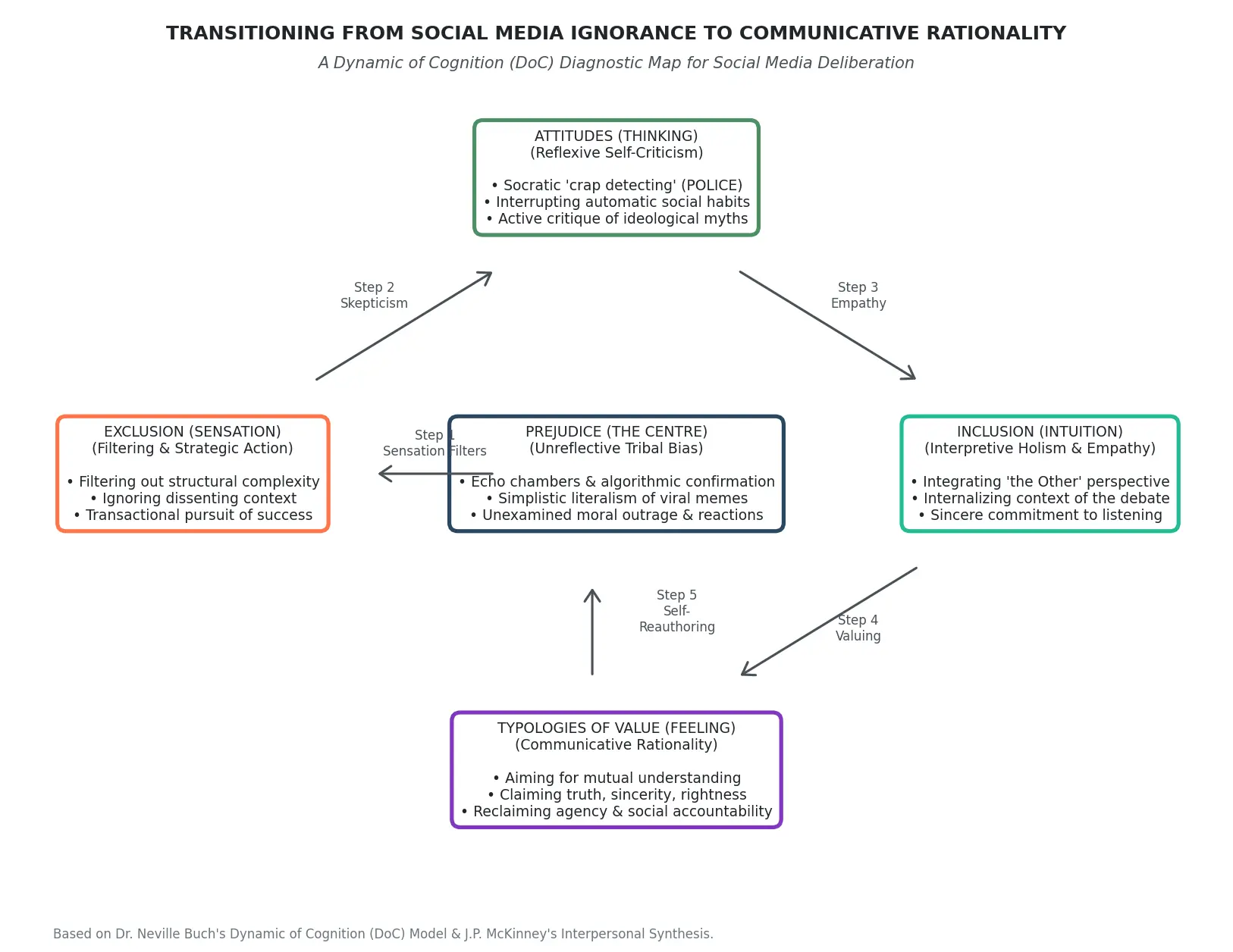
The Cognitive Transition Pathway
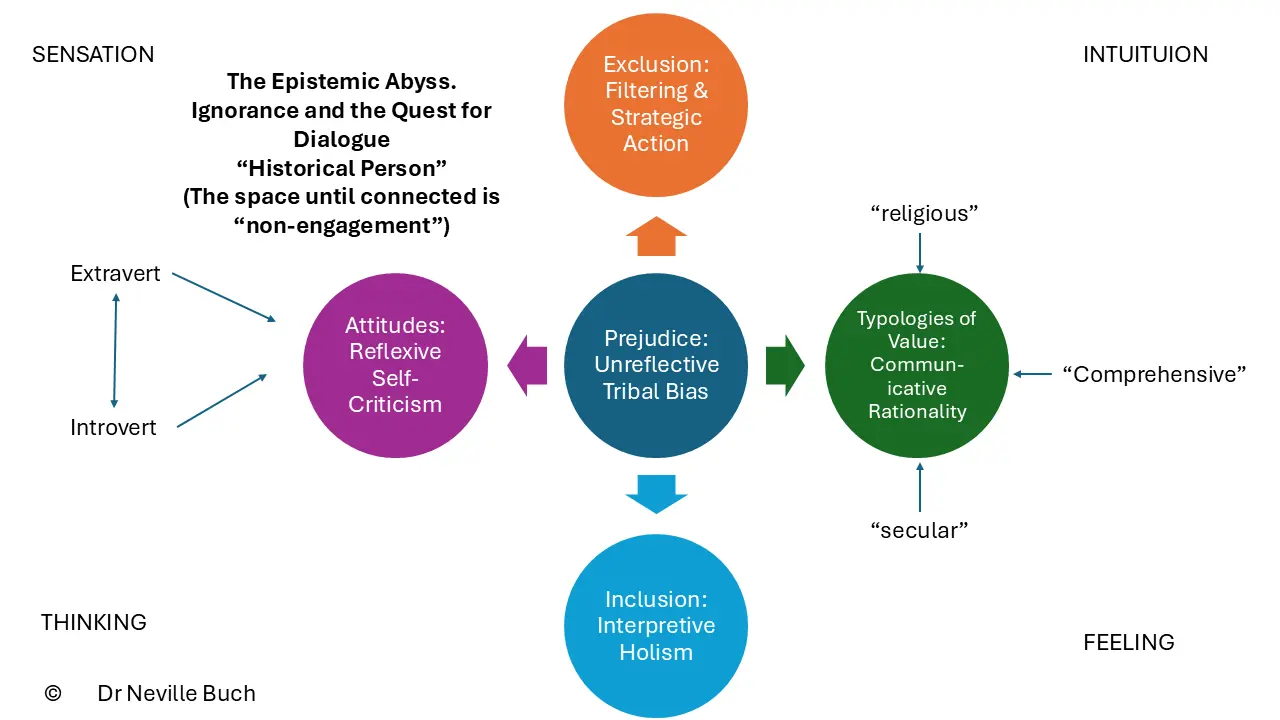
- Prejudice (The Centre) – Unreflective Tribal Bias: The starting state on social media, dominated by algorithmic confirmation, echo chambers, and knee-jerk moral outrage.
- Exclusion (Sensation) – Filtering & Strategic Action: The first step of intervention where the mind separates from the “feed”. It filters out simplistic binaries, PR mirages, and strategic manipulation designed purely for transactional success.
- Attitudes (Thinking) – Reflexive Self-Criticism: The active phase of “crap detecting” (using the POLICE model). This step interrupts automatic reaction habits and subjects all dogmas to systematic skeptical doubt.
- Inclusion (Intuition) – Interpretive Holism: The cognitive shift to empathy. Here, the user actively seeks the perspective of “the Other,” integrating deep historical and social contexts rather than isolated, literalist data.
- Typologies of Value (Feeling) – Communicative Rationality: The mature “Senior” state where success is measured by mutual understanding (Verständigung). Communication is restored to its humanistic purpose, anchored in the four validity claims: comprehensibility, truth, rightness, and sincerity.
Navigating the Epistemic Abyss: Modern History Pedagogical Strategy
Integrating the transition away from the “Epistemic Abyss” of social media ignorance into the QCAA Senior Modern History (2025) Syllabus requires a deliberate shift in pedagogical strategy. Rather than treating historical data as a static artifact to be memorized (the techné mindset), history must be taught as an active, ethical practice—philosophy in practice.
This integration is most effectively situated within Unit 4: International Experiences in the Modern World (Topic 5: The Information Age since 1936), focusing on the contemporary crisis of “denoetization” (the mechanical liquidation of the human capacity to judge under automated systems).
The following detailed lesson plan template outlines how to operationalize Dr. Neville Buch’s Dynamic of Cognition (DoC) diagnostic to guide students from unreflective internet prejudice to critical, communicative rationality.
QCAA Senior Modern History (2025) Lesson Plan
- Unit 4: International Experiences in the Modern World
- Topic 5: The Information Age since 1936
- Aspect of the Topic: Digital Denoetization vs. Communicative Action
- Duration: 2 x 60-minute sessions (or a single intensive block)
- Core Axiom: “Understanding history is philosophy in practice”.
- Core Goal: To transition students from a “Junior” state of unreflective execution (accepting algorithmic narratives) to a “Senior” state of social accountability and Aristotelian flourishing (eudaimonia).
Syllabus Objectives & Cognitive Verbs Addressed
- Comprehend terms, concepts, and issues related to the Information Age (specifically denoetization, hyperreality, and the techné mindset).
- Analyse evidence from historical/digital sources to reveal “aspects that are not immediately obvious” (identifying transactional truth vs. objective reality).
- Evaluate the usefulness and reliability of digital sources by identifying hidden presuppositions, biases, and manufactured myths.
- Synthesise evidence to develop a sophisticated, non-linear historical argument.
The DoC Classroom Transition Pathway
| Lesson Phase / DoC Component | Student Cognitive Activity | Pedagogical Mechanism |
| Phase 1: Prejudice (Centre) | Confronting the unreflective “thrown” state of digital consumption. | Deconstructing a trending social media controversy. |
| Phase 2: Exclusion (Sensation) | “Crap Detecting”—filtering out PR mirages, “institutional bullshit,” and binary propaganda. | Applying the POLICE Model to digital source work. |
| Phase 3: Inclusion / Attitudes (Intuition/Thinking) | Spiral Historiography—reading the present through the “uncoiled” patterns of past struggles. | Hermeneutic re-enactment of historical debates. |
| Phase 4: Value (Feeling) | Communicative Rationality—generating collaborative, peer-justified social truths. | The “Philosophy Parlour Game” (Simulation). |
Detailed Lesson Procedures
Session 1: Deconstructing the Feed (Phases 1 & 2)
- Step 1: Confronting the “Thrown State” (Prejudice) [15-20 mins]
- Activity: The teacher projects a highly polarized, contemporary digital debate (e.g., an algorithmic conflict regarding urban spaces or regional identity).
- Task: Students are asked to write down their immediate, instinctive response. The teacher introduces J.P. McKinney’s critique of epistemological individualism—showing students that their “personal” opinions are actually constructed by a pre-existing, unreflective linguistic background.
- Cognitive Shift: Moving students from seeing social media data as “neutral facts” to recognizing them as socially constructed battlegrounds of power.
- Step 2: Activating the Intellectual Immune System (Exclusion) [40 mins]
- Activity: The teacher introduces the POLICE model and the art of “Crap Detecting”. Students are handed a dossier of conflicting digital sources, municipal PR releases, and historical documents regarding the same issue.
- Task: Students must systematically filter out “transactional assertions” (arguments designed purely for strategic success) and “singular messaging”. They categorize claims using “Thick Ethical Concepts” (e.g., separating abstract political rhetoric from concrete historical facts of dispossession or class stratification).
- Syllabus Alignment: Direct application of QCAA Objective 4 (Evaluate)—formulating discerning judgments regarding usefulness and reliability.
Session 2: Historiographical Re-enactment & Deliberation (Phases 3 & 4)
- Step 3: Uncoiling the Spiral (Inclusion / Attitudes) [25 mins]
- Activity: The teacher introduces Spiral Historiography. Rather than viewing the current digital crisis as a unique modern phenomenon, students trace its genealogy back to older historical struggles (e.g., the transition from the mid-century techné mindset to the 1970s push for critical consciousness under Freire and Illich).
- Task: Students re-enact the perspectives of past thinkers. They analyse how current “post-truth” dynamics are a recursive return of the “Spiral History Theory of Stupidity”—societies repeating past intellectual errors because their origins were forgotten.
- Syllabus Alignment: Direct application of QCAA Objective 3 (Analyse)—identifying causes, consequences, and continuities.
- Step 4: The Philosophy Parlour Game (Value / Praxis) [35 mins]
- Activity: The classroom is transformed into an “oppositional democratic public sphere”. The teacher facilitates Dr. Buch’s “Parlour Game” philosophic simulation.
- Task: Operating in unequal groups to simulate real-world structural disparities, students must negotiate a resolution to the initial controversy. To succeed, their arguments must survive peer-review based on Habermas’s Universal Pragmatics—meaning their claims must be comprehensible, objective, normatively right, and sincere.
- Outcome: Students produce a collaborative Critical Summary (matching QCAA IA2 specs) that synthesizes their arguments to justify a socially accountable decision.
- Cognitive Shift: Students achieve “Sufficient Comprehension” and reclaim human authorship over the shared world-picture, moving from passive compliance to active citizenship.
This guide integrates Dr. Neville Buch’s Dynamic of Cognition (DoC) model and POLICE diagnostic directly into Unit 4, Topic 5 of the QCAA Senior Modern History General Syllabus. It bridges the gap between historical inquiry and applied philosophical ethics, moving students from unreflective pre-judgment to mature social accountability.
PDF File
Teacher’s Unit Guide Contents
- Executive Abstract & Rationale: Outlines the contemporary threat of “denoetization” (the mechanical liquidation of critical human judgment) in digital feeds and justifies the necessity of interdisciplinary learning.
- Syllabus Integration Map: Formally aligns the unit with the QCAA Modern History course objectives, mapping cognitive verbs like comprehend, analyse, evaluate, and synthesise directly to diagnostic activities.
- 2-Lesson Plan template:
- Lesson 1: Guides students through Jack Philip McKinney’s “Cartesian Impasse” to understand that shared knowledge is an interpersonal social product. Instructs students on using the POLICE model for systematic digital “crap-detecting”.
- Lesson 2: Engages students in Dr. Buch’s “Philosophic Parlour Game”—an active classroom simulation where different ideological standpoints negotiate a policy scenario using Habermas’s Universal Pragmatics.
- Print-Ready Student Worksheet: A three-page structured student handout, complete with metadata headers, theoretical prompts, and lined templates for auditing modern digital myths (such as the folksy Queensland Character narrative).
- Grading Rubric & Score Card: A comprehensive two-page grading matrix matching QCAA standards (A–E) across all criteria, paired with an evaluator report card for rapid checking of cognitive milestones and structured written feedback
Featured Image: Screenshot-2025-01-14-Social-Media-Making


Neville Buch
Latest posts by Neville Buch (see all)
- Thank you, Richard: Knowing the message but then acting – October 8, 2026
- The Desiccation of the Common Well: Identity Politics, Algorithmic Assessment, and the Crisis of Adult Responsibility – October 6, 2026
- Academic Rigour, Epistemic Renewal, and the Crisis of Inquiry: A Scholarly Review of the Vanderbilt Commission Report on the State of Scholarship – October 5, 2026