

Dr Neville Buch[1]
The “Reclaiming Your Mind from Tilted Politics” audio commentary on MICE’s Contributory Economy and Human Authorship:
Abstract
This essay provides a comprehensive exploration of the structural tensions between social hierarchy and the “level playing field,” utilizing the interdisciplinary frameworks of the Dynamic of Cognition (DoC) and Habermasian communicative action. Traditionally, hierarchy and structural fairness are juxtaposed as mutually exclusive; however, this analysis posits that such a binary is a cognitive artifact of “potted thinking” and strategic political deception. By applying the DoC model, we map the cognitive descent from unreflective habit—a “Junior” mindset of mere execution—to the “Analytical Abyss” characterized by specialized ignorance and the use of “thin” concepts. Conversely, we argue for a “humanistic ascent” toward a “Senior” mindset of social accountability, achieved through “Inclusion” and a “Horizon Worldview.”
Central to this transition is the adoption of Jürgen Habermas’s theory of communicative action, specifically the shift from closed traditions to “open constitutionalism.” By prioritizing the “unforced force of the better argument,” societies can establish “undamaged intersubjectivity,” removing the prejudicial privilege status of inherited worldviews. The essay further synthesizes Herbert Simon’s theory of “near-decomposability” in complex systems with ethical meritocracy, asserting that structural fairness requires “selective permeability” rather than a mechanical liquidation of discernment. Ultimately, the thesis contends that restoring “Human Authorship” necessitates “Spiral Historiography”—reading the past inclusively to re-author a just future—and the active filtering of institutional myths through the POLICE model to achieve philosophical compatibility in an evolving social landscape.
1. The Cognitive Architecture of Control and Openness
Social structures are the externalized manifestations of internal cognitive states. To understand the dynamics of power and fairness, one must first engage the “Dynamic of Cognition” (DoC), a methodological framework designed to map the transition from unreflective habit toward comprehensive knowledge (Buch 2026, p. 2). In this framework, thought is not a static object stowed within the brain, but a dynamic, purposive “thread of melody” running through sensory experience (Buch 2026, p. 2). Human beings are “thrown” into the world in a state of “Prejudice”—an initial belief in commonality where the individual assumes their perception of self and world is a universal standard.
The DoC identifies two primary axes correlating with control and openness. Control is typically maintained through the Sensation/Thinking axis, where “Exclusion” (externalism) and “Prejudice” serve as mechanisms to filter out the complexity of the “Other.” When these processes remain unreflective, they foster a “Junior” mindset of unreflective execution, leading to “Specialized Ignorance” and an “Analytical Abyss” (Buch 2026, p. 3; Buch 2025, p. 2). In this abyss, the mind operates on “thin” concepts—technical formalisms divorced from lived experience—that prevent the individual from grasping the textured reality of ethical life.
In contrast, openness is fostered through the Intuition/Feeling axis via “Inclusion.” This represents the “Horizon Worldview,” a state where diverse perspectives are internalized through empathy and Socratic reflection (Buch 2026, p. 3). This ascent is supported by “Spiral Historiography,” a non-linear method of reading foundational texts with modern inclusivity to identify cyclical patterns of truth (Buch 2025, p. 811). The “So What?” of this cognitive sociology is demanding: the “forcefulness of ideas” (Attitudes) conditions all human activity. Failing to move from “unconscious habit” to “reflective activity” leaves the individual as a “passive conduit” for dominant ideologies. This epistemic failure does not merely result in passivity; it creates a vacuum that invites the “weed of a lie” to take root in the social fabric (Buch 2026, p. 2).
2. Habermasian Communicative Action and the Quest for Intersubjectivity
The transition from internal cognitive openness to external structural fairness requires the strategic architecture of Jürgen Habermas’s communicative action. Habermas offers a vital solution for societies seeking to move from “closed constitutionalism”—where choices are fixed by perceived origins and the “colonization of the lifeworld”—toward “open constitutionalism” (Buch 2024, p. 4; Buch 2025, p. 11). In a closed system, the “Junior” mindset prevails, as inherited traditions resist reform and trap the citizenry in a “closed loop” of automated response.
The Habermasian solution is predicated on the “unforced force of the better argument.” By adopting a “dialogical approach,” the State can remove the prejudicial privilege status of any single grouping or inherited worldview (Buch 2024, p. 4). This process is essential for establishing “undamaged intersubjectivity,” where knowledge is recognized as an interpersonal product synthesized from the “fusion of horizons” (Gadamer). Such an approach “unhooks” tradition from unreflective dogma, allowing for negotiated reform and the removal of “institutional arrogance.”
This dialogical ideal protects the “political health of the state” by ensuring that common grounds are found through transparent, rational-critical communication (Buch 2024, p. 4). By dismantling hierarchies that value dogmatic purity over the historical person, communicative action provides the framework to distinguish between “vindicatory” power—narratives used merely to justify the institutional status quo—and ethical, functional systems that facilitate human flourishing.
3. Typologies of Merit: Fairer Hierarchies and Level Playing Fields
A profound cognitive failure in political discourse is the conflation of exploitative power with functional hierarchy. However, as Herbert Simon (1962) demonstrated, complex systems naturally evolve into stable, nested hierarchical structures through “near-decomposability,” where subsystems maintain a degree of independent functionality (Simon 1962, p. 467). The “missing link” between Simon’s systems theory and the DoC lies in the transparency of the structure: ethical hierarchies are “Open” (Habermasian) because they are decomposable—they invite reflection and analysis. Conversely, “vindicatory” hierarchies refuse decomposition, relying on “thin” concepts to create an “Analytical Abyss” that shields power from scrutiny.
Ethical hierarchies, such as “hierarchies of knowledge/skill” or biological “compositional hierarchies,” are models of structural efficiency rather than domination (Annotated List of Works on Hierarchy, p. 1). They encourage a “Senior” mindset characterized by social accountability and the mastery of “Thick Ethical Concepts”—terms like courage or integrity that unite factual description with evaluative meaning (Moore 2003; Williams 1985).
The “level playing field” serves as the regulator of these structures, ensuring “selective permeability” rather than the “mechanical liquidation of discernment” (Buch 2025, p. 14). This fairness is operationalized through:
- Economic/Regulatory Frameworks: Net Neutrality and Antitrust Laws, which prevent the “monopolistic exclusion” that would otherwise swallow the “Other” (Annotated List of Works on Level Playing Field, p. 1).
- Social/Competitive Frameworks: Offsetting systemic disadvantage through standardized testing, public school funding reforms, and scholarships for marginalized demographics. These are not attempts to enforce total neutrality but to ensure fair entry points into meritocratic hierarchies (Annotated List of Works on Level Playing Field, p. 1).
4. The Anatomy of Confusion: Deception and Cognitive Failure
The persistence of unfair structures often relies on the “strategic utility of confusion.” Simplistic “Binary Traps”—such as Religion vs. Secularity or Idealism vs. Realism—are political devices intended to distract from nuanced options like open constitutionalism (Buch 2024, p. 4). These binaries encourage “potted thinking”—the acceptance of ready-made statements that save the individual from the “actual labour of deep reflection” (Buch 2026, p. 2).
A seminal case study in this deception is William F. Buckley’s Up From Liberalism (1959). Buckley’s narrative, which characterized liberalism as an “intellectual cowardice” with “no position,” is the “weed of a lie” (Buch 2025, p. 1). By distorting the intellectual paradigm of liberalism, Buckley sought to reposition reactionary “rightism” as the centralist position. This “systematic banishing of historical context” has flourished into the “Age of Trumpism,” a contemporary manifestation of “Symbolic Misery”—the total loss of individual agency to automated, drive-based reflexes and manufactured myths (Buch 2026, p. 2; Buch 2025, p. 12).
To restore “Human Authorship,” individuals must engage in “Crap Detecting” through the POLICE model: Philosophically Ontology Logic Intersect Compatibility Education (Buch 2026, p. 3). The ultimate goal of the POLICE model is to achieve “Philosophical Compatibility”—an intellectual state where a person can be simultaneously rational, skeptical, and humanist (Buch 2024, p. 4). This model allows the individual to burst the “bubble of Mind” and move from the unreflective “Junior” state toward the socially accountable “Senior” state.
5. Conclusion: Restoring Human Authorship
The integration of structural hierarchy with the level playing field is both a political and a cognitive necessity. The “humanistic ascent” requires a transition from the “Specialized Ignorance” of unreflective habit toward the inclusive “Horizon Worldview.” This ascent is facilitated by “Spiral Historiography,” which reading ancient texts with modern inclusivity to avoid “Historical Forgetfulness” and to “re-author the future” (Buch 2025, p. 811).
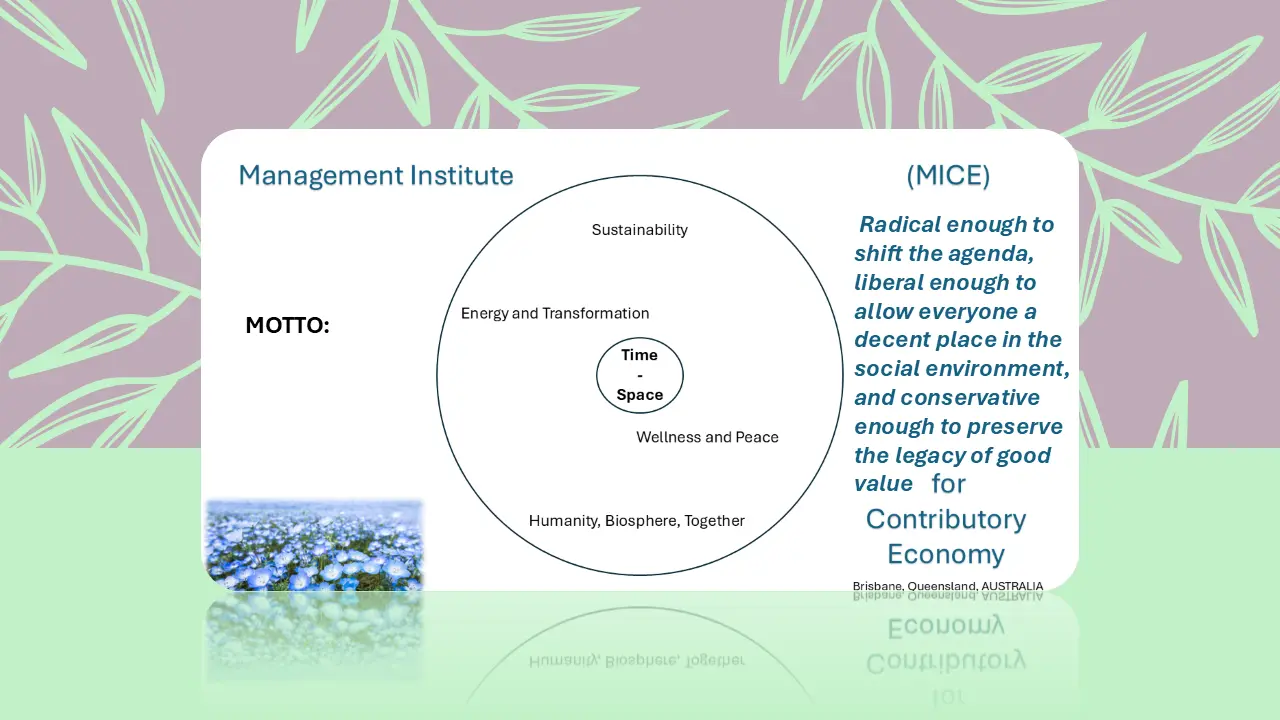
The ultimate objective of these frameworks is the restoration of “Human Authorship.” By dismantling the “Theological Masks” and the “Symbolic Misery” of the late capitalist state, the proactive “Who” of the person remains the master of their evolving worldview. Moving from narrow material utility toward the “Senior” mindset of social accountability, the individual ceases to be a “passive conduit” for technical systems and becomes a proactive author of a contributory economy of knowledge (Buch 2026, p. 3).
Take the MICE Quiz
6. Bibliography
Ahl, V. & Allen, T. F. H. (1996). Hierarchy Theory: A Vision, Vocabulary and Epistemology. New York: Columbia University Press.
Allen, T. F. H. & Starr, T. B. (1982). Hierarchy: Perspectives on Complex Systems. Chicago: University of Chicago Press.
Buch, N. (2024). Semantics and Strategies for the Level Playing Field. Brisbane: MPHA Queensland.
Buch, N. (2025). Applications in Liberalism. Brisbane: The Philosophy Café.
Buch, N. (2025). Buckley’s Up With Liberalism Mind-Twister. Brisbane: Dr Neville Buch Professional Historian.
Buch, N. (2026). Architecture of the Horizon: Navigating the Dynamic of Cognition. Brisbane: Management Institute for Contributory Economy.
Buckley, W. F. (1959). Up From Liberalism. New York: McDowell, Obolensky.
Habermas, J. (1979). Communication and the Evolution of Society. Trans. T. McCarthy. Boston: Beacon Press.
Moore, A. (2003). Williams on Ethics, Thick Knowledge, and Reflection. Philosophy, 78, pp. 337–354.
Saaty, T. L. (1980). The Analytic Hierarchy Process. New York: McGraw-Hill.
Simon, H. A. (1962). The Architecture of Complexity. Proceedings of the American Philosophical Society, 106(6), pp. 467-482.
Williams, B. (1985). Ethics and the Limits of Philosophy. London: Fontana Press.
*****
[1] Artificial Intelligence (A.I.) has been fairly used in the production of this work. The tool used is Google NotebookLM (recently rebranded as Gemini Notebook). It is an AI-powered virtual research assistant and thinking partner designed to help a person interact deeply with their own documents. Unlike general chatbots, it is source-grounded, meaning it only generates answers based on the specific PDFs, documents, or links uploaded. The A.I. process in the production of this work has been limited to the attached (prompts) on each of the questions in turn. This ensures an accurate reading of each source. The author then rearranged and re-edited the answers the A.I. provided. The human author publishes this work. A.I. is never an author when used properly. This assistance is not qualitatively different from a human research assistant when that assistance is deemed to have no authorial status but is acknowledged.
Featured Image:



Neville Buch
Latest posts by Neville Buch (see all)
- Thank you, Richard: Knowing the message but then acting – October 8, 2026
- The Desiccation of the Common Well: Identity Politics, Algorithmic Assessment, and the Crisis of Adult Responsibility – October 6, 2026
- Academic Rigour, Epistemic Renewal, and the Crisis of Inquiry: A Scholarly Review of the Vanderbilt Commission Report on the State of Scholarship – October 5, 2026