
Dr Neville Buch
Abstract
This essay explores the synthesis of C.G. Jung’s analytical psychology and John Dewey’s pragmatist social psychology within the framework of Dr. Neville Buch’s Dynamic of Cognition (DoC). It argues that Jung’s concept of archetypes—the “inherited possibilities of ideas”—provides the necessary primordial content for the “Prejudice” layer of the DoC, while Dewey’s theory of the reconstruction of experience offers the procedural method for moving toward Inclusion and Value. By identifying archetypes as the subconscious “patterns of instinctual behaviour” that precede conscious thought, this integration satisfies the DoC’s requirement to account for the “historical” and “ancestral” preconditions of human cognition. Ultimately, this synthesized approach facilitates individuation—the process of becoming a “total man”—through the intelligent control of habit and the reflexive evaluation of social meaning.
——————————————————————————–
Jung, Dewey, and the Dynamic of Cognition
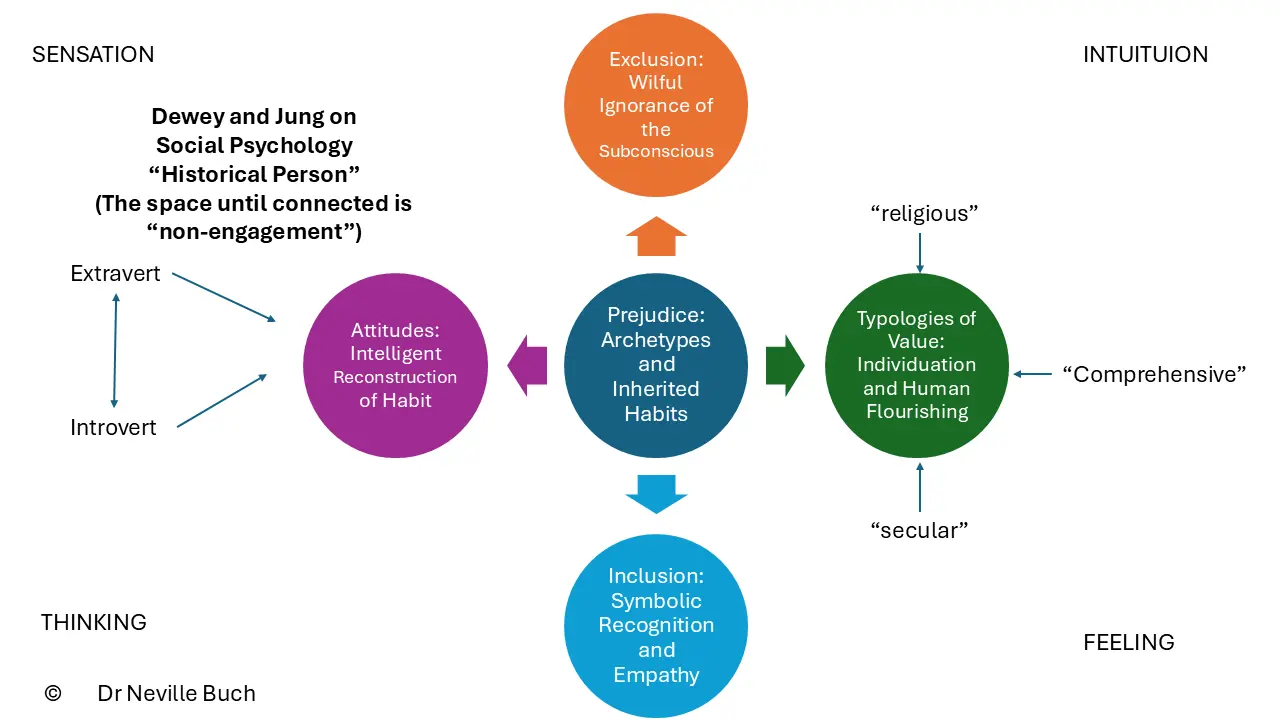
Understanding C.G. Jung’s archetypes in the application of John Dewey’s own social psychology and education theory, meets the requirements of Dr Buch’s Dynamic of Cognition. This integration is possible because both Jung and Dewey reject the notion of the human mind as a tabula rasa or a mere “empty vessel”. For Jung, the mind possesses a collective unconscious containing archetypes, which are “primordial types” or universal images that have existed since the remotest times. These archetypes function as the “Prejudice” (Centre) in Dr. Buch’s DoC framework, representing the unreflective, “pre-judged” information that constitutes the starting point of all human inquiry.
Dewey’s social psychology complements this by focusing on the “hyphen” between stimulus and response, arguing that the organism is always already active in its environment. Dewey posits that “concrete habits do all the perceiving, recognizing, and reasoning that is done”. In the DoC model, these habits—much like Jung’s archetypes—often operate as “unconscious habits that express profound tendencies”. The “Exclusion” (Sensation) phase of the DoC occurs when a “techné mindset” or “wilful ignorance” filters out the depth of these subconscious patterns in favour of narrow, quantifiable metrics.
To move toward “Inclusion” (Intuition), the individual must employ empathy (sympathy) to internalize external information into revisable knowledge. Jung provides the symbolic language for this inclusion, asserting that “the archetype, because of its power to unite opposites, mediates between the unconscious substratum and the conscious mind”. By recognizing archetypal symbols, the knower connects with the “real but invisible roots of consciousness”. This recognition facilitates the “Attitude” (Thinking) component of the DoC, which Dewey defines as the “drive to transform unconscious habits into intentional, reflective activities”.
The synthesis concludes in the “Value” (Feeling) quadrant, where knowledge is anchored in “thick ethical concepts” and concrete reality. For Jung, this is the goal of individuation, a “synthetic process” where the unconscious is integrated into consciousness to make the person whole. For Dewey, this is the “reconstruction of experience,” a continuous process of growth that gives individuals a “personal interest in social relationships and control”. Together, Jung’s archetypes and Dewey’s social practice satisfy the DoC’s mandate to transition from “unreflective prejudice” toward “Aristotelian Flourishing” and “Substantial Fairness”.
——————————————————————————–
Summary: The Archetypes and the Collective Unconscious
In this seminal work, C.G. Jung establishes the existence of a collective unconscious, a second psychic system of an “impersonal nature” that is identical in all individuals and inherited through heredity. The contents of this system are the archetypes, which Jung describes as “pre-existent forms” or “patterns of instinctual behaviour”.
Jung identifies several major archetypes:
- The Shadow: The “negative” side of the personality, representing inferior traits that the subject refuses to acknowledge.
- The Anima/Animus: The feminine inner personality in men and the masculine in women, often projected onto the ‘opposite’ sex (as to disposition).
- The Wise Old Man: An archetype of “spirit” or “meaning” that appears in situations where insight and planning are needed.
- The Child: A symbol of “wholeness” that mediates between the conscious and unconscious, often signifying the potential for future development.
The work also explores mandalas—circular symbols of the “self”—as representations of the “totality of the psyche altogether”. Jung argues that the ultimate goal of human life is individuation, a process of integrating these archetypal contents into the conscious ego to achieve psychological wholeness.
——————————————————————————–
DoC Table: Archetypal Pragmatism
| DoC Component | Phenomenon in Jung-Dewey Synthesis | Source Rationale and Cognitive Impact |
| Prejudice (Centre) | Archetypes and Inherited Habits | The unexamined starting point of thought, comprising “primordial types” and “original tendencies” that structure experience. |
| Exclusion (Sensation) | Wilful Ignorance of the Subconscious | The filtering out of “historical antecedents” and “lived experience” in favour of a “mechanical conjunction of processes”. |
| Inclusion (Intuition) | Symbolic Recognition and Empathy | The use of “empathy (sympathy)” to acknowledge the “internal nature” and symbolic “roots of consciousness”. |
| Attitude (Thinking) | Intelligent Reconstruction of Habit | The active disposition to transform “unconscious habits” into “intentional, reflective activities” through inquiry. |
| Value (Feeling) | Individuation and Human Flourishing | The standard of success is the transition to a state of “wholeness,” where “wisdom and moral character” guide social action. |
——————————————————————————–
Jungian Matrix for the Dynamic of Cognition
This matrix maps Jung’s four functions of consciousness onto the DoC quadrants to show how they interact during the cognitive cycle.
| DoC Quadrant | Jungian Function | Role in the Dynamic of Cognition |
| Sensation (Exclusion) | Sensation | Perceiving the “physical fact” without its “psychic meaning”; if isolated, it leads to the “poverty of the idea”. |
| Intuition (Inclusion) | Intuition | Perceiving the “archetypal foundations” and “half-glimpsed meanings” within the environment. |
| Thinking (Attitude) | Thinking | The “voluntary act” of organizing subject matter into “matured intellectual habits” and “plans”. |
| Feeling (Value) | Feeling | The subjective evaluation of “worth and meaning,” leading to a “shifting of the centre of personality” toward the heart. |
——————————————————————————–
BIBLIOGRAPHY
Bibliography of Jung-Dewey Thinking
Alexander, T. M. (1987). John Dewey’s theory of art, experience, and nature. State University of New York Press.
Bandura, A. (2006). Toward a psychology of human agency. Perspectives on Psychological Science, 1(2), 164–180.
Buch, N. (2015, May 31). Process of learning (principles) & the dynamic of cognition. Dr Neville Buch ABN: 86703686642.
Dewey, J. (1896). The reflex arc concept in psychology. Psychological Review, 3, 357–370.
Dewey, J. (1916). Democracy and education: An introduction to the philosophy of education. Macmillan.
Dewey, J. (1922). Human nature and conduct: An introduction to social psychology. Henry Holt and Company.
Dewey, J. (1933). How we think: A restatement of the relation of reflective thinking to the educative process. D.C. Heath and Co.
Dewey, J. (1934). Art as experience. Minton, Balch & Company.
Dewey, J., & Bentley, A. F. (1949). Knowing and the known. Beacon Press.
Fesmire, S. (2015). Dewey. Routledge.
Jung, C. G. (1959). The archetypes and the collective unconscious (R. F. C. Hull, Trans.). Bollingen Series XX, Vol. 9, Part 1. Princeton University Press.
Mayhew, K. C., & Edwards, A. C. (1936). The Dewey School. Appleton-Century-Crofts.
Rockefeller, S. C. (1991). John Dewey: Religious Faith and Democratic Humanism. Columbia University Press.
Rorty, R. (1979). Philosophy and the mirror of nature. Princeton University Press.
Schwartz, R. D. (1989). Artificial intelligence as a sociological phenomenon. The Canadian Journal of Sociology, 14(2), 179-202.
Swanger, D. (1982). Shadow and Light: Read, Dewey, Plato, And Aesthetic Education. The Journal of Education, 164(3), 256–270. http://www.jstor.org/stable/42772867
Werthner, H., et al. (Eds.). (2024). Introduction to digital humanism. Springer International Publishing.
——————————————————————————–
Analogy: Integrating Jung’s archetypes with Dewey’s social theory is like reconstructing an old cathedral. The archetypes are the ancient, subterranean foundations that dictate the basic footprint of the building (the Prejudice). Dewey’s social practice is the act of masonry and architecture (the Attitude) that uses modern tools to rebuild the walls and clear the windows, transforming a dark, forgotten space into a vibrant “city of intellect” where diverse people can finally see one another in the light of shared values.
Featured Image: Brick-and-Mortar-Brick-and-Mortar-0003-e1435189491989.jpg



Neville Buch
Latest posts by Neville Buch (see all)
- The Unbound Mind: Independent Scholarship, Institutional Isolation, and the Restoration of Human Authorship – October 20, 2026
- The Road to Geelong: A Re-Narrativization of The Story of Resilience Part 1 – October 20, 2026
- The Human Being Above the Transaction and Why Markets Cannot Measure Human Worth – October 15, 2026