
Geoffrey Bolton: Comprehensive Historiography and the Philosophy of Geoffrey Bolton (HAPI Past Series)
Series Abstract: For the past few years, I have been researching and writing about the defuncted Department of History, University of Queensland, 1911-2000. It will take a few more years before a tome on the subject may be published. In the meantime, it has occurred to me to write up on the past academics of what is now called the school of “Historical and Philosophy Inquiry”. It is certainly appropriate for myself as my career at UQ began in this direction of interdisciplinary thought. The series publishes the articles in no particular order, and selection is based on the availability of materials.
Abstract
This essay examines the historiographical contributions of Geoffrey Curgenven Bolton (1931–2015), with particular focus on his tenure as the Bicentennial Professor of Australian History and Head of the History Department at the University of Queensland (UQ) from 1989 to 1993. Recognized alongside Manning Clark and Geoffrey Blainey as one of Australia’s pre-eminent historians, Bolton’s work is characterized by a transition from rigorous empiricism toward a nuanced, “Middle Way” interpretation of national identity. His historiography intentionally challenged the intellectual dominance of the “Golden Triangle” (Melbourne, Sydney, and Canberra) by providing a “view from the edge,” elevating the regional histories of Western Australia and North Queensland to national significance. By integrating emerging themes such as environmental history, Indigenous perspectives, and gender relations, Bolton’s scholarship at UQ provided a critical bridge between traditional political biography and a more inclusive, socially accountable historical practice.
The Historiography of Geoffrey Bolton
The Historiography of Geoffrey Bolton: A View from the Edge at UQ
Geoffrey Bolton’s arrival at the University of Queensland in 1989 as the Bicentennial Professor of Australian History marked a significant moment for the department, which now resides within the School of Historical and Philosophical Inquiry (HAPI). Bolton brought a distinct methodological clarity often described as a “revolution” in historical empiricism. Rejecting the “metaphysical grand themes” that sometimes characterized mid-century narratives, Bolton advocated for the systematic collection and interpretation of data as the foundation for historical generalizations.
- Challenging the “Golden Triangle”
A central pillar of Bolton’s historiography was his self-perception as an outsider to the Melbourne-Sydney-Canberra intellectual axis. He argued that the “tyranny of distance” often led to a parochialism in the national narrative where the sun was perceived to “rise over Sydney and set over Canberra”. At UQ, he utilized this perspective to highlight how “outer states” like Queensland and Western Australia provided significant challenges to the centralization of national power. This was epitomized in his analysis of Queensland Premier Joh Bjelke-Petersen, whom he characterized as possessing a “provincial’s tenacity and sure sense of local emotions”.
- The “Middle Way” and Social Cohesion
Bolton’s contribution to the Oxford History of Australia (Volume 5), subtitled The Middle Way, serves as a testament to his balanced interpretive style. He sought a narrative that avoided ideological extremes, focusing instead on the subtle evolution of the Australian people. His historiography at UQ was not merely “scissors-and-paste” fact-gathering but an interpretive holism that incorporated the arts, environment, and social surveys to understand the “actual man underneath” the political surface.
- Pedagogical Style: The “Chalk and Talk” Mentor
Bolton was regarded as a “superb lecturer of the old school,” known for lecturing “off the back of an envelope”. His ability to Master the blackboard—drawing perfect maps of Australia from memory—symbolized his deep internal connection to the geography and history he taught. As a mentor at UQ, he was noted for his egalitarian instincts, taking the work of obscure undergraduates as seriously as that of established scholars, thereby fostering a vibrant community of inquiry.
——————————————————————————–
Summaries of Key Articles and Essays
- A Thousand Miles Away: A History of North Queensland (1963): Regarded as a classic of Australian regional history, this work was a major turning point in Bolton’s career. It filled serious gaps in the literature by documenting European settlement and industry from 1861 to 1920, while notably incorporating an unprecedented historical interest in Indigenous perspectives for its time.
- Spoils and Spoilers: Australians make their environment 1788-1980 (1981): This seminal work was one of the first of its type in Australia, establishing Bolton as a pioneer of environmental history. It explored the ecological impact of European settlement, linking land use patterns to broader cultural and political developments.
- The Oxford History of Australia Volume 5: The Middle Way 1942-1995 (1990): Completed during his years at UQ, this volume is perhaps Bolton’s most influential national narrative. It argues for a centrist interpretation of Australia’s post-war development, emphasizing patterns of social equity and the tensions between state and federal governance.
- Who Owns Australia’s Past? (1992 Boyer Lectures): In these lectures delivered while at UQ, Bolton addressed the public responsibility of the historian. He interrogated how history is constructed, contested, and used by various social groups to define national identity, functioning effectively as an “intellectual immune system” for the public square.
- “Australian Historians Networking, 1914–1973” (2017): Published posthumously, this essay examines the art of networking within the Australian academic community. Bolton traces the exchange of information and professional advantages through institutions like the Australian Dictionary of Biography, highlighting the human relationships that underpin formal scholarship.
——————————————————————————–
https://www.academia.edu/164965692/Geoffrey_Bolton_Comprehensive_Historiography
https://drnevillebuch.com/geoffrey-bolton-comprehensive-historiography/
PDF File: Geoffrey Bolton. Comprehensive Historiography
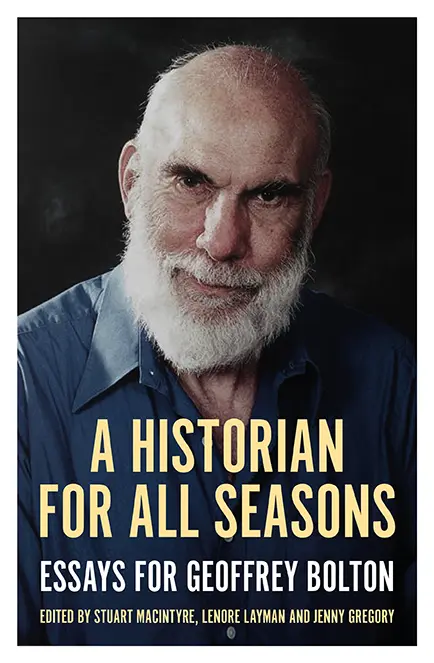
Featured Image: From Macintyre, Layman, Gregory, A Historian for All Seasons. Geoffrey Bolton.


Neville Buch
Latest posts by Neville Buch (see all)
- The Personalist Approach to Argument: Dialectic, Relationality, and the Spiral of Human Authorship – October 12, 2026
- From Augustine’s Pears to Academic Boycotts: Fundamental Sociological Change in Australian Cultural Relations – October 11, 2026
- Yes, I want Anger Expressed But Then Resolved – October 11, 2026