
Series Abstract: For the past few years, I have been researching and writing about the defuncted Department of History, University of Queensland, 1911-2000. It will take a few more years before a tome on the subject may be published. In the meantime, it has occurred to me to write up on the past academics of what is now called the school of “Historical and Philosophy Inquiry”. It is certainly appropriate for myself as my career at UQ began in this direction of interdisciplinary thought. The series publishes the articles in not particular order, and selection is based on the availability of materials.
Abstract
This essay explores the historiographical and theological contributions of Charles Ringma, an Emeritus Professor and Honorary Professor at the University of Queensland within the School of Historical and Philosophical Inquiry (HAPI). Ringma’s intellectual project is defined by a critical engagement with dialogical hermeneutics, specifically the work of Hans-Georg Gadamer, which he utilizes to bridge the gap between academic theology and transformative social practice. His historiography rejects the “uncritical assimilation” of tradition, instead advocating for a “fusion of horizons” where the past is revitalized through a dialogue with the pressing social concerns of the present—particularly those of the marginalized. By integrating the “hermeneutics of suspicion” with a commitment to social justice, Ringma moves historical and religious inquiry from narrow specialization toward a broad social accountability, effectively functioning as a “transformative intellectual” in the Asia-Pacific region.
——————————————————————————–
PDF File: Charles Ringma. Comprehensively Christian Historiography
The Historiography of Charles Ringma: Dialogue, Distance, and Justice
Charles Ringma’s position within the University of Queensland’s intellectual lineage is marked by his 1991 doctoral dissertation, Gadamer’s Dialogical Hermeneutic, submitted to the Department of Studies in Religion (now part of HAPI). This work serves as the foundational text for his historiographical method, which treats the interpretation of history and scripture not as a search for static, objective facts, but as a dynamic, dialogical event.
- Rejection of Objectivist Historical Methods
A central pillar of Ringma’s historiography is an extensive critique of objectivist historical methods. Drawing on Gadamer, he argues that objectivism fails to understand its own “historicality” and often treats the historical text as a passive object to be dominated by the interpreter. Ringma contends that an adequate historical approach must respect the text’s “distance, strangeness and particularity” while recognizing that the interpreter’s own “pre-understanding” (Vorurteil) is an inescapable part of the process.
- The Fusion of Horizons and “Effective-Historical Consciousness”
Ringma emphasizes the concept of Horizontverschmelzung (fusion of horizons), where the meaning of a historical text or event is not found solely in its past context but emerges from the interaction between the past horizon and the interpreter’s present horizon. This approach necessitates an “effective-historical consciousness”—an awareness of how history continues to exert power over the present. For Ringma, this is not a move toward relativism but a commitment to a truth that is worked out through the “dialectic of question and answer”.
- Historiography as Social Critique
Ringma’s work is uniquely characterized by its application of hermeneutic theory to socially marginalized contexts. He evaluates the historiographies of New Testament sociologists and “social theologians” (including feminist, black, and liberation theologians), arguing that the study of the past must be transformative. He integrates the “hermeneutics of affirmation” found in Heidegger and Gadamer with the “hermeneutics of suspicion” associated with Marx, Nietzsche, and Freud to uncover the voices of the oppressed often silenced by dominant historical accounts.
——————————————————————————–
Summaries of Key Articles and Essays
- Towards a True Humanism: Some Small Theological Steps: In this essay, Ringma outlines a theological framework for a humanism that prioritizes individual and social dignity. He argues that reflective self-understanding requires truthfully examining our social and historical bearings to overcome the cognitive failures of our conflicted era.
- Three Graces for a Word of Truth (2017): Co-authored with Remy Chadwick, this work examines the church’s calling in a troubled world. It calls for a “fragile engagement” with contemporary crises, utilizing theological insights to address the “grand design” of social structures while maintaining local relevance.
- Chase Two Horses: Proverbs and Sayings for an Everyday Spirituality (2018): This publication distils Ringma’s focus on “praxis”—the application of wisdom to daily life. It moves away from abstract theory to provide a prolific set of reflections on how Christian faith can lead to human flourishing in an institutionally unbounded way.
- In the Midst of Much-Doing: Cultivating a Missional Spirituality (2023): This work addresses the modern pathology of busy-ness and the “techné mindset”. Ringma advocates for a “missional spirituality” that is grounded in contemplation and social justice, challenging the reduction of human life to mechanical utility.
- “Participating in Communities of Resistance and Hope” (2025): In this reflective paper, Ringma explores the notion of resistance against systemic injustice and the role of “intentional communities” in fostering hope. He links these themes to the “Social Justice of Jesus” and “Radical Discipleship”.
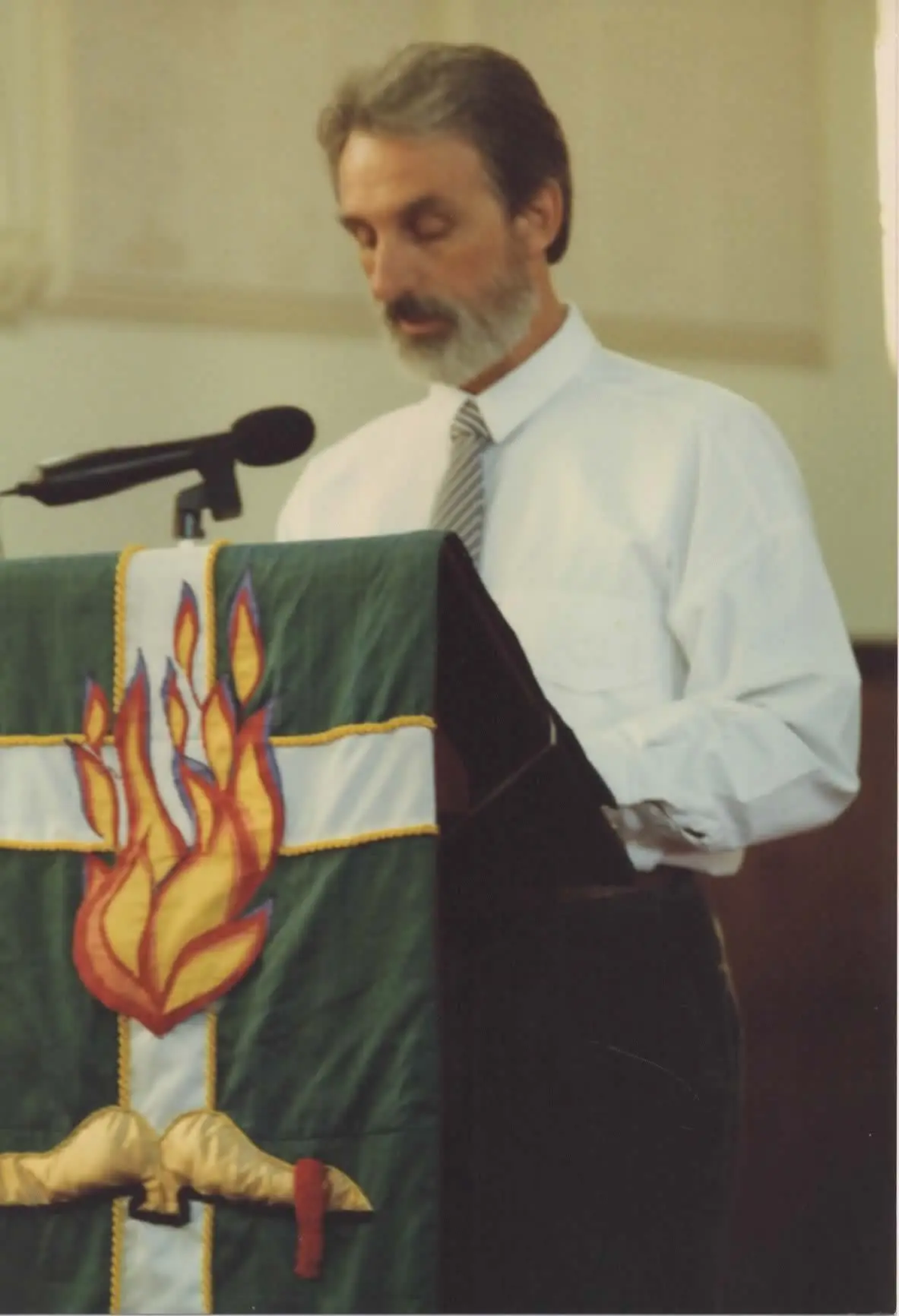
Featured Image: Charles Ringma, 18 June 1988, Kangaroo Point, Queensland, AUSTRALIA.
 uee
uee


Neville Buch
Latest posts by Neville Buch (see all)
- From Augustine’s Pears to Academic Boycotts: Fundamental Sociological Change in Australian Cultural Relations – October 11, 2026
- Yes, I want Anger Expressed But Then Resolved – October 11, 2026
- Part 3:The Failure of an Educational Institution and How to Spiral Forward – October 10, 2026