
Political reform is fundamentally an ontological movement, navigating the subject from the state of Geworfenheit (thrownness) toward the restoration of human authorship. This analysis employs Dr. Neville Buch’s Dynamic of Cognition (DoC) to contrast the “thick” ethical knowledge of the 1950s with the “analytical abyss” of the 2020s. In the mid-20th century, reform was anchored in shared social practices and world-guided concepts that allowed for a “level playing field” within established traditions. Conversely, the 2020s are characterized by “denoetization” and “symbolic misery,” where algorithmic automaticity and “potted thinking” liquidate individual discernment. By synthesizing the “crap detecting” capabilities of the POLICE model with the non-linear methodological habit of “Spiral Historiography,” this essay argues that contemporary policy intelligence must move beyond simplistic binaries. To succeed, the modern politician must transition from unreflective “prejudice”—the deceptive assumption of commonality—to a state of inclusion that affirms the “dignity of difference” and re-establishes the proactive “Who” as the master of the Horizon Worldview.
1. The Divergent Horizons: Why the 1950s is Different to the 2020s
The “states of affairs” defining the 1950s and 2020s are separated by a collapse in cognitive depth. Reform in the 2020s is frequently blocked by “simplistic binaries”—religion vs. secularity, realism vs. idealism—that confuse the actual political landscape (Buch 2024: 1). In the 1950s, the perception of “realism” (how the world is) and “idealism” (our ideas of the world) was structured by a commitment to the “permanent things” of the Burkean and Hobbesian traditions (Architects: 3; Buch 2024: 7). In contrast, the 2020s are defined by “denoetization”—the systematic loss of knowledge-based diversity—and “symbolic misery,” where human agency is surrendered to automated calculation (Stiegler 1998; Buch 2026: 1). This “technical abyss” is exacerbated by what Melinda Laituri (2026: 24) identifies as “specialized ignorance” in humanitarian geospatial AI, where automated systems create a data-driven formalization that severs policy from the multi-textured reality of lived experience.
Comparative Cognitive Landscapes
Feature, 1950s Framework, 2020s Framework
· Dominant Logic, Thick ethical concepts; world-guided and action-guiding (Williams 1985), Algorithmic behaviour; symbolic misery and drive-based reflexes (Stiegler 1998)
· Role of the Individual, “Proactive author with an ““inner gyroscope” “of agency (Gordon-McCutchan 1981)”,” Passive conduit for automated stimuli and ““stencilled” “soundbites (Buch 2026: 1)”
· Information Processing, Reflective synthesis using thick concepts and shared tradition, “Specialized ignorance; ““potted thinking” “and compressed statements (Buch 2026: 2)”
· Primary Political Fear, “Social disruption and the loss of ““permanent things” “(Kirk)”, Denoetization and the mechanical liquidation of discernment (Buch 2026: 1)
2. The Mechanics of Consensus: How Politics in the 1950s Succeeded
The success of mid-century reform was predicated on “Thick Ethical Concepts” which, as Bernard Williams (1985) and Adrian Moore (2003) argue, are simultaneously “world-guided and action-guiding.” These concepts thrived on shared social practices, providing a structured framework for “human authorship” that prevented the erosion of ethical knowledge by premature reflection.
The 1950s drew from “Philosophic Radicalism” (Bentham and Mill), utilizing a scientific approach to political economy to uproot “Old Corruption” (Architects: 4-5). This was balanced by T.H. Green’s “Positive Liberty,” which tasked the state with creating the moral conditions for individual realization (Architects: 6). Unlike the reactive movements of the 2020s, mid-century reform operated within a “Heroarchy” influenced by Thomas Carlyle and the Cromwellian order, providing a foundation for stable, hierarchical leadership that viewed society as an organic entity with mutual obligations (Architects: 8, 22).
Reform operated on a “presumption for the level playing field,” utilizing an “inner gyroscope” of biblically guided conscience to navigate social transformation without lapsing into chaos (Gordon-McCutchan 1981: 309; Buch 2024: 10). This allowed for a transition from unreflective “Established Tradition” to a “Liberal” framework that remained context-embedded but not context-determined.
3. The Analytical Abyss: How Politics in the 2020s is Failing
Contemporary failure is rooted in the “closed loop” of automaticity. According to the Dynamic of Cognition (DoC), all thought begins with Geworfenheit (thrownness), leading to “prejudice”—the unexamined belief in “commonality” (Buch 2025: 1; Buch 2026: 2). The 2020s have failed to move beyond this cycle, resulting in “Exclusion” and an “Analytical Abyss” where policy is divorced from the “Other” (Buch 2026: 3).
A primary driver of this collapse is the “political falsehood” of William F. Buckley’s Up From Liberalism (1959). Buckley’s narrative was a “political device to deliberately confuse the public,” fusing reactionary traditionalism with classical liberalism to claim that “liberalism has no position” (Buch 2024: 8; Buch 2025). This “weed of a lie” facilitated the “hollowing out” of conservative culture described by John Gray, eventually yielding the chaotic “Trumpism” of the current era (Architects: 11; Buch 2025).
The 2020s suffer from “Dilemmas of humanitarian geospatial AI,” where technical formalisms replace empathetic inclusion (Laituri 2026: 24). This results in a state where the individual is a “passive conduit” for dominant ideologies, repeating “stencilled” soundbites rather than engaging in the labour of deep reflection (Buch 2026: 2).
The Four Maladies of 2020s Political Cognition
● Prejudice: The unreflective state of Geworfenheit where individuals assume their perception is a universal standard, leading to “potted thinking” (Buch 2026: 2).
● Attitude-Reinforcement: A “residue of experience” that functions as an unconscious habit, expressing “profound tendencies in a drive toward action” without conscious inquiry (Buch 2025: 2; Buch 2026: 2).
● Misaligned Typologies: The reliance on “simplistic binaries” (Religious vs. Secular) that ignore the “plurality of worth” and incommensurable goods (Buch 2024: 1; Buch 2026: 2).
● Wilful Exclusion: The systematic filtering of information that is “beyond the horizon worldview,” leading to “Historical Forgetfulness” and “institutional arrogance” (Buch 2025; Buch 2026: 3).
4. The Humanistic Ascent: What 2020s Politicians Must Do to Succeed
Success requires a “humanistic ascent” toward “Open Constitutionalism “a framework negotiated through periodical reform and a “dialogical approach” (Buch 2024: 10; Habermas 1979). This necessitates the removal of privileged status for any grouping to foster a genuine “level playing field” (Symposium Concept 2024).
Politicians must adopt the POLICE model (Philosophically Ontology Logic Intersect Compatibility Education) as a “procedural mechanism” for “crap detecting.” This filter deconstructs “institutional bullshit” and “vindicatory histories” that merely justify the current status quo (Buch 2025; Buch 2026: 4).
Policy intelligence must be grounded in Spiral Historiography, a “non-linear methodological habit” of reading the past inclusively. By integrating past philosophical insights with “modern inclusivity,” politicians can “unhook” faith and policy from restrictive dogmas to “re-author the future” (Buch 2025: Applications).
Action Plan for Policy Intelligence
- Implementing the POLICE Model: Systematically filter out manufactured myths and “vindicatory narratives” to transition from unreflective habit toward social accountability (Buch 2026: 5).
- Fostering Noetic Diversity: Reject “monopolistic exclusion” in favour of a “dialogical approach” that recognizes the “dignity of difference” between all substantive belief systems (Buch 2024: 11; Krabbendam 2014).
- Transposing Ethical Experience: Take the unreflective, spontaneous experiences of the past and transpose them into a “new context of intelligence and judgment” to restore human authorship (Moore 2003; Buch 2025).
- Achieving Philosophical Compatibility: Cultivate an intellectual state where the individual is “simultaneously rational, skeptical, and humanist,” ensuring policy is “context-embedded but not context-determined” (Buch 2025; Buch 2026: 5).
This essay continues to presents a rigorous analysis of the contemporary democratic crisis in the United States, specifically the era of 2017–2029, through the synthesis of cognitive sociology, political theory, and historical critique. The core thesis posits that contemporary politics, exemplified by the “humourless” populism of the Trump presidency and its subsequent ideological entrenchment, represents a self-defeating reduction of governance to pure agonism and “institutional bullshit.” This decline is fundamentally a cognitive failure, characterized by the collapse of “Human Authorship” and the rise of “denoetization”—a loss of individual agency to automated, drive-based reflexes. Utilizing Dr. Neville Buch’s “Dynamic of Cognition” (DoC) and “Spiral Historiography,” the narrative explores how the Republican Party underwent a “theological capture,” where reactionary intent was masked by revivalist tradition to justify neoliberal precarity. By evaluating the early 21st-century cultural premonition found in Barry Levinson’s Man of the Year (2006), the essay identifies the crucial differentiator between the film’s disruptive satire and the subsequent reality: the presence of a “moral exit” versus a descent into a self-perpetuating “Analytical Abyss.” This abyss, the essay argues, is the direct result of the wilful exclusion of the “Other” and the reliance on “potted thinking”—ready-made statements that circumvent deep reflection. Finally, the essay proposes a path toward renewal through “open constitutionalism” and the application of the POLICE model (Philosophically Ontology Logic Intersect Compatibility Education). By reclaiming “thick ethical concepts” and honouring individual “ground projects,” the narrative advocates for a transition from passive conduit to proactive author. Through “Spiral Historiography,” individuals may “unhook” faith and policy from unreflective dogma, achieving a state of “philosophical compatibility” essential for a realistic, deliberative utopia.
1. The Ontological Friction of Politics: Between Cooperation and Agonism
The strategic viability of a democratic state rests upon its capacity to maintain “politics” as a field of productive tension rather than a theatre of terminal conflict. In its most functional form, politics is a specific institutional activity aimed at resolving conflict through conciliation, grounded in a “Level Playing Field” where substantive belief systems are treated with equitable regard (Wikipedia 2026; Buch 2024). However, when the balance between cooperation and agonism is severed, the system descends into a self-defeating cycle of decay. The decline of the modern American state is best understood through the collapse of “thick ethical concepts”—those evaluative terms like justice, integrity, or courage that uniquely unite factual description with moral meaning (Williams 1985). When these are replaced by “thin” concepts and technical formalisms, the state enters the “Analytical Abyss.” Contrary to popular assumption, this abyss is not merely a vacuum of information; it is the specific result of Exclusion within the Dynamic of Cognition (Buch 2026). It is the state of what is filtered out through “wilful ignorance”—the systemic exclusion of the “Other” to preserve a perceived commonality that no longer exists. When politics is reduced to the Schmittian friend/enemy distinction, it ceases to be a tool for governance and becomes a mechanism for deception or kleptocracy (Wikipedia 2026). This agonistic reduction transforms the individual into a “passive conduit” for dominant ideologies. The resulting “Specialized Ignorance” allows for a governing style that thrives on “institutional bullshit”—a total indifference to truth that prioritizes the forcefulness of an idea over its veracity. This foundational rot, gestating within the cognitive structures of the electorate, found its cultural avatar in the celebrity populism of the mid-2000s.
2. Prescience and Parody: “Man of the Year” and the Rise of Humourless Populism
The 2006 film Man of the Year serves as a critical “states of affairs” description (Buch 2024) for the celebrity populism that would eventually dominate the 2017–2029 landscape. Barry Levinson’s film, featuring Robin Williams as comedian Tom Dobbs, presciently captured the fragility of the “level playing field” and the potential for an outsider to disrupt the political establishment. However, the film’s most profound insight lies in the differentiator between its fictional protagonist and the subsequent enactment of Trumpism. Tom Dobbs represents a disruptive but ultimately moral force; his trajectory concludes with a “moral exit”—a recognition of systemic failure that leads him to prioritize democratic integrity over personal power. In contrast, the Trump era (2017–2021, 2025–2029) enacted the Dobbsian premise “without the humour.” Using what Frankfurt (2005) and McManus (2020) define as “bullshit,” the era’s rhetoric was characterized by an indifference to truth that served as an agonistic weapon. The “truthful hyperbole” of the Trump presidency was not a satirical tool to expose the system, but a reactionary wedge to uproot liberal gains. The shift from the film’s disruption to the reality of January 6 and trade wars signifies a state of “Historical Forgetfulness.” The modern populist movement, unlike Dobbs, lacks the mechanism for a satirical “reset” because it has systematically banished the historical context of its own ideas. It is a movement caught in the “weed of a lie,” where the lack of self-awareness transforms political theatre into a humourless, self-defeating spiral of backsliding. This was not an isolated phenomenon but the result of the GOP’s long-term theological and cognitive capture.
3. The Historical Reckoning: The GOP, Theological Capture, and Institutional Bullshit
A political movement grounded in “historical forgetfulness” inevitably faces a governing crisis. The Republican Party’s trajectory from Cold War fusionism to its current posture reflects a deep-seated structural rot. Dr. Neville Buch identifies the catalyst for this decline in William F. Buckley Jr.’s Up From Liberalism , which he characterizes as a “weed of a lie.” For the Political Philosopher, a crucial distinction must be made: Buckley’s neo-conservatism was not merely “resistant to reform” (conservative) but fundamentally reactionary —actively seeking to uproot liberal gains under the mask of intellectualism. This trajectory facilitated a “theological capture,” where the American Revivalist Tradition (ART) provided “theological masks” for neoliberal precarity. As thinkers like Hazony and Scruton have argued, the shift toward a “life of piety” and “national sovereignty” served as a rhetorical shield for power, replacing genuine tradition with an “Apologetics Industry” designed to maintain “Specialized Ignorance.” This industry sustains the GOP’s postmodern conservatism through several cognitive mechanisms:
● The Analytical Abyss: The filtration of the “Other” and the rejection of lived experience in favour of thin, ideological formalisms.
● Theological Capture: The subordination of secular policy to dogmatic purity, masking a reactionary intent to dismantle the social contract.
● Rejection of the Level Playing Field: The abandonment of fair competition in favour of preserving inherited privilege (Buch 2024).This reliance on “institutional bullshit” creates a cycle of “potted thinking”—the acceptance of ready-made statements that save the individual from the labour of deep reflection (Buch 2026). This cognitive failure is a form of “Symbolic Misery” (Stiegler/Buch), where human agency is lost to automated, drive-based reflexes. A movement based on resentment-based postmodern conservatism cannot constructively govern because it has replaced policy-based deliberation with the mechanical liquidation of discernment.
4. The Democratic Spiral: Reclaiming Human Authorship and Open Constitutionalism
To exit this self-defeating cycle, the political system requires a shift toward “Spiral Historiography”—a non-linear method of reading the past to inclusively re-author the future (Buch 2025; Moore 2003). This involves “unhooking” faith and policy from unreflective dogma to achieve “Philosophical Compatibility.” The path to renewal necessitates the application of the POLICE model (Philosophically Ontology Logic Intersect Compatibility Education) to counter the “denoetization” of the public sphere. The “Logic” and “Intersect” components of the POLICE model specifically target “potted thinking” by demanding a rigorous deconstruction of internal narratives and an intersectional engagement with the Other. This facilitates a move toward Habermasean “Communicative Action,” where dialogue replaces agonism. The transition is best conceptualized as the shift from the “Closed Constitutionalism” of the old GOP to a proposed “Open Constitutionalism”.
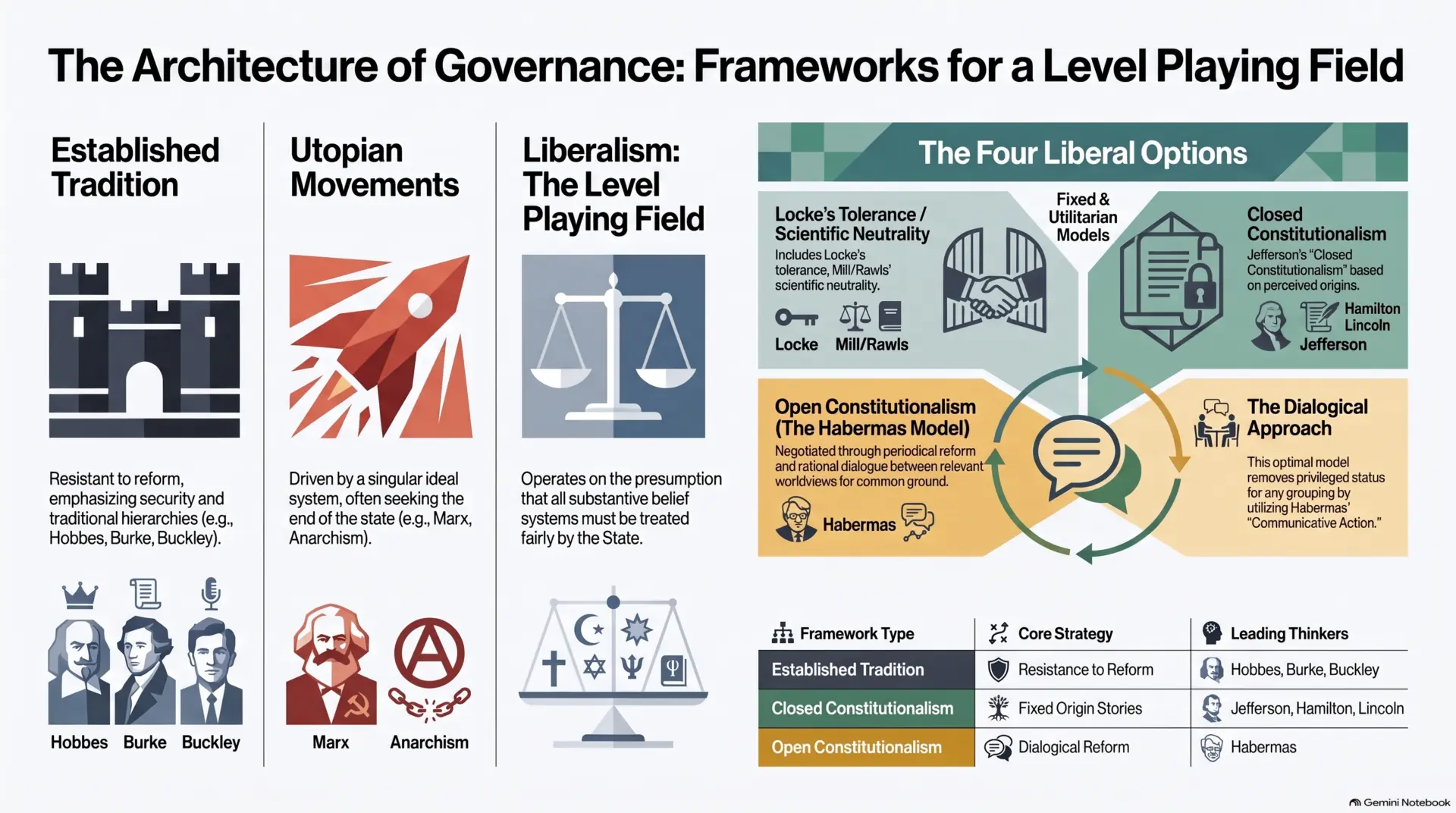
The restoration of Human Authorship is the ultimate safeguard against “Symbolic Misery.” Drawing on Bernard Williams’ (1981) concept of “Ground Projects,” we must recognize that an individual is defined by categorical desires that constitute character. A moral or political system that demands absolute, unreflective obedience risks the exclusion of the self. Renewal requires the individual to move from a “Junior” mindset of unreflective execution to a “Senior” state of social accountability. By mastering their own evolving “Horizon Worldview” (Buch 2026), the proactive author ensures that the state remains a realistic utopia—a space where faith, reason, and humanism coexist on a level playing field.
BIBLIOGRAPHY
Altman, M. J. (2019). ‘Religion, Religions, Religious’ in America: Toward a Smithian Account of ‘Evangelicalism’. Method & Theory in the Study of Religion, 31(1), 71–82.
Buch, N. (2024). Semantics and Strategies for the Level Playing Field. Management Institute for Contributory Economy.
Buch, N. (2025). The Dynamic of Cognition: Cognition Histories and Sociology. Management Institute for Contributory Economy.
Buch, N. (2025). Buckley’s Up From Liberalism Mind-Twister. Management Institute for Contributory Economy.
Buch, N. (2025). Applications in Liberalism. Management Institute for Contributory Economy. Management Institute for Contributory Economy.
Buch, N. (2026). Basic Social Psychology: Architecture of the Horizon — Navigating the Dynamic of Cognition.
Buch, N. (2026). Architecture of the Horizon: Navigating the Dynamic of Cognition. Management Institute for Contributory Economy.
Frankfurt, H. G. (2005). On Bullshit. Princeton University Press.
Gordon-McCutchan, R. C. (1981). The Irony of Evangelical History. Journal for the Scientific Study of Religion, 20(4), 309–326.
Habermas, J. (1979). Communication and the Evolution of Society. Beacon Press.
Laituri, M. (2026). Dilemmas of humanitarian geospatial artificial intelligence. Academia AI and Applications.
Levinson, B. (Director). (2006). Man of the Year Film. Morgan Creek Productions.
McManus, M. (2020). The Rise of Post-Modern Conservatism.
Moore, A. (2003). Williams on Ethics, Thick Knowledge, and Reflection. Philosophy, 78: 337–354.
Noll, M. A. (1994). The Scandal of the Evangelical Mind. Eerdmans Publishing Company.
Siedentop, L. (2014). Inventing the Individual: The Origins of Western Liberalism. Penguin.
Stiegler, B. (1998). Technics and Time, 1: The Fault of Epimetheus. Stanford University Press.
Wikipedia. (2026). Politics. Excerpts regarding Agonism, Moralism, and Governance.
Williams, B. (1981). Moral Luck. Cambridge University Press.
Williams, B. (1985). Ethics and the Limits of Philosophy. Fontana Press.
Williams, B. (2002). Truth and Truthfulness: An Essay in Genealogy. Princeton University Press.


Neville Buch
Latest posts by Neville Buch (see all)
- The Unbound Mind: Independent Scholarship, Institutional Isolation, and the Restoration of Human Authorship – October 20, 2026
- The Road to Geelong: A Re-Narrativization of The Story of Resilience Part 1 – October 20, 2026
- The Human Being Above the Transaction and Why Markets Cannot Measure Human Worth – October 15, 2026