
Dr Neville Buch
https://www.academia.edu/166258355/An_Account_of_Intellectual_Communities_The_Dynamic_of_Cognition_and_the_Archetype_of_the_Person
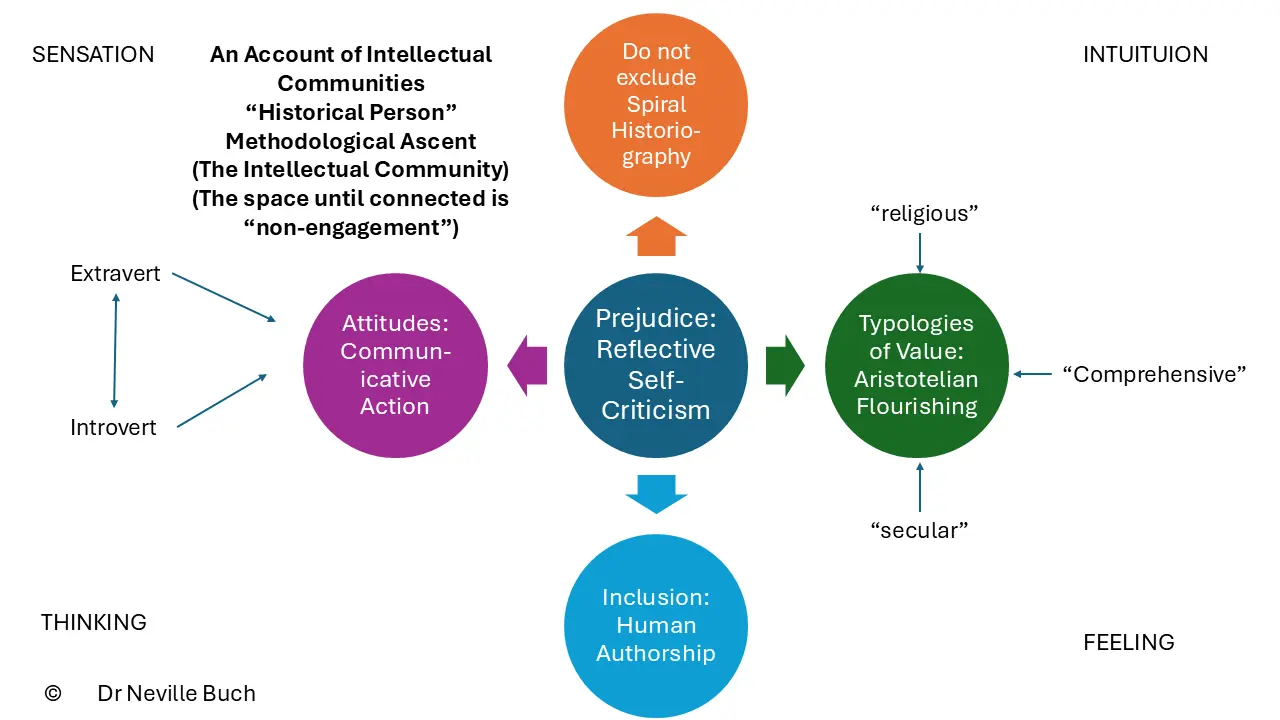
This essay provides a comprehensive Dynamic of Cognition (DoC) analysis of the diverse intellectual communities detailed in the sources, including the Management Institute for Contributory Economy (MICE), the Sea of Faith in Australia (SOFiA), and radical Christian experiments such as the House of Freedom and the Waiters Union. It argues that these communities, despite their varied theological or secular foundations, are bound by a shared resistance to “denoetization”—the mechanical liquidation of human judgment—and a commitment to the archetype of the “Person”. By utilizing spiral historiography to uncoil patterns of historical forgetfulness and the 0-1-3 method to build relational stability, these groups aim to transition from a “Junior” state of passive compliance to a “Senior” state of social accountability, ultimately striving for Aristotelian flourishing.
——————————————————————————–
Intellectual Communities: From Denoetization to Authorship
- The Relational Core: The 0-1-3 Method
The sources identify the 0-1-3 method as the fundamental building block for sustainable intellectual communities. This methodology posits that group formation begins with a triad (three individuals) that establishes a stable structure of independent but connected relationships, preventing the “domination of one person by another”. This core is evident in the history of the House of Freedom (HOF), which evolved from a student mission into a settled intentional community focused on “radical discipleship,” and the Waiters Union, which emphasizes “friendship with Christ” and “acceptance not agreement”.
- The Theological and Philosophical Synthesis
A “Jesus intellectual community” is bound together by a methodology—most clearly articulated by Gregory C. Jenks—that merges archaeology, history, and personal reflection. This approach treats religious texts with the same critical scrutiny as historical artifacts, moving the community from “unreflective habit” toward a “rigorously scientific” study of tradition. For SOFiA, this synthesis takes the form of non-realism, where “God” is understood as a human cultural construction, creating a “level playing field” for inter-belief dialogue. Both frameworks seek “Sufficient Comprehension”—the ability to seek the whole of a matter while remaining permanently open to correction.
- The Structural Map: Row 4 of the Matrix
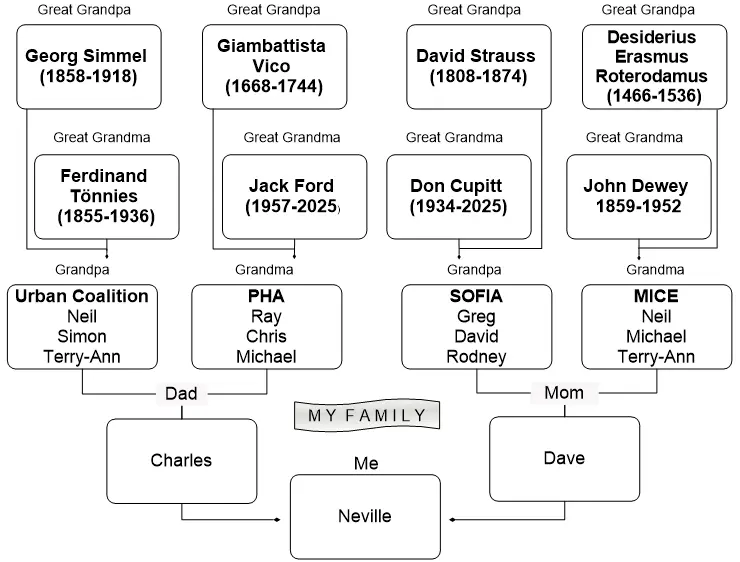
In Dr. Neville Buch’s “Matrix of Sociology,” these communities occupy Row 4 (The Basic Individual-Collective). The institutional focus is the University (broadly defined as a community of scholars), anchored by the prophet Erasmus and the archetype of the “Person”. Legitimacy in this domain is derived from Charismatic Authority (Holy Spirit), which is rooted in specialized expertise and an “inner calling” to truth. This order is dedicated to the functions of scholarship and writing, creating a “collective memory” that resists the “symbolic misery” of automated digital stimuli.
- The Methodological Corrective: Spiral Historiography
A primary function of these intellectual communities is “crap detecting”—the systematic unmasking of “institutional bullshit” and manufactured myths. This is achieved through Spiral Historiography, a “post-post-postmodernist” approach that reads ancient texts as inclusively modern and “uncoils” repetitive patterns of intellectual error. By tracing the history of “big belief and doubt,” these groups combat “Historical Forgetfulness”, ensuring that the individual remains the proactive author of their narrative rather than a “puny human node” in a calculative network.
- Transition to Seniority: Social Accountability
The ultimate goal across these communities is the “neganthropic turn”—the process of converting technical and social power into a force for the collective good. This requires a developmental ascent from a “Junior” mindset of docile execution toward a “Senior” state of conscious competence and social accountability. In this state, the historian or scholar acts as a “transformative intellectual” who bridges the gap between abstract theory and the practical needs of the republic, fostering an environment where human beings master their technical systems.
——————————————————————————–
Dynamic of Cognition (DoC) Table: Full Account of Intellectual Communities
| DoC Component | Pathological Regression (Stagnant/Massified) | Methodological Ascent (The Intellectual Community) | Epistemological Rationale |
| Prejudice (Centre) | Technical Administration: Treating relations as calculation problems. | Reflective Self-Criticism: Institutional focus on the “Person” and reason. | Moves from mindless habit to active authorship. |
| Attitudes (Thinking) | Mechanical Techné: Reducing life to quantifiable data and “job-ready” utility. | Communicative Action: Dialogue aimed at mutual understanding (Verständigung). | Replaces strategic manipulation with noetic judgment. |
| Typologies (Value) | Symbolic Misery: Loss of agency to automated or hegemonic stimuli. | Aristotelian Flourishing: Success measured by wisdom, character, and dignity. | Affirms the complexity of the person over vocational fitness. |
| Exclusion (Sensation) | Historical Forgetfulness: Systemic banishment of origins and shared struggles. | Spiral Historiography: “Uncoiling” patterns of error to reveal political roots. | Filters out manufactured myths and “institutional bullshit”. |
| Inclusion (Intuition) | Puny Human Node: Reducing the person to a data point in a network. | Human Authorship: Reclaiming the role as the proactive creator of meaning. | Restores the capacity for new beginnings (Natality). |
——————————————————————————–
Bibliography
- Arendt, H. (1977). The Life of the Mind. Harcourt Brace Jovanovich.
- Buch, N. (2025). MICE Principles and Philosophy (First Development). Management Institute for Contributory Economy.
- Buch, N. (2025). The Dynamic of Cognition. Academia.edu.
- Buch, N. (2026). A Matrix of Sociology. Management Institute for Contributory Economy.
- Buch, N. (2026). Limited Thinking and the Contributory Economy. Management Institute for Contributory Economy.
- Buch, N. (2026). MICE: From Hyperintelligent Species to Human Authorship.
- Buch, N. (2026). The Jesus Intellectual Community: Synthesis and Solidarity.
- Cupitt, D. (2008). The Meaning of the West. SCM Press.
- Habermas, J. (1979). Communication and the Evolution of Society. Beacon Press.
- Jenks, G. C. (2014). Jesus Then and Jesus Now: Looking for Jesus, Finding Ourselves. Morning Star Publishing.
- Lonergan, B. J. F. (1972). Method in Theology. Herder & Herder.
- Stiegler, B. (1998). Technics and Time, 1: The Fault of Epimetheus. Stanford University Press.
- Westoby, P., et al. (2025). The Community Builder’s Journal. Practical Action Publishing.
——————————————————————————–
Endnotes
- MICE utilize a “post-post-postmodernist” approach bounce ideas off past scholars via AI.
- SOFiA is rooted in Don Cupitt’s non-realist philosophy.
- The House of Freedom was an intentional community based on “radical discipleship.”
- The 0-1-3 method is the primary building block for sustainable groups.
- The “techné mindset” reduces human life to quantifiable data and vocational fitness.
- The “Person” archetype is an individual who is the object of their own reflective consciousness.
- Denoetization is the mechanical liquidation of human discernment and judgment.
- Spiral historiography uncoils repetitive patterns of stupidity in collective memory.
- “Historical Forgetfulness” is a systemic pathology where a society repeats errors after origins are forgotten.
- Sufficient Comprehension is the ability to seek the whole while remaining open to correction.
- Reclaiming human authorship ensures that the “who” remains the master of the “what.”
- The “Senior” state is characterized by conscious competence and social accountability.
- “Crap detecting” involves unmasking “institutional bullshit” and manufactured myths.
- In Row 4, the “University” is a community of scholars dedicated to rational-critical dialogue.
- Natality refers to the human capacity for new beginnings through free thought.
Featured Image: “It is not a laughing matter, daughter”.



Neville Buch
Latest posts by Neville Buch (see all)
- Part 3:The Failure of an Educational Institution and How to Spiral Forward – October 10, 2026
- Part 2:The Failure of an Educational Institution and How to Spiral Forward – October 10, 2026
- Part 1:The Failure of an Educational Institution and How to Spiral Forward – October 10, 2026