
PDF FILE: The Cognitive Organic Mechanics of Outlander’s Historical Workshop
https://www.academia.edu/166781431/The_Cognitive_Organic_Mechanics_of_Outlander_s_Historical_Workshop
The Outlander Workshop: Cognitive Landscapes of the 18th Century
I. Contractarianism and the Strategic Social Deal
In Outlander, the social structures of 1743 Scotland are characterized by a Hobbesian Contractarianism. This political theory posits that legitimate authority and moral norms derive from mutual agreement based on self-interest and mutual advantage. The clan system, led by figures like Jamie Fraser and Colum MacKenzie, operates as a “strategic deal” for security against the “depredations of others”—notably the encroaching British Crown. Unlike Contractualism, which is rooted in Kantian mutual respect among equals, the contractarian world of the Highlands is driven by the need for survival in a volatile environment.
II. Superstition as a Contrarian Tool for Uncertainty
Superstition and Contrarianism emerge in the series as psychological mechanisms to manage the “abyss of ignorance” regarding the unknown. While superstition is often dismissed as a pejorative “fear-based or magical thinking,” it functions in Outlander as a “contrarian” tool to manipulate fate. In high-stakes situations where individuals lack real control—such as the looming Jacobite rising—superstition provides a perceived sense of influence. This “contrarian superstition” involves wishing for the opposite of a true desire to prevent bad luck, a behaviour that mirrors the Contrariants of the 14th century who defined themselves by their opposition to the mainstream.
III. Displaced Expertise: The Expertise Reversal Effect
The protagonist, Claire Randall, embodies the Expertise Reversal Effect. As an expert in 20th-century medicine and history, her advanced schema (long-term memory structures) allows her to perform fluently in tasks that are unintelligible to her 18th-century peers. However, the expertise reversal effect dictates that instructional techniques (or communication strategies) that assist “novices” can be neutral or even harmful for experts. Claire’s attempts to “guide” her peers with future knowledge often lead to a cognitive load conflict, resulting in negative consequences such as witchcraft accusations. Her expertise requires “reduced guidance” and adaptive fading in how she presents the truth to avoid overwhelming the limited “working memory” of a society trapped in Historical Forgetfulness.
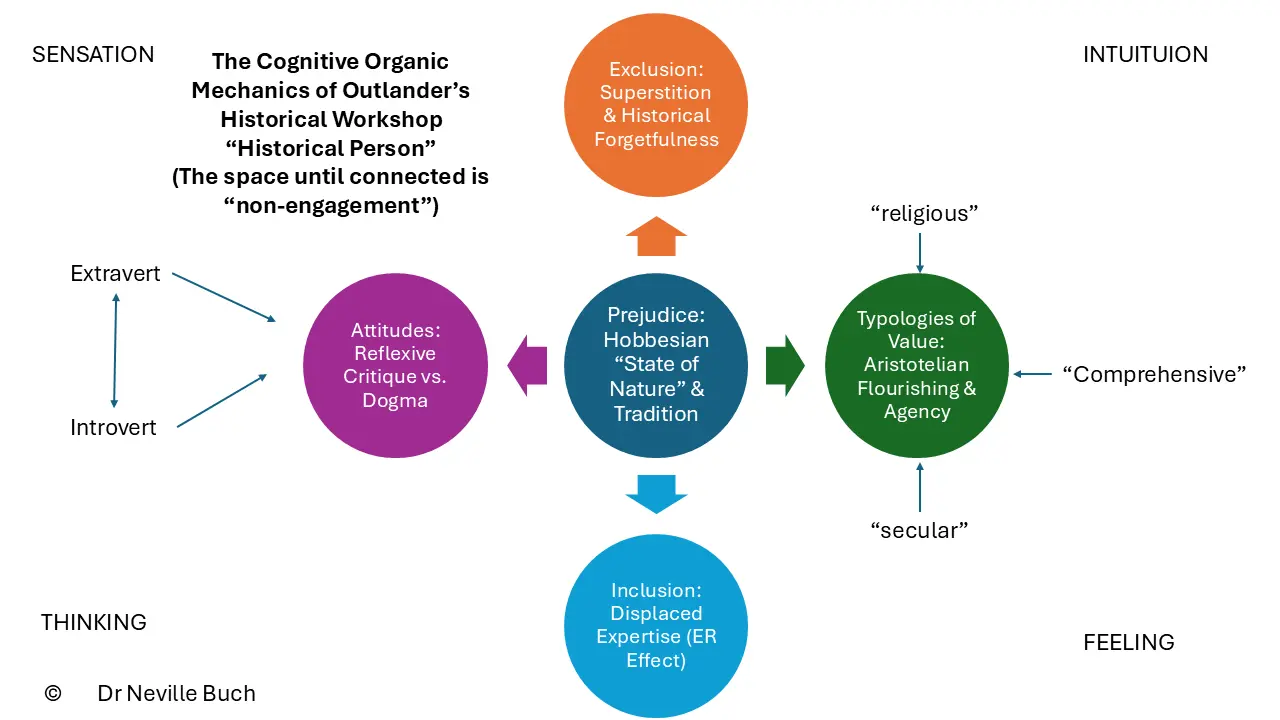
Dynamic of Cognition (DoC) Table: Cognitive Relations in Outlander
| DoC Component | Phenomenon in Outlander | Source Rationale and Cognitive Impact |
| Prejudice (Centre) | Hobbesian “State of Nature” & Tradition | The initial unreflective starting point where life is “brutish and nasty” and security is found only in the Clan contract. |
| Attitudes (Thinking) | Reflexive Critique vs. Dogma | Claire’s internal struggle to apply modern logic (Reason) against the unexamined beliefs (Prejudice) of the 1740s. |
| Exclusion (Sensation) | Superstition & Historical Forgetfulness | The filtering out of scientific facts in favour of “official stories” and magical thinking to maintain social order. |
| Inclusion (Intuition) | Displaced Expertise (ER Effect) | The challenge of integrating advanced future schema (Expertise) into a “novice” social context without triggering a legitimacy crisis. |
| Typologies of Value (Feeling) | Aristotelian Flourishing & Agency | The ultimate goal of characters attempting to “re-author” history and move from “Junior” execution to “Senior” accountability. |
Bibliography
- Buch, N. (2015, May 31). Process of Learning (Principles) & The Dynamic of Cognition. Dr Neville Buch Research.
- Buch, N. (2025, November 24). Mapping the Cognition of Australian-American Systems. Management Institute for Contributory Economy.
- Cudd, A. (2025). Contractarianism. Stanford Encyclopedia of Philosophy.
- Kalyuga, S. (2007). Expertise reversal effect and its implications for learner-tailored instruction. Educational Psychology Review.
- McKinney, J. P. (1971). The Structure of Modern Thought. Chatto and Windus.
- Kramer, T., et al.(2008). Conscious and Nonconscious Components of Superstitious Beliefs in Judgment and Decision Making. Journal of Consumer Research, 34(6), 783–793. https://doi.org/10.1086/523288
- Moore, R. D. (2014). Outlander [TV Series]. Starz.
- Park, A., & Sabourian, H. (2011). Herding and Contrarian Behaviour in Financial Markets. Econometrica, 79(4), 973–1026. http://www.jstor.org/stable/41237854
- Potter, M.-A. (2019). “Everything and nothing”: Liminality in Diana Gabaldon’s Outlander. Interdisciplinary Literary Studies, 21(3), 282–296. https://doi.org/10.5325/intelitestud.21.3.0282
- Sachs, B. (2016). III—Contractarianism as a Political Morality. Proceedings of the Aristotelian Society, 116(1), 49–67. https://www.jstor.org/stable/26781280
- Stiegler, B. (1998). Technics and Time, 1: The Fault of Epimetheus. Stanford University Press.
- Vyse, S. (2020). Superstition: A Very Short Introduction. Oxford University Press.
Endnotes as References
- Outlander as Workshop: The series simulates the “messiness of humanity” against historical contingency.
- Contractarian Motivation: Contractarianism (Hobbesian) is based on self-interest and “What do I gain?”, while Contractualism (Kantian) seeks mutual justification.
- State of Nature: The initial situation characterises the parties’ motivation to come to an agreement for mutual advantage.
- Expertise Reversal: Instructional guidance that is essential for novices may have negative consequences for more experienced learners.
- Cognitive Load: The reversal is explained by a framework where existing cognitive resources influence the effectiveness of information.
- Superstition as Management: Superstitious rituals arise when individuals face uncertainty or high-stakes situations where they feel they have no control.
- Contrarian Superstition: Individuals trick fate by wishing for the opposite of their true desire.
- Historical Forgetfulness: A state where a population loses context regarding the origins of their intellectual bearings.
- Human Authorship: The recognition that humans are the collective “authors of reality,” responsible for reconstructing experience through co-operation.
- Philosophy in Practice: Understanding history serves as the essential grounding for ethical critique and self-understanding.
Featured Image: Ross, Gordon, Kay, and Neville, back in history.



Neville Buch
Latest posts by Neville Buch (see all)
- The Unbound Mind: Independent Scholarship, Institutional Isolation, and the Restoration of Human Authorship – October 20, 2026
- The Road to Geelong: A Re-Narrativization of The Story of Resilience Part 1 – October 20, 2026
- The Human Being Above the Transaction and Why Markets Cannot Measure Human Worth – October 15, 2026