
Neville Buch (Dr)
Abstract: The writer is involved in Brisbane’s Urban Coalition alliance of community organisations in urban sociology, discussing the planning for the Brisbane Olympics. This article explains why the thinking of the local Brisbane Olympic Committee has strayed so badly. (2023 words).
Unsurprising is that populists, including political representatives, do not know much about Urban Sociology. What is surprising is the lack of understanding in how bad decisions around planning the Brisbane 2032 Olympics will come back to bite. The public has a fair idea of the problems in Olympic events in recent decades. There is a dynamic of cognition inside the local Brisbane Olympic Committee (the thinking):
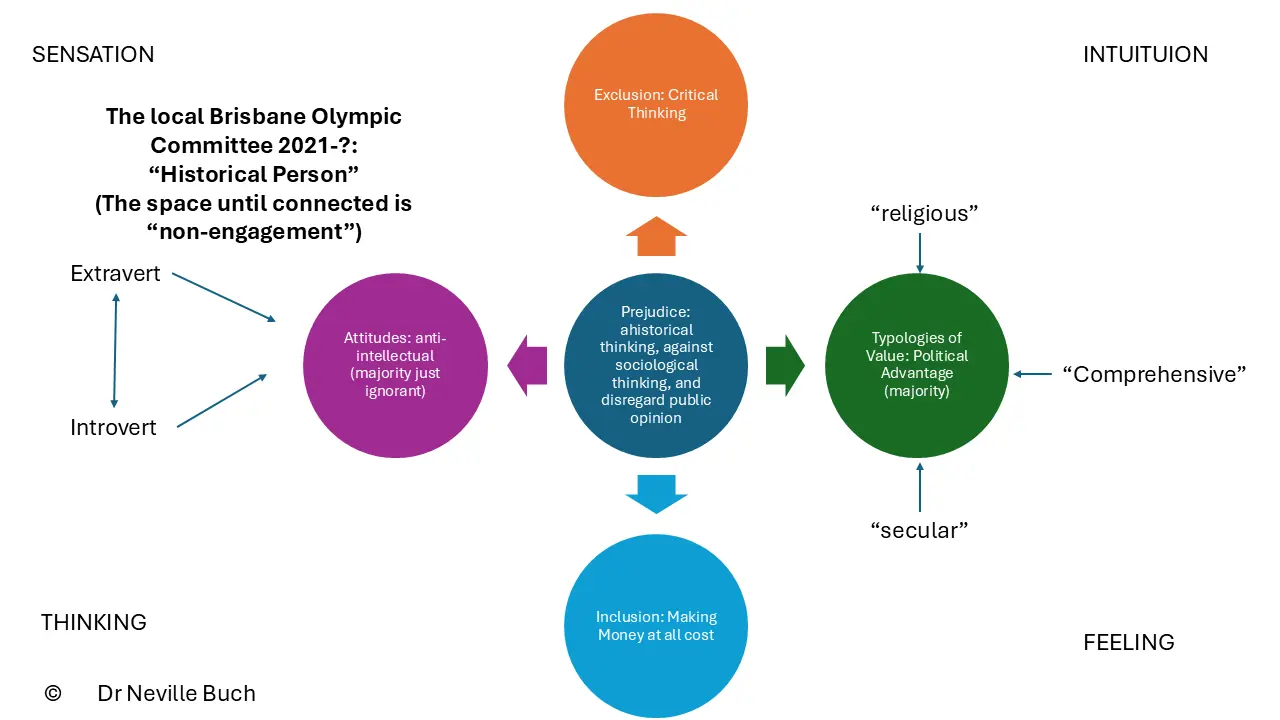
An ahistorical approach significantly hinders effective planning; a failure rooted in a deep-seated culture of anti-intellectualism that minimizes the value of the life of the mind Richard Hofstadter (1955) identified this as a “de-cognitive” process inherent to every “age of reform,” where intellectual rigour is often sacrificed in the hyper-competition over populist ideas. Hofstadter (1963) further demonstrated how this anti-intellectual disposition subtly undermines socio-political planning by replacing expertise with the “plain sense” of the unreflective person. This intellectual decline is often manifested as a “Paranoid Style” of thinking, a phenomenon that, while prominent in the United States, has also deeply affected Australian political culture. Hofstadter’s colleague, C. Wright Mills (1956), described how “power elites” maintain control when they lack the “sociological imagination” (1959) required to connect personal experiences to the broader historical and social framework.
This critical awareness is largely absent in local Australian contexts, despite a rich history of intellectual precedents. C.R. Badger (1971) documented this in the legacy of Reverend Charles Strong, tracing the evolution of his early 20th-century urban missions into a more sophisticated Christian socialism and practical, scientific sociology. While Adelaide has historically served as a planned hub for strong progressivist ideas, other Australian capitals struggle with “Historical Forgetfulness”. In particular, Brisbane’s intellectual ethos has been constrained by a “techné mindset” and a materialist prejudice that dismisses complex abstractions in favour of immediate, quantifiable political profit. Compare political conversations with this model of urban sociological thinking:
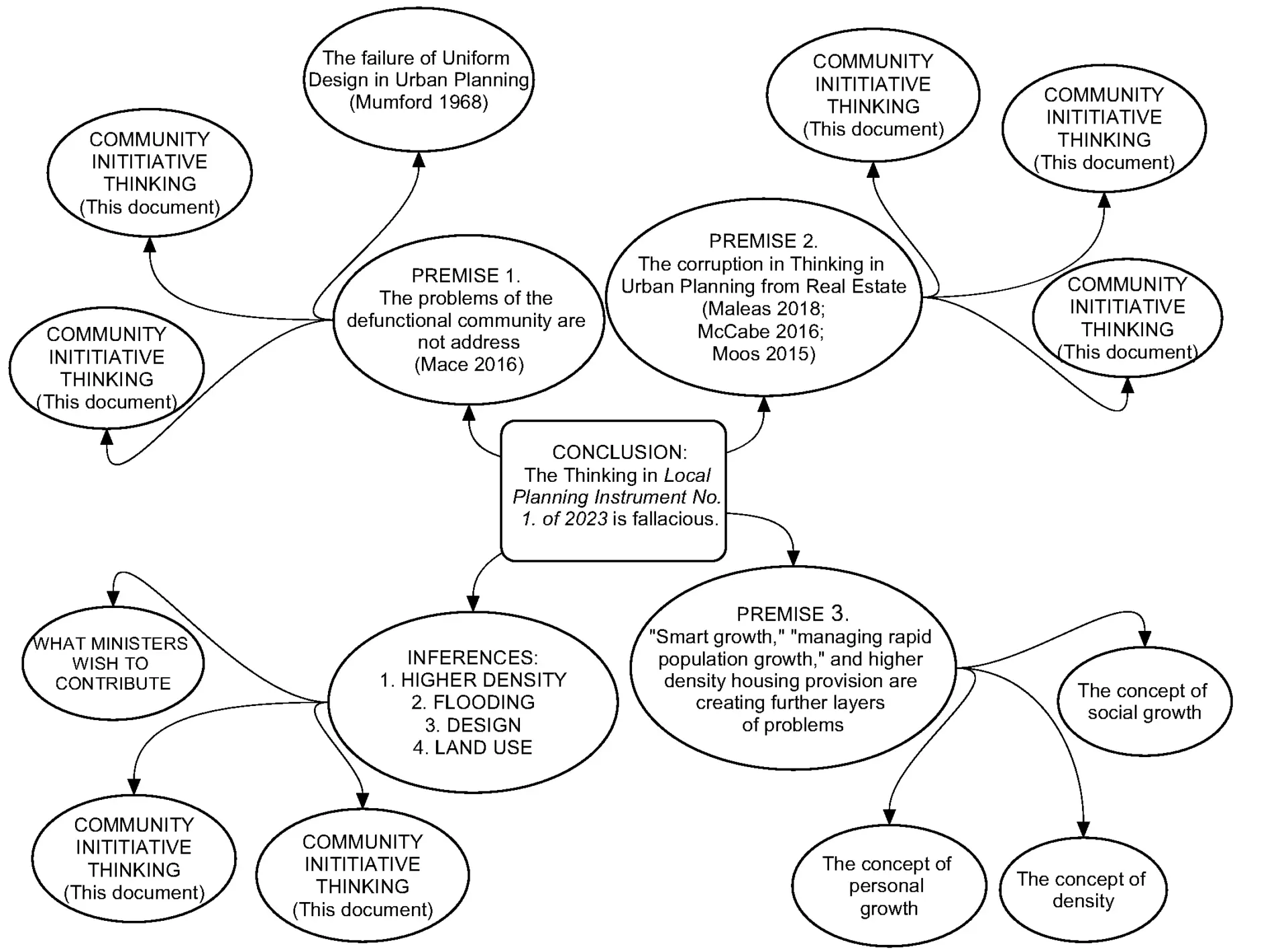
The local industry has been hyped and foolish in its optimism (Rodgers 2021). Fortunately, there are local journalists who are far smarter, such as Jericho (2021). Some of the legitimisation argues for the local Games are fair comments on the need to renew the city’s infrastructure (e.g. Caffrey 2024), but the economic costs have been dishonestly conveyed. And now, currently in Brisbane, legal challenges are mounting (In Daily Queensland 2025). The premature talk is of “Brisbane’s abandoned 2032 Olympic Games” (Artfield 2025). Premature because the politicians will arrogantly push through the project, unless the public opposition makes their re-election unattainable.
However, the poor thinking of Brisbane 2032 Olympics Committee was not necessary. There were better proposals (Buch, Cole 2022) than the ones’ decided. In the 2023 TASA Paper, “Emotion-Caring-Convivial Urban Sociology” Buch (2023) wrote:
Global models operate or do not in the sphere of Brisbane governance. Galuszka (2019:143) examines “participatory planning or self-help housing, co-production has started to gain momentum in the global South context.” That is one model yet to be seen in Brisbane. Cooperative enterprise had existed but they have been kept at arm’s length to the Brisbane City Council over the history. Ormerod and MacLeod (2019:319) also considers entrepreneurial municipal housing strategies in the context of housing governance. Their conclusion in the examination of ‘post-politicizing tendencies in urban planning’… “reveals how [these] anti-democratic processes might be more appropriately understood as political accomplishments on the part of those who have been newly incorporated into a local state in transition.” The description aptly describes the relation of the Brisbane City Council to the Queensland State Government. The State has a tight control over local councils and the processes mute democratic dissent. In the Australian Paradigm, the processes are known as ‘Strategic Planning’ (Searle and Bunker 2010:163-4).
There is a great contrast between the political-appointed Brisbane 2032 Olympics Committee and the Urban Coalition alliance of community organisations. Peach (2024) produced the SBSF Expo document that had this notation:
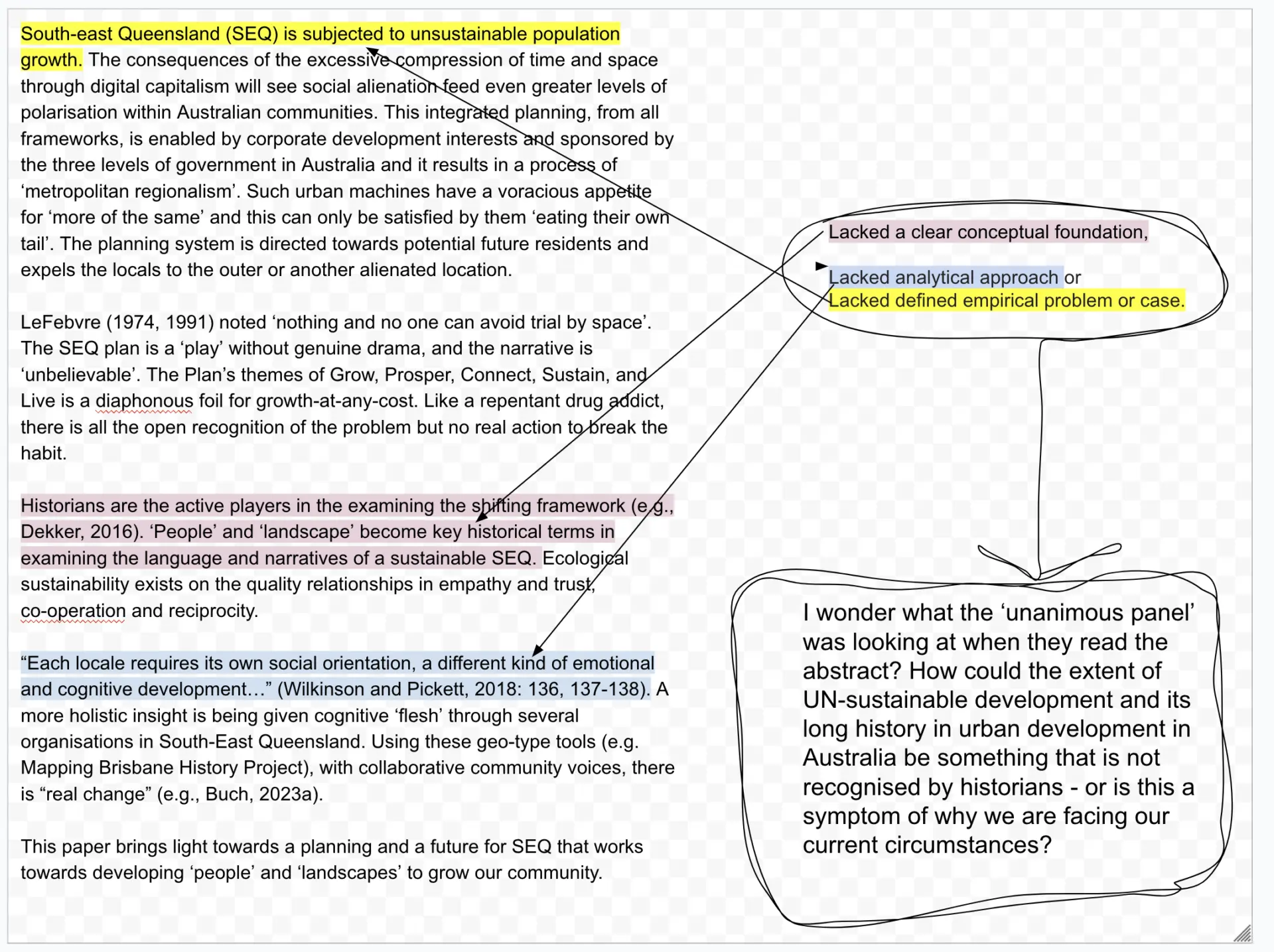
It is a demonstration of self-critical, meta-reflection which political-appointed Committees lack.
In 1976 the Australian Paul Bourke (1976: 211) reviewed Elkin and McKitrick’s essay in the book, The Hofstadter Aegis, noting “the reinterpretation of Hofstadter’s work: his search for a new approach to political analysis and his concern for the historical and contemporary role of intellectuals, those whom C. Wright Mills called ‘the powerless people’.” And “Hofstadter’s lifelong search for an intellectual framework that would transcend the categories of Progressive historical writing.” C. Wright Mills’s historian collaborator, Richard Hofstadter, articulated the facts of the local sociology; that Hofstadter’s biographer well established (Brown 2006: 32, 82, 123, 137-8, 167). Finally, Marullo, Moayedi, & Cooke (2009) demonstrated, from C. Wright Mills, a “Friendly Critique of Service Learning” and an “Innovative Response: Cross-Institutional Collaborations for Community-Based Research”. This is why the Brisbane 2032 Olympics Committee has failed in its decision-making process.
Where the thinking goes wrong in the Brisbane Olympic Committee
The thinking within the Brisbane Olympic Committee and the associated state policy infrastructure suffers from a deep-seated intellectual pathology known as the “techné mindset”. This cognitive failure prioritizes simplified, quantifiable data and immediate utility over the complex, comprehensive social reality of the region. By reducing the 2032 Games to a series of technical-administrative tasks, the committee risks repeating historical patterns of “Historical Forgetfulness,” where previous systemic failures are ignored in favour of a “false narrative” of economic and political success.
The Pathology of Technocratic Reductionism
The core policy failure lies in technocratic reductionism, which treats human existence and community development as “calculable tasks”. This is most evident in the hyperbolic economic claims surrounding the Games, such as the estimated $18 billion in benefits. Critical analysis reveals that over half of this figure is based on intangible “social benefits”—like civic pride and “willingness to pay”—determined not by local surveys, but by “borrowing results” from other host cities. This constitutes a “doublethink of data,” where metrics are used to mask institutional gaps rather than address them Operationally, this leads to a “ticking off boxes” mentality regardless of the long-term viability of the venues.
Materialist Prejudice and “Retail Governance”
The committee’s focus remains trapped in materialistic reductionism, a historical dominance in Brisbane local governance that prioritizes “rates, roads, and rubbish” (or in this case, “stadiums, tracks, and pools”). This “retail governance” fogs the minds of policy-makers, causing them to neglect abstract but vital developments such as education, welfare, and intellectual access. The constant shifting of venue plans—such as the abandoned vision for the Roma Street Brisbane Arena, the contentious rejection of the Victoria Park stadium, and the relocation of rowing from Wyaralong Dam to the crocodile-inhabited Fitzroy River—demonstrates a lack of a “synoptic vision”. These decisions are often driven by short-term political expediency rather than a stable, long-term strategic framework.
Historical Forgetfulness and the “Queensland Character”
The committee operates in a state of “Historical Forgetfulness,” failing to learn from the “white elephant” legacy of past events like the Commonwealth Games. Instead, they rely on the “Queensland Character” myth, a folkish narrative used to rationalize intellectual neglect and historical delay. By characterizing the state through a “pioneer legend” of hard physical work over “egghead” cerebration, the committee inadvertently champions a “national character of dependence” that prefers “improvising imitations” of foreign paradigms rather than developing original, world-class standards of excellence. This anti-intellectual bias effectively sidelines the “intellectual immune system” required to detect “widely-believed falsehoods” in policy.
Operational Failures and Singular Messaging
Operational thinking is further hindered by “singular messaging,” a public relations strategy that fails intelligently because it ignores the layered, historical schemas through which a diverse community actually processes information. The top-down approach to the Victoria Park project, for instance, has already inspired “almost systemic” community opposition and potential legal action. By treating citizens as “passive conduits” for economic drives rather than agents of human authorship, the committee fosters a state of “symbolic misery” where governance is divorced from genuine meaning and human flourishing.
Conclusion: The Need for Digital Humanism
To correct these failures, the committee must transition toward Digital Humanism and a “Balanced and Comprehensive” worldview. This requires a philosophical mandate that treats history as “philosophy in practice,” ensuring that all operational details are truthfully informed by their social and historical bearings. Only by moving from a “Junior” state of unreflective execution to a “Senior” state of social accountability can the Brisbane Olympic Committee hope to deliver a legacy that prioritizes human values over narrow “Political Profit”.
——————————————————————————–
REFERENCES
Artfield, Cameron (2025). Brisbane’s abandoned 2032 Olympic Games, Brisbane Times, June 21, 2025.
Badger, C. R. (1971). The Reverend Charles Strong and the Australian Church, Melbourne: Abacada Press on behalf of the Charles Strong Memorial Trust.
Buch, Neville (2022). Statement of Support. QEII Olympic Nathan For 2032, Brisbane Southside History Network, Southern Brisbane Suburban Forum Inc., October 20, 2022.
Buch, Neville (2023). Emotion, Caring, and Convivial Urban Sociology Between The Academy and Community, 2023 Sydney TASA Conference, November 11, 2023.
Buch, N. (2024, February 11). The spiral history theory of stupidity: Getting stuck in time-space, and personal breakout of historical cognition patterns. Dr Neville Buch ABN: 86703686642.
Buch, N. (2025, December 5). Mapping Brisbane for the world. Dr Neville Buch ABN: 86703686642.
Buch, N. (2025, December 9). The 4-point plan and elements of good thinking. Dr Neville Buch ABN: 86703686642.
Caffrey, O. (2024, March 27). Never mind the Olympics, Gabba may soon be too out of shape to even host the cricket. InQueensland.
Charles, M. B., Ryan, N., Tuffley, D., Noble, D., & Stonecash, R. (2021). Australian attitudes towards innovation, work and technology: Towards a cultural explanation. Prometheus, 37(1), 54–68.
Caffrey, O. (2024, March 27). Never mind the Olympics, Gabba may soon be too out of shape to even host the cricket. InQueensland.
Charles, M. B., Ryan, N., Tuffley, D., Noble, D., & Stonecash, R. (2021). Australian attitudes towards innovation, work and technology: Towards a cultural explanation. Prometheus, 37(1), 54–68.
Cole, Simon (2022). Statement of Support, QEII Olympic at Nathan Proposal, September 23, 2022.
Bourke, Paul (1976) Politics and ideas: The work of Richard Hofstadter, Historical Studies, 17:67, 210-218, DOI: 10.1080/10314617608595548
Brown, David (2006). Richard Hofstadter: An Intellectual Biography, University of Chicago Press
Caffrey, Oliver (2024). Never mind the Olympics, Gabba may soon be too out of shape to even host the cricket, InQueensland, March 27, 2024.
Frost, Natasha, Why Are There So Many Jacintas? The Australia Letter (weekly newsletter from The New York Times Australia), October 12, 2023.
Jericho, Greg (2021). The Brisbane Olympic Games deserve a gold medal for hyperbole when it comes to economic benefits, The Guardian, July 25, 2021.
Hofstadter, Richard (1955, re-issued 1988). The Age of Reform: From Bryan to f.d.r., New York: Random House USA Inc.
Hofstadter, Richard (1963). Anti-intellectualism in American Life, New York: Random House USA Inc.
Hofstadter, Richard (1965; rev. edition, 2008) The Paranoid Style in American Politics, and Other Essays, New York: Random House USA Inc.
Marullo, S., Moayedi, R., & Cooke, D. (2009). C. Wright Mills’s Friendly Critique of Service Learning and an Innovative Response: Cross-Institutional Collaborations for Community-Based Research, Teaching Sociology, 37(1), 61–75. http://www.jstor.org/stable/20491290
Mills, C. Wright (1956, 2000). The Power Elite, Oxford University Press.
Mills, C. Wright (1959). The Sociological Imagination, Oxford University Press.
Ormerod, E., & MacLeod, G. (2019). Beyond consensus and conflict in housing governance: Returning to the local state. Planning Theory, 18(3), 319–338. https://www.jstor.org/stable/26759191
Peach, Neil (2024). SBSF Expo: an urban sociological report, June 5, 2024.
Rodgers, Shane (2021). Why hosting the Olympics is about much more than just keeping the lights on, InQueensland, July 25, 2021.
Searle, G., & Bunker, R. (2010). Metropolitan strategic planning: An Australian paradigm? Planning Theory, 9(3), 163–180. http://www.jstor.org/stable/26004259
Stiegler, B. (1998). Technics and time, 1: The fault of Epimetheus (R. Beardsworth & G. Collins, Trans.). Stanford University Press.
Unnamed (2025). Legal threat hangs over Brisbane Olympics centrepiece, In Daily Queensland, March 26, 2025.
Werthner, H., Nuseibeh, B., Prem, E., & Stanger, A. (Eds.). (2024). Introduction to digital humanism. Springer.
Williams, B. (1985). Ethics and the limits of philosophy. Fontana Press.
Featured Image: 23.-International-Olympic-Committee-is-founded-at-the-Sorbonne.jpg


Neville Buch
Latest posts by Neville Buch (see all)
- From Augustine’s Pears to Academic Boycotts: Fundamental Sociological Change in Australian Cultural Relations – October 11, 2026
- Yes, I want Anger Expressed But Then Resolved – October 11, 2026
- Part 3:The Failure of an Educational Institution and How to Spiral Forward – October 10, 2026