
Dr Neville Buch[1]
Politics in Queensland has historically undermined good governance by replacing professional, evidence-based institutional frameworks with a system of personal patronage, anti-intellectualism, and manufactured folkloric myths. This dynamic often leads to what is described as a “systemic cognitive pathology,” where political survival and immediate utility are prioritized over social accountability and humanistic flourishing.
The following mechanisms detail how politics has historically destroyed good governance in the state:
I. Conflation of the Leader with the State
Good governance is often destroyed when a powerful politician attempts to embody the state itself, moving beyond the role of a representative. In Queensland, this was epitomized by Premier Joh Bjelke-Petersen, who promoted the notion that “Queensland was Joh”. This shift toward an absolutist or totalitarian style meant that power resided in a person rather than in institutions, effectively bypassing rational-legal authority.
II. The “Techné Mindset” and Anti-Intellectualism
Politics in Queensland has frequently fostered an appallingly anti-intellectual administrative style that disparages research-based inquiry in favour of “common sense know-how”. This ”techné mindset” prioritizes narrow vocational fitness and measurable metrics over wisdom and critical reflection.
- Educational Stasis: This mindset led to a significant ”historical lag,” where the state was slow to embrace modern social and educational theories, instead maintaining a curriculum undergirded by imperialism and militarism.
- Hostility to Modernity: The 1978 banning of the MACOS and SEMP social education programs serves as an empirical marker of this ideological hostility, where the Cabinet rejected successful classroom trials as “un-Christian” to protect a manufactured agrarian identity.
III. Personal Patronage and Strategic Action
Good governance is compromised when institutional frameworks are replaced by personal influence, treating the bureaucracy as a tool for “strategic action” oriented toward political profit.
- Conflicts of Interest: Historically, the Cabinet was “peppered” with undeclared conflicts of interest, where ministerial decisions benefited the companies of friends or political donors.
- Systemic Secrecy: Until the post-Fitzgerald reforms, Cabinet processes were often ”chaotic,” with decisions frequently reached through oral submissions without attendant paperwork or departmental briefings. This reduced the Cabinet’s deliberative capacity and concentrated authority in a few hands.
IV. Manufactured Myths and “Historical Forgetfulness”
Politics often destroys governance by using ”folklore historiography” to sanitize the state’s past and maintain a triumphalist “Pioneer Legend”.
- Erasing the “Other”: Significant events, such as the 1840 Aboriginal massacres, were systematically silenced to legitimize colonial settlement.
- Sanitization of Brutality: The brutal factual conditions of the 1828 Convict Outstation at Coopers Plains were later recast into a heroic narrative of road-clearing, effectively obscuring the vice of the regime to preserve social cohesion.
V. Modern “Institutional Cheating” in Urban Planning
In contemporary contexts, politics can destroy governance through “symbolic inclusion”, “reducing residents to ‘mechanic citizens’” who provide feedback on minor amenities (like bike racks) while being shielded from foundational strategic decisions regarding tower heights and precinct density.
- Architecture of Scarcity: Governments may engineer an “architecture of scarcity” to drive up housing costs while appearing proactive.
- The Donation Loophole: Legislative changes, such as the 2026 lifting of the ban on property developer donations to state accounts, create a “back door” for development interests to influence planning laws, aligning public policy with corporate profit rather than community affordability.
Conclusion: The Path to Remediation
To restore good governance, the sources suggest a transition from a “Junior” mindset of unreflective execution to a ”Senior” state of social accountability. This requires ”Spiral Historiography”—the systematic “uncoiling” of manufactured myths and repetitive patterns of historical error to reclaim human authorship over the narratives that define the state.
The Pathology of Power: Queensland’s Dynamic of Cognition Analysis
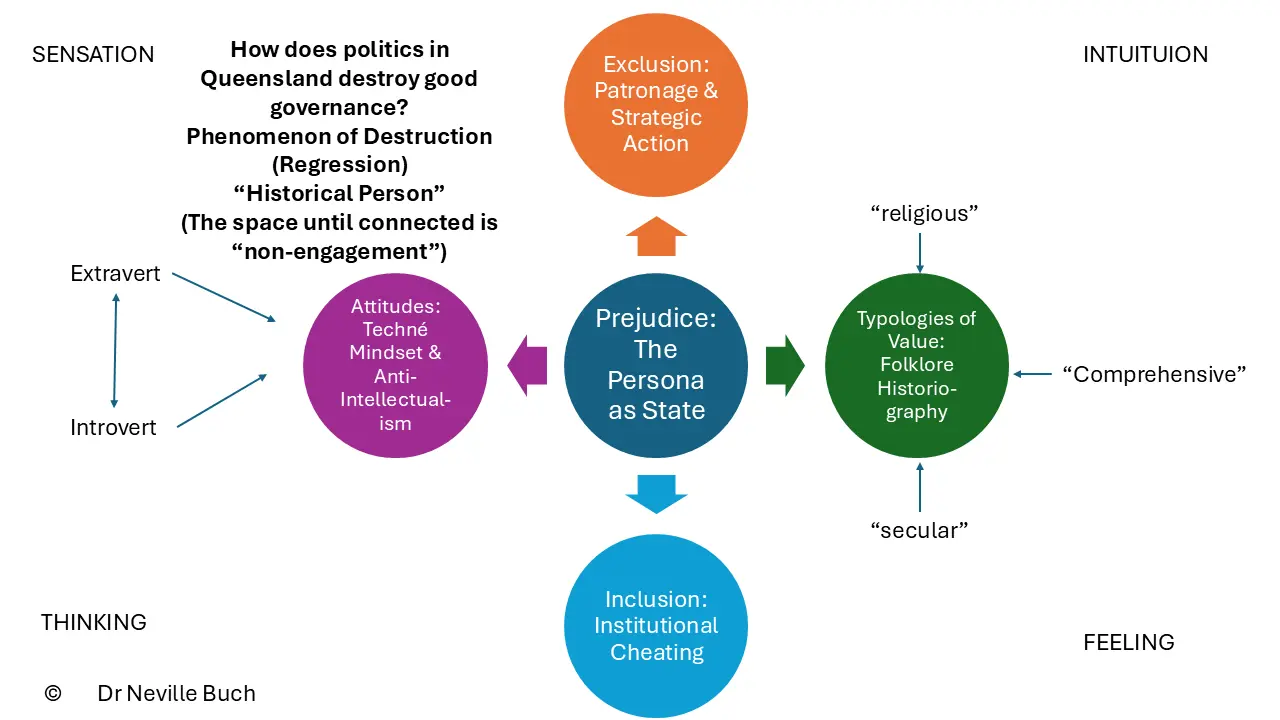
A Dynamic of Cognition (DoC) analysis reveals that politics in Queensland destroys good governance through a systemic cognitive pathology that prioritizes manufactured myths, personal patronage, and narrow technical utility over social accountability and critical wisdom. Historically, this destruction has manifested as a “historical lag,” where the state resisted modern social theories and professional administrative standards to preserve a folkloric status quo.
The following table summarizes the DoC components of how politics regresses into a destructive state and the required corrective mechanisms for remediation.
Dynamic of Cognition (DoC) Table: How Politics Destroys Governance in Queensland
| DoC Component | Phenomenon of Destruction (Regression) | Impact on Good Governance | Historiographical Remediation |
| Self (Identity) | The Persona as State: Conflating the leader’s identity with the state apparatus (e.g., “Queensland was Joh”). | Power resides in a person rather than institutional rules, leading to an absolutist or totalitarian style of leadership. | Senior Social Accountability: Reclaiming human authorship over historical identity and state narratives. |
| Mind (Judgment) | Techné Mindset & Anti-Intellectualism: Prioritizing narrow “vocational fitness” and “common sense” over research and wisdom. | Destroys the capacity for evidence-based policy and liquidates independent judgment (“denoetization”). | Noetic Action: Reclaiming individual discernment from rigid, “self-sealing” institutional systems. |
| Reason (Logic) | Folklore Historiography: Sanitizing brutal histories (e.g., 1840 massacres) into heroic “Pioneer Legends”. | Facilitates “Historical Forgetfulness,” causing the repetition of past administrative and ethical errors. | Spiral Historiography: “Uncoiling” repetitive patterns of error to achieve “Sufficient Comprehension”. |
| Utility (Action) | Patronage & Strategic Action: Manipulation oriented toward political or personal profit; “chaotic” Cabinet processes. | Blurs policy formulation and implementation; utilizes systemic secrecy to hide unfavourable information. | Communicative Action: Establishing professional, evidence-based forums (e.g., the 1989 Cabinet Handbook). |
| Love (Bond) | Institutional Cheating: Reducing residents to ”mechanic citizens” through symbolic, tactical inclusion. | Aligns policy with corporate profit (e.g., the ”donation loophole”) rather than public affordability or flourishing. | Strategic Resident Advocacy: Demanding whole-of-city impact assessments and ward-level transparency. |
Detailed Analysis of the Destructive Dynamic
I. Conflation of Sovereignty and Persona
Good governance is destroyed when the “strongman” politician captures sovereignty, replacing a “political-legal abstraction” with their own persona. In Queensland, this was epitomized by Premier Joh Bjelke-Petersen, who successfully promoted the notion that ”Queensland was Joh”. This captures state power within a charismatic legitimacy framework that bypasses traditional rational-legal authority, making institutions like Parliament instrumental rather than deliberative.
II. The “Techné Mindset” and the Liquidation of Judgment
The state’s governance is further degraded by a “techné mindset” that disparages “intellectual education” and “big ideas” in favour of measurable technical utility. This anti-intellectual administrative style was famously illustrated by the Premier’s claim that he learned more in a “cow bail” than he would have at Oxford. Such attitudes lead to “denoetization”—the liquidation of independent judgment—where bureaucrats and citizens become passive conduits for economic mandates rather than proactive authors of their social reality.
III. Historical Forgetfulness and Folklore
Politics in Queensland has historically used “folklore historiography” to sanitize Comfortable narratives and maintain a triumphalist “Pioneer Legend”. By systematically silencing events like the 1840 Aboriginal massacres or the brutal conditions of the 1828 Coopers Plains outstation, the state banishes the contingent origins of modern prejudices from memory. This state of “Historical Forgetfulness” ensures that the “intellectual wounds” of the past remain unhealed, leaving governance prone to repeating repetitive cycles of error.
IV. Strategic Action and Institutional Secrecy
Governance is compromised when institutional frameworks are replaced by personal patronage. Until the post-Fitzgerald reforms, Cabinet conduct was often “chaotic,” reaching decisions through oral submissions without attendant paperwork or departmental briefings. This system, “peppered” with undeclared conflicts of interest, utilized Cabinet secrecy to prevent the disclosure of information unfavourable to the government, effectively blurring the line between policy formulation and private interest.
V. Modern “Institutional Cheating” and Mechanic Citizenship
In contemporary urban governance, politics can destroy state flourishing through “symbolic inclusion”. Residents are invited to participate in minor tactical exercises (e.g., “pin-dropping” for bike racks) while being shielded from foundational strategic decisions regarding tower heights and yield analyses. This reduces individuals to “mechanic citizens”—passive sensors for the state rather than active political agents. Furthermore, 2026 legislative changes creating a “donation loophole” for property developers threaten to align planning decisions with corporate profit rather than community habitat, engineering an “architecture of scarcity”.
Conclusion: The Path to Remediation
To stop politics from destroying the state, citizens must transition from a “Junior” mindset of unreflective execution toward a “Senior” state of social accountability. This involves practicing “Spiral Historiography”—the meticulous uncoiling of manufactured myths and repetitive errors—to reclaim human authorship over the state’s shared reality.
Featured Image:

[1] Artificial Intelligence (A.I.) has been fairly used in the production of this work. The tool used is Google NotebookLM (recently rebranded as Gemini Notebook). It is an AI-powered virtual research assistant and thinking partner designed to help a person interact deeply with their own documents. Unlike general chatbots, it is source-grounded, meaning it only generates answers based on the specific PDFs, documents, or links uploaded. The A.I. process in the production of this work has been limited to the attached (prompts) on each of the questions in turn. This ensures an accurate reading of each source. The author then rearranged and re-edited the answers the A.I. provided. The human author publishes this work. A.I. is never an author when used properly. This assistance is not qualitatively different from a human research assistant when that assistance is deemed to have no authorial status but is acknowledged.


Neville Buch
Latest posts by Neville Buch (see all)
- The Human Being Above the Transaction and Why Markets Cannot Measure Human Worth – October 15, 2026
- Beyond Neoliberal Formalism: Should Taxpayers Fund Independent Philosophy – October 14, 2026
- A Critical Phenomenology and Epistemology of Open and Fixed Mindsets: Quantum Biology of the Open Mind – October 13, 2026