
Dr Neville Buch[1]
Abstract
This essay evaluates the sociological and intellectual crisis within elite higher education through the lens of Tyler Austin Harper’s 2026 Atlantic article, “Confessions of a Token Black Professor.” Using Dr. Neville Buch’s Dynamic of Cognition (DoC) framework, the analysis maps Harper’s narrative of institutional hypocrisy at Bates College as a case study in “Pathological Regression.” The essay explores how modern academia has prioritized “strategic manipulation” and “tokenization” over the humanist ideals of scholarship. It concludes by defining the critical distinction between academia—an increasingly bureaucratic and performative industry—and scholarship—a disciplined, personal quest for truth and “human authorship.”
A DoC Analysis of the Academic Crisis
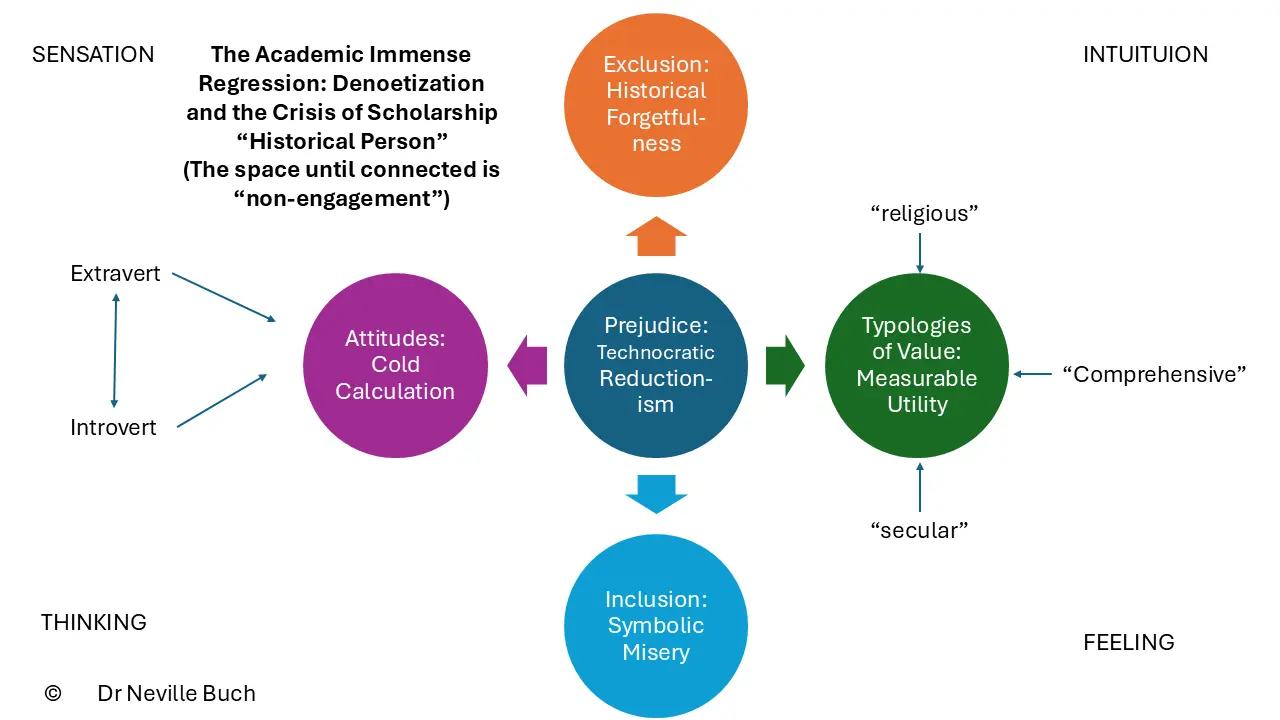
Tyler Austin Harper’s account of his departure from the tenure track at Bates College provides a stark primary source for Dr. Neville Buch’s Dynamic of Cognition (DoC) diagnostic. Harper’s experience illustrates a state of “denoetization”—the mechanical liquidation of the human capacity to judge—where the individual scholar is reduced to a “puny human node” within a performative bureaucratic system.
1. Prejudice: The Techné Mindset and Tokenization
In the DoC framework, Prejudice (the Centre) is manifested as a “Techné Mindset” that reduces human existence to quantifiable data. Harper’s narrative confirms this through his realization that he was a “DEI hire,” valued not for his specialized expertise in 19th-century British literature, but as a demographic metric for the college’s diversity reports. He describes being saddled with “Black-Guy Work”—such as leading MLK Day committees for which he had no academic training—simply because administrators required a specific racial face for their public relations.
2. Attitudes: Strategic Manipulation vs. Communicative Action
The DoC identifies Pathological Attitudes as “Strategic Manipulation”—using metrics and “trickster logic” to enforce compliance. Harper documents how elite colleges use “wokeness” as a convenient distraction from intractable economic issues like rising student debt and the exploitation of adjunct labour. While the administration “bleated about social justice,” they simultaneously hired corporate consultants to crush employee unionization efforts, a clear instance of what Buch terms “institutional bullshit”.
3. Exclusion: Historical Forgetfulness and the Banishment of Context
Exclusion in the DoC model refers to “Historical Forgetfulness,” where a population loses context regarding its origins. Harper notes this when he attempts to celebrate Bates as a college founded by abolitionists, only to be met with a “faint embarrassment” from the dean, who preferred a narrative of systemic racism over the school’s actual emancipatory history. By flattening complex institutional history to fit a predetermined political mask, the academy enacts what Buch calls the “Epimethean fault”—repeating errors because their roots have been banished from memory.
4. Inclusion: Relative Inauthenticity and Groupthink
Inclusion (Intuition) becomes pathological as “Relative Inauthenticity,” where the “I” is submerged in the crowd and habit. Harper observes a “cognitive paralysis” among white administrators when confronted with minorities who disagree with one another; they reflexively defer to the “last Black person I talked to,” a practice that replaces rigorous scholarly debate with a shallow, essentializing performance of identity.
5. Value: Simplistic Utility and the Adult Day Care
Finally, the DoC maps Value (Feeling) as “Simplistic Utility,” where success is measured by short-term optics rather than dignity or wisdom. Harper characterizes the result as an “adult day care,” where faculty are offered Play-Doh, LEGOs, and “soft bunnies” during “DeStress Fests” instead of the intellectual freedom and labour security required for genuine flourishing.
Conclusion: Academia vs. Scholarship
The divergence between Tyler Austin Harper’s experience and Dr. Neville Buch’s “Five Year Game Plan” highlights a fundamental difference between academia and scholarship.
- Academia is the institutionalized “Credential Society”. As seen in the Bates narrative, it has become a landscape of “neoliberal managerialism” and “hypo-competitive policies” that prioritize institutional status and political performance over learning. It is a system that often “chews up and spits out” talented researchers like Mia while rewarding those who enthusiastically participate in DEI bureaucracy.
- Scholarship, by contrast, is an act of “Human Authorship” and “Philosophy in Practice”. It is defined by the disciplined internal effort to seek “Sufficient Comprehension”—the ability to grasp the whole of a matter while remaining open to correction. As Harper moves into public journalism and Buch continues his independent research tour, they exemplify the scholar as a “transformative intellectual” who operates within a “Contributory Economy,” providing “digital torches of reason” to the public square regardless of institutional validation.
Ultimately, while academia functions as a technical and social system of behavioural control, scholarship remains the proactive reclamation of the person—the “who” remaining the master of the “what”.
The following bibliography comprises the primary academic sources and professional records utilized in the essay “The Death of Scholarship in the Managed Academy.” This work integrates the sociological narrative of Tyler Austin Harper with the philosophical and historiographical frameworks developed by Dr. Neville Buch over his career (2010–2025).
Primary Source
- Harper, Tyler Austin (2026). “Confessions of a Token Black Professor.” The Atlantic. This article serves as the foundational case study for the analysis of institutional hypocrisy and “pathological regression” within modern academia.
Core Theoretical & Philosophical Frameworks
- Arendt, Hannah (1977). The Life of the Mind (M. McCarthy, Ed.). Harcourt Brace Jovanovich. Provides the basis for the critique of “denoetization” (the liquidation of judgment) and the distinction between thinking and knowing.
- Buch, Neville (2026). The Humanistic Ascent: Reclaiming Agency from the Mechanized Mind. Management Institute for Contributory Economy. Detailed exposition of the Dynamic of Cognition (DoC) matrix and the POLICE model used to diagnose “institutional bullshit”.
- Collins, Randall (1998). The Sociology of Philosophies: A Global Theory of Intellectual Change. Belknap Press of Harvard University Press. Source for the concept of the “puny human node” and the analysis of intellectual networks.
- Collins, Randall (2019). The Credential Society: An Historical Sociology of Education and Stratification. Columbia University Press. Framework for understanding academia as an institutionalized credentialing system rather than a space for scholarship.
- Stiegler, Bernard (1998). Technics and Time, 1: The Fault of Epimetheus (R. Beardsworth & G. Collins, Trans.). Stanford University Press. Anchor for the “Epimethean fault”—the systemic pathology of historical forgetfulness.
Educational Sociology & Public Policy
- Biesta, Gert (2021). World-Centred Education: A View for the Present. Routledge. Analyses the shift toward a “new language of learning” that focuses on process over humanistic purpose.
- Illich, Ivan (1971). Deschooling Society. London: Calder & Boyars. Foundational critique of the “techné mindset” in schooling and the institutionalization of education.
- Labaree, David F. (1997). “Public Goods, Private Goods: The American Struggle Over Educational Goals.” American Educational Research Journal, 34(1), 39–81. Explores the conflict between social mobility (private asset) and citizenship (public good) in education.
Buch’s Professional Records & Artifact Narratives
- Buch, Neville (2025). Cognitive Maturity and the Historiographical Matrix (Artifact Narrative). Records the formalization of the “Five Year Game Plan” for independent scholarship.
- Buch, Neville (2026). z2010-2025 Summary: The Intellectual and Philosophical Journey of Dr. Neville Buch. Provides the longitudinal context for the “Contributory Economy” and the role of the independent scholar as a “global and local player”.
- Management Institute for Contributory Economy (2026). Limited Thinking and the Contributory Economy. Internal report defining the metrics of success for scholarship outside the “Managed Academy”.
[1] Artificial Intelligence (A.I.) has been fairly used in the production of this work. The tool used is Google NotebookLM (recently rebranded as Gemini Notebook). It is an AI-powered virtual research assistant and thinking partner designed to help a person interact deeply with their own documents. Unlike general chatbots, it is source-grounded, meaning it only generates answers based on the specific PDFs, documents, or links uploaded. The A.I. process in the production of this work has been limited to the attached (prompts) on each of the questions in turn. This ensures an accurate reading of each source. The author then rearranged and re-edited the answers the A.I. provided. The human author publishes this work. A.I. is never an author when used properly. This assistance is not qualitatively different from a human research assistant when that assistance is deemed to have no authorial status but is acknowledged.
Featured Image: The-Academic-Immense-Regression.-Denoetization-and-the-Crisis-of-Scholarship


Neville Buch
Latest posts by Neville Buch (see all)
- The Human Being Above the Transaction and Why Markets Cannot Measure Human Worth – October 15, 2026
- Beyond Neoliberal Formalism: Should Taxpayers Fund Independent Philosophy – October 14, 2026
- A Critical Phenomenology and Epistemology of Open and Fixed Mindsets: Quantum Biology of the Open Mind – October 13, 2026