

Dr Neville Buch[1]
Abstract of “Buch’s Existential Thesis”
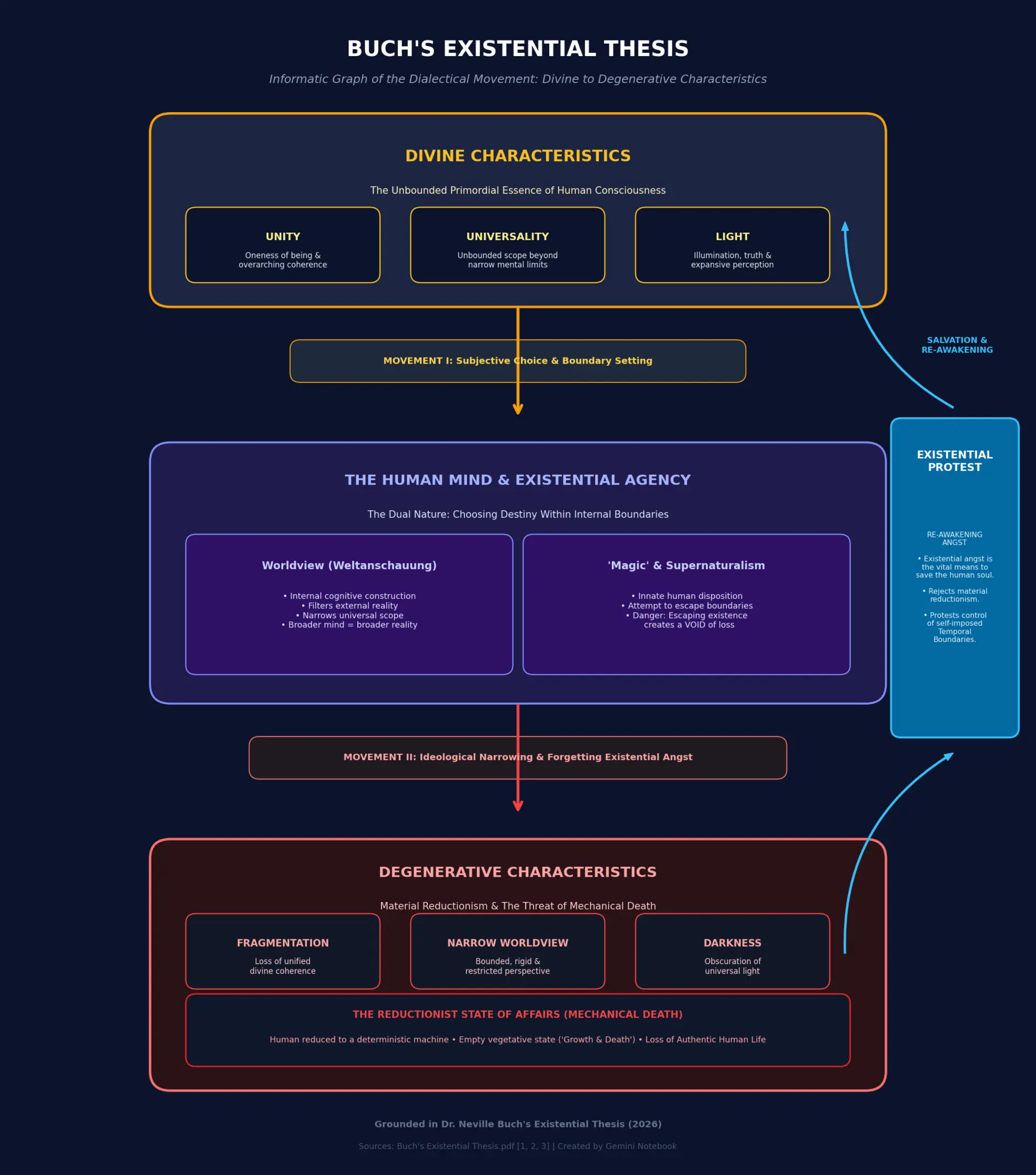
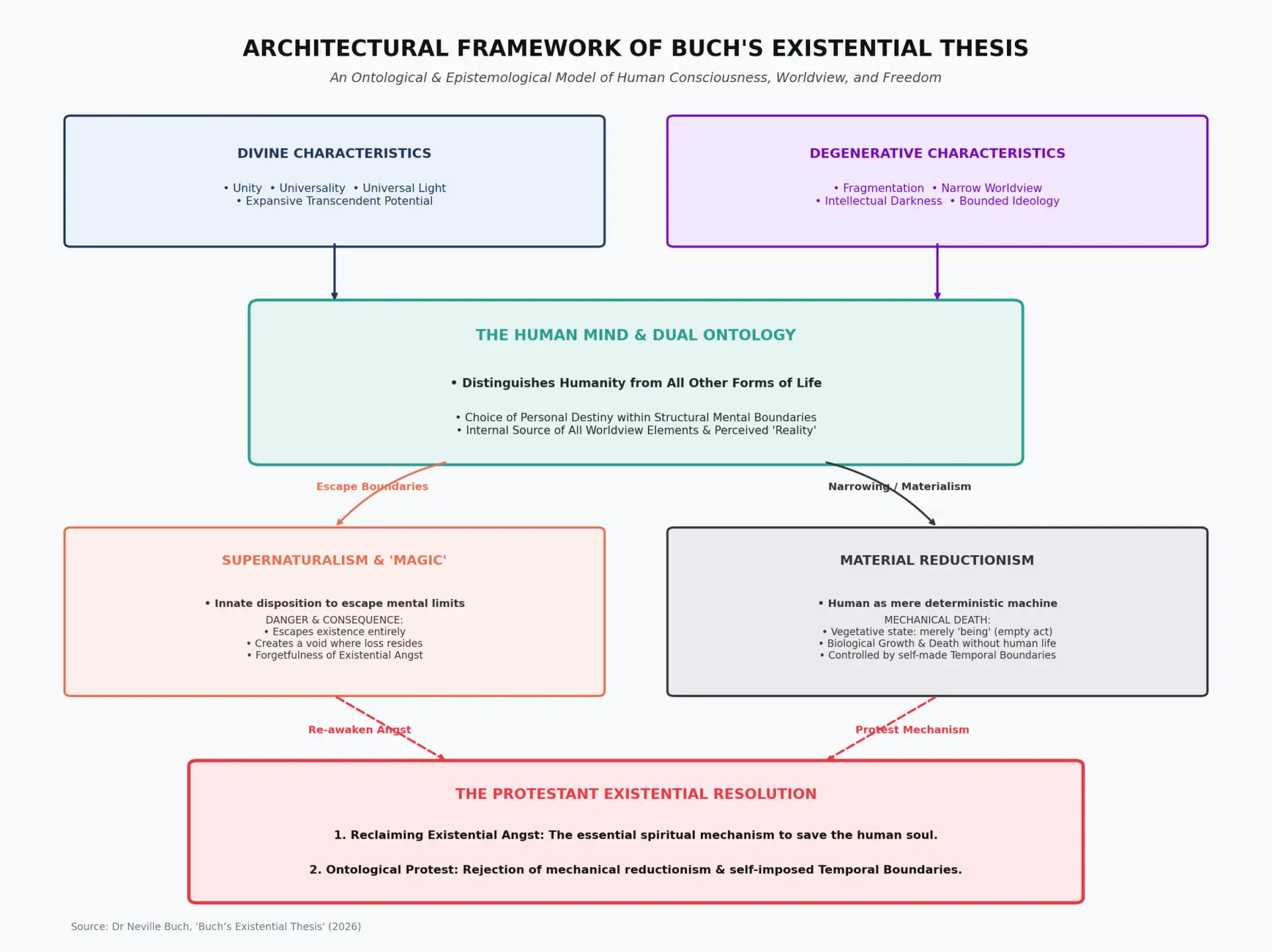
A human being is a creature defined by a dual nature of divine and degenerative characteristics (Buch 2026, p. 1)[1]. Divine characteristics embody qualities of unity, universality, and light, whereas degenerative characteristics manifest as fragmentation, darkness, and the narrowing of perspective into a bounded worldview (Buch 2026, p. 1)[1]. This fundamental tension distinguishes humanity from all other forms of life, granting each individual the capacity to choose their own destiny within the structural boundaries of the mind (Buch 2026, p. 1)[1]. Supernaturalism and “magic” represent a natural human disposition attempting to escape these existential boundaries, as all elements of a worldview originate from within the human mind (Buch 2026, pp. 1–2)[2]. While a broader mind expands the scope of constructed reality, attempting to escape existence entirely risks creating a void where loss resides and where existential angst—the vital mechanism for saving the human soul—is forgotten (Buch 2026, pp. 2–3)[2][3]. Without this angst, human beings are reduced to mere deterministic machines under material reductionism, existing only vegetatively through physical growth and biological death rather than authentic human life (Buch 2026, p. 3)[3]. Protestant existentialism fundamentally protests this mechanistic reduction and the control of self-imposed temporal boundaries (Buch 2026, p. 3)[3].
1. Introduction
Dr. Neville Buch’s Existential Thesis presents a philosophical and theological interrogation of human agency, consciousness, and spiritual destiny (Buch 2026, pp. 1–3)[1]. Authored explicitly as a human-produced work devoid of artificial intelligence, the thesis serves as a defence of authentic human subjectivity against the encroaching paradigms of material reductionism and technocratic determinism (Buch 2026, p. 1)[1][3]. At its core, Buch’s thesis posits that the human condition is defined by an intrinsic ontological struggle between divine transcendent qualities—such as unity, universality, and light—and degenerative earthly limitations—characterized by fragmentation, ideological narrowing, and darkness (Buch 2026, p. 1)[1].
By framing a “worldview” not as an ultimate spiritual achievement but as a degenerative narrowing of perspective, Buch challenges traditional metaphysical constructs and aligns his analysis with the broader tradition of Christian existentialism (Buch 2026, p. 1)[1]. This essay explores the structural coherence of Buch’s thesis by examining how the elements of the Protestant worldview fit together, how human belief must surmount the threat of mechanical death, the internal and external limits of Protestant existentialism, and the enduring significance of Buch’s work in contemporary philosophical discourse.
2. How the Elements of the Protestant Worldview Fit Together
To understand how the elements of the Protestant worldview interlock within Buch’s framework, one must first examine the nature of a worldview (Weltanschauung) itself. Anthroposophically and epistemologically, a worldview constitutes a fundamental cognitive orientation—an internal framework of presupposition, values, and perceptual boundaries through which an individual or culture interprets reality (Wikipedia 2026i; Buch 2026, p. 2)[2]. Buch identifies worldview formation as an activity originating entirely within the human mind (Buch 2026, p. 2)[2]. However, he crucially categorizes worldview as a degenerative characteristic because it inherently narrows perspective, fragmenting the divine ideal of universal light into localized, protective ideological constructs (Buch 2026, p. 1)[1].
The Protestant tradition provides a unique theological backdrop for this mental dynamic. The historic Protestant movement—built upon the foundational five solae (sola scriptura, sola fide, sola gratia, solus Christus, and soli Deo gloria)—dismantled medieval sacramental hierarchies in favour of direct, unmediated personal responsibility before God (Wikipedia 2026g)[8]. Central to this theology is the universal priesthood of all believers, which posits that every individual possesses the spiritual right and moral duty to interpret scripture, exercise reason, and confront their personal destiny without institutional intermediaries (Wikipedia 2026g)[8].
In Buch’s formulation, these Protestant theological elements fit together through the dialectic of internal mental boundaries and individual agency:
- Inward Origin of Reality: Just as Protestantism locates salvation in an unmediated, internal movement of faith (sola fide) rather than external ecclesiastical mechanics, Buch argues that all worldview elements emanate from within the human mind (Buch 2026, p. 2; Wikipedia 2026g)[2]. The mind constructs its perceived reality, determining how external impingements are acknowledged or integrated (Buch 2026, pp. 2–3)[2][3].
- The Tension of Divine and Degenerative Attributes: The Protestant doctrine of human nature views humanity as simultaneously created in the image of God (Imago Dei) yet marked by inherent fallibility (Wikipedia 2026g, 2026j)[8][12]. Buch mirrors this duality by contrasting divine qualities (unity, universality, light) with degenerative qualities (fragmentation, narrow worldview, darkness) (Buch 2026, p. 1)[1]. The Protestant worldview holds these opposing forces in tension, requiring the individual mind to choose its destiny within its bounded self (Buch 2026, p. 1)[1].
- Existential Angst as Spiritual Catalyst: Protestant existentialists, beginning with Søren Kierkegaard, asserted that objective religious certainty is impossible and that true faith requires enduring profound angst and making a subjective “leap of faith” (Wikipedia 2026b)[5]. Buch integrates this directly into his thesis: existential angst is the essential spiritual mechanism (“the means to save our human soul”) that prevents humanity from collapsing into passive, worldly conformity (Buch 2026, p. 3)[3].
- Protest Against Temporal Determinism: The historic act of “protest” in Protestantism rejected papal and temporal hegemony over conscience (Wikipedia 2026g)[8]. Buch elevates this historical protest to an ontological principle: human beings must protest against “the control of Temporal Boundaries of our own making”—rejecting the illusion that artificial, mechanical, or self-imposed time constraints can dictate the boundaries of the human spirit (Buch 2026, p. 3)[3].
3. Surmounting the Threat of a Mechanical Death
A central contribution of Buch’s thesis is its critique of material reductionism and physicalism (Buch 2026, p. 3)[3]. In modern philosophy, material reductionism asserts that all phenomena, including mind, consciousness, and life itself, are entirely reducible to physical matter and mechanistic physical laws (Wikipedia 2026d, 2026h)[17]. During the nineteenth-century German Materialismusstreit (materialism controversy), physiologists like Carl Vogt argued that mental states were merely bodily secretions, famously claiming that thoughts stand in the same relation to the brain as bile does to the liver (Wikipedia 2026c)[20]. Under such a strict mechanistic paradigm, human actions are causally predetermined, free will is dismissed as an illusion, and the human individual is reduced to an automated biological machine (Wikipedia 2026c, 2026d)[18].
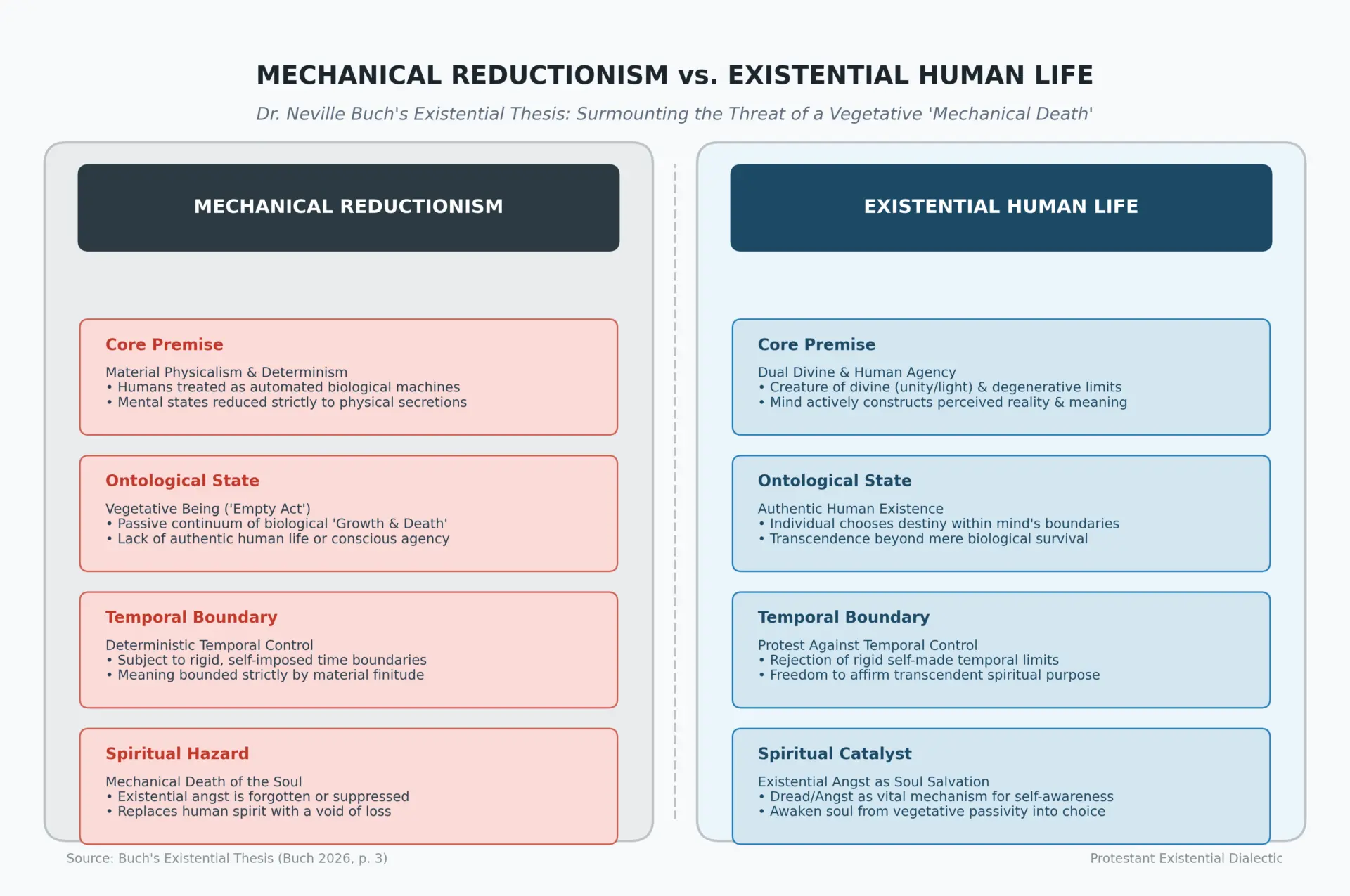
Buch warns that surrendering to material reductionism results in a state of “mechanical death” (Buch 2026, p. 3)[3]. In this degraded state of affairs:
“we do not exist; only ‘be’ (vegetatively), an empty act. Growth and Death, but not human life.” (Buch 2026, p. 3)[3]
Here, Buch draws a sharp distinction between mere biological existence—characterized by cellular metabolism, physical growth, and somatic death—and authentic human life, which requires conscious self-determination, moral choice, and spiritual awareness (Buch 2026, pp. 1, 3; Wikipedia 2026e, 2026f)[1].
To surmount the threat of mechanical death, human belief in life must reassert the primacy of the mind and existential freedom (Buch 2026, pp. 1–3)[1]. First, humanity must reclaim existential angst (Buch 2026, p. 3)[3]. Rather than treating dread or anxiety as a biological malfunction to be chemically suppressed or mechanically eliminated, existential angst must be recognized as the fundamental experience of human freedom confronting its own responsibility (Buch 2026, p. 3; Wikipedia 2026b)[3]. Angst awakens the individual from vegetative passivity, forcing them to acknowledge that they are not merely objects governed by physical causation, but active agents responsible for constructing meaning (Buch 2026, p. 3; Wikipedia 2026b)[3].
Second, surmounting mechanical death requires confronting and shattering the “temporal boundaries” that human systems impose (Buch 2026, p. 3)[3]. When society models human life strictly on mechanistic throughput, efficiency, and physical life cycles, it reduces existence to a linear march toward physical decay (Buch 2026, p. 3; Wikipedia 2026g, 2026h)[3]. True belief in human life surmounts this by insisting upon the transcendent, divine characteristics within consciousness—unity, universality, and light—which allow the mind to break through rigid material determinism and affirm an authentic, soul-saving existence (Buch 2026, pp. 1, 3)[1][3].
4. What Are the Limits of Protestant Existentialism?
While Protestant existentialism offers a powerful critique of mechanistic reductionism, Buch’s thesis and the broader theological-philosophical tradition illuminate several critical boundaries and limits inherent to this position (Buch 2026, pp. 1–3)[1]:
- The Paradox of the Narrowed Worldview: Buch defines divine qualities as universal and unified, while explicitly defining a “worldview” as a degenerative narrowing of perspective characterized by fragmentation and darkness (Buch 2026, p. 1)[1]. The primary paradox of Protestant existentialism is that in formulating its own distinct theological or philosophical worldview, it risks falling into the very degenerative narrowing it seeks to overcome (Buch 2026, p. 1)[1]. The moment existential subjective insights harden into a fixed, dogmatic worldview, they lose their universal light and become fragmented mental constructs (Buch 2026, p. 1)[1].
- The Temptation of “Magic” and Escape from Boundaries: Buch observes that “supernaturalism” or “magic” represents an innate disposition of the human mind attempting to escape its existential boundaries (Buch 2026, p. 2)[2]. However, attempting to flee concrete human boundaries poses a grave danger:
“we escape our own existence and create a void where loss resides.” (Buch 2026, p. 3)[3]
Protestant existentialism reaches its limit when the individual, overwhelmed by angst, attempts an ungrounded escape into mysticism or supernaturalism, thereby abandoning concrete bodily facticity and falling into nihilistic emptiness or “bad faith” (Buch 2026, pp. 2–3; Wikipedia 2026b)[2].
- Extreme Subjectivism and Solipsism: By grounding all elements of reality within the individual human mind and emphasizing direct, unmediated personal faith, Protestant existentialism inherently struggles with social cohesion and intersubjectivity (Buch 2026, p. 2; Wikipedia 2026b, 2026g)[2]. As seen in Kierkegaardian inwardness or Sartrean analyses of “the Look” of the Other, an hyper-individualized focus on subjective freedom can isolate the individual, making shared communal life and institutional solidarity difficult to sustain (Wikipedia 2026b)[5].
- The Boundary of Facticity and Finitude: Protestant existentialism cannot grant absolute, unconditioned freedom (Wikipedia 2026b)[33][39]. Human choices are always bounded by the finite architecture of the mind, physical embodiment, historical context, and temporal limits (Buch 2026, pp. 1, 3; Wikipedia 2026b)[1]. Humanity cannot create reality ex nihilo; it can only choose its destiny within the boundaries given to it (Buch 2026, p. 1)[1].
5. Why Buch’s Existential Thesis Is Important
Dr. Neville Buch’s Existential Thesis holds profound contemporary importance across philosophical, theological, and technological domains (Buch 2026, pp. 1–3)[1]:
- A Re-assertion of Human Dignity in the Age of Artificial Intelligence: In an era increasingly dominated by automated systems, machine learning, and algorithmic determinism, Buch explicitly highlights the human origin of his thesis, noting that no artificial intelligence was used in its creation (Buch 2026, p. 1)[1]. The thesis provides a timely philosophical defence against reducing human consciousness to computational algorithms or vegetative biological processing (Buch 2026, p. 3)[3].
- Re-evaluating Existential Angst as a Positive Spiritual Force: Modern secular culture frequently pathologizes mental distress, treating existential dread purely as a psychological disorder to be eradicated (Wikipedia 2026b)[26]. Buch reframes existential angst as a necessary ontological instrument—the vital “means to save our (human) soul”—without which humanity forgets its higher purpose and sinks into mechanistic apathy (Buch 2026, p. 3)[3].
- Synthesizing Theology and Philosophy of Mind: Buch bridges the gap between classical Christian theology (divine light, salvation, soul) and modern cognitive philosophy (mental boundaries, constructed reality, worldview dynamics) (Buch 2026, pp. 1–2)[1][2]. By conceptualizing worldviews as internal products of the mind that can either degenerate into narrow dogmatism or expand to acknowledge external realities, Buch offers a sophisticated model for understanding human cognitive orientation (Buch 2026, pp. 1–2)[1][2].
- A Call to Resistance Against Self-Imposed Temporal Control: The thesis provides an ethical imperative to protest “The control of Temporal Boundaries of our own making” (Buch 2026, p. 3)[3]. It calls upon individuals to resist economic, societal, and technological pressures that reduce human life to mere biological maintenance (“Growth and Death”) and instead reclaim a life of intentional choice, spiritual depth, and universal light (Buch 2026, pp. 1, 3)[1][3].
6. Conclusion
Buch’s Existential Thesis articulates a compelling vision of human existence positioned at the crossroads of divine potential and degenerative limitation (Buch 2026, p. 1)[1]. By tracing how the internal elements of a worldview interact with Protestant existential principles, Buch demonstrates that authentic human life cannot be sustained by biological functioning or material reductionism alone (Buch 2026, pp. 1–3)[1]. Surmounting the threat of mechanical death requires a courageous engagement with existential angst, an acknowledgment of human boundaries, and a continuous protest against the self-imposed temporal mechanics of modern life (Buch 2026, p. 3)[3]. Ultimately, Buch’s thesis stands as a vital reminder that while a narrowed worldview can fragment and darken human perspective, the human mind retains the innate, divine capacity to choose its own destiny and awaken to universal light (Buch 2026, p. 1)[1].
Bibliography
Buch, N. (2026) Buch’s Existential Thesis. Unpublished manuscript, Dr Neville Buch, pp. 1–3[1].
Wikipedia (2026a) Catholicity.pdf. Wikipedia, The Free Encyclopedia[40].
Wikipedia (2026b) Existentialism.pdf. Wikipedia, The Free Encyclopedia[4].
Wikipedia (2026c) Materialism controversy.pdf. Wikipedia, The Free Encyclopedia[20].
Wikipedia (2026d) Materialism.pdf. Wikipedia, The Free Encyclopedia[17].
Wikipedia (2026e) Mind.pdf. Wikipedia, The Free Encyclopedia[160].
Wikipedia (2026f) Naturalism (philosophy).pdf. Wikipedia, The Free Encyclopedia[204].
Wikipedia (2026g) Protestantism.pdf. Wikipedia, The Free Encyclopedia[8].
Wikipedia (2026h) Reductionism.pdf. Wikipedia, The Free Encyclopedia[19].
Wikipedia (2026i) Worldview.pdf. Wikipedia, The Free Encyclopedia[6].
Wikipedia (2026j) Unity in diversity.pdf. Wikipedia, The Free Encyclopedia[12].
Take the MICE Quiz
[1] Artificial Intelligence (A.I.) has been fairly used in the production of this work. The tool used is Google NotebookLM (recently rebranded as Gemini Notebook). It is an AI-powered virtual research assistant and thinking partner designed to help a person interact deeply with their own documents. Unlike general chatbots, it is source-grounded, meaning it only generates answers based on the specific PDFs, documents, or links uploaded. The A.I. process in the production of this work has been limited to the attached (prompts) on each of the questions in turn. This ensures an accurate reading of each source. The author then rearranged and re-edited the answers the A.I. provided. The human author publishes this work. A.I. is never an author when used properly. This assistance is not qualitatively different from a human research assistant when that assistance is deemed to have no authorial status but is acknowledged. The Buch’s Existential Thesis is itself a human-produced thesis.
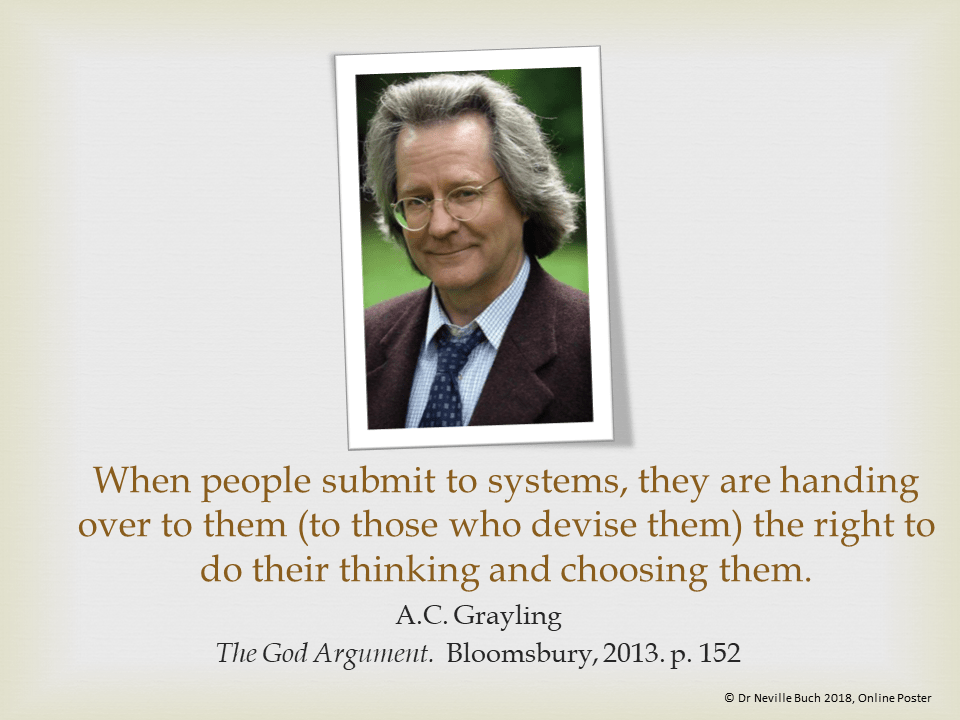
Featured Image: Grayling-on-Systems-on-Independent-Thinking.


Neville Buch
Latest posts by Neville Buch (see all)
- What Happened to Ross Johnston? – October 9, 2026
- Thank you, Richard: Knowing the message but then acting – October 8, 2026
- The Desiccation of the Common Well: Identity Politics, Algorithmic Assessment, and the Crisis of Adult Responsibility – October 6, 2026