
The audio commentary on MICE’s Contributory Economy and Human Authorship.
Dr Neville Buch[1]
Abstract
This essay examines the intersection of structural poverty, diaconal social practice, and theological inquiry in conceptualizing the transition to a Contributory Economy—a model that structurally values and fairly pays individuals for their services to the common good. Critiquing the historical failures of the nineteenth-century model of voluntarism, the paper illustrates how localized, private charity acts as an insufficient “band-aid” that obscures systemic economic exploitation. It analyses the contemporary pathology of credential inflation, “political labour,” and the devaluing of humanistic knowledge, which systematically traps highly educated, creative individuals and volunteers in severe economic deprivation. This structural marginalization is shown to be particularly severe in the Australian and Queensland contexts due to the convergence of distinct cultural pathologies, including the “Tall Poppy Syndrome,” the unreflective “Queensland Character” myth, and imported Americanised anti-intellectualism. Finally, the essay demonstrates how Christian social thought, Kathryn Tanner’s economy of grace, and William Cavanaugh’s Eucharistic theology provide the moral and ontological foundation for a Contributory Economy. By transitioning from strategic, transactional calculation to communicative social justice, this model restores human authorship and facilitates genuine Aristotelian flourishing (eudaimonia).
1. The Failure of the 19th-Century Model of Voluntarism
The contemporary reliance on voluntarism and localized private charity to manage systemic inequality is a regression to a failed historical paradigm. The nineteenth-century model of voluntarism—characterized by moral reform, fragmented private benevolence, and uncoordinated “friendly visiting”—proved structurally and historically inadequate against industrial-scale poverty (Kidd 1999: 1; Prochaska 2006: 1). Historical analyses demonstrate that reliance on voluntary action and the restrictive 1834 Poor Law failed to meet systemic demands, forcing working-class households to develop survival strategies completely outside elite philanthropy (Kidd 1999: 1).
Voluntary organizations in urban industrial centres like Bristol suffered from severe administrative limitations, parochial class biases, and a complete inability to scale up to compensate for structural failures (Gorsky 1999: 1; Prochaska 2006: 1). Ultimately, the eventual collapse of Victorian religious voluntarism necessitated the rise of state-driven welfare provision (Prochaska 2006: 1).
In modern practical theology, this historical failure is replicated when religious communities operate under the “colonial irony” (Beukes and Beukes 2023: 10). Originally defined as the patronizing attitude of “we do to you and we do for you because we know what is best for you,” this mindset restricts contemporary social practice to a “charity mode” (Beukes and Beukes 2023: 10). By focusing on short-term “hand-outs” like soup kitchens and food parcels, localized charity addresses immediate physical distress but fails to challenge the political and structural roots of suffering, leaving the marginalized permanently dependent on the fluctuating willingness of affluent givers (Beukes and Beukes 2023: 10; Holte 2023: 12).
2. The Pathology of the Impoverished Intellectual: Educated Volunteers Trapped in Poverty
Within the contemporary neoliberal labour market, highly educated, creative, and intelligent individuals are systematically excluded from paid labour and trapped in structural poverty (Buch 2025b: 1). This is not a failure of individual effort or utility, but a symptom of an “immense regression” and a severe crisis of the humanities (Buch 2025b: 1). Under a pervasive “techné mindset” in governance and higher education, the fundamental Socratic question of “how should one live?” is discarded in favour of narrow “job readiness” metrics and pure calculative efficiency (Buch 2025b: 2; Buch 2026c: 2).
This systemic collapse is driven by several interrelated factors:
- Credential Inflation: Academic certificates have become a devalued currency of social respectability (Buch 2025b: 1; Collins 2019). Rather than certifying skill, advanced degrees function as arbitrary barriers used by organizational elites to limit the supply of candidates, leaving highly specialized specialists (such as PhD scholars) overqualified and “unemployable” in standard markets (Buch 2025b: 1; Buch 2026a: 2).
- The Hegemony of Political Labour: Access to paid labour is rarely a neutral reward for productive skill; instead, it is a form of “positional property” acquired through organizational manoeuvring (Buch 2025b: 2). Employment gatekeepers screen candidates for conformist personality traits and the internalization of organizational values rather than technical or intellectual competence, systematically excluding independent thinkers who lack established “cultural capital” or “old school ties” (Buch 2025b: 2).
- The “Sinecure Society”: Neoliberal institutions distribute massive wealth to those who control large administrative bureaucracies, while those who contribute to social memory, historical preservation, or creative knowledge production are treated as unpaid “nobodies” (Buch 2025b: 2).
This produces a profound personal and social dissonance: creative independent scholars who labour “seven days a week, 8–10 hours a day” are forced to rely on food pantries and drive vehicles “running on fumes” to Mount Gravatt or other community centres (Buch 2025b: 1; Buch 2026a: 2). This monetary marginalization devalues human dignity, as the elite treats the independent thinker’s labour as “voluntary” or economically worthless while exploiting their intellectual contributions (Buch 2025b: 2; Buch 2026a: 2).
3. The Australian and Queensland Pathologies: Tall Poppies, Agrarian Myths, and Soft Colonization
The structural poverty of educated volunteers is significantly worsened in Australia, and specifically Queensland, due to highly entrenched cultural and political phenomena:
I. Tall Poppy Syndrome and Anti-Intellectualism
At the heart of Australian public culture is a pervasive anti-intellectualism that treats deep academic reflection and scholarly expertise with severe suspicion (Buch 2025b: 2). Political and cultural actors frequently denigrate intellectual specialists as “pointy heads” or disconnected “elites,” making a virtue of preferring the “beer-drinking man on a lawn mower” (Buch 2025b: 2). Historically, pre-1940 attitudes in Queensland were appallingly anti-intellectual, treating professional or academic careers as the exclusive, snobby reserve of the social elite while preferring “learning on the job” or basic manual labour (Buch 2016a: 79).
II. The “Queensland Character” Myth
Dr. Neville Buch identifies the myth of the “Queensland Character” as a destructive literary and political device utilized by the ruling class to maintain intellectual stasis and “Historical Forgetfulness” (Buch 2026a: 2; Buch 2026b: 6). This folkish, masculine construct portrays Queenslanders as bumbling, unreflective “innocent fools” or tough, “happy-go-larrikins” deeply connected to “the call of the land” (Buch 2021a: 10; Buch 2026b: 6). Originally constructed in the 1890s through agrarian land selection narratives and popularized by Steele Rudd’s On Our Selection, this myth is used as a political card to resist “southern” or liberal intellectual influences (Buch 2021a: 10; Buch 2026b: 6; Buch 2026c: 2). It deliberately hides a complex local history of sophisticated scholarship and frontier conflict, isolating the population from critical thought and reducing city-shaping policies to a simple, anti-intellectual “rates, roads, and rubbish” model (Buch 2026a: 2; Buch 2026b: 6).
III. Americanised Anti-Intellectualism
Since 1945, Australian Christian and secular education have succumbed to a soft colonization of American cultural paradigms (Long and Buch 1996: 10). Driven by the import of American fundamentalist techniques—such as the All-Age Sunday School (AASS) and low-fee Christian school systems like Accelerated Christian Education (ACE)—this movement imported rigid, anti-progressive ideologies (Long and Buch 1996: 10). It introduced the constructed American myth of “secular humanism” as an existential threat to education, forming a highly conservative political subculture in Queensland during the Premier Joh Bjelke-Petersen era (Buch 2024: 161).
Following William F. Buckley Jr.’s God and Man at Yale, this Americanised neoconservatism launched political and partisan attacks against modern progressive curricula (such as the banning of SEMP and MACOS in Queensland schools), cementing a “bubble thinking” that isolated congregations from critical biblical studies and broader sociological changes (Buch 2024: 175, 176; Long and Buch 1996: 18).
4. Theology’s Contribution to the Contributory Economy
To dismantle the technocratic reductionism of computational capitalism, we must transition to a Contributory Economy—a post-capitalist theoretical framework pioneered by Bernard Stiegler and operationalized through the Management Institute for Contributory Economy (MICE) (Buch 2026a: 2; Stiegler 2010: 1). This economy collapses the divide between production and consumption, paying a “contributory income” to reward the generation of social knowledge, local noodiversity, and the common good (Buch 2026a: 2; Stiegler 2010: 1).
Christian social thought and theology provide the indispensable ontological and moral foundations for this transition:
I. The Economy of Grace
Kathryn Tanner (2005: 44) argues that the Christian understanding of divine grace establishes an economic model based on radical, non-competitive gift-giving rather than retributive exchange. Because God’s infinite provision rejects the neoliberal premise of absolute scarcity, humans are freed to participate in a non-competitive economy of mutual support, shared resources, and unconditional service to others (Tanner 2005: 44).
II. Eucharistic Communion and Relational Economy
William Cavanaugh (2008: 12) connects the practice of the Eucharist to a bodily, grounded economy where production and consumption serve relational neighbour-love rather than isolated, possessive individualism. In the Eucharistic feast, bread and wine are distributed equally, acting as a “practice for a kingdom economics” where none go hungry due to alienated labour or hoarding (Cavanaugh 2008: 12).
III. Catholic Social Teaching and Social Justice
Catholic Social Teaching aligns with Nancy Fraser’s three-dimensional social justice model of redistribution, recognition, and representation (Beukes and Beukes 2023: 10; Fraser 2010: 146). It insists that economic systems must be structured around human dignity, solidarity, and the common good, establishing that every person has both the right and the moral duty to contribute (Beukes and Beukes 2023: 10).
By redefining diaconal social practice from paternalistic “charity” to systemic “justice,” theology demands that the state and church actively recognize and fairly compensate the agency, capital, and labour of marginalized contributors (Beukes and Beukes 2023: 10). It integrates “Thinking as Caring” (panser) into the rational process, acting as a procedural shield to protect human particularity from the “coldness of pure calculation” (Buch 2026a: 2; Buch 2026b: 6).
5. Conclusion
The historical failures of nineteenth-century voluntarism and the ongoing devastation of neoliberal credentialism demonstrate that a society cannot survive on the “logic of the market” and individual self-interest alone (Kidd 1999: 1; Buch 2025b: 2). To uncoil the “vicious circles of stupidity” that keep creative specialists impoverished, we must adopt the foundational axiom that “understanding history is philosophy in practice” (Buch 2026c: 1). By utilizing theological models of grace and mutual solidarity, the Contributory Economy replaces the “techné mindset” with Interpretive Holism (Buch 2026a: 2). This re-orientation ensures that the “who” (the human person) remains the master of the “what” (the economic system), steering society toward true Aristotelian flourishing (eudaimonia) where human dignity, wisdom, and character are recognized as the ultimate standards of value (Buch 2026a: 2; Buch 2026b: 6).
Bibliography
- Beukes, J. W. and Beukes, L. E., 2023. Proposing a Social Justice Approach to Diaconia for a South African Context. Religions, 14(668), pp. 1–20.
- Buch, N., 2021a. The Intellectual Ethos of Charles Strong in Queensland 1855–1917. In: M. Maddox, ed. Charles Strong’s Australian Church: Christian Social Activism 1885–1917. Carlton: Melbourne University Press, pp. 130–146.
- Buch, N., 2024. Queensland history, religious education, and belief. In: D. W. Kim & D. Wright, eds. Socio-anthropological approaches to religion: Environmental hope. Lexington Books, pp. 161–190.
- Buch, N., 2025b. Why not job? The Failure of Creative and Intelligent Individuals in the Marketplace. Sunnybank Hills: Management Institute for Contributory Economy.
- Buch, N., 2026a. Dr Buch in Intellectual Community: Reclaiming Authorship in the City of Intellect. Brisbane: Management Institute for Contributory Economy.
- Buch, N., 2026b. Intellectual Sovereignty and the Sociological Legacy of Jack McKinney: Thinking Deeper. Brisbane: Management Institute for Contributory Economy.
- Buch, N., 2026c. Understanding History is Philosophy in Practice: A Cognition History of Queensland. Brisbane: Management Institute for Contributory Economy.
- Cavanaugh, W. T., 2008. Being Consumed: Economics and Christian Desire. Grand Rapids: William B. Eerdmans Publishing.
- Collins, R., 2019. The Credential Society: An Historical Sociology of Education and Stratification. New York: Columbia University Press.
- Gorsky, M., 1999. Patterns of Philanthropy: Charity and Society in Nineteenth-Century Bristol. London: Royal Historical Society.
- Hofstadter, R., 1963. Anti-intellectualism in American Life. New York: Alfred A. Knopf.
- Holte, B. H., 2023. Diaconia as the Art of the Possible: Diaconal Engagement for Roma Migrants in Oslo, Norway. Religions, 14(817), pp. 1–19.
- Kidd, A., 1999. State, Society and the Poor in Nineteenth-Century England. London: Macmillan.
- Long, R. D. and Buch, N., 1996. The Americanisation of Christian Education in Queensland: A Study of the Sunday School and New Christian School Movements 1945–96. Australian Religion Studies Review, 9(2), pp. 10–21.
- Prochaska, F., 2006. Christianity and Social Service in Modern Britain: The Disinherited Spirit. Oxford: Oxford University Press.
- Stiegler, B., 2010. For a New Critique of Political Economy. Cambridge: Polity Press.
- Tanner, K., 2005. Economy of Grace. Minneapolis: Fortress Press.
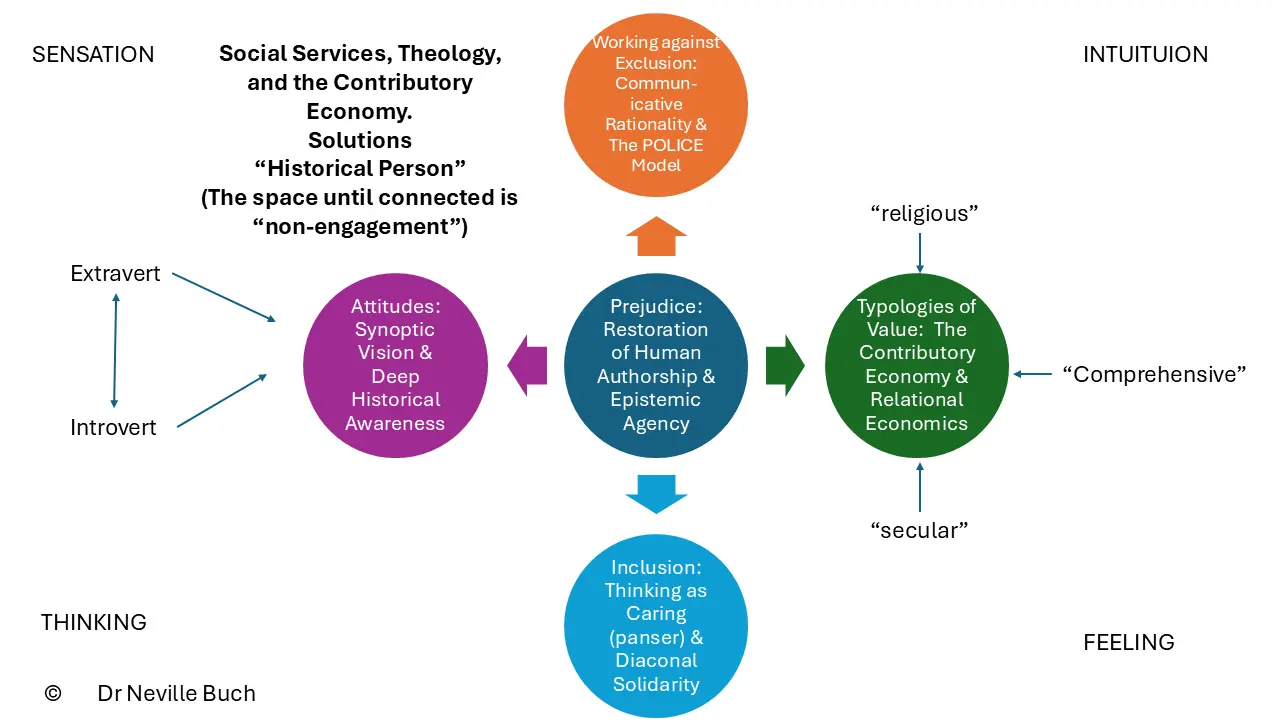
📊 The comparative Dynamic of Cognition (DoC) Table for a clear visual layout of how the pathologies of voluntarism align against the theological and social correctives of the Contributory Economy.
Dynamic of Cognition (DoC) Table mapping the specific pathologies of nineteenth-century voluntarism, private charity, and localized cultural myths against the theological and social correctives of a Contributory Economy:
DoC Table: Voluntarism Pathologies vs. Contributory Correctives
| DoC Component | Voluntarism, Private Charity, & Cultural Pathologies | The Theological & Social Corrective of the Contributory Economy | Philosophical & Theological Rationale |
| Self (Identity) | The “Colonial Irony” of Dependency: Treating the marginalized as passive, helpless “objects” of charity (“we do to/for you because we know best”), while devaluing the humanistic labour of educated scholars as unpaid “voluntarism”. | Restoration of Human Authorship & Epistemic Agency: Reclaiming the Historical Person as a proactive, self-determining creator of their own narrative and active partner in community development. | Moves the starting point of selfhood from unreflective paternalism to the recognition of equal dignity under the theological anthropology of the imago Dei. |
| Mind (Judgment) | The “Techné Mindset” & Character Myths: Using narrow commercial metrics to evaluate human worth, while hiding structural inequalities behind unreflective folkloric legends like the agrarian “Queensland Character”. | Synoptic Vision & Deep Historical Awareness: Reintegrating the philosophic and literary minds to read the social and environmental landscape as a layered historical text. | Overcomes Historical Forgetfulness and denoetization (the mechanical liquidation of judgment) by grounding current policies in concrete, localized historical contexts. |
| Reason (Logic) | Systematically Distorted Communication: Strategic manipulation for “Political Profit”, moralistic political agendas, and imported, anti-progressive Americanised anti-intellectualism [Long & Buch 1996]. | Communicative Rationality & The POLICE Model: Engaging in rational-critical dialogue aimed at mutual understanding (Verständigung) and unforced consensus. | Employs Philosophically Ontology Logic Intersect Compatibility Education as an intellectual immune system to “crap detect” and unmask automated “institutional bullshit”. |
| Utility (Action) | Possessive Individualism & Private Almsgiving: A “sinecure society” relying on fragmented, private benevolence and “job-ready” vocational compliance to treat the person as a transaction. | The Contributory Economy & Relational Economics: Rewarding the generation of social knowledge and local noodiversity through a collective “contributory income”. | Transitioning to Aristotelian flourishing (eudaimonia), supported by Kathryn Tanner’s (2005) non-competitive “Economy of Grace” and William Cavanaugh’s (2008) relational Eucharistic communion. |
| Love (Bond) | Paternalistic Charity & The Coldness of Calculation: Short-term, transactional “band-aids” (soup kitchens, food parcels) that relieve immediate physical distress but maintain the donor/recipient social hierarchy. | Thinking as Caring (panser) & Diaconal Solidarity: Reintegrating active compassion and empathy into the rational process as a procedural shield to protect the particularity of the person. | Transforms diaconal practice from moral self-indulgence to structural social justice, treating acts of service as mutual, relational neighbour-love and “solidarity with the shaken”. |
Key Ontological Integration
- The Problem of the “Band-Aid”: Relying on localized, voluntary charity isolates social problems from their political and structural roots. It leaves the marginalized trapped in cycles of dependency and devalues the labour of creative and intelligent individuals.
- The Restorative Path: True liberation is not achieved by more efficient “work” (purposive-rational action), but through the rationalization of our moral-practical consciousness. By transforming private sensations into shared, communicative knowledge, the Contributory Economy ensures that the “who” (the human being) remains the master of the “what” (the economic system).
[1] Artificial Intelligence (A.I.) has been fairly used in the production of this work. The tool used is Google NotebookLM (recently rebranded as Gemini Notebook). It is an AI-powered virtual research assistant and thinking partner designed to help a person interact deeply with their own documents. Unlike general chatbots, it is source-grounded, meaning it only generates answers based on the specific PDFs, documents, or links uploaded. The A.I. process in the production of this work has been limited to the attached (prompts) on each of the questions in turn. This ensures an accurate reading of each source. The author then rearranged and re-edited the answers the A.I. provided. The human author publishes this work. A.I. is never an author when used properly. This assistance is not qualitatively different from a human research assistant when that assistance is deemed to have no authorial status but is acknowledged.
Featured Image:



Neville Buch
Latest posts by Neville Buch (see all)
- The Unbound Mind: Independent Scholarship, Institutional Isolation, and the Restoration of Human Authorship – October 20, 2026
- The Road to Geelong: A Re-Narrativization of The Story of Resilience Part 1 – October 20, 2026
- The Human Being Above the Transaction and Why Markets Cannot Measure Human Worth – October 15, 2026