
The audio commentary on MICE’s Contributory Economy and Human Authorship:
Abstract
This essay explores the intellectual development of Unitarian-Universalism (UU) through the cognitive triad of Unity, Universality, and Sufficient Comprehension. It frames this “cognitive ascent” as a critical countermeasure to contemporary pathologies of thought. By drawing on the Dynamic of Cognition (DoC) and Spiral Historiography, the essay begins with a taxonomic distinction between a class, a category, and a classification to prevent “categorical mistakes” in religious and social organization. It then diagnoses the “crisis of comprehension” in modern public discourse, specifically analysing how social media accelerates “denoetization” and “thoughtlessness” in interactions with formal education. Finally, it critiques the way “culture” has hijacked the narrative of critical thought, reducing complex philosophical systems to ideological battlegrounds of “culture-history warfare.” The essay concludes that “Sufficient Comprehension” serves as a vital epistemological bridge, integrating reason and empathy to restore human authorship and foster holistic flourishing (eudaimonia).
Unity, Universality, and Sufficient Comprehension
I. Introduction: The Triad of Ascent
Unitarian Universalist (UU) congregations have historically positioned themselves at the liberal vanguard of religious and philosophical pluralism, prioritizing individual freedom, the subjection of all ideas to the light of reason, and a rejection of fixed, dogmatic creeds (Buch 2026b, p. 1). However, in the contemporary era, this tradition must confront a dual threat: the “passive nihilism” of unreflective belief and the “fragmentation” of specialized ignorance (Buch 2026b, p. 1). To navigate these modern pathologies, the UU cognitive framework requires a rigorous engagement with the conceptual triad of Unity, Universality, and Sufficient Comprehension (Buch 2026b, p. 1).
Unity, at its cognitive core, is the capacity of consciousness to be aware of multiple diverse representations simultaneously as a single complex whole (Brook 2000, p. 138; Buch 2026b, p. 1). In the UU context, this is lived as “Unity in Diversity”—a continuous balancing of individual perspectives within the “beloved community” without enforcing uniform dogmatic consent (Buch 2026b, p. 1). Universality expands this bonding outward, scoping beyond local, tribal, and national boundaries toward a world-embracing vision of shared human dignity (Buch 2023b, p. 145; Buch 2026b, p. 1). Bridging these two is Sufficient Comprehension—the “wicket gate” of the seeker’s journey, which establishes that while human knowledge is never absolute, it can be sound and sufficient for ethical action when grounded in history and context (Buch 2026b, p. 1).
To understand how these concepts operate, we must first examine the formal structures of cognitive organization, beginning with the logical distinctions that govern how we sort our world.
II. The Taxonomy of Thought: Class, Category, and Classification
In organizing human knowledge, the distinction between a class, a category, and a classification represents a fundamental cognitive sorting mechanism. Confusing these terms leads directly to what Dr. Neville Buch calls “categorical mistakes” of fragmentation (Buch 2023a, p. 143).
To prevent such confusion, we must understand their structural and functional differences:
- Classification is a methodical activity or structural action used to assign objects to specific buckets (Difference between a class, a category and a classification 2026, p. 1). It is the structural framework itself.
- Classes and Categories are the actual nouns or buckets created by the classification framework (Difference between a class, a category and a classification 2026, p. 1).
- Class represents a specific division or formal rank in a structured, hierarchical system (Difference between a class, a category and a classification 2026, p. 1). Classes possess rigid, strict, and mutually exclusive boundaries, such as taxonomic ranks in biology or formal legal definitions (Difference between a class, a category and a classification 2026, p. 1).
- Category represents a looser, more general term characterized by broad, flexible, and descriptive boundaries (Difference between a class, a category and a classification 2026, p. 1). Categories can be fuzzy, overlapping, and context-dependent, grouping items by situational utility rather than immutable laws (Difference between a class, a category and a classification 2026, p. 1).
In public and religious discourse, a catastrophic failure of reasoning occurs when fluid categories are treated as rigid, exclusionary classes. For instance, reducing the dynamic, floating spaces of human cognition to static, totalizing classifications—such as the hard binary of “religious” versus “secular”—creates “Identity Thinking” (Buch 2025a, p. 2; Buch 2025d, p. 2). This unreflective literalism classifies history into fixed, unmoving laws, masking the “thisness” (haecceity) of the individual person (Buch 2023b, p. 146; Buch 2025d, p. 2). To achieve true “Sufficient Comprehension,” a community must adopt an epistemological pluralism that utilizes flexible categories rather than rigid classes, recognizing that human existence is an integrated whole (Buch 2025d, p. 2; Buch 2026b, p. 1).
III. The Stupefied Mind: Social Media, “Denoetization,” and the Retreat of Education
The modern public square has experienced an “immense regression” in reading capacity and cognitive depth, driven by a pervasive “crisis of comprehension” (Buch 2026a, p. 1). Increasingly distracted by smartphones and algorithmic digital environments, individuals struggle to read long books or process complex ideas (Buch 2026a, p. 1). This decline is accelerated by “denoetization”—a state where technical systems and digital habits systematically prevent individuals from judging and thinking independently (Buch 2026a, p. 2).
On social media platforms like TikTok and Instagram, conversations are characterized by an extreme “chopping up” of information (Buch 2026a, p. 2). This fragmentary format induces a state of “symbolic misery,” where the public lives on the surface of events, consuming manufactured myths and repeating stenciled slogans without active mental engagement (Buch 2026a, p. 2; Buch 2026c, p. 18). When these social media habits collide with formal education, a profound “unthinkingness” emerges:
- The Rise of the Credential Society: Educational institutions have increasingly succumbed to a “Credential Society” ethos, where students prioritize “job tickets,” grades, and “measurable outcomes” over the actual, reflective labour of learning (Buch 2026a, p. 2).
- The Stupefying Effect of Vocationalism: Marketers and neo-liberal bureaucrats have rebranded narrow vocational “quick-to-job” training as “education” (Buch 2025b, p. 1). By cutting funding for the humanities and social sciences because they are not deemed “job-ready,” these policies actively induce “noetic desertification” (Buch 2025b, p. 2; Buch 2026c, p. 27).
- Populist Ignorance and Anti-Intellectualism: This systemic decline produces populist audiences who “spiral around in ignorance” and view academic expertise with aggressive skepticism (Buch 2025b, p. 2). This represents a modern victory of Irving Babbitt’s narrow, elitist humanism over Charles William Eliot’s vision of comprehensive “book education for the masses” (Buch 2025c, p. 1). The result is a population characterized by “mass stupidity” and “thoughtlessness” that relies on superficial numbers and test scores while actively mocking deep reading and scholarship (Buch 2025c, p. 1; Buch 2026a, p. 3).
Under the Dynamic of Cognition, this digital thoughtlessness acts as a pathological block, reducing the individual from an active author of meaning to a “puny human node” reacting blindly to external, algorithmic stimuli (Buch 2025e, p. 12; Buch 2026a, p. 3).
IV. The Hegemony of “Culture”: How the Narrative Hijacked Thinking
Crucial to diagnosing this cognitive decline is understanding how the concept of “culture” has taken over and hijacked the narrative of critical thought. Rather than acting as a tool for self-understanding, “culture” has been weaponized within modern public arenas:
First, the “culture wars” have reduced complex philosophical and ethical inquiries to simplistic, ideologically driven binaries (Buch 2025c, p. 3). Opponents of academic scholarship co-opt “culture” to dismiss objective, peer-reviewed findings as mere “political bias” or “personal grievances” (Buch 2025c, p. 3; Buch 2026c, p. 16). Public discourse becomes trapped in “culture-history warfare,” where “idiots fixated on freedom of thought” battle “idiots fixated on systems thought” (Buch 2025c, p. 2). This simplistic conflict prevents any meaningful interdisciplinary synthesis (Buch 2025c, p. 2).
Second, “culture” is frequently used as an instrument of imperialistic self-projection. As sociologist Mel van Elteren argues, dominant nations often employ “imperial gestures” to portray their own highly specific, corporate-driven popular culture as a “universal culture” that allegedly represents the pinnacle of global cosmopolitanism (van Elteren 2006, p. 207). This creates a class of “parochial cosmopolitans”—global elites who travel extensively but remain enclosed within a protective “sociocultural bubble” of standardized hotels, media, and language (Hunter & Yates, cited in van Elteren 2006, p. 231). This bubble shields them from genuine contact with indigenous or alternative ways of knowing, while allowing them to superimpose their own cultural “melting-pot” models on the rest of the world (van Elteren 2006, p. 217, 231).
Finally, this obsession with superficial “cultural markers” induces “Historical Forgetfulness” (the Epimethean fault) (Buch 2026c, p. 18). By banishing the deep, structural context of how social and political identities are historically formed, populations become highly vulnerable to sociological propaganda (Buch 2026c, p. 18). “Culture” is turned into a “theological mask” that shields institutional power and “civilized hypocrisy” from ethical accountability (Rosenblatt, cited in Buch 2025f, p. 5; Buch 2026c, p. 11).
V. Conclusion: The Path to Eudaimonia
To escape the “vicious circle” of digital denoetization and cultural tribalism, UU congregations and the broader public must actively cultivate Sufficient Comprehension (Buch 2026c, p. 19). This requires the implementation of Spiral Historiography—a non-linear learning model that uncoils recurring historical errors through regret and accountability, allowing us to “unhook” our narratives from restrictive tribal stencils (Buch 2025d, p. 2; Buch 2026c, p. 19).
True comprehension is like the restoration of a damaged fresco; it demands that we seek the “whole of the matter,” filtering out “institutional bullshit” to replace automated reflexes with communicative action (Buch 2025d, p. 3, 5; Buch 2026c, p. 18). By integrating the Five Intentions (Self, Mind, Reason, Utility, and Love), communities can move beyond the passive numbness of cynicism and positivism (Buch 2026b, p. 1). In doing so, we restore human authorship over our own lives, transitioning from “ignorant habit” to a state of practical confidence and Aristotelian flourishing (eudaimonia) (Buch 2025a, p. 3; Buch 2026c, p. 19).
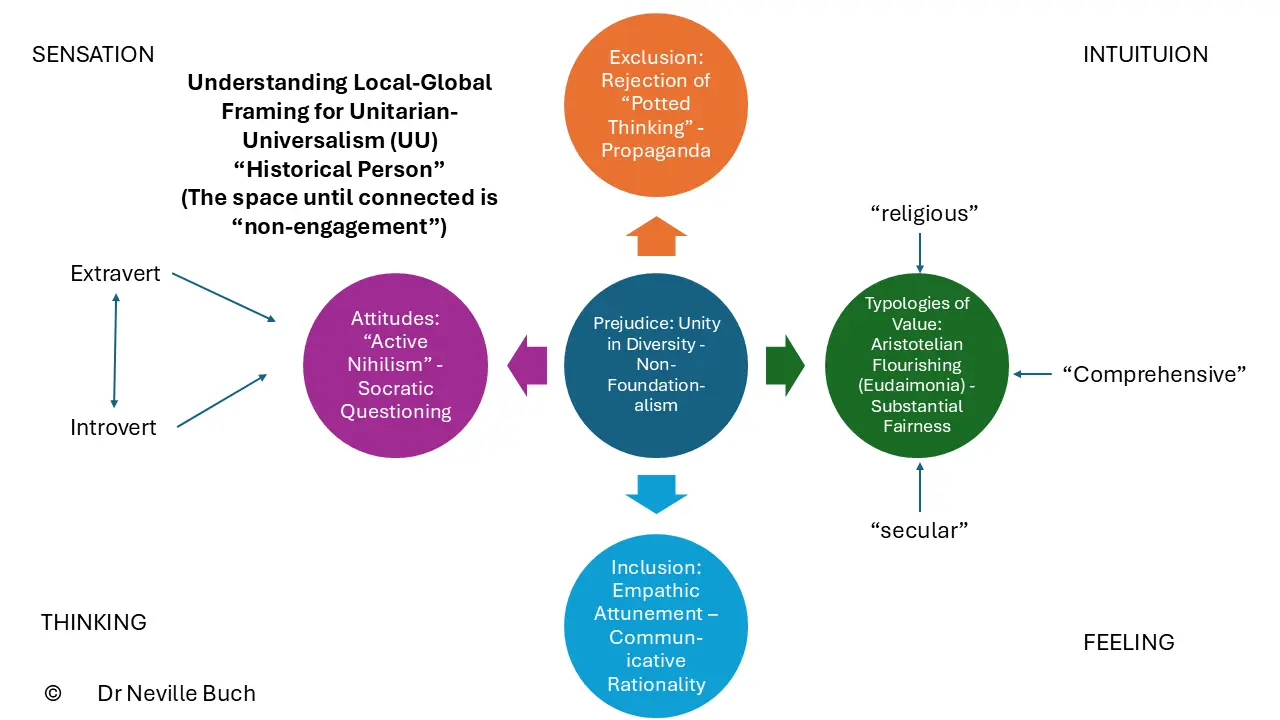
The Dynamic of Cognition (DoC) is Dr. Neville Buch’s general methodological tool used for philosophical critique and applied history. The DoC maps the transition of unreflective, “thrown” prejudices into coherent, revisable knowledge by organizing cognitive functions across four interacting domains: Prejudice (Centre), Attitudes (Thinking), Typologies of Value (Feeling), Exclusion (Sensation), and Inclusion (Intuition).
Applying this framework to “Cognitive Ascent: Unity, Universality, and Sufficient Comprehension” exposes how Unitarian Universalist (UU) communities can reject the passive regressions of nihilism, cynicism, and positivism to reclaim active human authorship and achieve holistic flourishing.
I. DoC Component Stance: Rejecting Passive Cognition
The primary application of the DoC in the “Cognitive Ascent” is the systemic rejection of passive, fragmented, and reductionist thought in favour of an integrated, active intellect.
| DoC Component | UU Cognitive Ascent Stance | Cognitive Impact and Rationale |
| Prejudice (Centre) | Unity in Diversity / Non-Foundationalism | The unavoidable, “thrown” starting point of thought is reformed into an unprejudiced love of truth. It rejects fixed, external absolutes and dogmas in favour of a pluralistic, revisable, and shared worldview. |
| Exclusion (Sensation) | Rejection of “Potted Thinking” / Propaganda | To safeguard the integrity of thought, the mind systematically filters out the “techné mindset” (which reduces human complexity to quantifiable data) and passive nihilism (which surrenders the labour of thinking to stay a consumer of propaganda). |
| Inclusion (Intuition) | Empathic Attunement / Communicative Rationality | The external is made internal through empathy and the “fusion of horizons”. This process internalizes the perspectives of the “Other” into a “shared stream of consciousness” and a secure “we space”. |
| Attitude (Thinking) | “Active Nihilism” / Socratic Questioning | Transforming unconscious habits into a force for active inquiry. Rather than succumbing to the “void” of future uncertainty, this attitude uses Socratic questioning to continually dismantle dogmatic illusions and seek truth. |
| Value (Feeling) | Aristotelian Flourishing (Eudaimonia) / Substantial Fairness | Instead of evaluating human worth by political or economic utility, the standard of value is anchored in character, wisdom, and meaningful social contribution. Lived experience is prioritized over instrumental, calculated outcomes. |
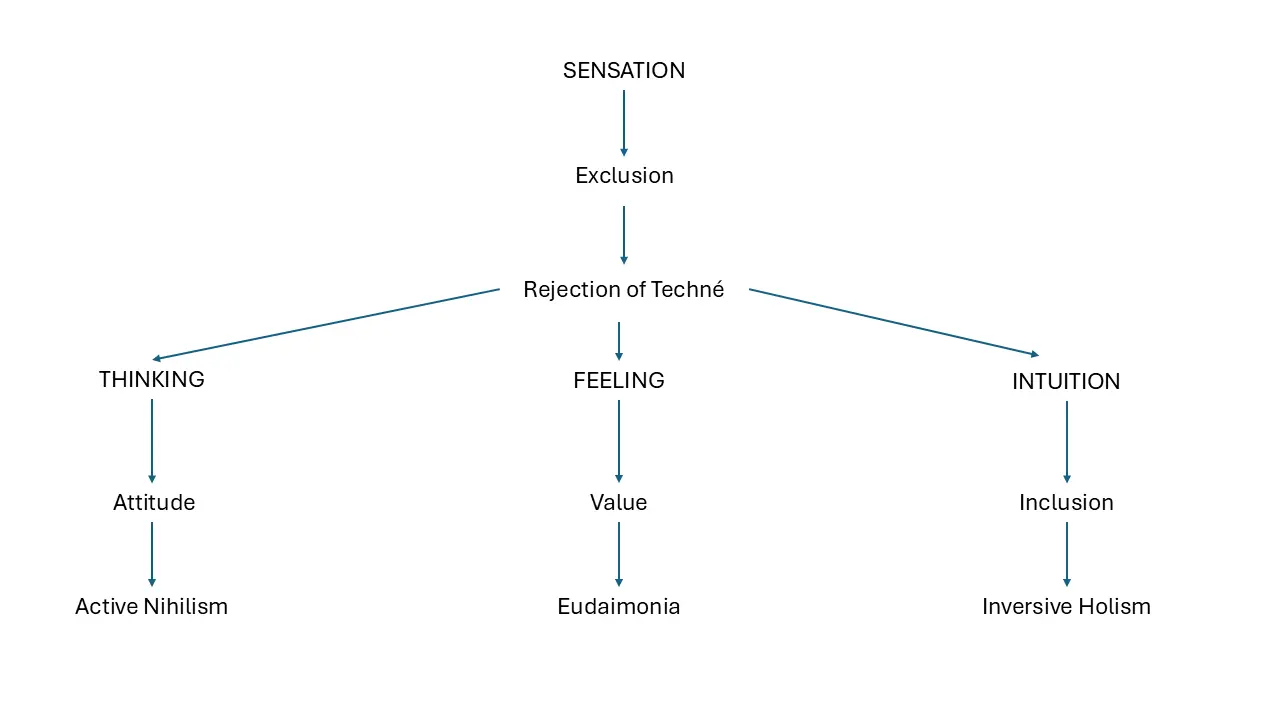
II. DoC Quadrant Mapping: The Jungian Typological Functions
By leveraging the Jungian orienting functions, the Cognitive Ascent translates raw sensory inputs and internal orientations into a state of “conscious competence”.
- Sensation (Exclusion): Rather than perceiving the “Other” or external challenges as security threats to be locked out behind an intellectual “fortress,” sensation is directed outward to view the world as a diverse, multi-textured social geography.
- Intuition (Inclusion): It moves past the “symbolic misery” of short digital attention spans to perceive the archetypal foundations of a shared humanity. It uncovers a “hidden wholeness” beneath modern fragmentation.
- Thinking (Attitude): Thinking is treated not as a passive, strategic calculation, but as a voluntary, courageous act of organizing rational-critical dialogue to engage in necessary “crap detecting”.
- Feeling (Value): Feeling moves away from the coldness of pure calculation toward caring (panser) and empathy. This shifts the core of personality to evaluate the human person as an active, willing, and evaluating agent.
III. The Outcome: Uncoiling the Epimethean Fault
Without this cognitive path of ascent, the human agent slips into “Historical Forgetfulness” (the Epimethean fault), banishing historical context and repeating old prejudices under new, unreflective labels. Navigating the DoC allows the seeker to pass through the “wicket gate” of Sufficient Comprehension. Under a fallibilist epistemology, the individual recognizes that while our knowledge of the universe is never perfect or complete, it remains valid and sound if it is sufficient to act with practical confidence, love, and justice in the concrete reality of our lives.
Bibliography
Brook, Andrew. (2000). ‘Unity of Consciousness: What It Is and Why’, Proceedings of the Annual Meeting of the Cognitive Science Society, vol. 22, no. 22, pp. 138-142.
Buch, Neville. (2023a). SoFiA Melbourne: Unity and Fragmentation, Dr Neville Buch, MICE, Brisbane.
Buch, Neville. (2023b). Spiral Historiography: Socio-Historical Change in Unitarian Universalism, Australian and New Zealand Unitarian Universalist Association (ANZUUA), MICE, Brisbane.
Buch, Neville. (2023c). The Universal in Crisis: A Research Note, Dr Neville Buch, MICE, Brisbane.
Buch, Neville. (2025a). The Dynamic of Cognition, Dr Neville Buch, MICE, Brisbane.
Buch, Neville. (2025b). Comprehensive Background Today on so-called Religion and Secularity, Dr Neville Buch, MICE, Brisbane.
Buch, Neville. (2025c). Comprehensive Understanding of Humanism Today, Dr Neville Buch, MICE, Brisbane.
Buch, Neville. (2025d). Five Intention Prejudice and Global Thinking Series. Paper No. 4: The Synoptic Vision – A Philosophical Inquiry into Comprehension, Dr Neville Buch, MICE, Brisbane.
Buch, Neville. (2025e). Comprehension: Solutions and The Plan, Dr Neville Buch, Brisbane.
Buch, Neville. (2025f). Humanism in the Trumpocene: Week 1.A (Historical Lesson from the Seventeenth Century), Dr Neville Buch, MICE, Brisbane.
Buch, Neville. (2026a). The Crisis of Comprehension and the Restoration of Deep Reading: Part 2. Response to Critics, Management Institute for Contributory Economy, Brisbane.
Buch, Neville. (2026b). The Unitarian Universalist Cognitive Ascent, Dr Neville Buch, MICE, Brisbane.
Buch, Neville. (2026c). Identity Politics and the Ascent toward Comprehensive Empathy, Dr Neville Buch, MICE, Brisbane.
Difference between a class, a category and a classification. (2026). Academic Reference Document.
Lowenthal, David. (2019). Quest for the Unity of Knowledge, Routledge, London.
van Elteren, Mel. (2006). ‘Imperial Gestures in Portrayals of U.S. Culture as a “Universal Culture”‘, Amerikastudien / American Studies, vol. 51, no. 2, pp. 207-238.

Featured Image:


Neville Buch
Latest posts by Neville Buch (see all)
- Thank you, Richard: Knowing the message but then acting – October 8, 2026
- The Desiccation of the Common Well: Identity Politics, Algorithmic Assessment, and the Crisis of Adult Responsibility – October 6, 2026
- Academic Rigour, Epistemic Renewal, and the Crisis of Inquiry: A Scholarly Review of the Vanderbilt Commission Report on the State of Scholarship – October 5, 2026