
The audio commentary of Dr. Buch’s early 20th century intellectual history.
Dr Neville Buch[1]
Abstract
This essay critiques the rise of bureaucratic humanism in the early twentieth century, a period marked by an intellectual regression where humanism was stripped of its reflective, interpretive depth and captured by elite academic structures and technical reductionism. Originating in Irving Babbitt’s restrictive “New Humanism” and reinforced by a Comtean, positivist obsession with calculation, this paradigm reduced human subjectivity to a series of institutional cogs and “meaningless scratches”. To diagnose these failures, this paper presents a detailed Dynamic of Cognition (DoC) analysis, demonstrating how the era’s intellectual history stagnated in monistic rationalism, conservative elitism, and the repression of technics. In response, the paper identifies the powerful corrective insights of contemporary philosophers of the era—including F.C.S. Schiller’s pragmatic humanism, William James and Max Scheler’s non-formal personalism, and Jack McKinney’s advanced synthesis of lived experience. By reclaiming human authorship and moral agency against the coldness of bureaucratic calculation, these thinkers laid the groundwork for an inclusive, lived humanism that remains vital for navigating modern technocratic crises.
I. The Historical Context: Babbitt, Eliot, and the Birth of Bureaucratic Humanism
The early twentieth century witnessed a profound crisis in the definition of the humanistic enterprise, as classical education and secular inquiry became entangled with industrial management and academic professionalization. This transition birthed what is termable as bureaucratic humanism—an administrative, elite-focused framework that prioritized rigid structural hierarchies over the fluid, evolving needs of mass democratic societies.
The primary catalyst for this shift was the emergence of “New Humanism” in American universities, championed by the polemical academic Irving Babbitt. In a fierce battle over the direction of modern education, Babbitt opposed the democratic philosophy of Harvard President Charles Eliot, who argued for the comprehensive book education of the masses. Babbitt asserted that the humanist’s sole role was to teach a highly cultured, narrow elite. The victory of Babbitt’s elitist framework left a permanent “bad odour” hovering over the term “humanism,” associating it with a rigid, exclusionary posture that dismissed the creative and intellectual potential of common humanity.
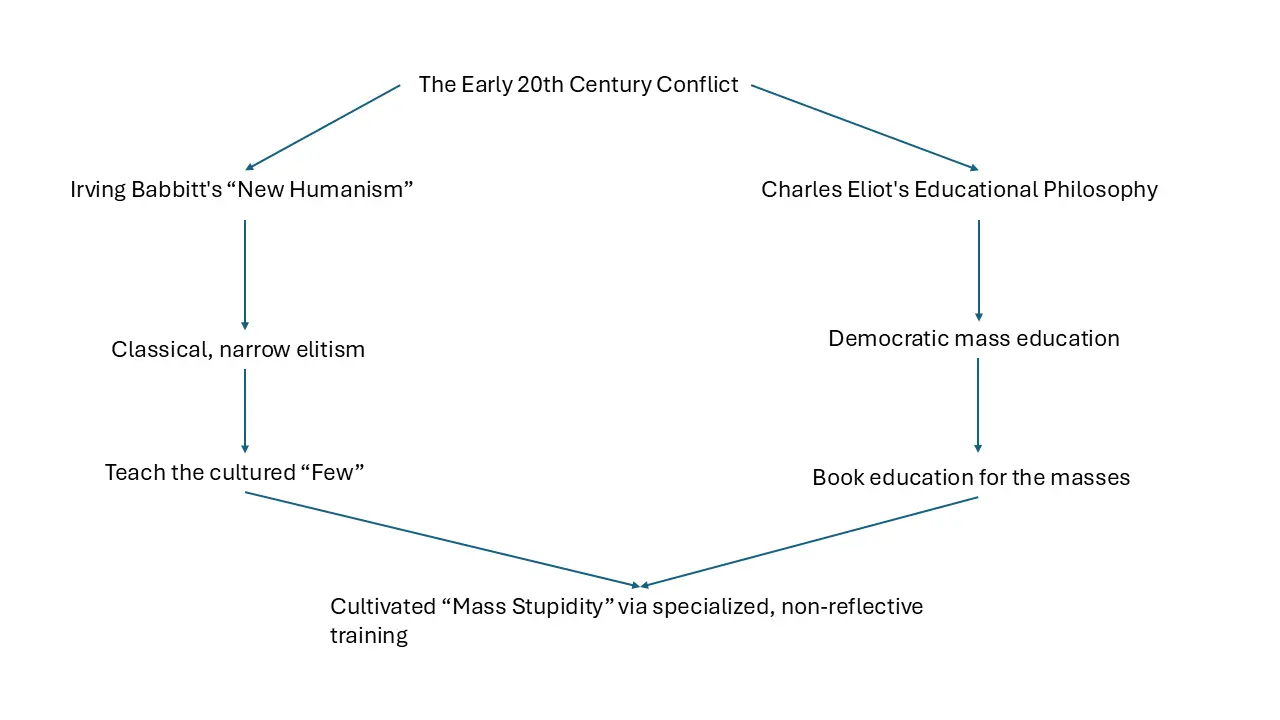
Crucially, while Babbitt’s followers were hailed as defenders of traditional liberal culture, they inadvertently fostered the very positivist, mechanistic systems they claimed to oppose. By attacking “systems thought,” nineteenth-century liberal humanists like John Stuart Mill had inadvertently created a false binary between individual freedom of thought and sociological organization. In the early twentieth century, this confusion allowed the New Humanists to adopt a Comtean, positivist sociology. They reduced the “lived experience” of the human subject to quantifiable, operational concepts, aligning humanism with the Techné Mindset of modern bureaucracies. Under this administrative gaze, the individual was stripped of proactive human authorship and treated as a passive, “puny human node” to be moulded by elite classical curriculum.
II. Dynamic of Cognition (DoC) Analysis: Mistakes of the Intellectual History
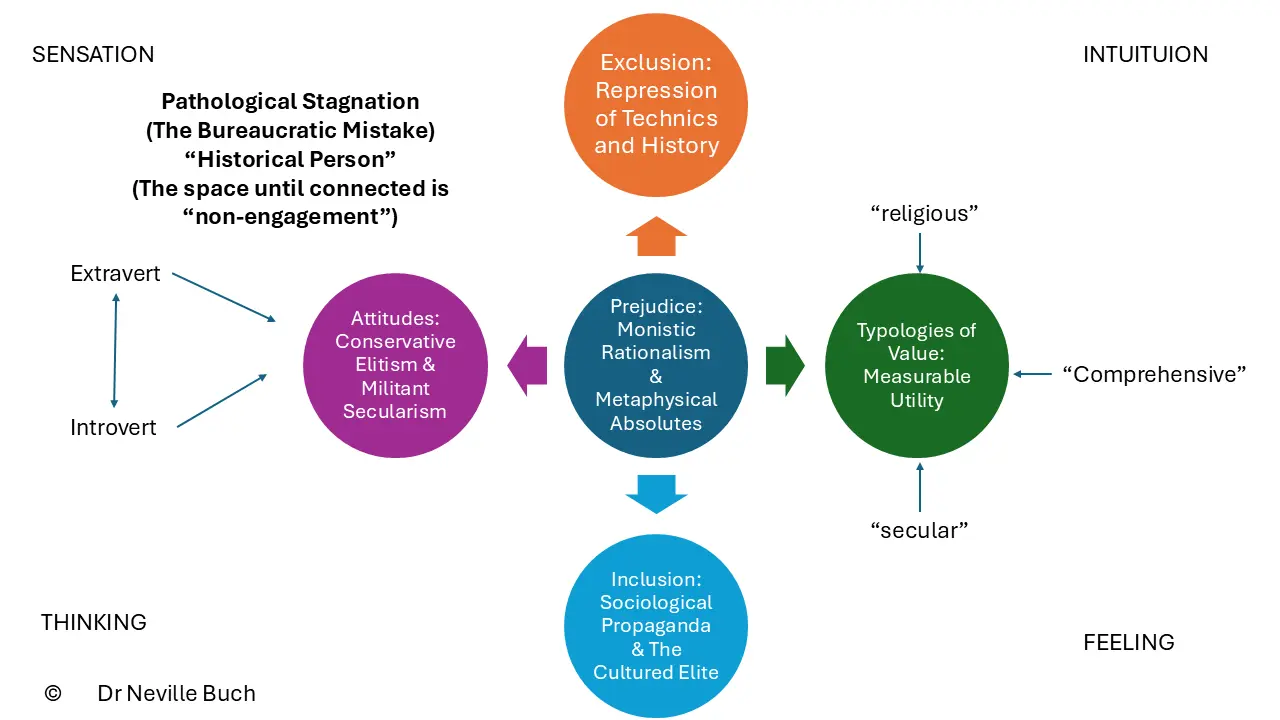
To understand how early twentieth-century humanism lost its reflective core, Dr. Neville Buch’s Dynamic of Cognition (DoC) model provides a diagnostic tool to map the era’s cognitive failures and pathological stagnations. The following analysis outlines how the unreflective habits of the bureaucratic elite resulted in a systematic closing of intellectual horizons.
Dynamic of Cognition (DoC) Table: The Stagnations of Bureaucratic Humanism
| DoC Component | Pathological Stagnation (The Bureaucratic Mistake) | Source Rationale & Historical Critique |
| Prejudice (Centre) | Monistic Rationalism & Metaphysical Absolutes: The conviction that truth is derived from a fixed, external, non-contextual system. | Rejects the “perpetual becoming” of human thought, seeking to insulate the elite from the contingency of “moral luck” and historical change. |
| Attitudes (Thinking/Extrovert) | Conservative Elitism & Militant Secularism: The habitual restriction of humanist discourse to the cultured few while unethically marginalizing diverse modes of thought. | Derived directly from Babbitt’s academic elitism. This attitude confuses philosophical rationalism with rigid literalism, eliminating the reflective self-criticism needed to adapt to changing social realities. |
| Typologies of Value (Feeling/Introvert) | Measurable Utility: Prioritizing narrow, vocational fitness (“Job Ready”) and technical profit over moral character, wisdom, and spiritual depth. | Reduces the human mind to a causal or computational mechanism. This creates “artificial stupidity” and a discontinuous personality dependent on external stimuli. |
| Exclusion (Sensation/Intuition) | Repression of Technics and History: Filtering out the foundational role of technology (prosthesis) and committing “Historical Forgetfulness”. | Banishes the deep historical context of conceptual schemas. This leads to the Epimethean fault, where hindsight arrives too late to correct systems built without human empathy. |
| Inclusion (Thinking/Feeling) | Sociological Propaganda & The Cultured Elite: Relying on “Integration Propaganda” and bureaucratic orthopraxy to enforce uniform behavioural control. | Reconstitutes a rigid “temple of Western culture” that treats the mind as a receptacle to be filled with data deposits rather than a site of active, living disclosure. |
III. The Correction Path: Philosophical Insights of the Era
The stagnation of bureaucratic humanism did not go unchallenged. Throughout the early-to-mid twentieth century, a vibrant network of philosophers launched a major revolt against this senseless division of hearts and minds, offering profound corrective insights to restore genuine human authorship.
1. F.C.S. Schiller’s Pragmatic Humanism
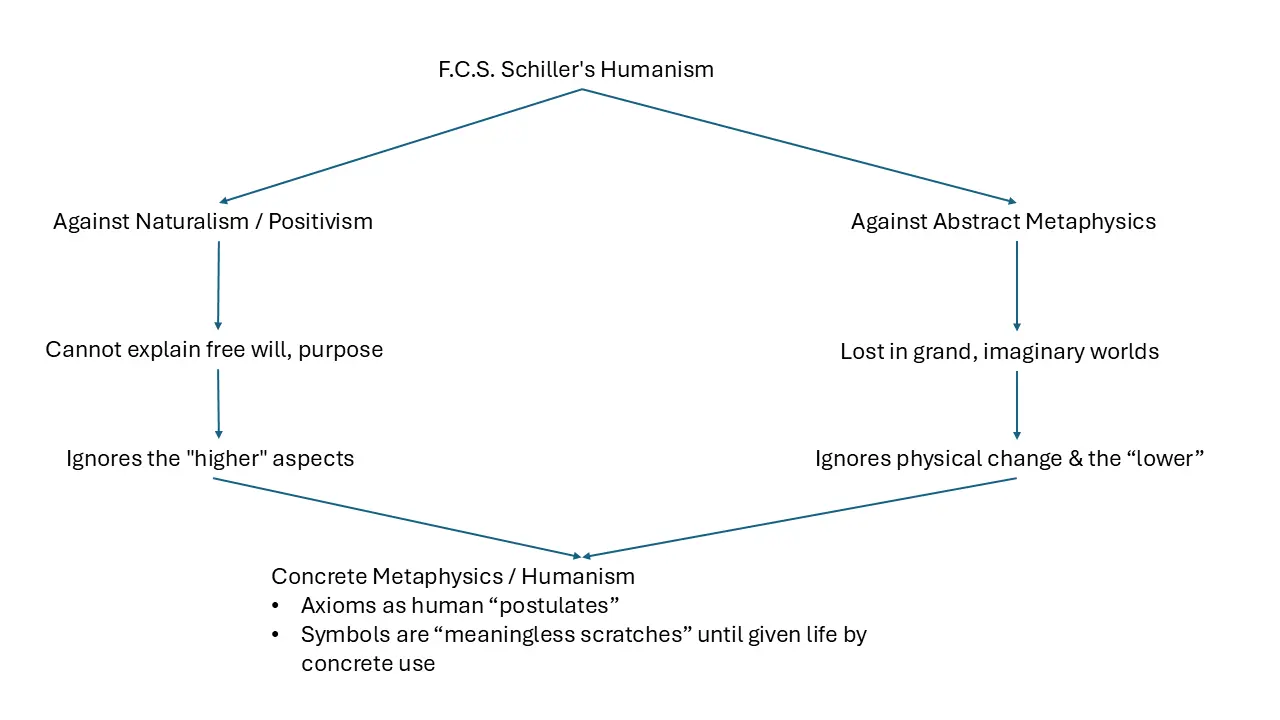
One of the most devastating contemporary critiques of early twentieth-century formalist abstraction came from the British-American pragmatist F.C.S. Schiller. Schiller accused both naturalism (positivism) and abstract metaphysics of losing touch with the lived world. He argued that naturalism was a “pseudometaphysics” incapable of making sense of the “higher” aspects of the world—such as free will, purpose, consciousness, and moral values. Conversely, abstract metaphysics built grand, imaginary worlds that could not account for the “lower” aspects of physical change, imperfection, and lived time.
For knowledge and morality to be possible, Schiller maintained that both elements must be bridged through what he termed ”concrete metaphysics,” which he later renamed ”humanism”. He asserted that axioms are not fixed, divine absolutes, but rather ”postulates” that must be tested and validated by human use. In his landmark work Logic for Use (1929), Schiller famously proclaimed that logical symbols, data, and abstract laws are nothing more than ”meaningless scratches” unless they are given life and purpose within a specific, concrete human situation. Meaning, therefore, is not an inherent property of a formal system, but an active, creative human construction.
2. William James, Max Scheler, and the Lived Body (Leib)
Similarly, the radical empiricism of William James and the phenomenological value-ethics of Max Scheler converged on a shared defence of the moral and emotional dimensions of human life over dry logical formalism. Both thinkers shared an early preoccupation with the moral life, standing in stark contrast to the purely mathematical and logical starting points of Edmund Husserl and Charles Sanders Peirce.
Scheler, in Human Place and the Cosmos (1928), argued that none of the dominant modern frameworks—theological, philosophical, or scientific—offered a uniform or cohesive idea of what it means to be human. He warned that European culture, since René Descartes, had systematically de-personalized the human being, fostering a technocratic crisis where individuals were treated as superfluous cogs in bureaucratic machines. To resist this objectification, Scheler and James put the person front and centre as the unique focal point of lived experience, demonstrating that human agency cannot be reduced to a computer model or a biological mechanism. They insisted that our primary access to reality is through intentional feeling and the “lived body” (Leib), validating emotional complexity and spiritual depth as core cognitive necessities.
3. Jack McKinney’s Advanced-Thinking Humanism
In the mid-twentieth century, Australian philosopher Jack McKinney built upon these pragmatist and realist insights to formulate a comprehensive “advanced-thinking humanism”. Citing early twentieth-century thinkers such as Susan Stebbing, Alfred North Whitehead, Bertrand Russell, and William James, McKinney mapped how every formal, logical system inevitably “eats itself in the unforgiving criticism of its ancestry”.
McKinney’s central thesis, articulated in The Challenge of Reason (1950) and The Structure of Modern Thought (1971), was that reality and knowledge must be understood as the dynamic sum of all individual human experiences. He rejected the positivist-behaviorist assertion that knowledge is merely a set of logical inferences drawn from sense-data. Instead, he argued that language, meaning, and our shared “world-picture” are active social constructions synthesized from the collective, historical experience of humanity—a process he termed the ”Original Synthesis of Experience”.
McKinney warned that when technical philosophy and specialized science isolate themselves in narrow, specialized silos, they fail to communicate with common humanity. This academic provincialism forces the ordinary citizen into either skepticism and mysticism, or “into the arms of some ready-made formula” and populist simplification. To prevent this general state of irrationality, McKinney advocated for a compatible path that brought hearts and minds back together, insisting that there is not “one truth for the elite, and another truth for common humanity”.
IV. Conclusion: Reclaiming Human Authorship
The early twentieth-century mistake of bureaucratic humanism lay in its attempt to strip humanism of its historical, contingent, and lived character to serve the demands of institutional efficiency and social control. By reducing the rich “fuzziness, ambiguity, and coincidence” of human life to monistic rationalism and measurable utility, it initiated an immense regression toward absolute non-knowledge.
The corrective path laid down by Schiller, James, Scheler, and McKinney demonstrates that humanism cannot survive as an elite academic dogma or an unreflective administrative tool. Instead, humanism must be continuously reinvented as a lived, interdisciplinary practice where thinking is integrated with caring (panser). To move from a “Junior” state of unreflective execution to a “Senior” state of social accountability, we must utilize Spiral Historiography to critically engage past intellectual struggles and uncoil the repetitive patterns of technocratic stupidity. Only by re-situating meaning in rebus—within specific, concrete historical localities—can we protect the human person from the coldness of pure calculation and restore genuine human authorship over our shared destiny.
Bibliography
Arendt, H. (1958). The Human Condition. Chicago: University of Chicago Press.
Bakewell, S. (2023). Humanly Possible: Seven Hundred Years of Humanist Thinking, Enquiry and Hope. London: Chatto & Windus.
Bourdieu, P. (1990). Outline of a Theory of Practice. Cambridge: Cambridge University Press.
Buch, N. (2015). No Regrets in the Evening of Life: The History of Junction Park State School (1888–2013). Salisbury, QLD: Boolarong Press.
Buch, N. (2025). Chapter 7 Outline. Humanism in the Digital Age. Brisbane: Management Institute for Contributory Economy.
Buch, N. (2025). Humanism in Australia. Lost Thought and Awareness. Brisbane: Management Institute for Contributory Economy.
Buch, N. (2025). Project Humanism and the Contributory Economy. Brisbane: Management Institute for Contributory Economy.
Buch, N. (2025). The Limits of Humanism. Brisbane: Management Institute for Contributory Economy.
Buch, N. (2026). MICE. Project Humanism and the Contributory Economy. Brisbane: Management Institute for Contributory Economy.
Buch, N. (2026). The Problem of Unreformed Humanism. Brisbane: Management Institute for Contributory Economy.
Collins, R. (1998). The Sociology of Philosophies: A Global Theory of Intellectual Change. Cambridge, MA: Belknap Press of Harvard University Press.
Collins, R. (2019). The Credential Society: An Historical Sociology of Education and Stratification. New York: Columbia University Press.
Habermas, J. (1979). Communication and the Evolution of Society. (T. McCarthy, Trans.). Boston: Beacon Press.
Habermas, J. (1981). The Theory of Communicative Action: The Critique of Functionalist Reason. (T. McCarthy, Trans.). London: Polity Press.
James, W. (1952). Principles of Psychology. Chicago: William Benton Publishers.
Larsen, M. (2021). ”Battleground of Humanisms: How Väinö Linna’s Under the North Star United What Liberalism, Socialism, and Fascism Tore Apart.” The European Legacy, 26(1), 1–18.
McKinney, J. P. (1950). The Challenge of Reason. Brisbane: Mountain Press.
McKinney, J. P. (1971). The Structure of Modern Thought. London: Chatto & Windus.
Noddings, N. (1984). Caring: A Feminine Approach to Ethics and Moral Education. Berkeley: University of California Press.
Ringma, C. (n.d.). Free Thought and True Humanism. Online Manuscript.
Scheler, M. (1973). Formalism in Ethics and the Non-Formal Ethics of Value: A New Attempt Toward the Foundation of an Ethical Personalism. (M. Frings & R. Funk, Trans.). Evanston, IL: Northwestern University Press.
Scheler, M. (2009). Human Place and the Cosmos. (M. Frings, Trans.). Evanston, IL: Northwestern University Press.
Schiller, F. C. S. (1891). Riddles of the Sphinx. London: Chatto & Windus.
Schiller, F. C. S. (1903). Humanism. London: Macmillan & Co.
Schiller, F. C. S. (1929). Logic for Use. London: G.P. Putnam’s Sons.
Stiegler, B. (1998). Technics and Time, 1: The Fault of Epimetheus. (R. Beardsworth & G. Collins, Trans.). Stanford: Stanford University Press.
Stiegler, B. (2025). The Immense Regression. (D. Ross, Trans.). Berlin: K. Verlag.
Williams, B. (1985). Ethics and the Limits of Philosophy. London: Fontana.
Williams, B. (1995). Making Sense of Humanity and Other Philosophical Papers 1982–1993. Cambridge: Cambridge University Press.
Williams, B. (2008). Philosophy as a Humanistic Discipline. (A. W. Moore, Ed.). Princeton, NJ: Princeton University Press.
🎧 A.I. Notebook says: “Since we’ve mapped out the intellectual errors of this historical period and the corrective paths offered by McKinney and Schiller, would you be interested in generating a polished audio overview that synthesizes these philosophical debates into a dynamic conversation?”
Available above.
[1] Artificial Intelligence (A.I.) has been fairly used in the production of this work. The tool used is Google NotebookLM (recently rebranded as Gemini Notebook). It is an AI-powered virtual research assistant and thinking partner designed to help a person interact deeply with their own documents. Unlike general chatbots, it is source-grounded, meaning it only generates answers based on the specific PDFs, documents, or links uploaded. The A.I. process in the production of this work has been limited to the attached (prompts) on each of the questions in turn. This ensures an accurate reading of each source. The author then rearranged and re-edited the answers the A.I. provided. The human author publishes this work. A.I. is never an author when used properly. This assistance is not qualitatively different from a human research assistant when that assistance is deemed to have no authorial status but is acknowledged.
Featured Image: Humanism-in-Australia-and-Canada


Neville Buch
Latest posts by Neville Buch (see all)
- The Unbound Mind: Independent Scholarship, Institutional Isolation, and the Restoration of Human Authorship – October 20, 2026
- The Road to Geelong: A Re-Narrativization of The Story of Resilience Part 1 – October 20, 2026
- The Human Being Above the Transaction and Why Markets Cannot Measure Human Worth – October 15, 2026