
Dr Neville Buch
Abstract
The Mapping Brisbane History (MBH) Project represents a pioneering effort in Digital Humanism, transforming local studies from static “folk history” into a rigorous, interdisciplinary research tool. Grounded in the axiom “Understanding history is philosophy in practice,” the project utilizes a Dynamic of Cognition (DoC) methodology to spatially represent the intellectual and social evolution of Brisbane across four distinct epochs. Since its inception in 2012, MBH has moved from a localized pilot study of the city’s Southside to a comprehensive regional repository of over 1,060 historical sites. The forthcoming program shifts focus toward restorative truth-telling through oral history reports and the archiving of radical community narratives, seeking to remediate “Historical Forgetfulness” and foster a Contributory Economy where citizens act as proactive authors of their shared reality.
——————————————————————————–
Mapping Brisbane for the World: History and Future Directions
The Genesis and Evolution of the Project (2012–2025)
The MBH Project originated in 2012 as the Mapping Brisbane Southside History (MBSH) project, initially funded by a Brisbane City Council Community History Grant and administered by the Coopers Plains Local History Group. Directed by Dr. Neville Buch, the project was designed to overcome the “parochial prejudice” of traditional local history by linking specific localities to global theoretical frameworks.
The history of the project is defined by its expansion through nine research stages. Key achievements include:
- Methodological Rigour: The rejection of “tub-thumping” pro-development propaganda in favour of a social science-based mapping program that secures large volumes of data.
- Spatial Epochs: The division of Brisbane’s history into four thematic periods (Early 19th Century to Late 20th Century), allowing for a nuanced understanding of how site uses transmuted over time.
- Digital Humanism: Recreating lost landscapes through 20-year interval snapshots (e.g., 1901, 1921, 1941) to “uncoil” the history of environmental and social change.
The Forthcoming Program (2026 and Beyond)
As of 2026, the MBH program is transitioning from its initial data-gathering phases toward an applied practice of community archiving and oral history. The forthcoming agenda is characterized by three primary initiatives:
- The Oral History and Community Site Invite: Launched in May 2026, this program specifically targets the documentation of important community sites, including the cultural history of the Botanic Gardens, St. John’s Cathedral, and the extensive network of communal households associated with the House of Freedom (HOF).
- Institutional Commissions: Dr. Buch has been commissioned by the Service Personnel Anglican Help Society (SPAHS) to produce a published history of the organization’s origins and mission, utilizing the MBH methodology to move beyond “unreflective tradition”.
- Radical Community Historiography: Building on the first drafts of the HOF History, the project aims to integrate the narratives of 1970s radical discipleship experiments with the broader social and political context of the Bjelke-Petersen era.
The ultimate goal of the forthcoming program is the realization of the “Contributory Future,” ensuring that the “who” (the human being) remains the master of the “what” (technical mapping systems) to achieve Aristotelian flourishing.
——————————————————————————–
Dynamic of Cognition (DoC) Table: The Process of Mapping
| DoC Component | Mapping Phenomenon | Philosophical Rationale |
| Self (Identity) | Educational Authorship | Transitions the individual from a “puny human node” to a proactive author of local history. |
| Mind (Judgment) | Analytical Depth | Moves beyond nostalgic “folk history” toward narrative explanations grounded in the social sciences. |
| Reason (Logic) | Spiral Historiography | Recreates lost landscapes in 20-year snapshots to “uncoil” repetitive patterns of historical error. |
| Utility (Action) | Regional Cooperation | Assists voluntary societies to work together to gain a broader, global-regional perspective. |
| Love (Bond) | Restorative Truth-Telling | Untangles complex place-names and unearths “lost” Indigenous and radical narratives to heal intellectual wounds. |
——————————————————————————–
APA Bibliography
Buch, N. (2015). No regrets in the evening of life: The history of Junction Park State School (1888–2013). Boolarong Press.
Buch, N. (2025, March 17). MICE principles and philosophy (First development). Management Institute for Contributory Economy.
Buch, N. (2025, December 5). Mapping Brisbane for the world: A digital historiography of cognition and place. Management Institute for Contributory Economy.
Buch, N. (2026, April 8). HOF history (First draft). Management Institute for Contributory Economy.
Buch, N. (2026, May 31). New MBH program: Invite for oral history reports. Management Institute for Contributory Economy.
Buch, N. (2026, June 3). History of Dr. Buch’s models (40 years of scholarly work). Management Institute for Contributory Economy.
Kerkhove, R. (2026, May). Rediscovering the Frontier Wars: Queensland’s contribution and the role of The Royal Historical Society of Queensland 1950s-1960s. Queensland History Journal, 26(6), 511-522.
Management Institute for Contributory Economy. (2026, May 18). Website write-up: Home page. Retrieved from https://mappingbrisbanehistory.com.au/
——————————————————————————–
Endnotes
- Philosophy in Practice: The axiom established by Dr. Buch asserts that history must provide the empirical grounding for ethical critique.
- Digital Humanism: The project uses technology to serve humanistic goals of autonomy and democratic participation.
- MBSH Origins: Mapping Brisbane Southside History was the original pilot name before being subsumed into the city-wide MBH project.
- Historical Forgetfulness: A systemic pathology where societies repeat past errors because the origins of their core concepts are forgotten.
- Panser (Thinking as Caring): The methodological shield used to protect human particularity from abstract, calculating logic [12.1, 249, 288].
- Contributory Economy: An economic re-orientation that values knowledge production and human dignity over narrow transactional profit.
- Verstehen: Empathetic understanding used to merge repellent experiential fields into a coherent narrative.
******
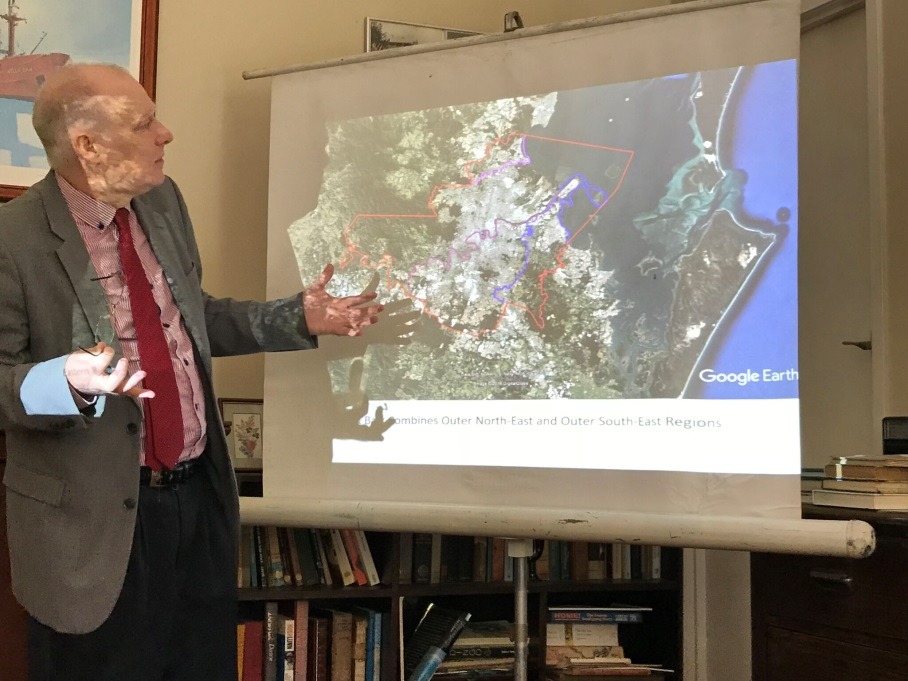
Featured Image: MBH on the World Map

MBH Presentation to the RGSQ Map Group, 6 June 2018 (note this is exactly 8 years ago to this blog article)


Neville Buch
Latest posts by Neville Buch (see all)
- The Unbound Mind: Independent Scholarship, Institutional Isolation, and the Restoration of Human Authorship – October 20, 2026
- The Road to Geelong: A Re-Narrativization of The Story of Resilience Part 1 – October 20, 2026
- The Human Being Above the Transaction and Why Markets Cannot Measure Human Worth – October 15, 2026