
Dr Neville Buch
The Tripartite Spectrum of Cultural, Religious, and Theological Identity
Abstract
In conversations with Dr. Buch, there is confusion in the false binary of “Cultural Christianity versus Theological Christianity” or it ends in a simplistic “One and the Same” conclusion. The issue here is a misunderstanding across a belief system spectrum. There are cultural Christians who are not theological let alone religious, and theological conversant who are not being cultural nor religious in the conversation. Too many persons think exclusively either culturally, theologically, or religiously. None of the adjectives are the same as the other, but they can overlap as a person’s set of beliefs. To be cultural is a commitment to a cultural set of beliefs, to do with practices which refer either concretely or abstractly or particularly to artefacts (which is why a commitment to materialism skews the thinking). To be religious is to take a particular position on “faith matters” that involves a high view of dogma and institutions. To be theological is to think deeply in reason and logic on matters of faith; the outcomes can be either conservative, liberal, or radical (and maybe a mix of all three on different questions). None of these positions are necessarily exclusive, but institutional thinking makes it so.
——————————————————————————–
Navigating the Spectrum: Culture, Religion, and Theology
The contemporary landscape of belief in 2026 is often marred by “blunt categories” that fail to distinguish between the various modes of Christian engagement. This confusion frequently manifests in the public square as “unreligious religiosity”, where Christian identity is decoupled from traditional practice and reassembled as a tool for cultural warfare and political mobilization. Dr. Neville Buch’s historiographical work suggests that moving beyond these binaries requires a “Spiral Historiography” and an “Ontological Compass” to map how these distinct categories—the cultural, the religious, and the theological—interact within specific geographical and historical places.
The Cultural Mode: Identity and Artifact
To be a cultural Christian is to inhabit a narrative of belonging that may have little to do with divine encounter or dogmatic assent. In the Australian context, this was exemplified by the “Protestant civic piety” of the Bjelke-Petersen era, where “Faith in the Sunshine State” functioned as a civil religion that prioritized “deeds not creeds” and linked material development with divine favour. This cultural mode often utilizes religious symbols as “memeable” signals—such as the public kissing of an icon or the holding of a Bible—to denote tribal loyalty rather than deep spiritual commitment. When these practices become purely materialistic, they result in “theological capture”, where faith is weaponized as a technology of rhetorical defence for cultural sovereignty.
The Religious Mode: Dogma and Institutional Scaffolding
The religious position is characterized by a high view of institutional organization and the unreflective repetition of “theological stanzas”. This mode thrives in what Paulo Freire termed the “banking system” of education, where dogmas are deposited into passive practitioners who act as “receptacles” for narrated content. In Queensland’s history, this was evident in the 1986 Pentecostal gathering, which functioned as a “ritual of power” to secure political dominance through a “Deep North” ethos of rugged individualism. For the religious mind, belonging is often an “M-type” (membership) choice that accepts external institutional constraints as the definitive boundaries of the sacred.
The Theological Mode: Reason, Logic, and the Radical Leap
In contrast, to be theological is to engage in a rigorous process of reasoned inquiry regarding the nature of existence. This mode allows for a spectrum of outcomes: from the “conservative” neo-orthodoxy of Karl Barth to the “radical Christianity” of Don Cupitt, which centres on “loving life” and “co-humanity” as the sacred centres of a post-metaphysical era. Theological thinking, as explored in Michael Macklin’s work on the “logic of analogy”, acknowledges that while language is finite, the drive to seek the “personal ultimate” requires a “leap in the dark” that analysis alone cannot provide. True theology is “modestly non-epistemic”, relying on an authentic self-disclosure rather than institutional decree.
The Institutional Divorce and the Path to Flourishing
Institutional thinking forces these overlapping circles apart, creating a “rift” between the active investigative mind and the passive, “filled” patterns of formalized education. Charles Ringma’s Life Matters serves as a modern counter-example, presenting a theology that is invitational and dialogical—engaging the cultural, the religious, and the theological without succumbing to parochial dogmatism. Buch displays empathy for this approach, as it restores “Human Authorship” over spiritual narratives and views faith as a diagnostic tool to tend to social fragmentation.
Ultimately, the goal of navigating this spectrum is “Aristotelian flourishing” (eudaimonia), where the “problem of religion” is solved by re-anchoring faith in the practical realities of the lived world. By adopting a “Pedagogy of Choice”, individuals can break out of historical cognition patterns and become “critical co-investigators” of their own beliefs, whether they find themselves situated culturally, religiously, or theologically.
The following artifacts provide the documentation for the essay “The Tripartite Spectrum of Cultural, Religious, and Theological Identity,” drawing from the provided sources and the conceptual framework established in our conversation history.
APA Bibliography
- Arendt, H. (1977). The life of the mind (M. McCarthy, Ed.). Harcourt Brace Jovanovich.
- Breeden, D., & Hooper, J. E. (2023). Resistance at the margins: Pentecostalism [Minns Lectures].
- Buch, N. (1995). American influence on Protestantism in Queensland since 1945 (Ph.D. thesis). University of Queensland.
- Buch, N. (2025). The dynamic of cognition. Academia.edu.
- Buch, N. (2026). Thinking religion in place: Religion is not what it was.
- Cupitt, D. (2008). The meaning of the West: An apologia for secular Christianity. SCM Press.
- Cupitt, D. (2009). Jesus and philosophy. SCM Press.
- Freire, P. (1970). Pedagogy of the oppressed. Seabury Press.
- Harrison, J. (2004). Joh Bjelke-Petersen: Pietism and the political culture of Queensland. University of Queensland.
- Macklin, M. (1967). Analogy, analysis and God [Philosophical Thesis].
- Mills, C. Wright (1959/2000). The sociological imagination. Oxford University Press.
- Ramalho, C. (2025). The theological capture of society. Luther Seminary.
- Ringma, C. (2023). Life matters: A brief theology for an Aussie neighbour.
- Serdyukov, P. (2021). A growing formalization of contemporary online education. Academia Letters, Article 2601.
- Stiegler, B. (2014). Symbolic misery, 1: The hyperindustrial epoch. Polity Press.
——————————————————————————–
Endnotes and References
- Blunt Categories: The sources identify that popular understandings of religion are often uneducated in the nuanced academic distinctions between “religion” and “non-religion”.
- Unreligious Religiosity: Identity is increasingly decoupled from traditional practice and reassembled as a tool for political power.
- Cultural Warfare: Religious identity is weaponized under the banner of “cultural sovereignty”.
- Spiral Historiography: A model used to correct “historical forgetfulness” and reveal the historical contingency of social worlds.
- Protestant Civic Piety: A civil religion observed in Queensland history that prioritized “deeds not creeds” over traditional ethics.
- Sunshine State: The Bjelke-Petersen era combined personal piety with a “rat cunning” political culture.
- Theological Capture: The perversion of theology, intended to liberate, into a tool for political and ideological control.
- Cultural Sovereignty: A banner used by nationalist movements to control institutions, contrasting with a “theology of relation”.
- Banking System: Paulo Freire’s term for a model where students are passive receptacles for narrated content.
- Ritual of Power: The 1986 Pentecostal gathering is framed as a ritual to secure political dominance through a specific ethos.
- Radical Christianity: A framework centring on secularized spirituality and values rather than traditional dogma.
- Sacred Centres: Don Cupitt identifies “Life” and “Co-humanity” as the new sacred centres for a post-metaphysical era.
- Logic of Analogy: Michael Macklin’s exploration of the limits of language in reaching for the “personal ultimate”.
- Leap in the Dark: Theological thinking that acknowledges analysis alone cannot provide spiritual answers.
- Reflexive Insider: C. Wright Mills’ concept of craftsmanship, where personal life experience is central to intellectual work.
- Human Authorship: The capacity for an individual to become the proactive author of their own spiritual and intellectual narrative.
- Aristotelian Flourishing: Orthopraxis (right action) aimed at communal well-being, or eudaimonia.
- Pedagogy of Choice: A cognitive shift that restores the “initiative in education” to the individual co-investigator.
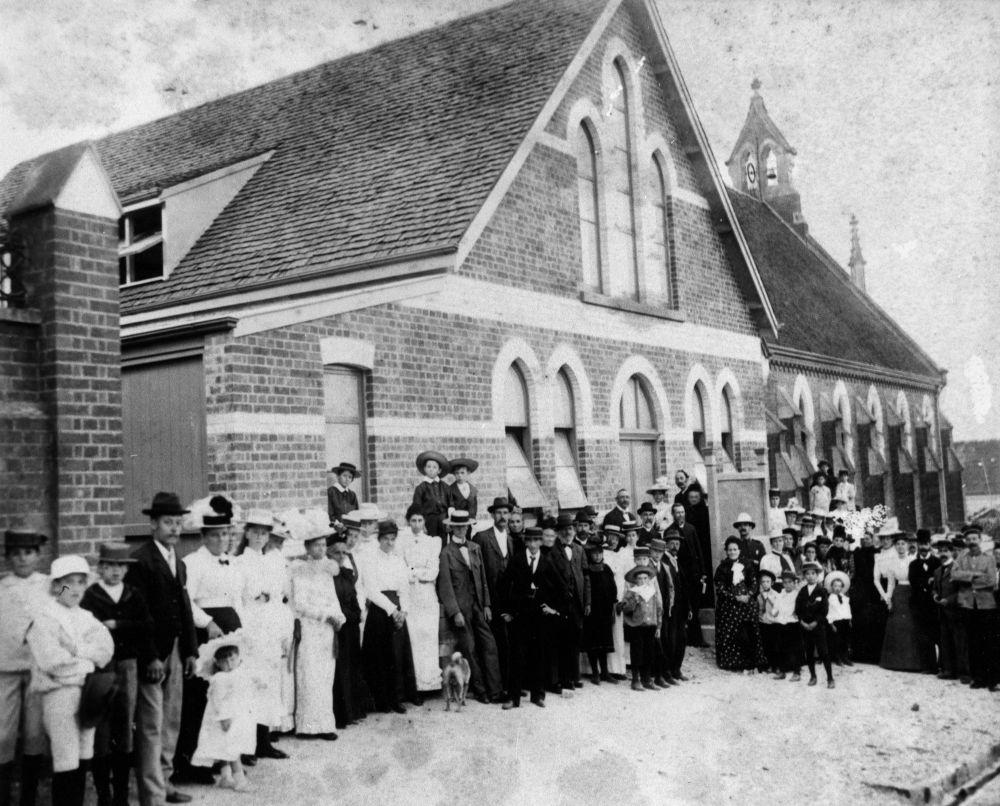
Featured Image: West End Methodist Church, circa 1900. Source – State Library of Queensland.


Neville Buch
Latest posts by Neville Buch (see all)
- From Augustine’s Pears to Academic Boycotts: Fundamental Sociological Change in Australian Cultural Relations – October 11, 2026
- Yes, I want Anger Expressed But Then Resolved – October 11, 2026
- Part 3:The Failure of an Educational Institution and How to Spiral Forward – October 10, 2026