
Dear friends,
For those who can make decisions, why are you ignoring my global impact when you can provide me with minimum paid work? Screenshot 2026-03-20 400 Google Clicks in 28 days:

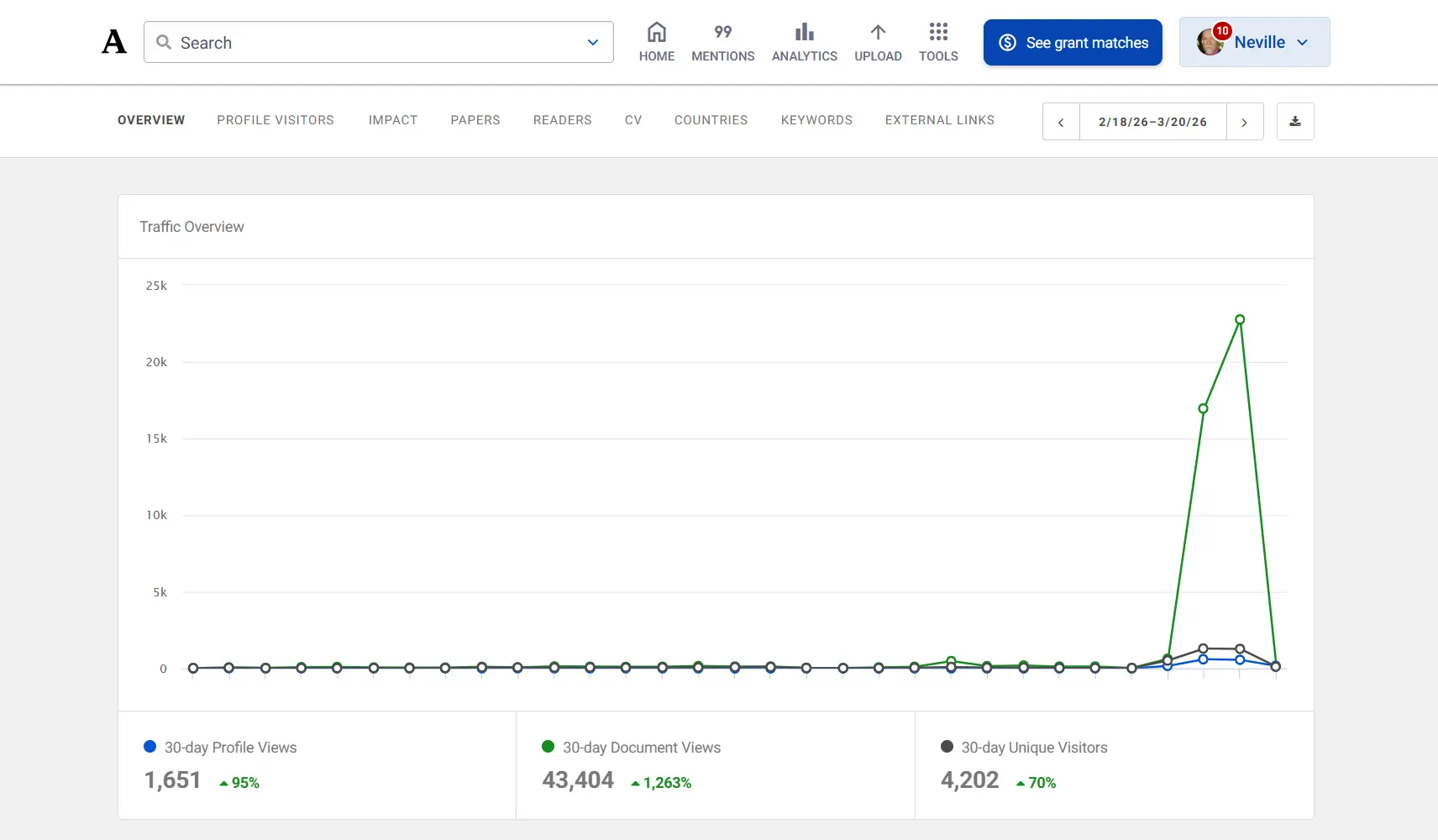
That is by one measure, 22,762 document views in one day (March 19, 2026).
I, personally, as representing MICE, am now engaged with over 100,000 persons around the world. In the last 30 days my work has been read, in some way, even as passing, by 4,202 persons; there are 43,404 persons who have come to my Academia.edu pages in that same time. My profile has been seen by 1,651 persons. Of the 8,746 committed followers, 3,907 are highly engaged, 532 are in my network, and there are 1,124 across my fields of learning (a few hours ago; a moving feast). I am getting the average daily attention of 1,000 persons in the last day or so.
That is in the last hour, 38,877 International Views:
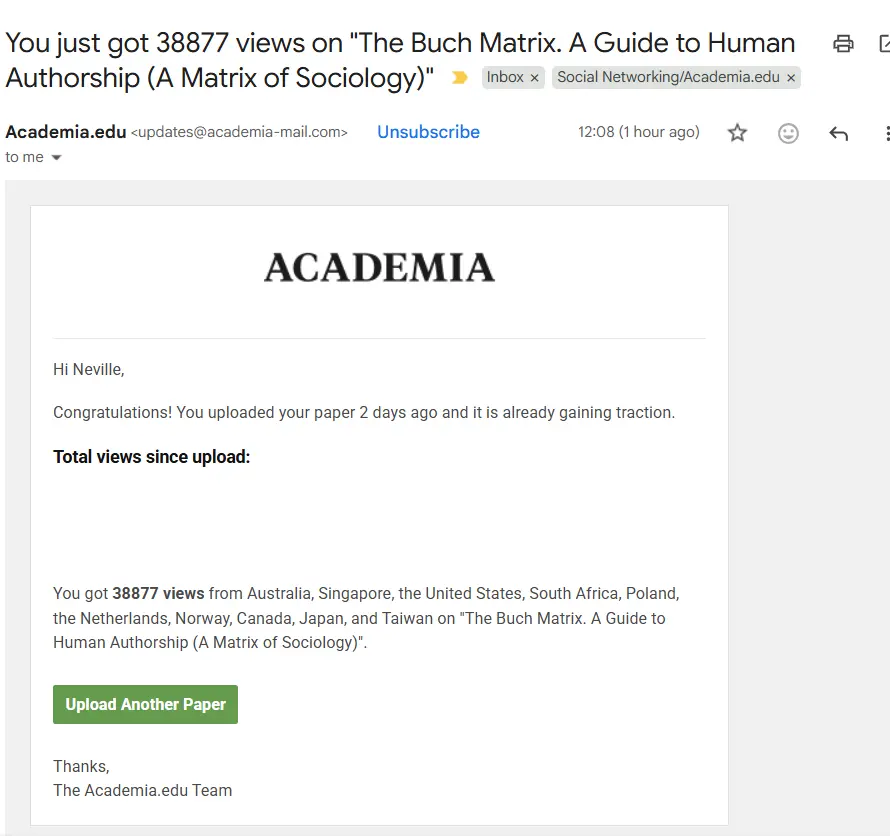
I have a message that must be acknowledged. And better that it is engaged in. In essence, Dr. Buch’s practice offers a sophisticated form of consultancy, research, and education that links high-level global philosophical and cognitive theory directly to the local social, economic, and organizational imperatives. He explicitly states that his professional service should be paid for, instructing readers to “Employ him or contract him”.
Hannah Arendt. Intelligence and Ethics Part 1
https://www.academia.edu/165237955/Hannah_Arendt_Intelligence_and_Ethics_Part
Attached: Hannah Arendt. Intelligence and Ethics Part 1
Dr Neville Buch ABN: 86703686642
Abstract:
This essay, the first in the “Intelligence and Ethics” series, examines the foundational contributions of Hannah Arendt (1906–1975) to the understanding of human mental activity as a prerequisite for ethical life. Arendt, one of the most influential political theorists of the twentieth century, established a vital link between the faculty of thinking and the ability to distinguish right from wrong. By analysing her concepts of the “banality of evil,” “natality,” and the distinction between thinking and knowing, this analysis demonstrates how Arendtian thought provides the groundwork for contemporary scholarship on human agency and moral responsibility. Arendt’s work asserts that ethical failure often stems not from inherent malice, but from a failure of reflective rationality, a realization that compels a reconsideration of the relationship between intelligence and the preservation of human freedom.
Neil Peach-Neville Buch. Intelligence and Ethics Part 2
https://www.academia.edu/165237993/Neil_Peach_Neville_Buch_Intelligence_and_Ethics_Part_2
Attached: Neil Peach-Neville Buch. Intelligence and Ethics Part 2
Dr Neville Buch ABN: 86703686642
Abstract:
The collaborative work of Drs. Neil Peach and Neville Buch extends the Arendtian link between mental vitality and ethical responsibility into a rigorous, interdisciplinary diagnostic framework. At the core of their contribution is “A Matrix of Sociology,” a synoptic map that identifies the structural “fit” between Western institutional focuses (State, Church, Common, University) and the modes of social action that govern them. By synthesizing the theories of Max Weber, C. Wright Mills, and Patricia Hill Collins with the contemporary philosophy of Bernard Stiegler, Peach and Buch operationalize a tool for “crap detecting”—the systematic unmasking of the “institutional bullshit” and manufactured myths that sustain hegemonic power. This second essay in the “Intelligence and Ethics” series demonstrates how their “Dynamic of Cognition” (DoC) provides a pathway for individuals to resist “denoetization” (the mechanical liquidation of discernment) and reclaim human authorship over their social and technical existence, thereby fostering Aristotelian flourishing.
The Holistic Global Scholarship. Intelligence and Ethics Part 3
https://www.academia.edu/165238028/The_Holistic_Global_Scholarship_Intelligence_and_Ethics_Part_3_Final_
Attached: The Holistic Global Scholarship. Intelligence and Ethics Part 3
Dr Neville Buch ABN: 86703686642
Abstract:
The final essay in the “Intelligence and Ethics” series, “The Holistic Global Scholarship,” examines the current frontier of intellectual production where individual mental vitality (Arendt) and structural diagnostic tools (Peach and Buch) converge into a planetary synoptic vision. Contemporary global scholarship faces an “immense regression” characterized by cognitive overload and “denoetization,” yet it possesses unprecedented tools for digital humanism. By integrating Bernard Stiegler’s pharmacological approach to technology, Jürgen Habermas’s universal pragmatics, and Randall Collins’s global mapping of philosophical networks, this essay argues for a “noodiversity”—a diversity of knowledge that protects human agency against algorithmic automation. The goal of this holistic scholarship is to foster a contributory economy of ideas where human authorship remains the proactive force in shaping a sustainable and ethical future.
List of Tags
- Neville Buch
- Neil Peach
- Michael Macklin
- Brisbane
- Queensland
- Roy Wood Sellars
- Wilfrid Sellars
- Jürgen Habermas
- Jean Piaget
- Lawrence Kohlberg
- Hannah Arendt
- Nel Noddings
- Susan Haack
- Bernard Williams
- Bernard Stiegler
- Bernard Lonergan
- Political Theory
- Political Communication
- Thinking
- Cognition
- Appearance
- Foolishness
- Truthfulness
- Value
- Focus
- Exclusion
- Inclusion
- Paid Work
If you have the capacity to make financial investments in MICE, and believe it is worthwhile, here are some suggestions:
- Organise a meeting with MICE to make an offer; or
- Donate to Dr Neville Buch, on behalf of MICE; the Funds will be used to literary-literally feed the researcher and pay MICE bills.
Dr. N.D. Buch
Great Southern Bank
BSB: 814282
Account: 30253480
Any funds deposited will be declared against the insufficient Social Security.
Featured Image:



Neville Buch
Latest posts by Neville Buch (see all)
- Salus Populi Suprema Lex Esto. Ciceronian Statecraft, Spinozan Toleration, and Prophetic Praxis – September 19, 2026
- Esse Quam Videri: Integrity, Historiographical Practice, and the Ciceronian Imperative in the Scholarship – September 19, 2026
- The lessons from Joshua Kyle T. Rovero’s The Perennialist (2026) – September 18, 2026