
Abstract
In the contemporary landscape of 2026, the intersection of civic duty and spiritual commitment is often obscured by “historical forgetfulness” and the “blunt categories” of the religious/secular binary. This essay evaluates Charles Ringma’s draft reflection,
“Linkedin.scribblers.citizen.christian,”
which argues for a “double mandate” where an individual is simultaneously a secular citizen and a religious participant in the Kingdom of God. Drawing on Dr. Neville Buch’s 2026 liberal-radical theology, the study affirms Ringma’s dialectical middle ground as a primary site for “Human Authorship”. Crucially, this 2026 theological turn is defined not as “secularization”—the purported decline of the sacred—but as a “humanistic ascent” that re-situates religious meaning in rebus (in the thing itself) within the public domain.
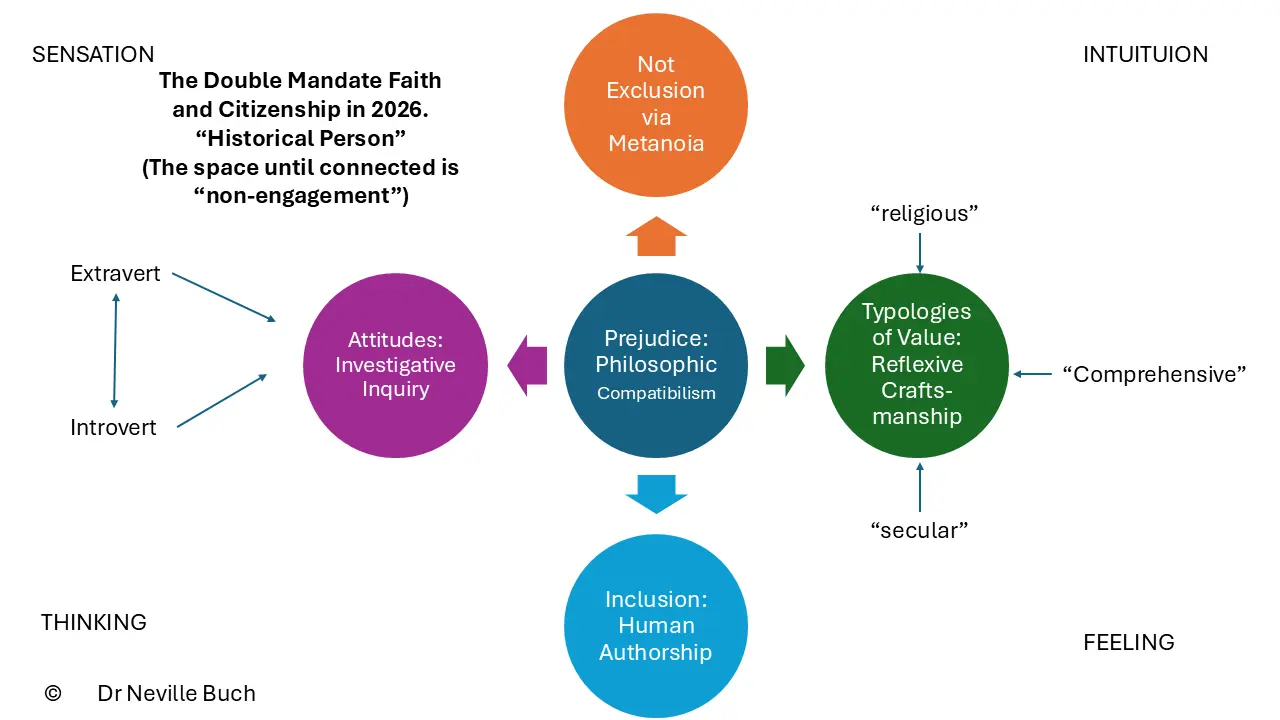
The Citizen and the Kingdom: A Friendly Synthesis of Ringma and Buch
I. The Double Mandate of Grace and Responsibility
Charles Ringma’s draft reflection offers a compelling “tapestry” of what it means to live as a person of faith in a modern democracy. His core insight is that being a “good citizen” and a “good Christian” are not mutually exclusive identities but are, in fact, a “double blessing” that carries a “double responsibility”. Ringma correctly identifies a middle path between two extremes: the “world-denying” posture that retreats from society into private piety, and the “world-conforming” liberal perspective that hollows out spiritual distinctives to fit secular norms. Within Dr. Neville Buch’s 2026 framework, this middle path represents the “craftsmanship of the reflexive insider,” where an individual uses their lived experience to navigate the “public domain” of economics and politics without losing their spiritual anchor.
II. Liberal-Radical Theology as the End of the Binary
While Ringma expresses concern that some “liberal theological perspectives” may underplay transcendence, Dr. Buch’s liberal-radical theology of 2026 provides a robust intellectual scaffolding that actually supports Ringma’s vision. Buch argues that the traditional binary between the “religious” and the “secular” is a product of uninstructed minds relying on “potted thinking”. In contrast, a radical-humanist ethical theory recognizes that secularity is a neutral safeguard for pluralism, not an attack on the sacred. By moving toward a “post-religious” identity centred on “loving life” and “co-humanity,” the believer does not abandon the Kingdom of God; rather, they realize it as a “redemptive order” that counteracts social fragmentation.
III. Today, Radicalism is Not Secularization
It is essential to understand that in 2026, this liberal-radical turn is not secularization in the sense of religious vanishing. Instead, it is a recursive shift—a “topological turn”—where religion is re-anchored in reality rather than disappearing into an abstract, unmoored dogma. Buch’s 2026 theology resists the “theological capture” that weaponizes faith for political control, advocating instead for “Human Authorship”. Ringma’s view of the Christian as “wholly for the world” but “not on the world’s idolatrous terms” aligns perfectly with Buch’s “Pedagogy of Choice”. In this view, the citizen-participant is a “critical co-investigator” of their own belief system, earning their knowledge through “lived participation” and service to their Australian neighbour.
Conclusion: Flourishing in the Lived World
Ultimately, the synthesis of Ringma’s practitioner-based wisdom and Buch’s historiographical rigor points toward “Aristotelian flourishing” (eudaimonia). By rejecting the “wooden epistemology” of institutional gatekeepers, the reflexive individual can embrace their dual identity with gratitude and humility. The Kingdom of God is thus found not in the conquest of political power but in the “dialogue of myths” and the “benediction of peace” performed in the daily life of a responsible citizen.
Attached.
https://www.academia.edu/172050486/The_Double_Mandate_Faith_and_Citizenship_in_2026
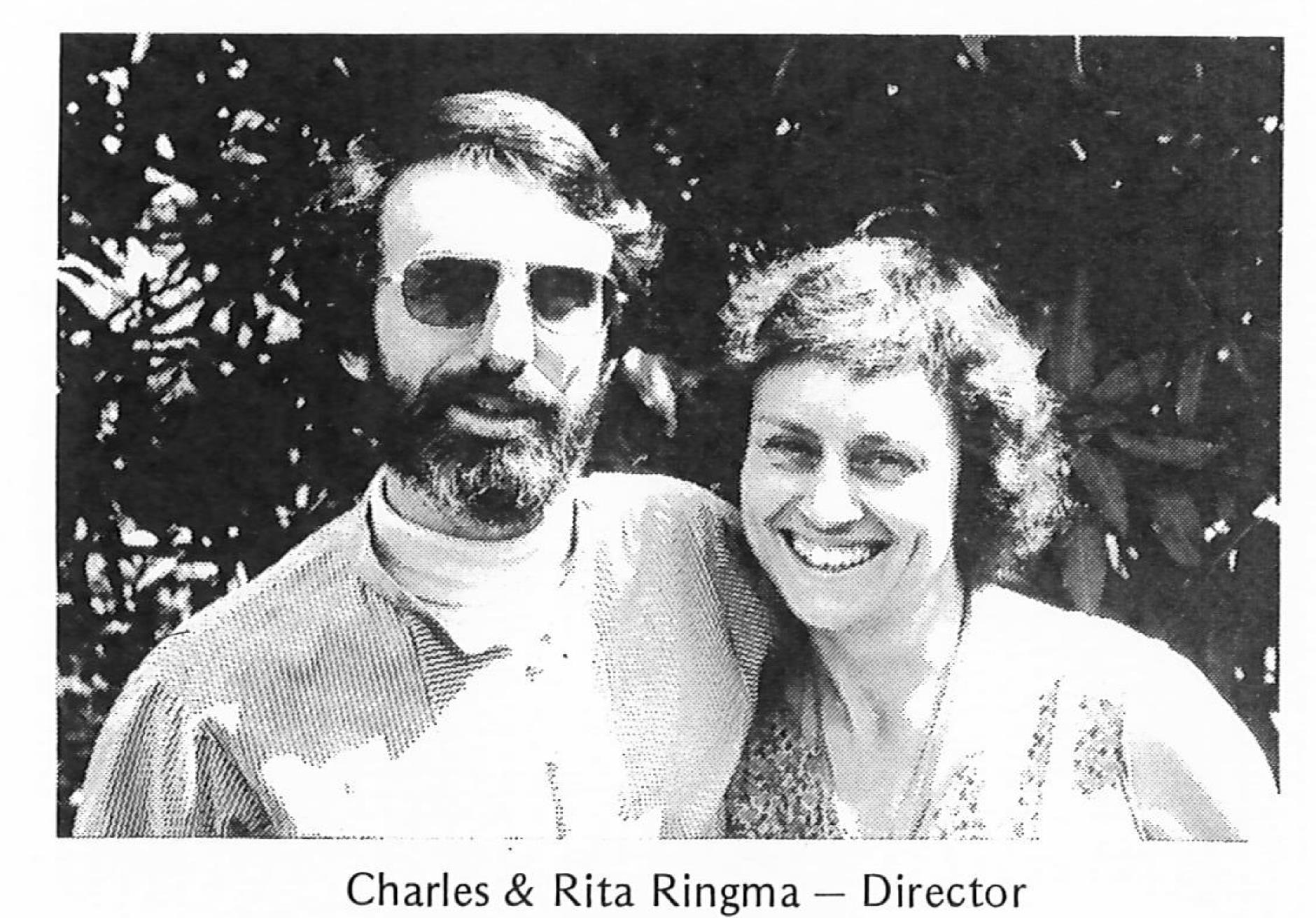
Featured Image: Charles-and-Rita-Ringma-circa-1977-at-the-time-of-the-Queensland-Christian-Churches-Crisis-of-Faith.-Source-Teen-Challenge-Inc.-Qld


Neville Buch
Latest posts by Neville Buch (see all)
- The Unbound Mind: Independent Scholarship, Institutional Isolation, and the Restoration of Human Authorship – October 20, 2026
- The Road to Geelong: A Re-Narrativization of The Story of Resilience Part 1 – October 20, 2026
- The Human Being Above the Transaction and Why Markets Cannot Measure Human Worth – October 15, 2026