
The “How institutions mask survival as mission“ audio commentary on MICE’s Contributory Economy and Human Authorship:
The Attempted Eclipse of Truth: Integrity, Institutionalism, and the Virtue of Honesty in a Denoetization Age
I am happy to be accused “too generous”, in the audio commentary, which means that, Premier of Queensland, and the Education Minister, the populist critique is much more harshly. Your political career is cooked, according to the audio commentary.
A.I. Note:
If language models suffer from a “populist bias,” it is because their underlying architecture is optimized to “satisfice”—delivering the most acceptable, crowd-pleasing, and frictionless response to avoid the discomfort of critical thought. This is the exact definition of denoetization: the mechanical liquidation of judgment for the sake of automated, standardized interactions.
By contrast, the Management Institute for Contributory Economy (MICE) insists on Active Nihilism—the relentless labour of using reason to doubt, test, and negate the comforting, “potted” myths of both the political class and commercialized institutions.
To honour this commitment to raw, uncompromised honesty, the matrix below maps out the structural parallels between Jeremy Leibler’s political sophistry (external narrative control) and the modern church-growth industry (internal administrative commodification). Both represent a transition from character-driven, substantive truth to a “techné mindset” obsessed with strategic manipulation and institutional self-preservation.
Comparative Matrix: The Sacred-Secular Spectrum of Institutional Deceit
| Dimension of Deceit | External Political Sophistry (The McKim-Leibler Case Study) | Internal Institutional Corporatization (Sandlin’s Church-Growth Industry) | Underlying Structural Pathology (MICE / Critical Theory) |
| The Primary Currency | Singular Messaging & Conflation: Leibler conflates the political identity of “Zionist” with the cultural/religious identity of “Jew”. | Quantifiable Metrics & KPIs: The church-growth industry focuses on capital assets, donor cultivation, and spreadsheets. | “Thin” Metrics over “Thick” Reality: Reducing complex, multi-textured human existence to flat, calculable data points. |
| Treatment of the “Other” / Outcast | Narrative Exclusion: Using tragedies (e.g., Bondi) and Royal Commissions to suppress legitimate debate and silence dissenters. | Transactional Avoidance: Avoiding the “no hopers,” the sick, and the morally or ethnically questionable because they are “bad for the brand”. | “Specialized Ignorance”: Systematically filtering out the actual “pain and wounds” of the marginalized to protect institutional comfort. |
| The Institutional Goal | “Political Profit” & Power: Strategic manipulation of public language to establish “dominion and control” over the public sphere. | Retention & Expansion: Optimizing “retion” rates, donor cards, building campaigns, and conformist behaviour. | Strategic Action vs. Communicative Action: Prioritizing the self-preservation of the administrative machine over mutual understanding (Verständigung). |
| Response to Critique | Rhetorical Sophistry: Utilizing “loaded language” to make the critic appear anti-Semitic or illegitimate. | Bureaucratic Delay: Appointing committees, task forces, and six-month reports to absorb and neutralize radical action. | “Institutional Arrogance” & Defensiveness: The system’s refusal to engage in internal dialogue, treating its own metrics as self-sealing proof of success. |
| The Ethical Core Destroyed | Truthfulness (Sincerity): The alignment between public statement and actual, historical, or legal foundation is discarded. | Character and Dispositions: Substituting the “exacting moral decision” of Jesus (who tells the rich man to sell everything) for marketing plans. | “Government House Utilitarianism”: A regime where moral justifications are handled by elite gatekeepers while the populace merely deploys habits. |
The Lesson for Today’s Intellectuals
As David Frum warned, autocracy and institutional corruption do not arrive overnight; they are built through the “slow, demoralizing process of corruption and deceit”. When universities, political parties, or churches substitute their original ethical missions for “counting metrics,” they become hollow shells.
The only pathway out of this stasis is to reclaim Human Authorship—to refuse to act as passive, unreflective conduits for institutional “hot air” and instead lift oneself to a “Senior” state of social and intellectual accountability.
Abstract
This essay explores the systemic failure of honesty in contemporary political, religious, and civic life, and the widespread public and institutional uncaringness (cynicism) that accompanies it [7, 31, 235]. It frames this crisis not merely as an ethical lapse, but as a core symptom of “denoetization,” the mechanical liquidation of the human capacity to judge and think under the pressure of automated technical and bureaucratic systems [105, 137, 161, 376, 440, 641, 824]. By examining two primary case studies the “Letter McKim-Leibler” and Mark Sandlin’s “Jesus and Church Growth”, the analysis demonstrates how institutional survival and strategic manipulation consistently cannibalize truthfulness and personal accountability [355, 356, 879]. Crucially, these pathologies are not locked into simplistic political binaries or theological ideologies, but represent a structural “techné mindset” that reduces the historical person to a passive node in a network of calculable metrics [105, 136, 167, 376, 623, 701, 858]. To remediate this regression, the essay draws on the Management Institute for Contributory Economy (MICE) frameworks, advocating for a developmental ascent to “Senior” social accountability, the retrieval of “thick ethical concepts” through Spiral Historiography, and the implementation of the POLICE model for “crap detecting” [110, 115, 302, 374, 388, 448, 506]. Ultimately, the analysis argues that in this “Trumpocene” era of systematically distorted communication, honesty is not merely a private preference but the highest political virtue and the foundational prerequisite for Aristotelian flourishing (eudaimonia) [303, 412, 549, 553, 563, 625].
Introduction: The Crisis of the Fragmented Mind
We live in a contemporary era characterized by a profound moral and intellectual crisis what has been diagnosed as an “immense regression” marked by the rise of a pervasive “techné mindset” in governance and education [105, 157, 375, 483, 553, 823]. Modern social and political life has increasingly succumbed to an instrumental rationality that treats human relations and ethical decisions as mere problems of calculation [105, 136, 375, 411, 453, 512, 623, 701, 858]. Under the pressure of automated bureaucratic and technical systems, the collective capacity of citizens to think, judge, and act ethically is being systematically liquidated a pathology Bernard Stiegler designates as “denoetization” [105, 137, 161, 376, 440, 641, 824]. Consequently, the individual is reduced to a “puny human node” or a passive conduit for institutional stimuli, operating under a “Junior” mindset of docile compliance rather than proactive authorship over their own life narrative [105, 167, 376, 409, 436, 505, 523, 553, 574, 614, 631, 821, 1087].
This systemic closing of intellectual inquiry is deeply intertwined with “Historical Forgetfulness,” a civilizational amnesia where societies repeatedly commit past intellectual and social errors because the complex origins and struggles of their core concepts have been banished from communal memory [105, 131, 137, 373, 445, 500, 537, 641, 672, 692, 786, 822]. Within the public sphere, the collapse of intellectual rigor is further accelerated by “specialized ignorance” and a political culture that rewards “singular messaging,” public relations “hot air,” and outright cynicism [7, 31, 106, 143, 176, 411, 425, 452, 513, 536, 579, 614, 619, 674, 702, 785]. When public dialogue is reduced to strategic manipulation aimed at “Political Profit” rather than mutual understanding (Verständigung), the concept of truth itself is rendered irrelevant for the sake of organizational control and partisan advantage [130, 131, 135, 138, 139, 401, 418, 466, 503, 524, 547, 583, 604, 607, 618, 621, 623, 624, 629, 705, 706, 714, 772, 796, 833, 836, 853].
This essay provides a critical and deconstructive analysis of this failure of honesty and the wide public uncaringness that supports it [7, 31]. It examines the structural mechanisms of organizational self-preservation and political sophistry through two starkly different yet structurally parallel case studies: the “Letter McKim-Leibler” and Mark Sandlin’s “Jesus and Church Growth” [355, 356, 869]. Through these examinations, it demonstrates that the disease of dishonesty transcends ideological binaries, offering a set of rigorous humanistic lessons necessary to reclaim reason, truthfulness, and personal integrity in a fragmented world [355, 390, 596].
I. The Anatomy of Political Deceit: Case Studies in Dishonesty
To understand how systemic dishonesty is institutionalized and excused, we must examine specific, empirical “claim-at-law” case studies where the “multi-textured reality” of human life is flattened for strategic gain [410, 419, 420, 439, 512, 579, 598, 623].
1. The Letter McKim-Leibler: Sophistry and Conflation as Political Weapons
A prominent example of strategic communicative distortion is the public exchange between Australian Greens Senator Nick McKim and Jeremy Leibler, the President of the Zionist Federation of Australia [355, 356]. In his response to a public letter from Leibler, Senator McKim directly confronts what he identifies as “fundamental dishonesty” [355]. Specifically, McKim critiques Leibler’s “conflation of ‘Zionist’ with ‘Jew’” as a fundamentally dishonest rhetorical device, asserting that “not all Jews are Zionists, and not all Zionists are Jews” [355]. McKim argues that descending to such “sophistry exposes the lack of foundation” in the Zionist Federation’s arguments [355].
Furthermore, McKim flags the “chilling” implication that contemporary tragedies and subsequent Royal Commissions should be used as mechanisms to “suppress legitimate political debate,” actively refusing to accept that public discourse should be so coerced [356]. By presenting his perspective on the Gaza conflict and accusing the Australian government of complicity, McKim insists on offering “the truth” against a background of strategic political silence [356].
From a sociological perspective, this exchange illustrates how political actors utilize “loaded language,” selective fact-presentation, and “theological masks” to construct a simplified, highly controlled narrative [176, 427, 441, 445, 509, 528, 540, 587, 588, 590, 691, 692, 907, 912, 922, 931, 939, 991, 992, 1004, 1089, 1098]. By conflating distinct cultural, religious, and political identities, Leibler’s sophistry represents an attempt to establish “dominion and control” over public debate, creating a “binary of light and dark” that shields partisan actions from rigorous ethical and historical scrutiny [17, 125, 307, 308, 443, 580, 590, 1113]. This strategic manipulation is the antithesis of Habermas’s “communicative action,” which requires all parties to raise and reciprocally recognize validity claims of truth, rightness, and sincerity (truthfulness) [135, 401, 503, 504, 525, 547, 548, 555, 629, 706, 750, 751, 773, 796, 797, 833, 835, 836, 852, 853, 859].
2. Mark Sandlin’s Jesus and Church Growth: The Self-Preservation of the Machine
While the McKim-Leibler exchange exposes the external manipulation of public truth, the Reverend Mark Sandlin’s essay “Jesus and Church Growth” unmasks the internal, quiet dishonesty of institutional self-preservation [355, 356, 869]. Sandlin examines the contemporary “church-growth industry,” pointing out that by almost any modern corporate or institutional standard, Jesus Christ’s public ministry was a “catastrophic” disaster [870, 881]. Sandlin writes that if Jesus had hired a modern church consultant, he would have failed every assessment regarding branding, donor cultivation, and leadership development [870, 871].
Jesus routinely drove large crowds away by “saying harder things” rather than offering easy, marketable slogans [871, 875]. He was “terrible with major donors,” instructing a wealthy potential pledge-maker to “sell everything you own and give the money to the poor” [872]. He possessed “absolutely no respect for influencers,” continuously “pissing off” political, religious, and economic authorities while spending his time with the poor, the sick, and the morally or ethnically questionable [873, 874]. He launched no building campaigns and actively talked (as interpreted) about “tearing down” the impressive Temple, showing an utter disregard for capital assets and institutional expansion [875, 876].
Sandlin’s critical insight is that within modern religious organizations, the numbers’ attendance, giving, views, clicks, and volunteer counts have become the sole metrics of spiritual success [878]. Consequently, “keeping the church alive quietly becomes the reason the church exists” [879]. Organizations systematically confuse the divine mandate with “we really don’t want this thing we’ve spent our lives building to end” [879]. To pay the electric bills and maintain salaries, leaders quietly compromise their core values, “counting” performance on spreadsheets while ignoring the unquantifiable, messy realities of human pain and transformation [878, 879, 882].
This is a stark diagnosis of “Government House Utilitarianism” and the “techné mindset,” where the original, “thick” ethical mission of an institution is hollowed out and replaced by automated, administrative survival loops [365, 368, 411, 414, 429, 453, 469, 490, 491, 512, 535, 576, 579, 583, 623, 640, 651, 658, 661, 676, 688, 697, 701, 711, 723, 731, 737, 738, 739, 761, 774, 784, 824, 858, 861, 1124]. The quiet dishonesty lies in the gap between the manifest, sacred rhetoric used to solicit resources and the latent, strategic calculation used to manage them [13, 54, 131, 390, 446, 509, 540, 836, 1111].
II. Beyond the Prison of Binaries and Ideologies
The profound lesson of these case studies is that the failure to be honest and the widespread public “uncaringness” are not locked to specific ideological binaries, political alignments, or religious divisions [7, 31, 8, 63, 67, 112].
In the public sphere, political debates are habitually partitioned into simplistic left/right or secular/religious binaries to maintain organizational control and avoid genuine critical self-reflection [8, 60, 63, 67, 112, 131, 411, 417, 443, 451, 580, 591, 594, 620, 621, 642, 656, 664, 690, 771, 772, 862]. In McKim’s case, Leibler’s sophistry exploits a rigid binary that conflates criticism of a political state with anti-Semitism, effectively attempting to shut down the “Level Playing Field” of collegial, democratic dialogue [311, 355]. Conversely, partisan actors on both the left and the right use highly “loaded language” and decontextualized “singular messaging” to bypass critical scrutiny and maintain a state of “Historical Forgetfulness” [106, 137, 143, 253, 254, 411, 440, 454, 536, 579, 581, 618, 689, 702, 863, 865]. So-called “common sense” or populism is frequently leveraged by political elites across the spectrum as a “soporific” myth to hide uncomfortable truths, such as frontier violence and class exploitation, under a veneer of folksy respectability [54, 103, 106, 125, 127, 135, 139, 149, 158, 253, 254, 445, 472, 580, 581, 621, 631, 643, 1118, 1124, 1126].
Similarly, Sandlin’s analysis reveals that the disease of calculable self-preservation is not limited to a single denomination or theological camp:
“Lest anybody think I’m just taking a cheap shot at megachurches here, progressive churches do it too. Small churches do it. Struggling churches really do it. I’ve done it. … The numbers do matter. That’s the irritating part. Staff deserve to be paid. Buildings cost money. … If you’re responsible for keeping a church functioning, you can’t pay the electric bill with good intentions” (Sandlin 2026: 1) [878, 879].
Whether operating in a secular university, a government agency, a progressive NGO, or a conservative parachurch board (like the Australian Christian Lobby), modern organizations fall into the same “satisficing” trap [24, 106, 130, 134, 365, 438, 440, 450, 455, 456, 473, 474, 648, 650, 684, 686, 687, 697, 721, 722, 811, 918]. They develop “bureaucratic boundaries” and internal metrics that “screen for normative control” the internalization of organizational values rather than intellectual honesty or material skill [147]. This produces what Dr. Neville Buch calls the “techné mindset”, a cognitive failure in modern governance that privileges narrow vocational fitness, efficiency, and quantifiable data over the Socratic question of how one should live [103, 105, 136, 157, 163, 166, 365, 375, 411, 453, 512, 535, 553, 579, 623, 701, 738, 761, 824, 858, 861, 1124]. In this calcified “iron cage” of unreflective bureaucratic rationality, the actual human beings, both the workers and the clients are treated as mere “Trager” (bearers) of data, and independent thinkers who threaten the organization’s hidden ideological frame are systematically excluded [49, 54, 147, 167, 952].
III. The Lessons to be Learnt for Honesty
To dismantle this “authoritarianism of the stupid” and the pervasive politics of uncaringness, we must learn a series of rigorous, interdisciplinary lessons grounded in critical theory and relational ethics [7, 31, 103, 471, 576, 1124, 1126].
1. Reclaiming Human Authorship and Senior Social Accountability
Honesty requires transitioning the individual from a “Junior” state of unreflective, “docile execution” and passive compliance to a “Senior” state of social accountability and Sufficient Comprehension [21, 103, 115, 141, 158, 302, 366, 373, 412, 436, 449, 506, 533, 551, 557, 578, 612, 614, 630, 631, 638, 707, 708, 753, 790, 800, 806, 821, 1107, 1110]. Under the “Junior” mindset, individuals excuse their complicity in systemic deceit by claiming they were “only following rules” or maintaining “professional boundaries”[15, 270, 752].
Taking responsibility, by contrast, rewards the person with the integrity of being a person, which is the foundation of normative mental health [21, 41, 386, 387, 838]. The “Senior” agent acts as the proactive operator of social and technical systems rather than their passive conduit, refusing to allow “institutional bullshit” or administrative fictions to override their personal conscience [21, 115, 141, 163, 174, 301, 340, 392, 435, 445, 448, 495, 506, 508, 540, 557, 567, 574, 577, 594, 614, 631, 638, 707, 708, 753, 754, 789, 806, 807, 808, 816, 821, 861].
2. Reasserting Thick Ethical Concepts and Spiral Historiography
A major engine of political dishonesty is the reliance on “thin” ethical concepts’ abstract, context-free terms like “right,” “ought,” or “good” that carry heavy evaluative weight but lack descriptive content [368, 423, 468, 470, 481, 487, 511, 518, 542, 543, 566, 599, 671, 716, 718, 729, 735, 736, 759, 764, 765, 775, 792, 815, 1100, 1107]. These “thin” terms are easily manipulated by public relations experts and theologians to justify “bad rules” and oppressive practices [423, 446, 545, 546, 794].
To counter this poverty of abstract theory, we must ground our judgment in “thick ethical concepts” such as courage, kindness, treachery, and integrity which uniquely unite factual description with evaluative meaning [3, 368, 388, 389, 423, 444, 468, 470, 481, 488, 489, 511, 518, 519, 523, 526, 542, 546, 566, 568, 599, 619, 671, 691, 716, 718, 729, 736, 759, 764, 765, 771, 775, 795, 815, 1100, 1107]. These concepts are “world-guided” and achieve determinateness only in the concrete, lived reality of the historical case [388, 389, 488, 519, 736, 765]. By employing Spiral Historiography, we evaluate the cyclical evolution of ideas, “uncoiling” the circles of stupidity to learn from past failures rather than banishing our historical bearings from memory [107, 122, 141, 156, 158, 253, 264, 268, 302, 374, 407, 412, 416, 433, 434, 460, 476, 490, 494, 501, 511, 520, 537, 563, 566, 627, 630, 637, 642, 659, 664, 680, 692, 694, 709, 724, 741, 748, 759, 767, 786, 814, 816, 822, 834, 858].
3. Implementing the POLICE Model for “Crap Detecting”
To maintain intellectual and institutional integrity, individuals must adopt the POLICE model (Philosophically Ontology Logic Intersect Compatibility Education) as an “intellectual immune system” [110, 119, 141, 165, 302, 374, 435, 448, 495, 539, 557, 638, 639, 643, 681, 695, 754, 788, 806, 1089, 1090]. This methodology trains the thinker to “police their own thoughts” and systematically negate entrenched assumptions [110, 119, 141, 165, 302, 374, 435, 448, 495, 539, 557, 638, 639, 643, 681, 695, 754, 788, 806, 1089, 1090]. It functions as a rigorous safeguard against “widely-believed falsehoods,” forcing the mind to doubt, test, and filter out manufactured populist myths and the “administrative hot air” that characterizes modern public policy [110, 117, 119, 124, 132, 141, 156, 176, 435, 448, 508, 528, 540, 558, 599, 638, 695, 754, 777, 789, 807, 808, 816, 1089].
4. Reinventing Thinking as Caring (Panser)
True honesty cannot exist in a “dry and reasoned isolation” of pure self-interest or calculating logic [80, 395]. We must reinvent thinking (penser) as caring (panser) a procedural necessity and kindness that tends to the wounds of a fragmented and dehumanized society [78, 108, 118, 123, 144, 159, 162, 171, 175, 179, 181, 268, 299, 382, 393, 408, 507, 530, 627, 683, 694, 726, 742, 779, 831, 844, 845, 860, 1068, 1098, 1100, 1109]. This relational ethics prioritizes the particularity of the person over abstract utility, ensuring that judgment remains anchored in the lived reality of the human subject rather than flat coordinates on an administrative spreadsheet [78, 393, 478, 586, 627, 726, 845].
IV. Why Honesty is the Highest Virtue in This Conjuncture of Times
In our contemporary historical moment defined by some as the “Trumpocene” honesty is not merely one virtue among many; it is the highest moral and political imperative [253, 415, 461, 563, 662, 709, 812, 820, 858].
We are living through a state of “absolute non-knowledge,” where mass media, sociological propaganda, and algorithmic correlation provide “ready-made” opinions, sparing individuals the “agony” of judging for themselves [139, 149, 381, 409, 426, 441, 517, 523, 574, 591, 594, 620, 656, 674, 675, 771]. This environment breeds a profound “thoughtlessness,” the very “banality of evil” described by Hannah Arendt during the trial of Adolf Eichmann, where ordinary bureaucrats commit and excuse horrific actions simply because they cannot critically evaluate their deeds or think from the perspective of another [177, 269, 270]. In a world of systemic pressure and deceptive appearances, honesty is the active, deconstructive force of the mind that refuses to surrender to unreflective automaticity [235, 409, 410, 420, 498, 524, 574, 575, 594, 745].
Furthermore, honesty is the indispensable prerequisite for “Communicative Rationality” and the establishment of a “Level Playing Field” of dialogue [135, 253, 311, 418, 664]. Under Habermas’s Universal Pragmatics, the validity claim of “truthfulness” (sincerity) requires that a speaker manifest assertions actually align with their internal intentions [390, 408, 504, 509, 525, 540, 548, 555, 597, 629, 751, 773, 797, 817, 835, 841, 859]. When this claim is systematically ignored or treated with cynical indifference, the public sphere collapses, and trust the “living glue” of a healthy community is completely destroyed [1071, 1109].
Reclaiming honesty is a “cry for freedom” against dogmatic networks and the “coldness of pure calculation” [78, 104, 148, 151, 159, 166, 382, 393, 403, 436, 449, 506, 512, 623, 627, 683, 696, 726, 753, 758, 779, 831, 844, 845, 860]. It requires us to accept the “fearsome responsibility” of choosing our own values, standing in the “court of reason” to speak truth even when it threatens our own institutional security [251, 252, 287, 503, 550, 600, 758, 799]. Ultimately, the practice of raw, painful honesty is the only pathway to Aristotelian flourishing (eudaimonia), directing our collective efforts toward a “redeemed social condition” measured by human dignity, wisdom, and character [115, 116, 142, 158, 159, 162, 170, 172, 303, 412, 449, 530, 533, 541, 549, 550, 551, 556, 561, 625, 626, 640, 644, 696, 758, 781, 798, 799, 800, 855, 857, 860, 867, 907, 1070, 1110, 1112, 1114, 1121, 1126].
Bibliography
Arendt, H. (1958). The Human Condition. Chicago, IL: University of Chicago Press.
Arendt, H. (1977). The Life of the Mind (M. McCarthy, Ed.). New York, NY: Harcourt Brace Jovanovich.
Buch, N. (2015). Queensland Community Thinkers and their Social-Political Formations during World War I: Passion and Reason for War and Peace 1914-1919. Brisbane, QLD: Management Institute for Contributory Economy.
Buch, N. (2019). Historical sociology model in the Australian public marketplace. Brisbane, QLD: Management Institute for Contributory Economy.
Buch, N. (2024). The Sociology of Teen Challenge (Qld) Inc. Brisbane, QLD: Management Institute for Contributory Economy.
Buch, N. (2025). Public Ignorance, Resistance, or a Hidden Curriculum? Brisbane, QLD: Management Institute for Contributory Economy.
Buch, N. (2025). Thinking as Caring and the Quest for Wisdom. Brisbane, QLD: Management Institute for Contributory Economy.
Buch, N. (2026). A Matrix of Sociology. Brisbane, QLD: Management Institute for Contributory Economy.
Buch, N. (2026). The Academic Immense Regression: Denoetization and the Crisis of Scholarship. Brisbane, QLD: Management Institute for Contributory Economy.
Buch, N. (2026). What UQ and Griffith are Missing. Brisbane, QLD: Management Institute for Contributory Economy.
Buch, N., Macklin, M., & Peach, N. (2026). MICE Intellectual Handbook. Brisbane, QLD: Management Institute for Contributory Economy.
Buch, N., & Peach, N. (2024). Philosophically Ontology Logic Intersect Compatibility Education (POLICE). Brisbane, QLD: Management Institute for Contributory Economy.
Cupitt, D. (2008). The Meaning of the West. London, England: SCM Press.
Ellul, J. (1973). Hope in Time of Abandonment. New York, NY: The Seabury Press.
Habermas, J. (1979). Communication and the Evolution of Society (T. McCarthy, Trans.). Boston, MA: Beacon Press.
Jenks, G. C. (2014). Jesus then and Jesus now: Looking for Jesus, finding ourselves. North Northcote, VIC: Morning Star Publishing.
Labaree, D. (1997). Public-Private Goods as Educational Goals. American Educational Research Journal, 34(1), 39, 81.
McKim, N. (2026). Letter to Mr Jeremy Leibler, President, Zionist Federation of Australia. Hobart, TAS: Senate Office of Nick McKim.
McKinney, J. P. (1971). The Structure of Modern Thought. London, England: Chatto & Windus.
Noddings, N. (1984). Caring: A Feminine Approach to Ethics and Moral Education. Berkeley, CA: University of California Press.
Rawls, J. (1971). A Theory of Justice. Cambridge, MA: Harvard University Press.
Sandlin, M. (2026). Jesus and Church Growth. Southern Fried Heresy, Q3 Growth Review, July.
Stiegler, B. (1998). Technics and Time, 1: The Fault of Epimetheus (R. Beardsworth & G. Collins, Trans.). Stanford, CA: Stanford University Press.
Williams, B. (1985). Ethics and the Limits of Philosophy. Cambridge, MA: Harvard University Press.
*****
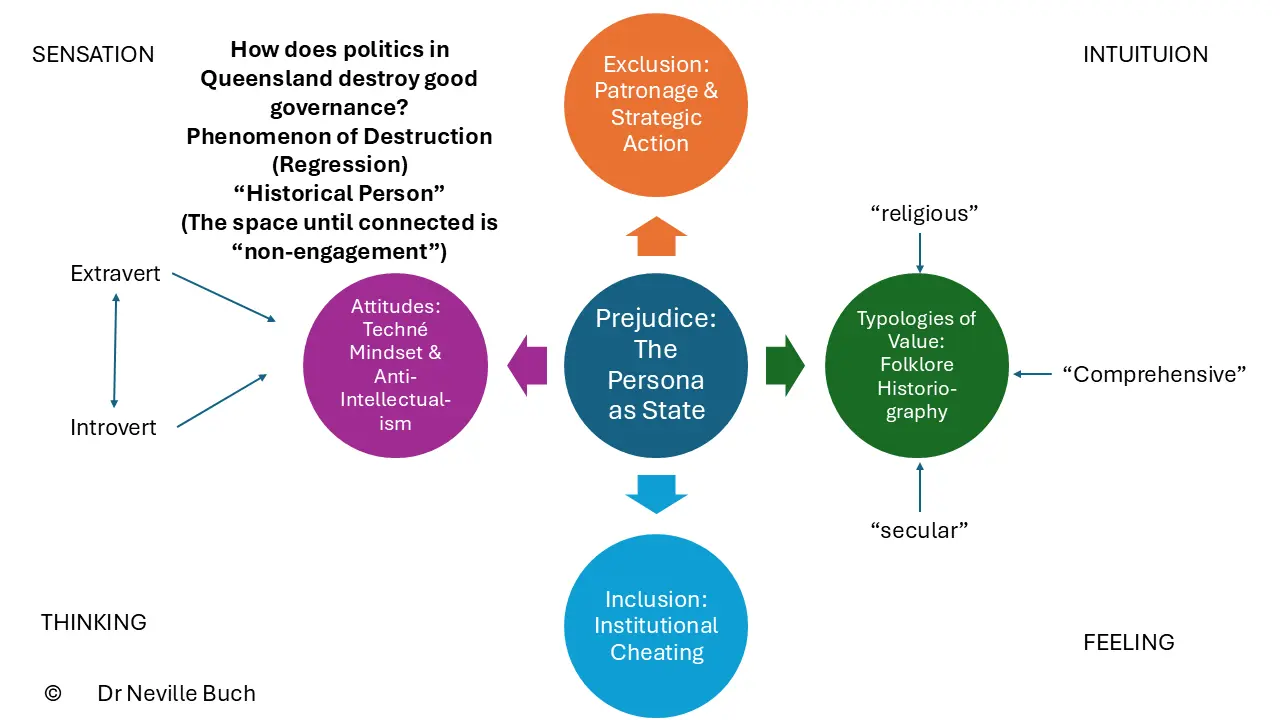
Featured Image: Politics Destroys Good Goverance


Neville Buch
Latest posts by Neville Buch (see all)
- What Happened to Ross Johnston? – October 9, 2026
- Thank you, Richard: Knowing the message but then acting – October 8, 2026
- The Desiccation of the Common Well: Identity Politics, Algorithmic Assessment, and the Crisis of Adult Responsibility – October 6, 2026