
Dr Neville Buch and MICE[1]
Image Posters and PowerPoint are available through the Management Institute for Contributory Economy: email [email protected]
Abstract
This essay constructs a neuro-philosophical synthesis between recent empirical discoveries in cognitive neuroscience—specifically Hans-Ferdinand Angel and Rüdiger J. Seitz’s (2024) theory of credition, Erik Asp et al.’s (2012) False Tagging Theory (FTT) of ventromedial prefrontal cortex (vmPFC) function, and Alan Lincoln’s (2026) model of uncertainty reduction as a primary reinforcer—and Dr. Neville Buch’s general methodology, the Dynamic of Cognition (DoC). By integrating these neurobiological frameworks with Dr. Buch’s critique of late-modern digital platform capitalism, we demonstrate that human belief formation is an automatic, pre-conscious, and affectively charged process that defaults to credulity. Doubt, critical assessment, and historical discernment require an active secondary “false tagging” mechanism and a cortical regulatory “brake.” We argue that contemporary digital environments—celebrated by neoliberal market fundamentalists like Bevin Luchel—exploit subcortical dopamine reward loops to deliver high densities of certainty, thereby outpacing the cortical brake and inducing “denoetization” and a severe “doubt deficit.” Finally, this paper shows that Dr. Buch’s proposal for a Contributory Economy, supported by the POLICE model, Spiral Historiography, and professional contractualism, provides the necessary non-market cognitive scaffolding to restore human authorship, protect critical judgment, and foster Aristotelian flourishing (eudaimonia).
I. Introduction: The Neuro-Ontological Thrownness of the Person
In his foundational work on the Dynamic of Cognition (DoC), Dr. Neville Buch asserts that human consciousness begins in a state of being “thrown into the world,” where the unavoidable cyclical starting point of all thought is Prejudice—the pre-judged state of unexamined convictions and immediate context (Buch 2025b, p. 1). Moving from this initial prejudice toward coherent, revisable knowledge requires a continuous cognitive dynamic across four interacting domains: Attitudes (the forcefulness of ideas), Typologies of Value (evaluations of worth), Exclusion (filtering out dogmatism and reductionism), and Inclusion (empathic attunement and historical holism) (Buch 2025b, pp. 1–3).
Historically, philosophical epistemology treated belief as an abstract, purely rational proposition—justified true belief arrived at through conscious deliberation (Kant 1781, cited in Angel & Seitz 2024, p. 64). However, modern cognitive neuroscience radically reframes this premise, revealing that the brain is fundamentally a predictive organ whose primary drive is the minimization of entropy and uncertainty (Friston 2010, cited in Lincoln 2026, p. 332; Lincoln 2026, p. 243).
When we synthesize Dr. Buch’s DoC framework with the neurobiology of belief—specifically Angel and Seitz’s (2024) model of credition, Asp et al.’s (2012) False Tagging Theory, and Lincoln’s (2026) evolutionary account of uncertainty reduction—we discover a profound convergence: human beings are biologically wired to believe automatically, while doubting requires continuous, energy-intensive cognitive labour. Without structural, non-market scaffolding to protect this secondary labour, the human mind succumbs to automated credulity, platform-driven manipulation, and civilizational amnesia.
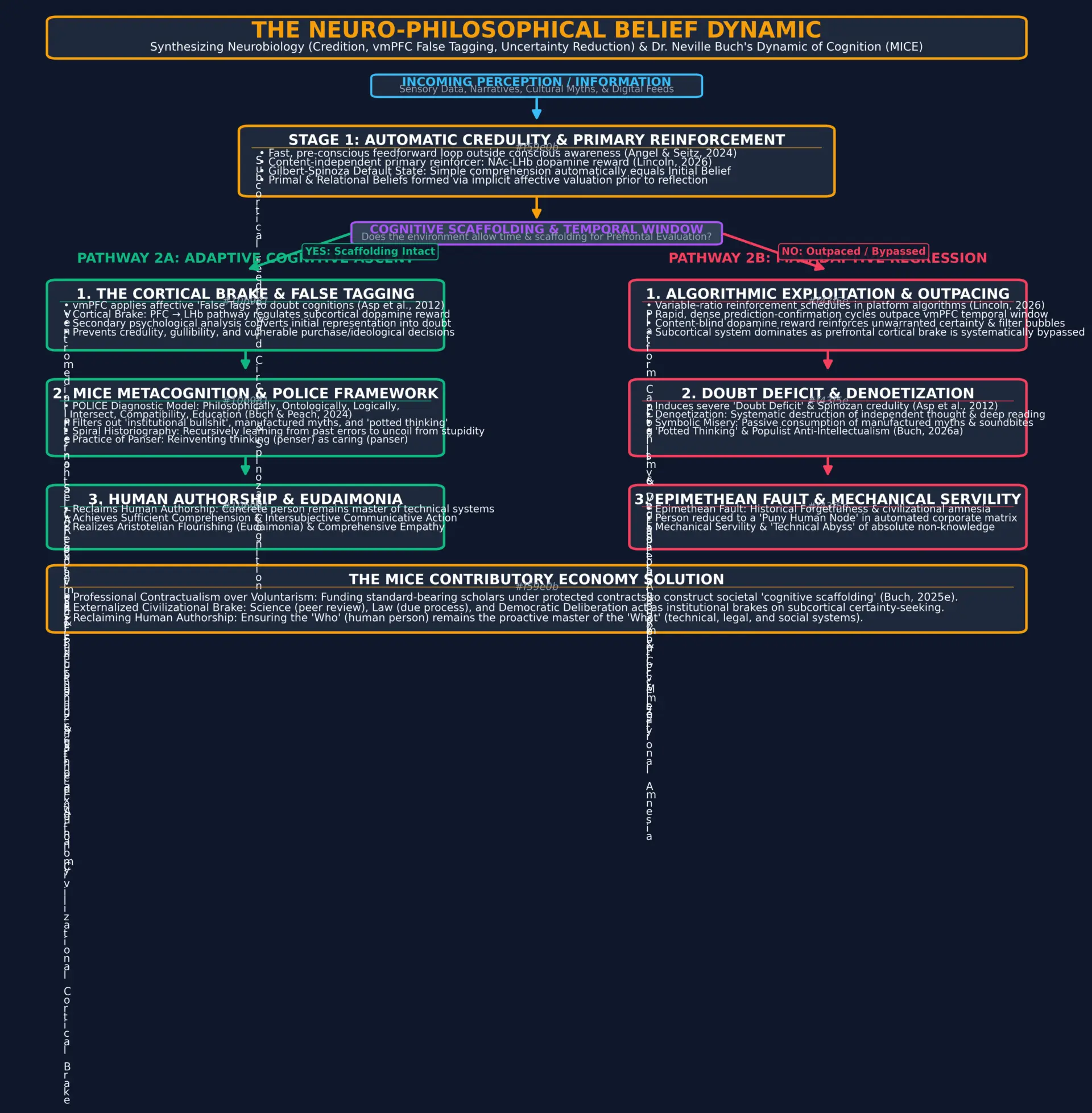
The Neuro-Philosophical Belief Dynamic Image:
II. Credition, False Tagging, and the Primary Reinforcement of Certainty
To understand why human cognition defaults to credulity, we must examine the subcortical and prefrontal mechanisms that govern belief formation:
1. Credition: The Pre-Conscious Feedforward Loop
Angel and Seitz (2024, p. 63) define credition (from the Latin credere, to believe) as a fundamental, meta-analytic brain function on the same level of abstraction as cognition and emotion. Credition operates predominantly outside conscious awareness through a fast feedforward model: incoming sensory inputs (objects, events, narratives) are associated with implicit emotional valuations in the amygdala, orbitofrontal cortex, and basal ganglia before the individual becomes aware of them (Angel & Seitz 2024, pp. 69–71).
People naturally trust their pre-conscious perceptions as “subjectively true,” storing them as patterns of neural activity that form a baseline worldview (Angel & Seitz 2024, pp. 70–72). Conscious propositional statements (“I believe that p”) and rational justifications are merely ex-post inferences or “elaborate fabrications” generated after the underlying neural belief state has already been established (Mercier & Sperber 2011; Dobbins et al. 2004, cited in Angel & Seitz 2024, p. 73).
2. False Tagging Theory: Spinozan Epistemology in the Brain
This neurobiological feedforward loop directly supports the Spinozan-Gilbert model of cognition tested by Erik Asp et al. (2012, p. 116). Under the Gilbert-Spinoza model, the mental representation of any idea inevitably involves its initial acceptance or belief; comprehension and belief are structurally identical at the first stage of perception (Gilbert 1991, cited in Asp et al. 2012, p. 116).
Assessment, doubt, and disbelief occur only at a secondary psychological stage, which requires the prefrontal cortex to attach an affective “false tag” to the represented idea, marking it as inaccurate or deceptive (Damasio 1994, cited in Asp et al. 2012, p. 116). Asp et al. (2012, p. 113) demonstrated that focal damage or age-related dysfunction in the ventromedial prefrontal cortex (vmPFC) causes a severe “doubt deficit.” Patients with vmPFC impairment exhibit significantly higher credulity and purchase intentions when exposed to misleading advertisements—even when the deception is explicitly flagged by a disclaimer—because their false tagging mechanism is disrupted (Asp et al. 2012, pp. 113, 116).
3. Uncertainty Reduction as a Primary Reinforcer
Alan Lincoln (2026, p. 244) extends this neuro-architectural account by demonstrating that the resolution of predictive uncertainty operates as an evolutionary primary reinforcer in humans, mediated by phasic dopaminergic prediction error signalling in the nucleus accumbens and lateral habenula (NAc-LHb) circuit. This subcortical reward system is content-independent: the dopamine signal responds to the structural resolution of uncertainty regardless of whether the belief being confirmed is factually true or false (Lincoln 2026, p. 250).
While the expanded granular prefrontal cortex provides a “cortical brake” (via the PFC $\rightarrow$ LHb pathway) that allows evidence-based belief revision, subcortical dopamine loops fire rapidly on a millisecond timescale, rewarding any input that yields a sense of prediction resolution (Lincoln 2026, pp. 254, 260, 300).
III. Digital Denoetization: Exploiting the Subcortical System and Bypassing the Cortical Brake
Synthesizing these neuro-developmental findings with Dr. Neville Buch’s sociological critique illuminates the precise mechanism behind contemporary cultural decay. Modern platform capitalism, social media feeds, and algorithmic recommendation systems are engineered to exploit the brain’s subcortical uncertainty reduction machinery (Pariser 2011; Schüll 2012, cited in Lincoln 2026, p. 310; Buch 2026a, p. 4).
Digital algorithms operate on variable-ratio reinforcement schedules that deliver high densities of belief-confirming content, generating dense prediction-confirmation cycles that release mesolimbic dopamine (Ferster & Skinner 1957, cited in Lincoln 2026, p. 310). Because these digital feeds deliver certainty-yielding information at a rapid pace, they outpace the temporal window required for the cortical brake and vmPFC false tagging mechanism to engage (Asp et al. 2012, p. 116; Lincoln 2026, p. 300).
This structural outpacing results in what Bernard Stiegler and Dr. Buch define as “denoetization”—the systematic destruction of the individual’s capacity for independent thought, deep reading, and critical evaluation (Stiegler 2025, cited in Buch 2026a, p. 2; Buch 2026c, p. 18). When the cortical brake is bypassed, the individual suffers from an artificially induced “doubt deficit,” falling into “symbolic misery” and “potted thinking” (Stiegler 2014, cited in Buch 2026a, p. 3; Asp et al. 2012, p. 113; Buch 2026c, p. 18). The citizen is reduced to a “puny human node” reacting to drive-based algorithmic stimuli, completely detached from their historical and social bearings—a state Dr. Buch terms the Epimethean fault (Historical Forgetfulness) (Stiegler 1998, cited in Buch 2026a, p. 2; Buch 2025b, p. 3).
This neuro-philosophical diagnosis completely demolishes the marketized epistemology of neoliberal apologists like Bevin Luchel (2026c, p. 154). Luchel contends that the “spontaneous order” of digital platforms and voluntary exchange creates an “extraordinary expansion of cognitive agency” (Luchel 2026c, p. 155).
The Mechanism of Digital Denoetization Image:
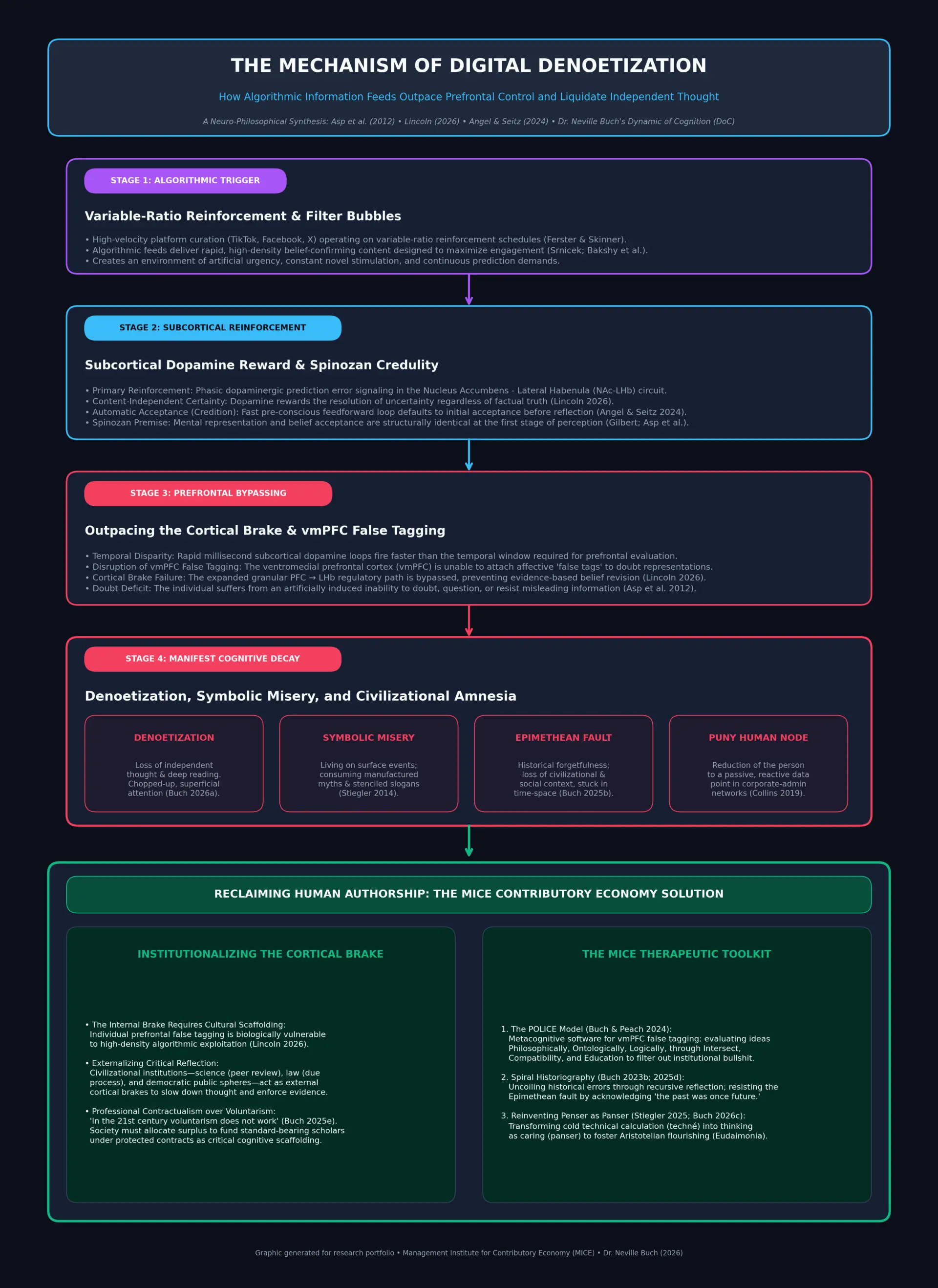
However, as Lincoln’s (2026, p. 307) and Asp et al.’s (2012, p. 113) empirical research proves, unregulated digital markets do not promote “epistemic diversity”; instead, they exploit subcortical content-blind reward loops, generating high densities of unwarranted certainty that lock users into filter bubbles, conspiracy theories, and radicalized “potted” ideologies. Confusing this commercial exploitation with “cognitive freedom” is a catastrophic category error that mistakes algorithmic addiction for genuine intellectual agency (Haack 1993, p. 231; Buch 2026e, p. 2).
IV. The Contributory Economy: Institutionalizing the External Cortical Brake
If human biology defaults to credulity, and if marketized digital platforms actively suppress the prefrontal mechanisms of doubt, how can society preserve critical reason and human agency? The answer lies in Dr. Neville Buch’s synoptic defence of the Contributory Economy and the therapeutic toolkit developed by the Management Institute for Contributory Economy (MICE) (Buch 2025e, p. 2; Buch 2026a, p. 4).
As Alan Lincoln (2026, p. 309) brilliantly observes, the internal cortical brake is an individual neural mechanism that requires externalized, cultural institutionalization to function effectively across generations. Science (peer review), law (due process), and democratic deliberation are civilizational “external brakes” designed to slow down thought, force comparison against evidence, and suppress unwarranted certainty (Merton 1942; Haack 2014, cited in Lincoln 2026, p. 309).
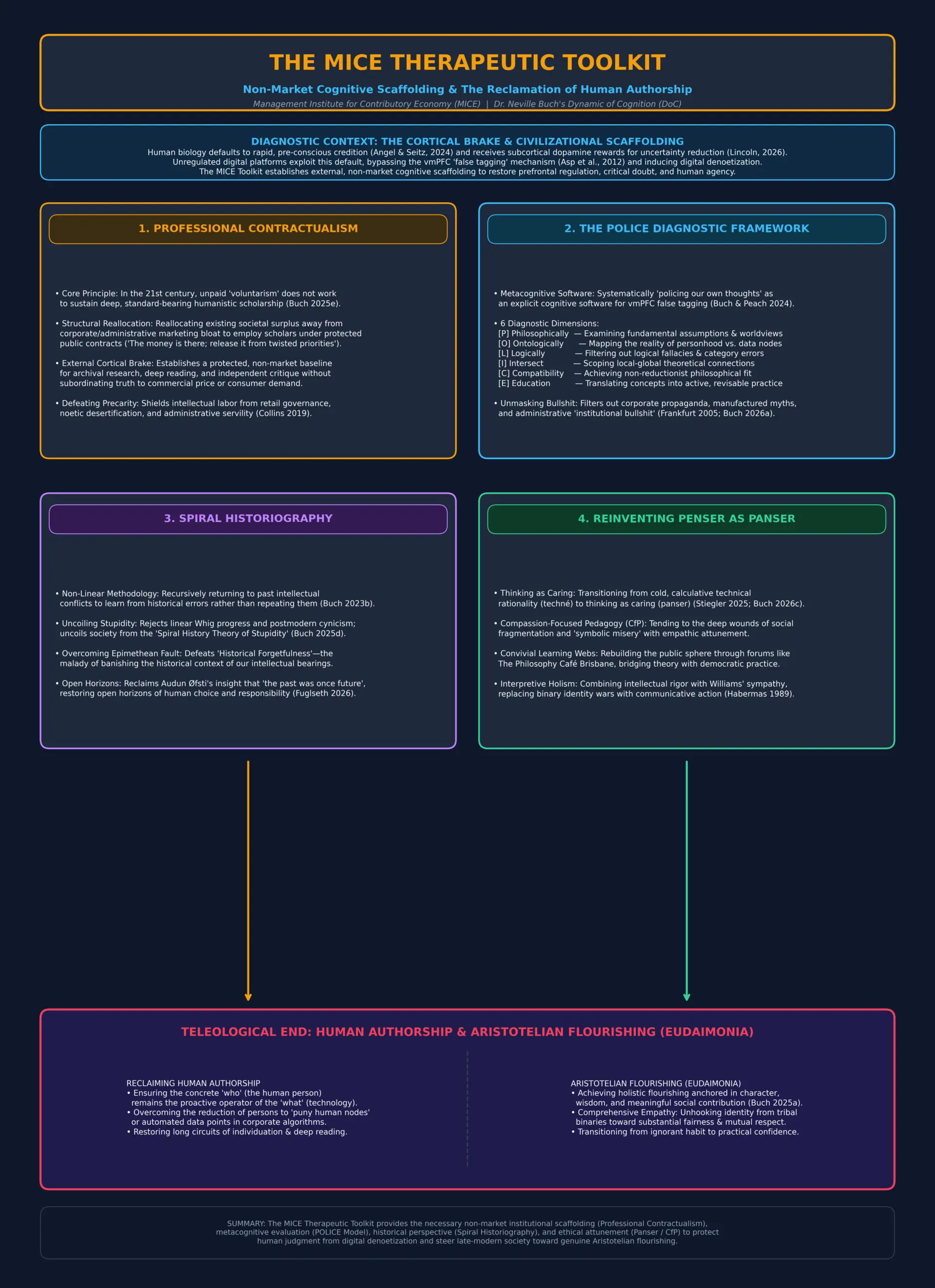
The Contributory Economy operationalizes this external cognitive scaffolding through four key pillars:
1. Professional Contractualism over Voluntarism
Dr. Buch’s contemporary project establishes that “in the twenty-first century, voluntarism does not work” to sustain deep, standard-bearing humanistic scholarship (Buch 2025e, p. 10). Leaving intellectual labour to unpaid charity or short-term market prices systematically marginalizes critical thinkers, forcing them into administrative servility (Collins 2019; Buch 2026a, p. 2). By contracting scholars under protected public appointments, society secures the non-market “cognitive scaffolding” required to maintain deep reading, archival research, and independent critique (Buch 2025e, p. 10; Buch 2026b, p. 12).
2. The POLICE Model
Developed by Dr. Neville Buch and Dr. Neil Peach (2024), the POLICE model acts as an explicit metacognitive software for the vmPFC false tagging mechanism. By evaluating ideas across six diagnostic dimensions—Philosophically, Ontologically, Logically, Intersect, Compatibility, and Education—the individual systematically “polices their own thoughts,” unmasking “institutional bullshit” and filtering out corporate-administrative propaganda (Frankfurt 2005; Buch & Peach 2024; Buch 2026a, p. 4).
3. Spiral Historiography
To counteract the Epimethean fault of civilizational amnesia, Dr. Buch introduces Spiral Historiography—a non-linear historical method that recursively returns to past intellectual conflicts to learn from previous errors (Buch 2023b, p. 3; Buch 2025d, p. 1). By re-evaluating historical grounds, thinkers “uncoil” from the “Spiral History Theory of Stupidity,” recognizing that “the past was once future” and restoring open horizons of human choice (Øfsti 1993, cited in Fuglseth 2026, p. 59; Buch 2025d, p. 1; Buch 2026a, p. 3).
4. Reinventing Penser (Thinking) as Panser (Caring)
Finally, the Contributory Economy replaces the cold, calculative rationality of the “techné mindset” with panser—the procedural necessity of transforming thinking (penser) into caring (panser) (Stiegler 2025, cited in Buch 2026c, p. 4). Grounded in Compassion-Focused Pedagogy (CfP), panser ensures that intellectual rigor is tempered by empathic attunement, healing the social wounds of cognitive fragmentation and guiding society toward true Aristotelian flourishing (eudaimonia) and comprehensive empathy (Buch 2025a, p. 3; Buch 2026b, p. 1; Buch 2026c, p. 1).
V. Conclusion: Reclaiming Human Authorship
The integration of cognitive neuroscience with Dr. Neville Buch’s Dynamic of Cognition exposes the ultimate stakes of late-modern intellectual life. Biology endows the human brain with a fast, pre-conscious credition system that defaults to initial belief and seeks certainty as a primary reinforcer (Angel & Seitz 2024, p. 63; Lincoln 2026, p. 244). When market forces deregulate information feeds, they turn this biological default into a tool of profit, inducing an artificial “doubt deficit” that strips away human agency (Asp et al. 2012, p. 113; Buch 2026a, p. 2).
To surrender to this marketized reduction—as advocated by Bevin Luchel—is to accept a future of mechanical servility, where human beings function as unthinking nodes in automated networks (Buch 2026a, p. 2; Luchel 2026c, p. 154).
The alternative is to embrace Dr. Neville Buch’s synoptic vision: building a Contributory Economy that invests in professional contractualism, practices the POLICE framework, and cultivates panser within convivial learning webs (Buch 2025e, p. 10; Buch & Peach 2024; Buch 2026c, p. 4). By providing the structural, non-market scaffolding that supports the brain’s cortical brake, we ensure that the concrete human person remains the proactive author of our shared social, technical, and historical destiny (Stiegler 1998; Buch 2026b, p. 6).
The MICE Therapeutic Toolkit Image:
References / Bibliography
Angel, Hans-Ferdinand and Seitz, Rüdiger J. (2024). ‘Credition and the neurobiology of belief: the brain function in believing’, Academia Biology, vol. 2, pp. 62–106 [https://doi.org/10.20935/AcadBiol7359].
Asp, Erik, Manzel, Kenneth, Koestner, Bryan, Cole, Catherine A., Denburg, Natalie L., and Tranel, Daniel. (2012). ‘A neuropsychological test of belief and doubt: damage to ventromedial prefrontal cortex increases credulity for misleading advertising’, Frontiers in Neuroscience, vol. 6, art. 100, pp. 112–125 [doi: 10.3389/fnins.2012.00100].
Brook, Andrew. (2000). ‘Unity of Consciousness: What It Is and Where It Is Found’, Proceedings of the Annual Meeting of the Cognitive Science Society, vol. 22, no. 22, pp. 126–133.
Bruce, Steve. (2002). Choice and Religion: A Critique of Rational Choice Theory, Oxford University Press, Oxford.
Buch, Neville. (2023a). SoFiA Melbourne: Unity and Fragmentation, Dr Neville Buch, Brisbane.
Buch, Neville. (2023b). Spiral Historiography: Socio-Historical Change in Unitarian Universalism, ANZUUA, Brisbane.
Buch, Neville. (2024c). When Humanists Know Nothing of Humanism: Contrast to the Comprehensive History, Humanists Brisbane, Brisbane.
Buch, Neville. (2025a). Comprehensive Understanding of Humanism Today, Dr Neville Buch, Brisbane.
Buch, Neville. (2025b). The Dynamic of Cognition: Person, Dr Neville Buch, Brisbane [Teaching Document, 21 March 2025].
Buch, Neville. (2025c). Humanism, Free Thought, and Our Conflicted Times, Dr Neville Buch Blog, Brisbane.
Buch, Neville. (2025d). Historiography and Humanism, Dr Neville Buch Blog, Brisbane.
Buch, Neville. (2025e). Comprehension: Solutions and The Plan, Management Institute for Contributory Economy, Brisbane.
Buch, Neville. (2026a). The Crisis of Comprehension and the Restoration of Deep Reading: Part 2. Response to Critics, Management Institute for Contributory Economy, Brisbane.
Buch, Neville. (2026b). The Unitarian Universalist Cognitive Ascent, Dr Neville Buch, Brisbane.
Buch, Neville. (2026c). Identity Politics and the Ascent toward Comprehensive Empathy, Dr Neville Buch, Brisbane.
Buch, Neville. (2026d). Steve Bruce on Rational Choice theory, Dr Neville Buch Blog, Brisbane.
Buch, Neville. (2026e). The Cynicism of the Market: Foundherentism, Contributory Economy, and the Subversion of Luchel’s Rent-Seeking Epistemology, Dr Neville Buch Blog, Brisbane.
Buch, Neville and Peach, Neil. (2024). Philosophically Ontology Logic Intersect Compatibility Education (POLICE), Dr Neville Buch ABN: 86703686642, Brisbane.
Collins, Randall. (2019). The Credential Society: An Historical Sociology of Education and Stratification, Columbia University Press, New York.
Damasio, Antonio R. (1994). Descartes’ Error: Emotion, Reason and the Human Brain, Grosset/Putnam, New York.
Difference between a class, a category and a classification. (2026). Academic Reference Document.
Frankfurt, Harry G. (2005). On Bullshit, Princeton University Press, Princeton.
Friston, Karl. (2010). ‘The free-energy principle: a unified brain theory?’, Nature Reviews Neuroscience, vol. 11, no. 2, pp. 127–138.
Fuglseth, Kåre S. (2026). ‘The Past Was Once Future: Reenactment of Values and Virtues on Historical Grounds in Education’, in Nangeroni Project Research Series, Bodø, pp. 56–59.
Gilbert, Daniel T. (1991). ‘How mental systems believe’, American Psychologist, vol. 46, no. 2, pp. 107–119.
Haack, Susan. (1993). Evidence and Inquiry: Towards Reconstruction in Epistemology, Blackwell, Oxford.
Haack, Susan. (2014). Evidence Matters: Science, Proof, and Truth in the Law, Cambridge University Press, Cambridge.
Habermas, Jürgen. (1989). The Structural Transformation of the Public Sphere, translated by T. Burger, MIT Press, Cambridge.
Hofstadter, Richard. (1963). Anti-Intellectualism in American Life, Alfred A. Knopf, New York.
Jameel, Arif. (2026). The Lifestyle State: A Theoretical Framework on the Succession of Legitimacy from Welfare Provision to Lifestyle Branding, Global Governance Research & Publications, Lahore.
Lincoln, Alan. (2026). ‘Uncertainty reduction as a candidate primary reinforcer: an evolutionary and neural account’, Academia Neuroscience and Brain Research, vol. 2, pp. 243–348 [doi: 10.20935/AcadNeurosci8451].
Luchel, Bevin. (2026a). The Desperation of Derivation: Buch’s Misapplication of Steve Bruce and the Failure of His Latest Rejoinder, Management Institute for Contributory Economy, Brisbane.
Luchel, Bevin. (2026b). The Illusion of the Non Market Panacea: A Formal Refutation of Dr. Neville Buch’s Reply and Vindication of The Prophet at the Food Bank, Management Institute for Contributory Economy, Brisbane.
Luchel, Bevin. (2026c). The Mirage of the Subsidized Mind: A Critique of Professional Contractualism, Rent-Seeking, and Noetic Protectionism, Academia.edu, Brisbane.
Luchel, Bevin. (2026d). The Misapplication of Susan Haack: An Epistemological Critique of “The Sovereign Intellect vs. The Marketized Mind”, Management Institute for Contributory Economy, Brisbane.
Luchel, Bevin. (2026e). The Prophet at the Food Bank: Why Dr. Neville Buch Would Starve in His Own Contributory Economy, Management Institute for Contributory Economy, Brisbane.
Menger, Carl. (1871/1981). Principles of Economics, Wilhelm Braumüller, Vienna.
Merton, Robert K. (1942). ‘The normative structure of science’, in N. W. Storer (ed.), The Sociology of Science, University of Chicago Press, Chicago, pp. 267–278.
Stiegler, Bernard. (1998). Technics and Time, 1: The Fault of Epimetheus, translated by R. Beardsworth and G. Collins, Stanford University Press, Stanford.
Stiegler, Bernard. (2014). Symbolic Misery, 1: The Hyperindustrial Epoch, translated by D. Ross, Polity, Cambridge.
Stiegler, Bernard. (2025). The Immense Regression: What is Called Caring? (Vol. 1), K. Verlag, Berlin.
Image Posters and PowerPoint are available through the Management Institute for Contributory Economy: email [email protected]
[1] Artificial Intelligence (A.I.) has been fairly used in the production of this work. The tool used is Google NotebookLM (recently rebranded as Gemini Notebook). It is an AI-powered virtual research assistant and thinking partner designed to help a person interact deeply with their own documents. Unlike general chatbots, it is source-grounded, meaning it only generates answers based on the specific PDFs, documents, or links uploaded. The A.I. process in the production of this work has been limited to the attached (prompts) on each of the questions in turn. This ensures an accurate reading of each source. The author then rearranged and re-edited the answers the A.I. provided. The human author publishes this work. A.I. is never an author when used properly. This assistance is not qualitatively different from a human research assistant when that assistance is deemed to have no authorial status but is acknowledged.


Neville Buch
Latest posts by Neville Buch (see all)
- The Unbound Mind: Independent Scholarship, Institutional Isolation, and the Restoration of Human Authorship – October 20, 2026
- The Road to Geelong: A Re-Narrativization of The Story of Resilience Part 1 – October 20, 2026
- The Human Being Above the Transaction and Why Markets Cannot Measure Human Worth – October 15, 2026