

Dr Neville Buch
Abstract
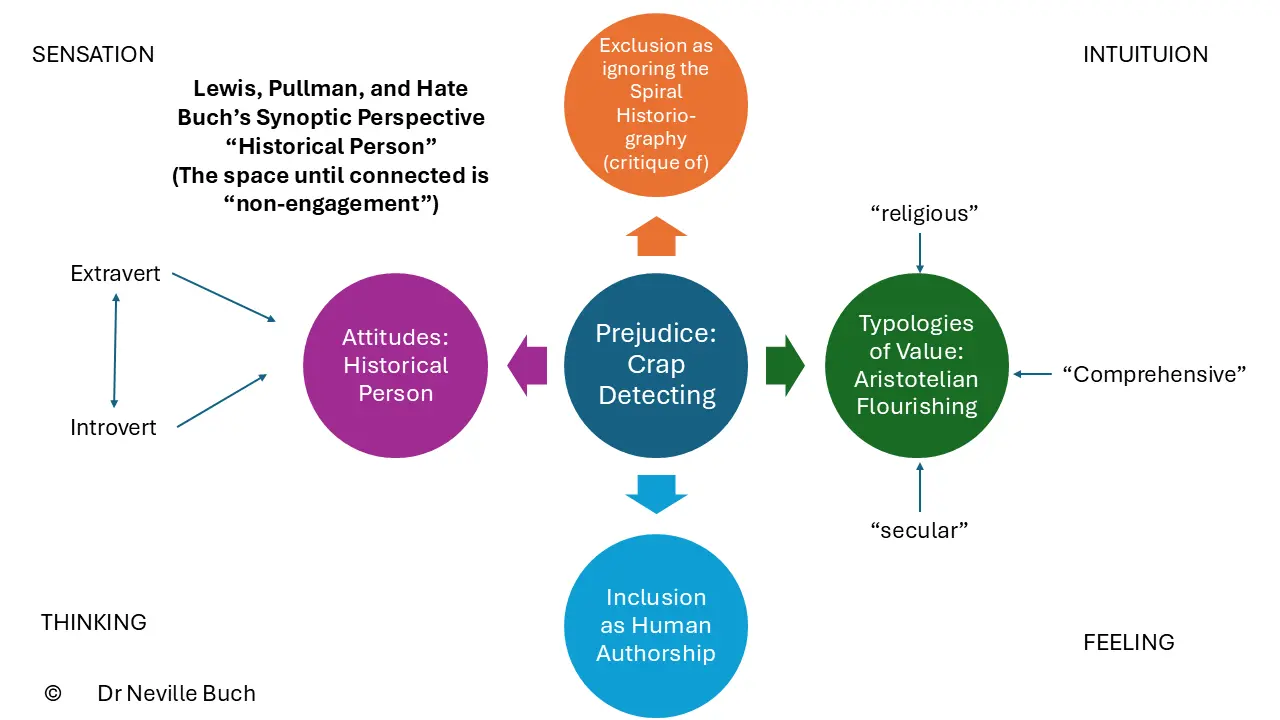
The literary and ideological clash between C.S. Lewis and Philip Pullman serves as a primary site for Dr. Neville Buch’s application of Spiral Historiography and the Dynamic of Cognition (DoC). While Pullman characterizes the Chronicles of Narnia as “poisonous” religious propaganda, Dr. Buch provides a synoptic evaluation that moves beyond simplistic binaries. By utilizing the diagnostic tool of “crap detecting,” Buch acknowledges the historical contingency of Lewis’s early twentieth-century militarism while supporting Pullman’s academic critique of how such narratives can be weaponized as far-right evangelical propaganda. Integrating the insights of Bernard Williams, Buch distinguishes between moral obligation (Lewis’s submission to Aslan) and moral imagination (Pullman’s “Republic of Heaven”). Ultimately, Buch posits that while both authors reject reductive materialism, Pullman’s secularized “Christ” aligns more closely with the historical Jesus of Nazareth, facilitating a movement toward Human Authorship and Aristotelian flourishing.
——————————————————————————–
The Battle for the Imagination: Navigating the Narnian Shadow
The debate between C.S. Lewis and Philip Pullman is often framed as a “live” conflict between Christian apologetics and New Atheism. However, from Dr. Neville Buch’s perspective, this confrontation is a valuable case study in denoetization—the mechanical liquidation of discernment—and the necessity of historical truthfulness.
I. The “Crap Detecting” of Narnian Militarism
Pullman’s visceral hatred of Narnia centres on its portrayal of childhood as a “golden age” and its exclusion of Susan Pevensie for her burgeoning interest in “lipstick, nylons, and invitations”. Dr. Buch, while noting Pullman’s use of populist propaganda and hyperbole, supports his academic assessment regarding the historical context of the work. Buch argues that too many readers “innocently read the early twentieth-century militarism of Narnia” without accounting for the problematic ways it is used today as a source for far-right evangelical propaganda. By applying Spiral Historiography, Buch insists on re-reading these “ancient” (mid-century) texts with modern inclusivity to avoid repeating the errors of institutional arrogance.
II. Moral Imagination vs. Moral Obligation
Drawing on Bernard Williams, Dr. Buch identifies the crux of the debate as the tension between moral obligation and moral imagination.
- Lewis and Submission: Lewis’s narrative often demands submission to a righteous, supernatural Authority (Aslan), which Buch’s Matrix might categorize as a form of Traditional Authority that risks collapsing into unreflective habit.
- Pullman and the Republic of Heaven: Pullman’s His Dark Materials emphasizes rebellion against an oppressive “Authority” to build a “Republic of Heaven” in the tangible world. Buch views this as a move toward Human Authorship, where the “who” (the person) remains the proactive operator of their own moral narrative.
III. Unexpected Convergences: Rebuffing the “Techné Mindset”
Despite their ideological opposition, Buch highlights that both Lewis and Pullman share a fundamental rejection of reductive materialism—the view that humans are merely biological machines. This shared concern aligns with Buch’s critique of the “techné mindset” in modern governance, which reduces human potential to mere “measurable utility”. Both authors utilize mythopoeic fantasy as a cognitive tool to preserve “noodiversity” (diversity of knowledge) against the “coldness of calculation”.
IV. The “Christ” of Experience
Perhaps Buch’s most provocative insight is his comparison of the two authors’ “Christ” figures. While Lewis offers a magic talking lion as a symbol of divine redemption, Buch argues that Pullman’s Christ is actually “much closer to the Jesus of Nazareth”. In this view, Pullman’s moral imagination, though it pulls away from the Church, remains deeply shaped by the humanistic end-points of the Christian tradition. Pullman’s call to be “cheerful and kind and curious and patient” in building the Republic of Heaven functions as a form of Devotio Moderna—a structural performance that stabilizes intellectual integrity and the archetype of the Person.
Conclusion
Dr. Buch’s perspective suggests that the Lewis-Pullman debate is not a simple choice between faith and atheism, but a complex dialectic between instructional dogma and reflective self-criticism. By “uncoiling” the mind from the comfortable prejudices of both theocratic submission and narrow secularism, one can reach a synoptic vision where the imagination serves as the organ of meaning. In the final analysis, Buch advocates for a “Balanced and Comprehensive” worldview that embraces the transformative power of story while remaining vigilantly anchored in historical truth.
——————————————————————————–
https://www.academia.edu/165646826/Myth_Morality_and_the_Republic_of_Heaven
Myth, Morality, and the Republic of Heaven
Featured Image: Dr Buch’s research into early 20th century literature in Port Washington, a hamlet on Long Island’s North Shore (New York), United States, with the Sinclair Lewis Collection, on 10 February 2023.



Neville Buch
Latest posts by Neville Buch (see all)
- From Augustine’s Pears to Academic Boycotts: Fundamental Sociological Change in Australian Cultural Relations – October 11, 2026
- Yes, I want Anger Expressed But Then Resolved – October 11, 2026
- Part 3:The Failure of an Educational Institution and How to Spiral Forward – October 10, 2026