
Table of Contents
Dr Neville Buch
Architecture of the Horizon: Navigating the Dynamic of Cognition
Abstract
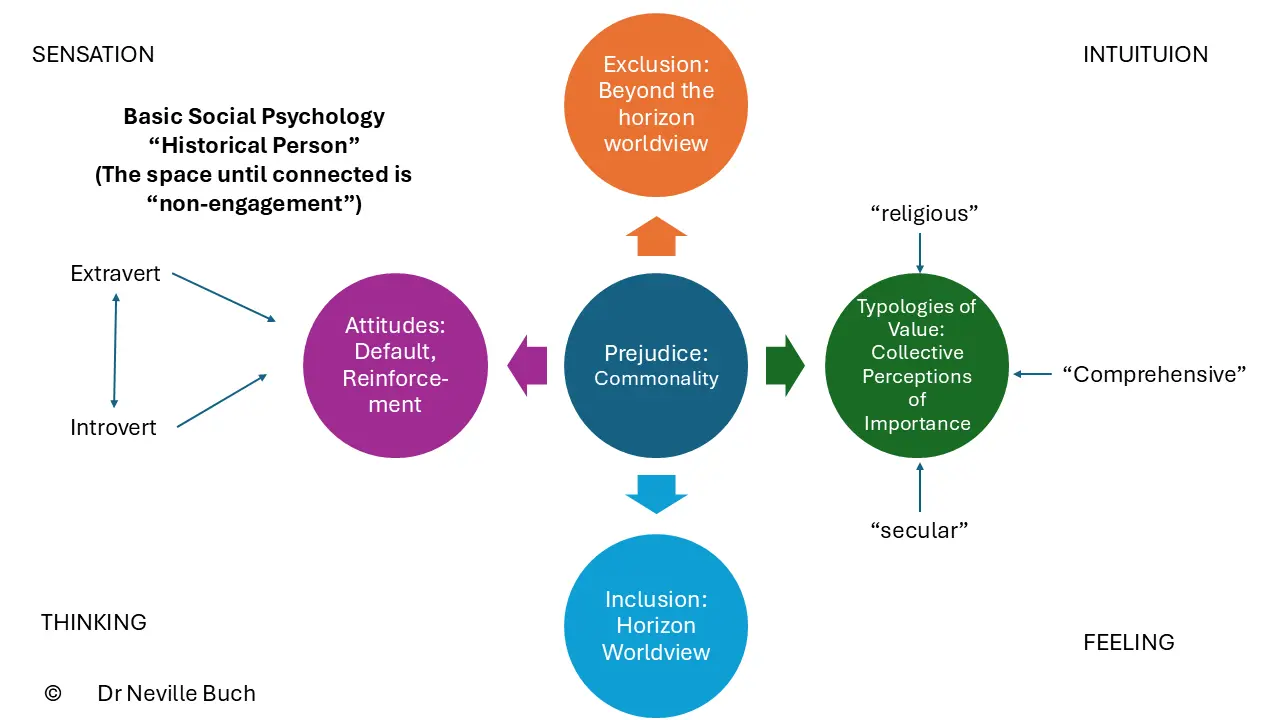
The Dynamic of Cognition (DoC) is made up of four labelled state of affairs: prejudice, attitudes, typology of values, exclusion, and inclusion. At the most basic level, prejudice is the belief in commonality – that my perception of self and world is common. Attitudes are the reinforcement of belief (either in original prejudices or judgements reviewed) ; a default position usually to do with social judgements. Typology of values are collective perceptions of importance. There is never one, singular value. Exclusion is what, in time, is beyond our grasp; beyond the horizon worldview. Inclusion is the Horizon Worldview. The challenge in thinking correctly is that each can’t assume the commonality of The Other; being careful not to reenforce each in prejudice in stated belief; being prepared to move to social judgements once rejected; always revaluating what is important; and understanding the evolution of our (and each) Horizon Worldview.
The Architecture of the Horizon: Navigating the Dynamic of Cognition
The Dynamic of Cognition (DoC) serves as a vital methodological framework for understanding how the human person, “thrown into the world” in a Heideggerian sense, moves from unreflective habit toward comprehensive knowledge. Thought is not a static object stowed within the brain, but a dynamic, purposive action—a “thread of melody” running through sensory experiences. To think correctly requires a systematic deconstruction of the internal states that govern our perception of reality and our relationship with the Other.
1. The Starting Point: Prejudice and the Illusion of Commonality
The cyclical beginning of all thought is prejudice, the initial state of unexamined belief in commonality. This state is often characterised by “potted thinking,” where individuals accept compressed, ready-made statements that save them from the actual labour of deep reflection. The conventional thinker, deceived by the “deceptive simplicity of appearance,” mistakenly assumes that their personal perception of the self and the world is a universal standard. Without the intervention of critical reflection, this prejudice settles into a “closed loop” of automaticity, where the individual remains a “passive conduit” for dominant ideologies rather than a master of their own fate.
2. The Mechanics of Belief: Attitudes and Social Judgments
Attitudes represent the “forcefulness of ideas,” functioning as a “residue of experience” that conditions and controls human activity. They are durable organisations of emotive, perceptive, and cognitive motivations directed toward the world. Within the DoC, attitudes serve as the default reinforcement of belief, often manifesting as ingrained social judgements. The way an attitude functions is heavily influenced by its metacognitive characteristics, such as importance and certainty. Because importance is the strongest predictor of behaviour, individuals often act upon these predispositions without conscious inquiry. True intellectual agency requires the drive to transform these unconscious habits into intentional, reflective activities through active critique.
3. The Plurality of Worth: Typologies of Value
A typology of values consists of collective perceptions of importance that guide our judgements and shape our social requirements. Crucially, there is never one singular value; instead, we navigate a complex web of “strong values” and incommensurable goods. These values are not abstract entities but relational terms that involve a reflexive reference to the human centre of a situation. They are operationalised through “thick ethical concepts”—such as courage, kindness, or integrity—which uniquely unite factual description with evaluative meaning. The ultimate measure of these values is their contribution to Aristotelian flourishing (eudaimonia), moving the subject from narrow material utility toward a state of social accountability.
4. The Boundaries of Engagement: Exclusion and Inclusion
The agency of determination in the DoC is defined by the states of exclusion and inclusion. Exclusion is the state of what we filter out through “wilful ignorance,” often correlating with an externalist focus on “thin” concepts or purely technical formalisms. This “Specialized Ignorance” creates an “Analytical Abyss,” where the mind operates without connecting ideas to the multi-textured reality of lived experience. Conversely, inclusion represents the Horizon Worldview—the state of what we systematically internalize through empathy and Socratic reflection. This requires a “fusion of horizons” (Gadamer), where the individual recognizes that knowledge is an interpersonal product synthesized from the experiences of many.
Conclusion: The Evolution of Authorship
The fundamental challenge of correct thinking lies in understanding that we cannot assume the commonality of the Other. Each person exists within their own “bubble of Mind,” which must be allowed to burst and reform into larger, more inclusive structures. By applying the POLICE model (Philosophically Ontology Logic Intersect Compatibility Education) to our internal narratives, we can filter out “widely-believed falsehoods” and manufactured myths. This developmental ascent from a “Junior” mindset of unreflective execution to a “Senior” state of social accountability restores human authorship, ensuring that the “Who” of the person remains the proactive master of their own evolving Horizon Worldview.
*****
The following bibliography and endnotes provide the formal scholarly apparatus for the essay “Architecture of the Horizon: Navigating the Dynamic of Cognition,” based on the integrated frameworks of Dr. Neville Buch and his primary theoretical influences.
Endnotes
- Dynamic of Cognition (DoC): A diagnostic framework used for philosophical critique and applied history that maps the interaction of thought processes (Thinking/Feeling) and information inputs (Sensation/Intuition) to identify and overcome cognitive failures.
- Prejudice and “Thrownness”: In the DoC, prejudice is the “cyclical beginning” of thought, representing the state of unexamined belief in commonality. It is influenced by the Heideggerian concept of being “thrown into the world” (Geworfenheit), where the starting point for inquiry is always an unreflective pre-judgment.
- Attitudes and Social Metacognition: Attitudes are defined as the reinforcement of belief or “default positions” regarding social judgments. They function as a “residue of experience” that conditions behaviour, often governed by metacognitive characteristics such as certainty and importance.
- Thick Ethical Concepts: Originating from Bernard Williams, these are evaluative terms (e.g., courage, kindness, justice) that unite factual description with moral meaning. Within the DoC, these concepts provide the “genuine determinateness” required to move from abstract values toward concrete social practice.
- Exclusion and the Analytical Abyss: Exclusion is the cognitive state of filtering out information that is beyond one’s immediate horizon worldview. When this process is unreflective, it leads to “Specialized Ignorance” or an “Analytical Abyss,” where the mind operates on “thin” concepts divorced from lived experience.
- Inclusion and the Horizon Worldview: Inclusion represents the systematic internalization of diverse perspectives (the “Other”) through empathy and Socratic reflection. This results in an evolving Horizon Worldview.
- Fusion of Horizons: A concept from Gadamer (often accessed through the work of Charles Ringma or Holtzen & Hill), describing the interpersonal process where individual knowledge is synthesized with historical context and the experiences of others to achieve mutual understanding.
- The POLICE Model: A specific procedural mechanism—Philosophically Ontology Logic Intersect Compatibility Education—designed to filter out manufactured myths and “institutional bullshit,” allowing for a transition from unreflective habit toward social accountability.
- Human Authorship: The core humanist principle that restores the proactive “Who” of the person as the master of their own narrative, ensuring the individual is no longer a “passive conduit” for technical or bureaucratic systems.
——————————————————————————–
Bibliography
- Bandura, A. (2006). Toward a psychology of human agency. Perspectives on Psychological Science, 1(2), 164–180.
- Buch, N. (2015, May 31). Process of learning (principles) & the dynamic of cognition. Dr Neville Buch ABN: 86703686642.
- Buch, N. (2024, March 4). Philosophically Ontology Logic Intersect Compatibility Education (POLICE). Dr Neville Buch ABN: 86703686642.
- Buch, N. (2025, March 1). History of cognition: Discussion sheet. The Philosophy Café Brisbane Meetup, Dr Neville Buch ABN: 86703686642.
- Buch, N. (2026, March 17). A matrix of sociology. Management Institute for Contributory Economy.
- Habermas, J. (1979). Communication and the evolution of society (T. McCarthy, Trans.). Beacon Press.
- Heidegger, M. (1927/1962). Being and time (J. Macquarrie & E. Robinson, Trans.). Harper & Row.
- Holtzen, W. C., & Hill, M. N. (Eds.). (2016). In spirit and in truth: Philosophical reflections on liturgy and worship. Claremont Press.
- Ringma, C. (1991). Gadamer’s dialogical hermeneutic (THE7485).
- Stiegler, B. (1998). Technics and time, 1: The fault of Epimetheus (R. Beardsworth & G. Collins, Trans.). Stanford University Press.
- Toulmin, S. (1992). Cosmopolis: The hidden agenda of modernity. University of Chicago Press.
- Werthner, H., Nuseibeh, B., Prem, E., & Stanger, A. (Eds.). (2024). Introduction to digital humanism. Springer International Publishing.
- Williams, B. (1985). Ethics and the limits of philosophy. Fontana Press.
Featured Image: Mind-Body-Cognition-with-Ideology


Neville Buch
Latest posts by Neville Buch (see all)
- Politicians, Other Political Players, why your messaging does not land with the general public – October 25, 2026
- The Unbound Mind: Independent Scholarship, Institutional Isolation, and the Restoration of Human Authorship – October 20, 2026
- The Road to Geelong: A Re-Narrativization of The Story of Resilience Part 1 – October 20, 2026