
Abstract[1]
This essay examines the intersection of structural poverty and systemic failure through the lens of Dr. Neville Buch’s personal narrative and his broader philosophical framework. It argues that contemporary society is trapped in an “immense regression” where creative and intelligent individuals are marginalized by a technocratic elite that values measurable utility over moral wisdom. By analysing the limitations of traditional charity and the failures of the modern employment market, the essay identifies what the collective must hear (the reality of the marginalized scholar), accept (the systemic roots of inequality), and act upon (the transition to a Contributory Economy). Drawing on the work of Amartya Sen, Martha Nussbaum, and Jack McKinney, the essay posits that the restoration of human authorship is the only path toward Aristotelian flourishing.
[1] Artificial Intelligence (A.I.) has been fairly used in the production of this work. The tool used is Google NotebookLM (recently rebranded as Gemini Notebook). It is an AI-powered virtual research assistant and thinking partner designed to help a person interact deeply with their own documents. Unlike general chatbots, it is source-grounded, meaning it only generates answers based on the specific PDFs, documents, or links uploaded. The A.I. process in the production of this work has been limited to the attached (prompts) on each of the questions in turn. This ensures an accurate reading of each source. The author then rearranged and re-edited the answers the A.I. provided. The human author publishes this work. A.I. is never an author when used properly. This assistance is not qualitatively different from a human research assistant when that assistance is deemed to have no authorial status but is acknowledged.
The Dissonance of the Independent Scholar: What Society Must Hear
Society must first hear the uncomfortable truth regarding the “independent scholar” in the 21st century. Dr. Buch’s personal testimony reveals a profound dissonance: an individual who works “seven days a week, 8–10 hours a day” but must drive a vehicle “running on fumes” to a community centre for food aid. This is not a failure of individual effort but a symptom of a structural collapse. Society often dismisses such individuals as less than “regular academics,” yet the distinction is frequently “purely monetary, not a difference in quality or expertise”.
The broader intellectual community is suffering from an “intellectual collapse” driven by credential inflation and political labour. In the current marketplace, educational degrees no longer function as measures of skill but as barriers used by “gatekeepers” to limit candidate supply. This has led to a state of “Specialized Ignorance,” where specialists in the humanities are discarded as “unemployable” by an elite that has succumbed to the “techné mindset”—the tyranny of quantifiable data over the multi-textured reality of being human.
The Failure of the Band-Aid: What Society Must Accept
Society must accept that traditional charity is often an insufficient response to systemic injustice. As highlighted in current philosophical literature, localized giving frequently fails the test of systemic justice because it avoids addressing the political roots of suffering. Poverty is not merely a lack of income; it is a “lack of real freedom” and the basic capabilities to live a valued life.
Furthermore, the “will to believe” in a fair economic game is undermined by the reality of “positional property”. Access to paid labour is often controlled by organizational manoeuvring and “informal ties” rather than technical competence. Accepting this requires a rejection of “Historical Forgetfulness”—the pathology where a community repeats past errors because it has banished the origins and struggles of its core concepts from memory. To truly address poverty, society must move beyond the “paper-back” solutions of neoliberalism and recognize that wealthy nations share a moral responsibility for structural inequality.
Reclaiming Authorship: What Society Must Act Upon
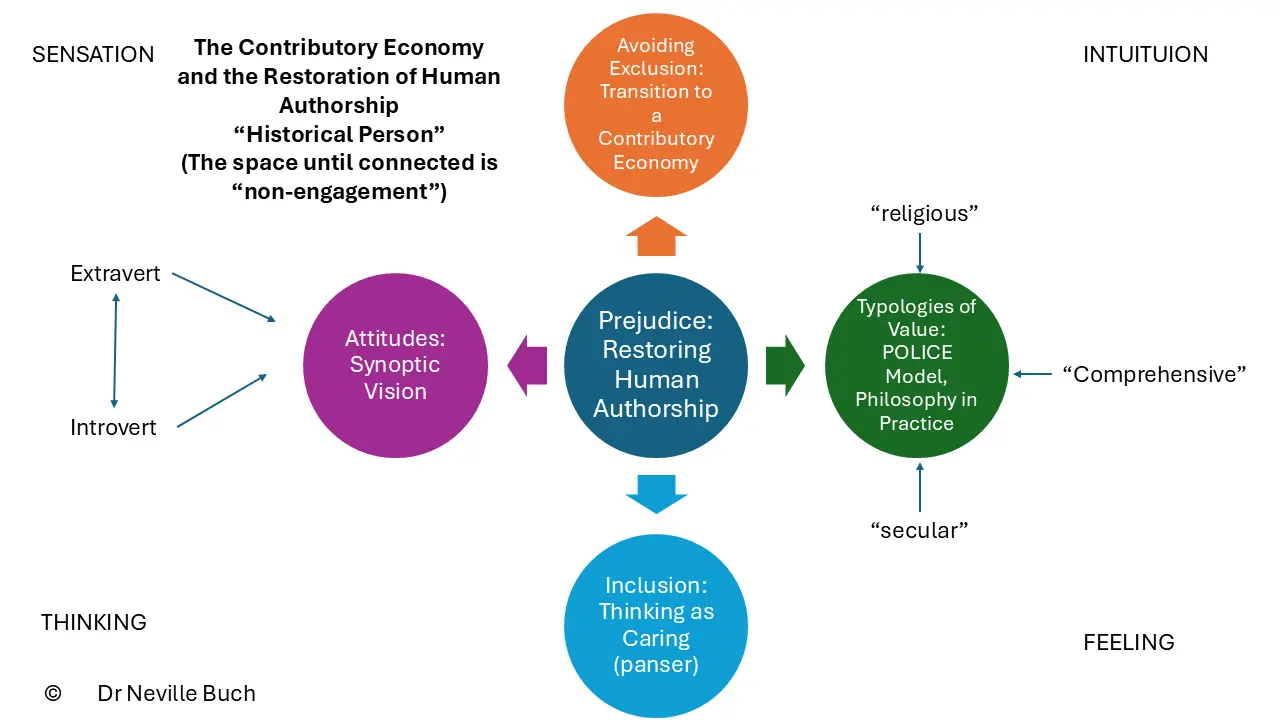
Action requires a fundamental re-orientation of the social and economic order toward a Contributory Economy. This model, operationalized through the Management Institute for Contributory Economy (MICE), measures success not by narrow “Political Profit” or technical efficiency, but by human dignity, wisdom, and character.
Society must act to:
- Restore Human Authorship: Transition the individual from a “puny human node” in automated systems to a proactive author of their own social existence.
- Implement an Intellectual Immune System: Utilize the POLICE model (Philosophically Ontology Logic Intersect Compatibility Education) to “crap detect” and unmask the “institutional bullshit” used to justify elite domination and systemic neglect.
- Practice “Thinking as Caring” (panser): Reintegrate empathy into the rational process as a procedural “shield” that protects human particularity from the cold calculation of pure assembly.
- Adopt a Synoptic Vision: Integrate the “philosophic mind and the literary mind” to challenge the mechanical liquidation of judgment known as denoetization.
Ultimately, society must embrace the axiom that “understanding history is philosophy in practice”. This means grounding ethical critique in historical data to prevent the repetition of “vicious circles of stupidity”. Only by recognizing knowledge as a collective, interpersonal “social act” can we build a world where the master architect is not replaced by a machine, and where the “unexamined life” is once again recognized as a life not worth living.
Based on the provided sources, the following table applies the Dynamic of Cognition (DoC) framework to The Contributory Economy and the Restoration of Human Authorship, mapping how this model remediates systemic failures through restorative intellectual phenomena.
DoC Table: The Contributory Economy and the Restoration of Human Authorship
| DoC Component | Intellectual Phenomenon | Philosophical Rationale |
| Self (Identity) | Restoring Human Authorship | Transitions the individual from a “puny human node” in automated technical and bureaucratic systems to a proactive author of their own social existence. |
| Mind (Judgment) | Synoptic Vision | Reintegrates the “philosophic mind and the literary mind” to challenge denoetization—the mechanical liquidation of human judgment. |
| Reason (Logic) | POLICE Model / Philosophy in Practice | Utilizes the POLICE model to “crap detect” and unmask “institutional bullshit” used to justify systemic neglect, while grounding ethical critique in rigorous historical data. |
| Utility (Action) | Transition to a Contributory Economy | Re-orients the social order toward Aristotelian flourishing (eudaimonia), where success is measured by human dignity, wisdom, and character rather than narrow transactional profit. |
| Love (Bond) | Thinking as Caring (panser) | Reintegrates empathy into the rational process as a procedural “shield” or “kindness” that protects human particularity from the cold calculation of pure assembly. |
Contextual Insights from the Sources
- The Systemic Crisis: The model diagnoses an “immense regression” where contemporary society marginalizes creative and intelligent individuals through credential inflation and the hegemony of “gatekeepers” who prioritize organizational control over actual skill.
- The Techné Mindset: This cognitive failure reduces the multi-textured reality of human life to quantifiable data and narrow “job readiness” metrics, leading to a state of “Specialized Ignorance”.
- Remediating Forgetfulness: A core goal of this framework is to reject “Historical Forgetfulness”—the pathology where societies repeat errors because they have banished the origins and struggles of their core concepts from memory.
- Social Act of Knowledge: Drawing on the legacy of Jack McKinney, the model asserts that knowledge is a collective, interpersonal “social act” rather than a commodity sequestered in elite silos.
BIBLIOGRAPHY
Core Philosophical and Economic Works
Crary, A., & Fedtke, J. (Eds.). (2023). The Good It Promises, The Harm It Does: Critical Essays on Effective Altruism. Oxford University Press.
Nussbaum, M. (2011). Creating Capabilities: The Human Development Approach. Belknap Press of Harvard University Press.
Pogge, T. (2002). World Poverty and Human Rights: Cosmopolitan Responsibilities and Reforms. Polity Press.
Schweiger, G., & Sedmak, C. (Eds.). (2020). The Routledge Handbook of Philosophy and Poverty. Routledge.
Sen, A. (1999). Development as Freedom. Oxford University Press.
The Works of Jack McKinney
McKinney, J. P. (1950). The Challenge of Reason. Mountain Press.
McKinney, J. P. (1971). The Structure of Modern Thought. Chatto & Windus.
Clarke, P., & McKinney, M. (Eds.). (2004). The Equal Heart and Mind: Letters between Judith Wright and Jack McKinney. University of Queensland Press.
The Works of Dr. Neville Buch
Buch, N. (1995). American Influence on Protestantism in Queensland since 1945 (Doctoral dissertation). Department of History, University of Queensland.
Buch, N. (2025). Mind, Body, Cognition with Ideology: The Fit of Materialism, Spiritualism, and Accurate Compatibility. Management Institute for Contributory Economy.
Buch, N. (2025). Why not job? The Failure of Creative and Intelligent Individuals in the Marketplace. Management Institute for Contributory Economy.
Buch, N. (2026). A Matrix of Sociology. Management Institute for Contributory Economy.
Buch, N. (2026). Dr Buch in Intellectual Community: Reclaiming Authorship in the City of Intellect. Management Institute for Contributory Economy.
Buch, N. (2026). Intellectual Sovereignty and the Sociological Legacy of Jack McKinney: Thinking Deeper. Management Institute for Contributory Economy.
Buch, N. (2026). Understanding History is Philosophy in Practice: A Cognition History of Queensland. Management Institute for Contributory Economy.
Buch, N., & Peach, N. (2024). Philosophically Ontology Logic Intersect Compatibility Education (POLICE). Management Institute for Contributory Economy.
Sociological and Educational Foundations
Collins, R. (1998). The Sociology of Philosophies: A Global Theory of Intellectual Change. Belknap Press of Harvard University Press.
Collins, R. (2019). The Credential Society: An Historical Sociology of Education and Stratification. Columbia University Press.
Dewey, J. (1916). Democracy and Education: An Introduction to the Philosophy of Education. Macmillan.
Habermas, J. (1979). Communication and the Evolution of Society (T. McCarthy, Trans.). Beacon Press.
Hofstadter, R. (1963). Anti-intellectualism in American Life. Alfred A. Knopf.
Illich, I. (1971). Deschooling Society. Calder & Boyars.
Illich, I. (1973). Tools for Conviviality. Harper & Row.
Kupfer, A. (Ed.). (2012). Globalisation, Higher Education, the Labour Market and Inequality. Routledge.
Marginson, S. (2016). The Dream Is Over: The Crisis of Clark Kerr’s California Idea of Higher Education. University of California Press.
Stiegler, B. (1998). Technics and Time, 1: The Fault of Epimetheus (R. Beardsworth & G. Collins, Trans.). Stanford University Press.
Williams, B. (2006). Philosophy as a Humanistic Discipline (A. W. Moore, Ed.). Princeton University Press.
Featured Image: Economics of Voluntary-Professional Endeavours in Local History



Neville Buch
Latest posts by Neville Buch (see all)
- Agency, Cultural Construction, and Synoptic Vision: On Matt Patterson’s Comprehensive Examination in Sociological Theory (2009) – September 20, 2026
- Human Existence, Existential Angst, and the Protestant Worldview: An Essay on Buch’s Existential Thesis – September 20, 2026
- Salus Populi Suprema Lex Esto. Ciceronian Statecraft, Spinozan Toleration, and Prophetic Praxis – September 19, 2026