
Dr Neville Buch and MICE[1]
The “Quantum Biology of the Open Mind” audio commentary on MICE’s Contributory Economy and Human Authorship at:
Abstract
The widespread popularization of Carol Dweck’s dichotomy between “growth” (open) and “fixed” mindsets has profoundly shaped contemporary educational psychology, management pedagogy, and self-help literature (Awan n.d., p. 1; Dweck 2015 cited in Awan n.d., pp. 1–2). While the growth mindset framework succeeds in highlighting how beliefs regarding malleable intelligence cultivate resilience and constructive engagement with failure, its conventional application frequently fails because it psychologizes systemic inequality, promotes a reductive moral binary, and ignores the structural conditions of cognition (Burgoyne, Hambrick and Macnamara 2020, pp. 258–260; Buch 2025b, pp. 1–3).
This operational failure is mirrored epistemologically in economic debates surrounding intellectual production, exemplified by Bevin Luchel’s (2026) “A Reply to The Epistemic Corrosion of Deregulation”. Luchel attempts to counter Dr. Neville Buch’s critique of neoliberalism by deploying Public Choice Theory and subjective value mechanics, yet Luchel’s model fundamentally fails: it commits a category error by reducing epistemic warrant to commercial market transactions, evades the cognitive degradation of digital “denoetization,” and retreats into an unfalsifiable, market-fundamentalist fixed mindset (Luchel 2026, pp. 3–18; Buch 2026d, p. 2).
Moving beyond these limitations requires articulating a more honest, phenomenological, and dialectical spectrum of open and fixed mindsets (Adler 2017, pp. 126–138; Buch 2025a, pp. 1–6). Drawing from Josh Adler’s phenomenology of openness, Umberto Eco’s semiotics, and Neville Buch’s Dynamic of Cognition (DoC), this spectrum frames openness not as a static individual virtue, but as a dynamic cognitive capacity for aesthetic receptivity, communicative rationality, and panser (“thinking as caring”) (Adler 2017, p. 131; Buch 2026b, p. 19). Ultimately, recalibrating the messaging of mindsets is vital for resisting neoliberal technocracy, dismantling “Job-Ready” instrumentalism, and re-establishing education as an oppositional democratic public sphere dedicated to genuine human flourishing ( eudaimonia ) (ANZHES 2026, pp. 1–2; Buch 2025b, pp. 4–6).
1. Introduction
For over two decades, the discourse of modern educational reform and corporate talent management has been captivated by the concept of “mindsets” (Awan n.d., p. 1; Buch 2026a, p. 1). Originating in the motivational psychology of Carol Dweck, the division of human cognitive orientations into “growth” (open) and “fixed” states has been championed as a universal remedy for academic underachievement, lack of resilience, and institutional stagnation (Dweck 2015 cited in Awan n.d., pp. 1–3). Under this conventional paradigm, an individual with a fixed mindset views intelligence as an immutable, innate endowment, whereas an individual with a growth mindset views cognitive capability as an expandable capacity cultivated through deliberate effort, mentorship, and iterative learning (Awan n.d., pp. 1–2).
However, when translated from controlled laboratory environments into complex socio-political and economic landscapes, this neat binary reveals profound fissures (Burgoyne, Hambrick and Macnamara 2020, p. 258). When detached from philosophical phenomenology and structural sociology, mindset theory risks devolving into an insidious form of individualistic determinism—one that ignores material conditions, pathologizes cognitive fatigue, and reduces human intellectual life to measurable commercial throughput (Buch 2025b, pp. 2–3; Luchel 2026, pp. 10–14).
This essay provides an exhaustive critique of how open and fixed mindsets function and fails, demonstrates the intellectual collapse of Bevin Luchel’s deregulatory market epistemology, constructs a multidimensional phenomenological spectrum of cognitive openness, and demonstrates why reforming mindset messaging is indispensable for democratic life.
2. How Open and Fixed Mindsets Work and Do Not Work
A. How They Work: The Motivational Mechanics of Malleability
At its foundational psychological level, Dweck’s model operates by altering an agent’s attributional schema and emotional response to difficulty (Awan n.d., pp. 1–2; Dweck 2015 cited in Awan n.d., p. 2):
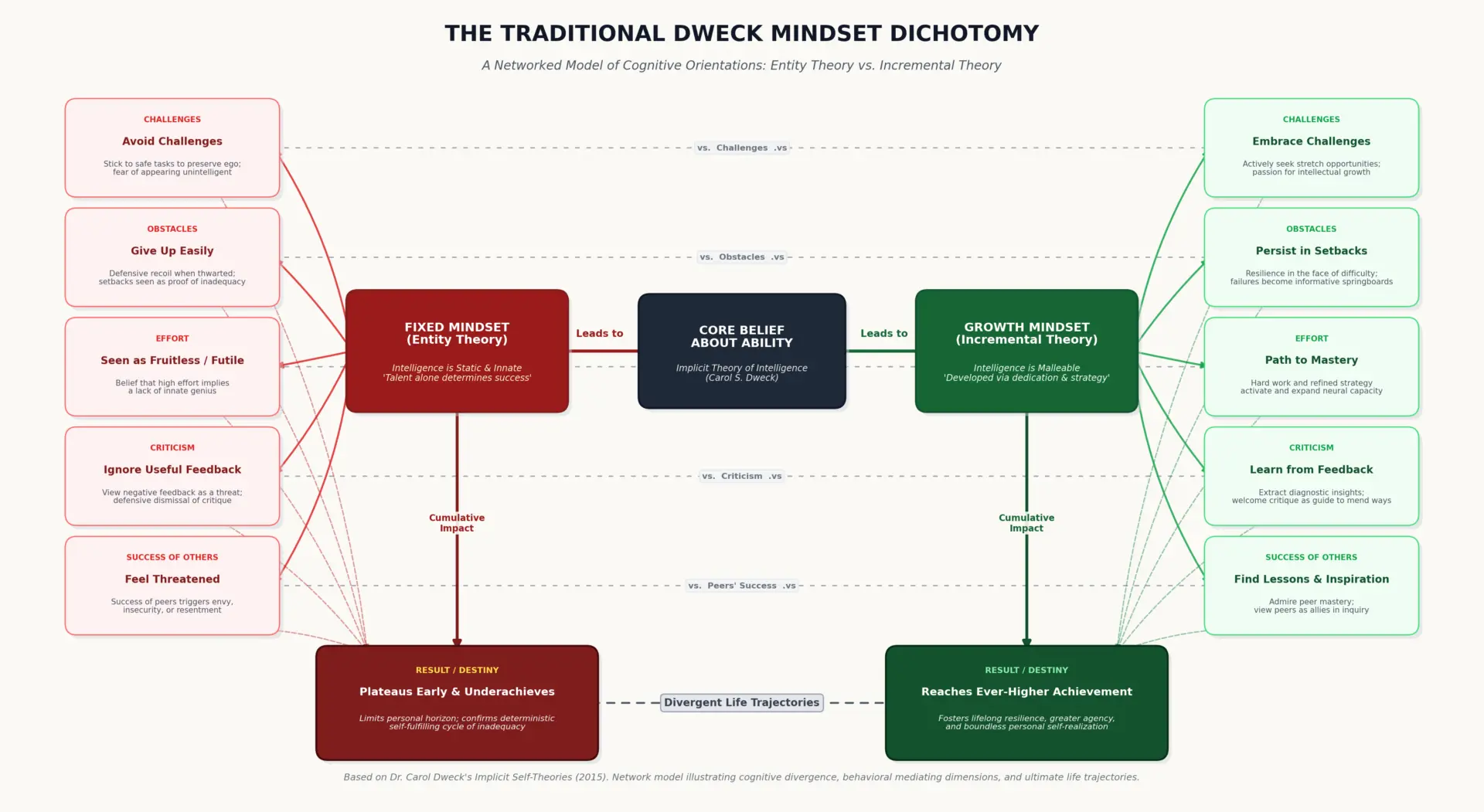
When functioning effectively, the growth mindset operates as an internal cognitive buffer against performance anxiety (Awan n.d., p. 2). By reframing failure not as an ontological verdict on personal worth but as diagnostic feedback, learners expand their tolerance for cognitive dissonance and stretch their abilities into the “Zone of Proximal Development” (Awan n.d., p. 3; Buch 2026c, p. 3). Conversely, the fixed mindset operates defensively: when individuals believe their talent is an invariant baseline, every challenging task becomes an existential courtroom where failure threatens to expose inherent intellectual inadequacy (Awan n.d., pp. 2–3). Consequently, fixed-mindset individuals retreat to safe, predictable tasks to preserve their identity as “smart,” forfeiting substantive developmental opportunities (Awan n.d., p. 2; Dweck 2015 cited in Awan n.d., p. 2).
B. How They Do Not Work: Empirical, Pedagogical, and Structural Failures
Despite these intuitive insights, the orthodox implementation of mindset theory suffers from four fatal operational failures:
- The Reification of a Moralistic Binary: Popular discourse treats the two mindsets as categorical character traits—sorting individuals into “enlightened” growth agents versus “defective” fixed thinkers (Awan n.d., p. 2). In practice, human beings do not inhabit uniform mindsets; rather, they operate across shifting domains, frequently displaying openness in creative pursuits while retreating into defensive rigidity when exposed to environmental instability or professional vulnerability (Awan n.d., p. 2; Adler 2017, p. 146).
- The “Praise Paradox” and Superficial Tokenism: As Dweck herself observed, superficial applications often degrade into praise for mere effort (“at least you tried!”) rather than cultivating actual diagnostic strategies and intellectual scaffolding (Dweck 2015 cited in Awan n.d., pp. 2–3). Praising speed, performance, or raw effort without providing rigorous epistemic tools drives learners toward exhaustion and “insanity” rather than genuine comprehension (Awan n.d., p. 3).
- Weak Empirical Replicability: Large-scale meta-analyses in cognitive science—most notably by Burgoyne, Hambrick, and Macnamara (2020, pp. 258–261)—have revealed that the empirical foundations of mindset theory are far more fragile than popular advocacy suggests. When controlling for socioeconomic background, baseline cognitive ability, and institutional resources, interventions designed to induce a growth mindset yield minimal, often statistically negligible effects on long-term academic achievement (Burgoyne, Hambrick and Macnamara 2020, p. 260).
- Neoliberal Co-optation and Structural Gaslighting: The most dangerous failure of orthodox mindset theory is its institutional weaponization within neoliberal education (Buch 2025b, pp. 1–3). By insisting that success is solely a matter of internal “grit” and “correct thinking,” institutional leaders deploy growth-mindset rhetoric to obscure structural inequities, underfunded public schools, and the commodification of learning (Buch 2025b, pp. 2–3; Buch 2025c, pp. 3–4). The burden of systemic failure is displaced onto the student’s psychological disposition, absolving the state of its duty to provide robust intellectual resources (Buch 2025b, p. 3).
3. How Bevin Luchel’s A Reply to The Epistemic Corrosion of Deregulation Does Not Work
A poignant real-world manifestation of cognitive fixity operating under the guise of intellectual debate occurs in Bevin Luchel’s (2026) treatise, “A Reply to The Epistemic Corrosion of Deregulation.” Responding to Dr. Neville Buch’s critique of neoliberal educational policy, Luchel attempts to mount a comprehensive defence of free-market deregulation, public choice theory, and spontaneous digital order (Luchel 2026, pp. 1–28). However, an analytical examination reveals that Luchel’s rebuttal completely collapses across five key dimensions:
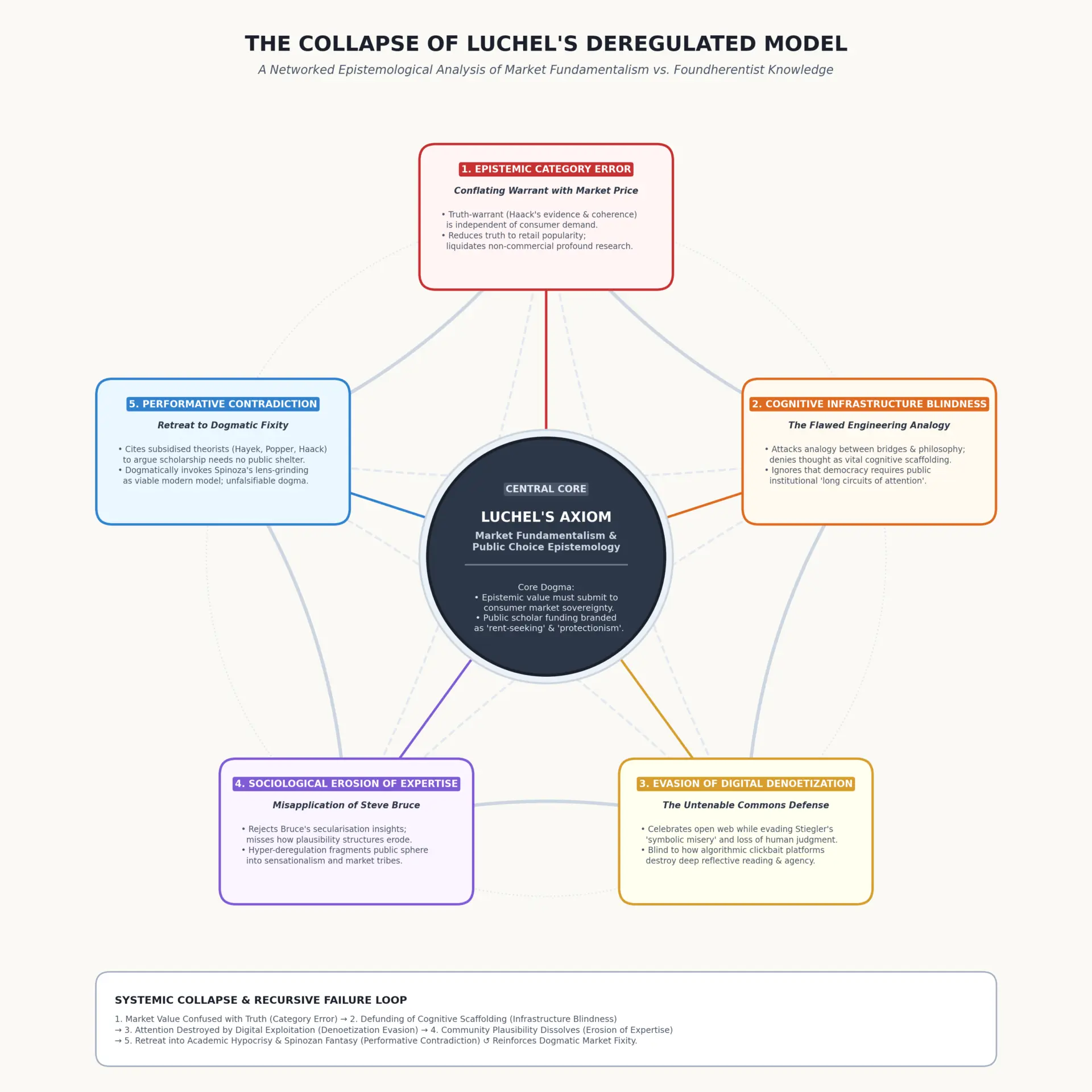
A. The Epistemic Category Error: Conflating Warrant with Price
Luchel claims to maintain a strict separation between “epistemic justification” and “economic price,” protesting that he never argued market preferences determine truth (Luchel 2026, pp. 3–4). Yet, in the very next breath, Luchel asserts that intellectual labour has no legitimate claim on public resources unless validated by consumer sovereignty in the marketplace (Luchel 2026, pp. 3–4, 27).
This is an egregious category error. As Susan Haack’s foundherentist epistemology demonstrates, the truth-warrant of a proposition is anchored in experiential evidence and mutual systemic coherence, completely independent of consumer demand (Haack 1993 cited in Luchel 2026, pp. 14–15; Buch 2026d, p. 1). Luchel candidly acknowledges that “an epistemologist who notes that a book of profound truth sold only forty copies reports an economic reality” (Luchel 2026, p. 4). However, by insisting that public funding for scholars constitutes illegitimate “rent-seeking” and “noetic protectionism,” Luchel implicitly subjects the very survival of complex intellectual inquiry to retail commercial viability (Luchel 2026, pp. 4, 26). In an unregulated market, profound truths that cannot find an immediate, commercial audience are economically liquidated.
B. The Flawed Engineering Analogy and Rejection of Public Goods
To justify defunding independent humanities research, Luchel attacks Buch’s analogy between civil engineering (bridges) and cognitive scaffolding (philosophical research) (Luchel 2026, pp. 18–20). Luchel argues that while physical bridges obey invariant laws of physics and produce universally measurable outputs, humanistic thought is non-rivalrous, interpretive, and value-laden (Luchel 2026, pp. 19–20). From this, Luchel deduces that state-funded cognitive infrastructure is a form of totalitarian “utopian social engineering” (Popper 1945 cited in Luchel 2026, p. 20).
This argument fails because it misunderstands the nature of public goods in democratic societies. A democratic public sphere does not require the state to decree which metaphysical dogma is orthodox; rather, it requires the state to sustain the institutional conditions—the “long circuits of attention”—necessary for deep reading, historical truth-telling, and critical dissent to exist outside corporate advertising cycles (Buch 2026d, p. 2; Stiegler 2025 cited in Luchel 2026, p. 21). By reducing all institutional funding to ideological capture, Luchel’s logic leaves the public square defenseless against corporate capture.
C. The Evasion of Digital Denoetization and Symbolic Misery
In attempting to prove that deregulated digital platforms create a thriving knowledge commons, Luchel appeals to rising global literacy rates and Yochai Benkler’s model of voluntary peer production (Wikipedia, open-source software) (Luchel 2026, pp. 10–13). Luchel dismisses Buch’s deployment of Bernard Stiegler’s concepts— “denoetization,” “symbolic misery,” and the “Altar of Autocomplete”—as unfounded “technopanic” and speculative jargon (Luchel 2026, pp. 10, 24).
Here, Luchel’s defence is completely blind to modern media ecology. The existence of digital commons like Wikipedia does not refute the pervasive reality of algorithmic denoetization—the systematic liquidation of deep human judgment and reflective attention by commercial platforms designed for hyper-fragmentation and engagement maximization (Stiegler 2014, 2025 cited in Luchel 2026, pp. 10, 21; Buch 2026c, p. 2). To claim that a society exposed to clickbait, automated autocomplete, and short-term marketing metrics is intellectually thriving simply because millions of open-access PDF files exist is an empirical evasion of the highest order (Luchel 2026, pp. 11–12).
D. The Misuse of Steve Bruce and Sociology of Knowledge
Luchel rejects Buch’s citation of sociologist Steve Bruce, arguing that Bruce’s critique of religious deregulation cannot be applied to scholarly knowledge production because religion relies on sacred dogma while scholarship relies on open-ended fallibilism (Luchel 2026, pp. 6–9).
However, Luchel misses the core sociological point: intellectual systems, like plausibility structures, require shared institutional integrity and sustained community commitment to survive (Bruce 2002 cited in Luchel 2026, pp. 6–8; Buch 2026e, p. 2). When intellectual labour is totally deregulated and subjected to transactional consumerism, the shared public sphere fragments into hyper-specialized niches and commercial sensationalism, eroding the social authority of tested expertise (Buch 2026d, p. 2).
E. Performative Contradiction and Dogmatic Rigidity
Finally, Luchel’s work collapses under its own performative contradiction. Throughout his essay, Luchel deploys a sophisticated, academic apparatus—citing classical economists (Menger, Hayek), Nobel laureates (Buchanan, Tullock), and philosophers (Popper, Haack)—to prove that intellectual labour has no legitimate value outside uncoerced consumer exchange (Luchel 2026, pp. 4, 14, 29–32). Yet, every one of the foundational thinkers Luchel relies upon produced their ideas within protected, university-subsidized, or structurally shielded environments (Buch 2026d, p. 2; Luchel 2026, p. 15).
When confronted with this contradiction, Luchel dismisses it as a genetic fallacy, appealing to outliers like Spinoza grinding lenses or David Hume working as a librarian (Luchel 2026, p. 16). By treating seventeenth-century lens-grinding as a viable economic model for twenty-first-century mass humanities scholarship, Luchel retreats into an ideological, fixed mindset that dogmatically refuses to engage the material realities of contemporary intellectual labour (Luchel 2026, pp. 16, 27).
4. What Is a More Honest Spectrum of Open and Fixed Mindsets?
If Carol Dweck’s individualistic dichotomy is empirically brittle and Bevin Luchel’s market reductionism is epistemologically bankrupt, how should we conceptualize cognitive openness?
A rigorous understanding requires moving from an individualized moral binary to a multidimensional, phenomenological, and cognitive continuum (Adler 2017, pp. 126–138; Buch 2025a, pp. 1–6):
1. Level 1: Dogmatic Fixity (The Techné Closed Loop)
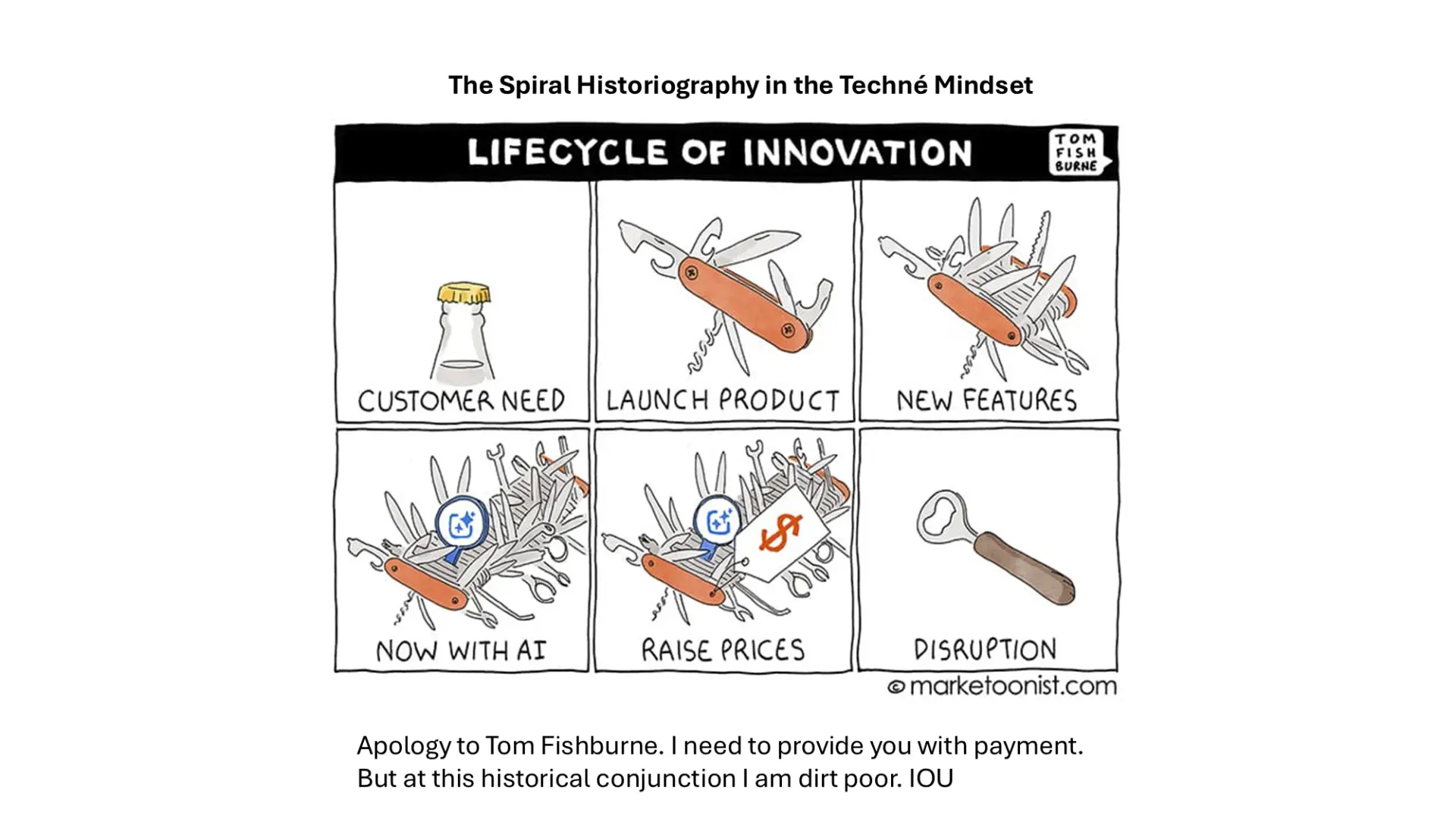
At the bottom of the spectrum lies Dogmatic Fixity, characterized by an unyielding, instrumental mindset (Buch 2025b, pp. 1–2). In education and society, this manifests as the “techné mindset”—an obsession with immediate utility, standardized testing, and “Job-Ready” compliance (Buch 2025b, p. 1; Buch 2026b, p. 18). Cognitive agents at this level treat established knowledge as fixed, fear intellectual friction, and delegate critical judgment to automated administrative or market algorithms (Stiegler 2025 cited in Buch 2026c, p. 3; Luchel 2026, p. 10). It is marked by “Historical Forgetfulness,” wherein the individual passively repeats unexamined cultural myths (Buch 2026b, p. 15).
2. Level 2: Defensive / Buffered Equilibrium
Recognizing that absolute openness is neither psychologically possible nor biologically desirable, Level 2 represents situational closure (Adler 2017, pp. 146–147; Runstrom 2015, pp. 25–27). As Josh Adler notes, cognitive closure often operates as an adaptive self-regulatory mechanism: under conditions of intense ambient noise, physical threat, time pressure, or emotional trauma, the mind temporarily constricts its boundaries to maintain internal equilibrium (Adler 2017, p. 146). An honest model does not demonize this state as a moral failure; rather, it identifies it as a functional protective shield that must be consciously acknowledged and dismantled once safety is restored (Adler 2017, p. 146; Awan n.d., p. 2).
3. Level 3: Deliberative and Communicative Openness
Moving toward active intellectual agency, Level 3 embodies reflective fallibilism and communicative rationality (Habermas 1979 cited in Buch 2025b, p. 3; Buch 2026c, p. 2). Here, the individual recognizes that personal beliefs are subject to error and actively seeks out counter-evidence, peer dialogue, and methodological critique (Buch 2026c, p. 2). It incorporates Neil Postman’s practice of “crap detecting”—the systematic filtering of institutional propaganda, corporate marketing, and manufactured political myths (Buch 2026c, p. 2). The mind at this level shifts other people from “judges” into “allies in inquiry” (Dweck 2015 cited in Awan n.d., p. 2).
4. Level 4: Generative and Phenomenological Openness (The Dynamic of Cognition)
At the highest stage of the spectrum is Generative Openness, an expansive, ontological orientation toward reality articulated across quantum biology, semiotics, and continental philosophy (Adler 2017, pp. 126–134; Buch 2025a, pp. 1–6). Drawing on Umberto Eco’s (1989) The Open Work, openness is defined as a conscious organization that “locates the infinite at the very core of the finite” and invites humanity to perceive the world as an unfolding field of possibilities (Eco 1989 cited in Adler 2017, p. 131).
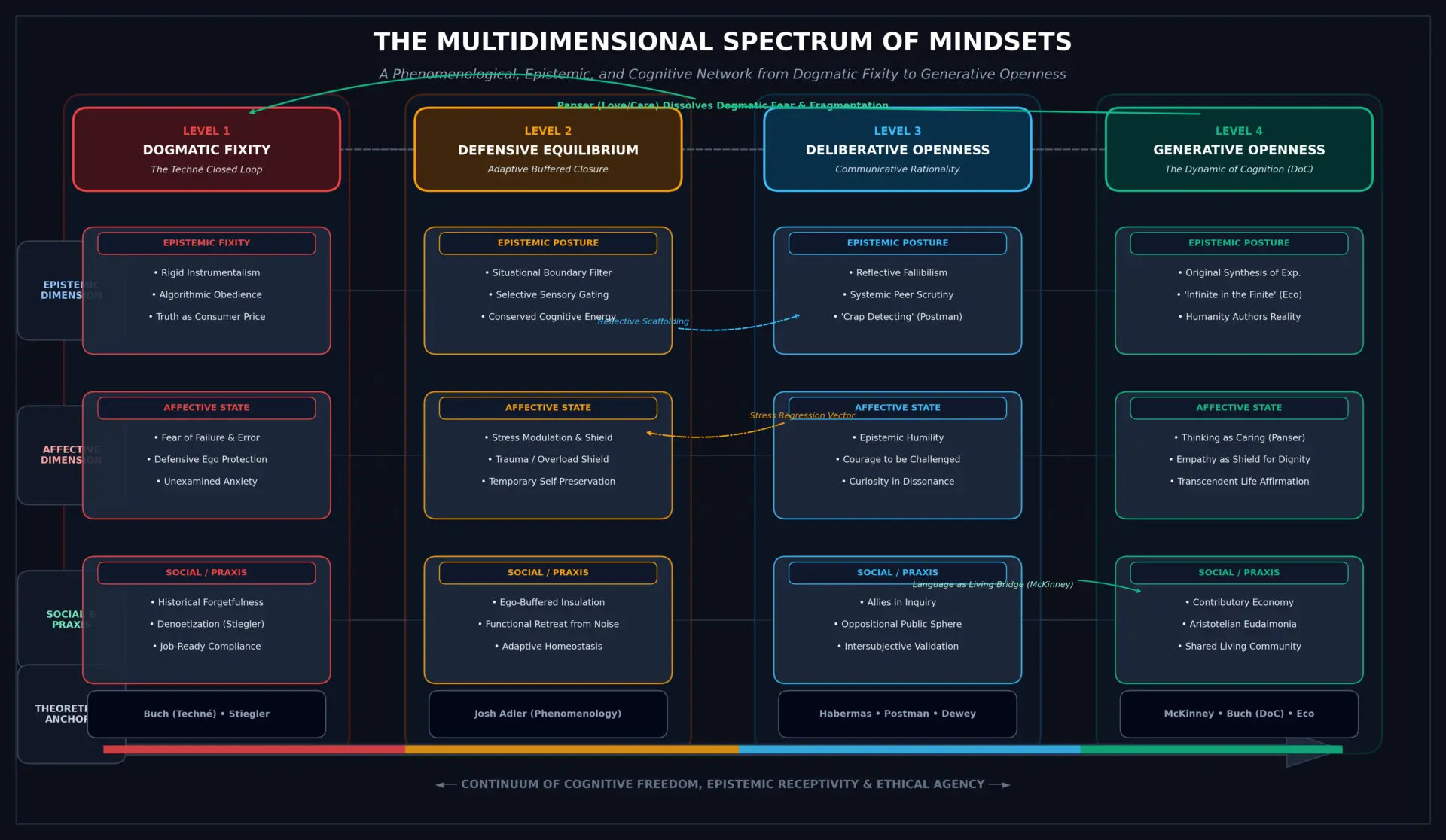
In Dr. Neville Buch’s Dynamic of Cognition (DoC) model, this level operationalizes the Five Intentions of Being:
- Self: Reclaiming agency as the conscious, proactive author of one’s narrative rather than a passive node of technocratic systems (Buch 2026b, p. 17).
- Mind: Exercising the faculty of judgment to heal intellectual wounds and correct automated denoetization (Buch 2026b, p. 17).
- Reason: Functioning as a “cognitive regulator” ensuring that scientific and computational tools remain subservient to ethical human ends (Buch 2026b, p. 17).
- Utility: Reorienting action away from pecuniary extraction toward meaningful contribution within a Contributory Economy (Buch 2026b, p. 18).
- Love ( Panser ): Embracing Bernard Stiegler’s imperative of “thinking as caring” ( panser )—an ethical shield of empathy that protects human vulnerability from cold, abstract algorithmic calculation (Buch 2026b, pp. 18–19; Buch 2026c, p. 3).
Crucially, Generative Openness incorporates Jack McKinney’s “Original Synthesis of Experience”: the recognition that objective reality is not a solitary Cartesian acquisition, but an “interpersonal thing” synthesized through the living bridge of language and community history (McKinney 1971, p. 280; Buch 2026b, pp. 12, 19).
5. Why This Nuanced Messaging of Mindsets Is Important
Replacing the simplistic “growth vs. fixed” binary with a multidimensional spectrum of cognitive openness is of paramount importance for three overarching reasons:
- Dismantling Neoliberal Pedagogical Gaslighting: Moving beyond individualistic growth-mindset rhetoric prevents educational authorities from using psychological jargon to conceal the gutting of public education (Buch 2025b, pp. 1–3). When mindset is understood within its sociological context, society recognizes that cultivating intellectual curiosity requires material investment: well-funded libraries, small class sizes, humanities research, and relief from the punitive pressures of “Job-Ready” market metrics (Buch 2025b, pp. 2–4; Buch 2025c, pp. 4–5).
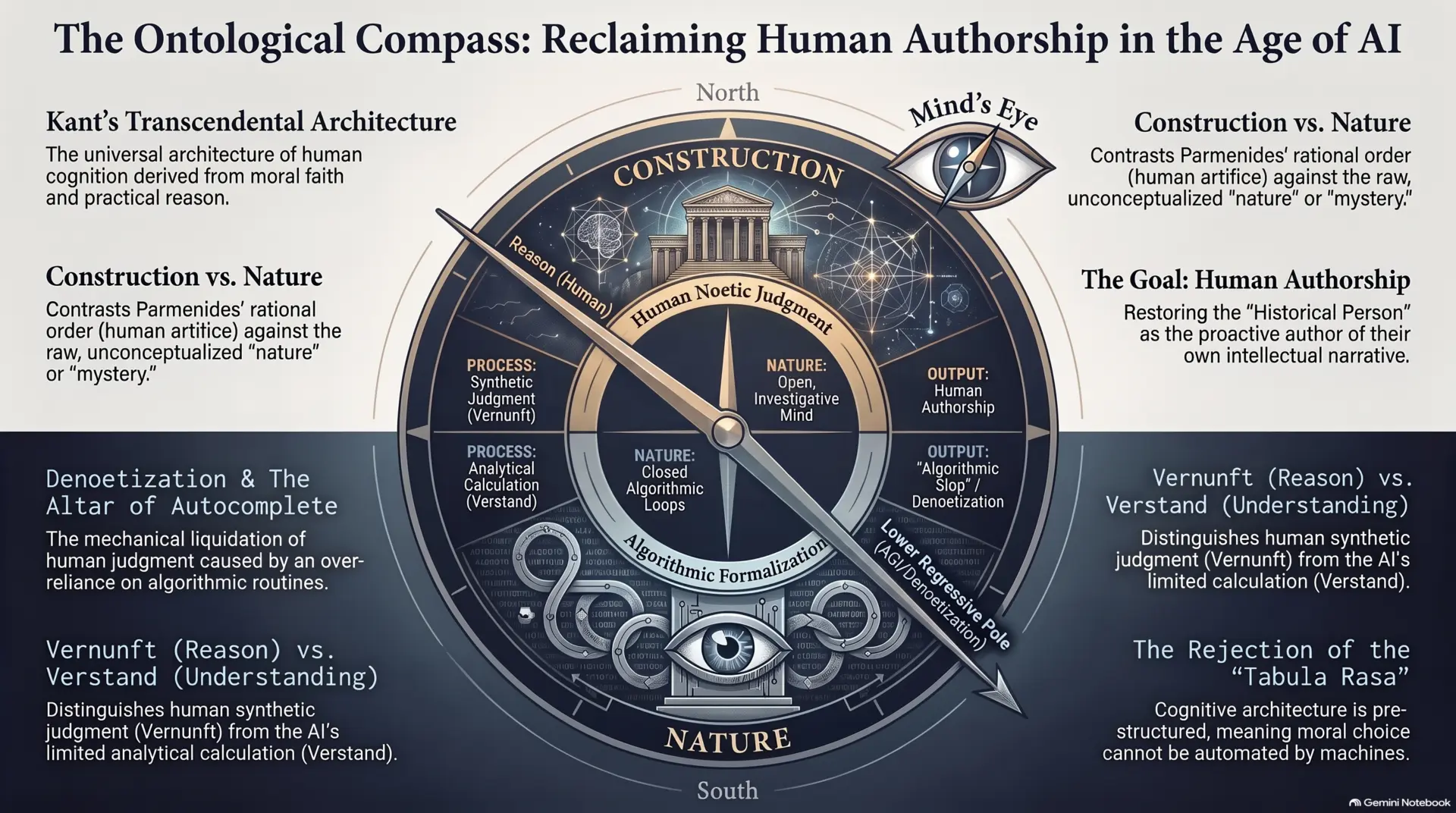
- Reclaiming Human Authorship in the Age of Artificial Intelligence: As automated generative models and commercial algorithms increasingly mediate text, thought, and communication, the threat of “denoetization” becomes acute (Buch 2026d, p. 2; Stiegler 2025 cited in Luchel 2026, p. 21). An honest spectrum of openness emphasizes that human beings are the active “authors of reality” (Buch 2026b, p. 7). Genuine openness is not passive submission to algorithmic autocomplete, but the cultivation of deep reading, critical historical literacy, and ethical reflection (Buch 2026d, p. 2; Adler 2017, p. 146).
- Revitalizing Oppositional Democratic Public Spheres: Democracy cannot function when citizens are trapped in the Dogmatic Fixity of populist folklore or the specialized technocratic ignorance of corporate management (Buch 2026b, p. 16; Luchel 2026, p. 18). An honest messaging of mindsets empowers schools, universities, and community learning spaces to function as oppositional democratic public spheres (ANZHES 2026, p. 2; Giroux 1988 cited in Buch 2026a, p. 7). By cultivating communicative rationality and panser, citizens develop the civic courage needed to interrogate entrenched power, engage in unforced consensus, and pursue Aristotelian human flourishing (eudaimonia) (ANZHES 2026, p. 2; Buch 2026b, p. 20).
6. Conclusion
The popular dichotomy of open and fixed mindsets, while offering useful insights into personal motivation, becomes an instrument of obfuscation when stripped of philosophical rigour and political-economic awareness (Burgoyne, Hambrick and Macnamara 2020, p. 258; Buch 2025b, pp. 1–3). As demonstrated by the analytical collapse of Bevin Luchel’s deregulatory market epistemology, attempting to evaluate intellectual life strictly through commercial exchange results in category errors and performative contradictions (Luchel 2026, pp. 3–17).
A truly honest paradigm locates cognitive openness along an experiential spectrum—spanning from defensive equilibrium under stress to the generative, communicative synthesis of the Dynamic of Cognition (Adler 2017, pp. 126–138; Buch 2025a, pp. 1–6). By understanding that knowledge is an interpersonal achievement co-authored across generations, educators and citizens can reject technocratic reductionism, reclaim their critical agency, and ensure that the life of the mind remains dedicated to collective democratic flourishing.
Bibliography
Adler, J. (2017) ‘The Open Mind: A Phenomenology’, Open Journal of Philosophy, 7(2), pp. 126–167. doi: 10.4236/ojpp.2017.72009.
ANZHES (2026) Abstract: The Place of Judith Wright in Queensland Education 1960s-1970s: Causes for Democracy. 2026 ANZHES Conference Abstract, pp. 1–2.
Awan, S. (n.d.) Growth Mind vs Fixed Mind Set: What Really Matters for Success? Research paper manuscript, pp. 1–4.
Benkler, Y. (2006) The Wealth of Networks: How Social Production Transforms Markets and Freedom. New Haven: Yale University Press.
Bruce, S. (2002) Choice and Religion: A Critique of Rational Choice Theory. Oxford: Oxford University Press.
Buchanan, J. M. and Tullock, G. (1962) The Calculus of Consent: Logical Foundations of Constitutional Democracy. Ann Arbor: University of Michigan Press.
Buch, N. (2025a) The Dynamic of Cognition: A Methodological Tool. Brisbane: Management Institute for Contributory Economy, pp. 1–8.
Buch, N. (2025b) The Critique of The Purposeful Decline of Education. Queensland Education Project, Dr Neville Buch, 5 December 2025, pp. 1–8.
Buch, N. (2025c) The Value and Limits of University Education. Queensland Education Project, Dr Neville Buch, 7 December 2025, pp. 1–7.
Buch, N. (2026a) Bibliography on Open and Fix Mindsets. Working bibliography, Dr Neville Buch, pp. 1–4.
Buch, N. (2026b) The Landscape Intellectual History of Jack McKinney and Judith Wright: Thinking Deeper. Dr Neville Buch, 2 July 2026, pp. 1–24.
Buch, N. (2026c) What is Sociology of Education? Dr Neville Buch, 13 May 2026, pp. 1–7.
Buch, N. (2026d) The Epistemic Corrosion of Deregulation: A Foundherentist Subversion of Bevin Luchel’s Neoliberal Epistemology. Brisbane: Management Institute for Contributory Economy, pp. 1–11.
Buch, N. (2026e) Steve Bruce on Rational Choice Theory. Brisbane: Dr Neville Buch Blog, pp. 1–4.
Burgoyne, A. P., Hambrick, D. Z. and Macnamara, B. N. (2020) ‘How Firm Are the Foundations of Mind-Set Theory? The Claims Appear Stronger Than the Evidence’, Psychological Science, 31(3), pp. 258–267.
Dewey, J. (1916) Democracy and Education: An Introduction to the Philosophy of Education. New York: Macmillan.
Dweck, C. S. (2015) Mindset: The New Psychology of Success. Updated edn. New York: Ballantine Books.
Eco, U. (1989) The Open Work. Translated by A. Cancogni. Cambridge, MA: Harvard University Press.
Freire, P. (1970) Pedagogy of the Oppressed. New York: Seabury Press.
Giroux, H. A. (1988) Schooling and the Struggle for Public Life: Critical Pedagogy in the Modern Age. Minneapolis: University of Minnesota Press.
Haack, S. (1993) Evidence and Inquiry: Towards Reconstruction in Epistemology. Oxford: Blackwell.
Habermas, J. (1979) Communication and the Evolution of Society. Translated by T. McCarthy. Boston: Beacon Press.
Luchel, B. (2026) A Reply to The Epistemic Corrosion of Deregulation. Monograph, 12 October 2026, pp. 1–32.
McCrae, R. R. (1996) ‘Social Consequences of Experiential Openness’, Psychological Bulletin, 120(3), pp. 323–337.
McKinney, J. P. (1971) The Structure of Modern Thought. London: Chatto & Windus.
Noddings, N. (1984) Caring: A Feminine Approach to Ethics and Moral Education. Berkeley: University of California Press.
Popper, K. R. (1945) The Open Society and Its Enemies. London: Routledge & Kegan Paul.
Rokeach, M. (1960) The Open and Closed Mind: Investigations into the Nature of Belief Systems and Personality Systems. New York: Basic Books.
Stiegler, B. (2014) Symbolic Misery, Volume 1: The Hyperindustrial Epoch. Translated by D. Ross. Cambridge: Polity.
Stiegler, B. (2025) The Immense Regression: What is Called Caring? Volume 1. Translated by D. Ross. Berlin: K. Verlag.
Zhang, J., Kuusisto, E. and Tirri, K. (2017) ‘How Teachers’ and Students’ Mindsets in Learning Have Been Studied: Research Findings on Mindset and Academic Achievement’, Psychology, 8(9), pp. 1363–1377.
Take the MICE Quiz
[1] Artificial Intelligence (A.I.) has been fairly used in the production of this work. The tool used is Google NotebookLM (recently rebranded as Gemini Notebook). It is an AI-powered virtual research assistant and thinking partner designed to help a person interact deeply with their own documents. Unlike general chatbots, it is source-grounded, meaning it only generates answers based on the specific PDFs, documents, or links uploaded. The A.I. process in the production of this work has been limited to the attached (prompts) on each of the questions in turn. This ensures an accurate reading of each source. The author then rearranged and re-edited the answers the A.I. provided. The human author publishes this work. A.I. is never an author when used properly. This assistance is not qualitatively different from a human research assistant when that assistance is deemed to have no authorial status but is acknowledged.


Neville Buch
Latest posts by Neville Buch (see all)
- A Critical Phenomenology and Epistemology of Open and Fixed Mindsets: Quantum Biology of the Open Mind – October 13, 2026
- The Spiral Historiography in the Techné Mindset – October 13, 2026
- The Personalist Approach to Argument: Dialectic, Relationality, and the Spiral of Human Authorship – October 12, 2026