
Dr Neville Buch and MICE[1]
Abstract
This essay explores the epistemological, ethical, and sociological implications of Dr. Neville Buch’s dictum: “I know many things, but thinking always makes it so.” Grounded in the moral philosophy of Hannah Arendt, the personalist care ethics of Louvain and Thomistic traditions, and Buch’s framework of Spiral Historiography, this study demonstrates that accumulating factual information (“knowing”) is fundamentally distinct from the active, reflective process of meaning-making (“thinking”). First, the essay analyses the societal error of evaluating human worth and intelligence through narrow, instrumental criteria of “knowing,” showing how this leads to “potted thinking,” specialized arrogance, and the erasure of individual dignity. Second, it refutes the anti-social stance—wherein individuals deflect ethical accountability by retreating into solipsistic skepticism, cynical non-engagement, or relativism—proving that personal knowledge is irreducibly social and bound to human plurality. Third, the paper examines the French idiom avoir une pensée pour (“to have a thought for someone”), demonstrating how directing thought toward another transforms abstract cognition into panser—a therapeutic synthesis of thinking (penser) and caring (panser) that grounds human dignity in relational vulnerability (esprit incarné). Finally, the essay articulates why this message is essential in an age of automated “denoetization,” offering the intellectual scaffolding needed to reclaim active human authorship and guide society toward genuine Aristotelian flourishing (eudaimonia).
Introduction: The Epistemological Chasm Between Knowing and Thinking
In contemporary technocratic culture, human intelligence is routinely conflated with the rapid accumulation, storage, and processing of factual data (Arendt 1977, p. 13; Buch 2026a, p. 9)[1]. Yet, as Dr. Neville Buch concisely encapsulates in his statement—”I know many things, but thinking always makes it so”—there exists a profound, irreducible chasm between the passive possession of information (knowing) and the active, transformative operation of reflective judgment (thinking) (Buch 2025b, p. 8; Buch 2026a, p. 111)[4][5].
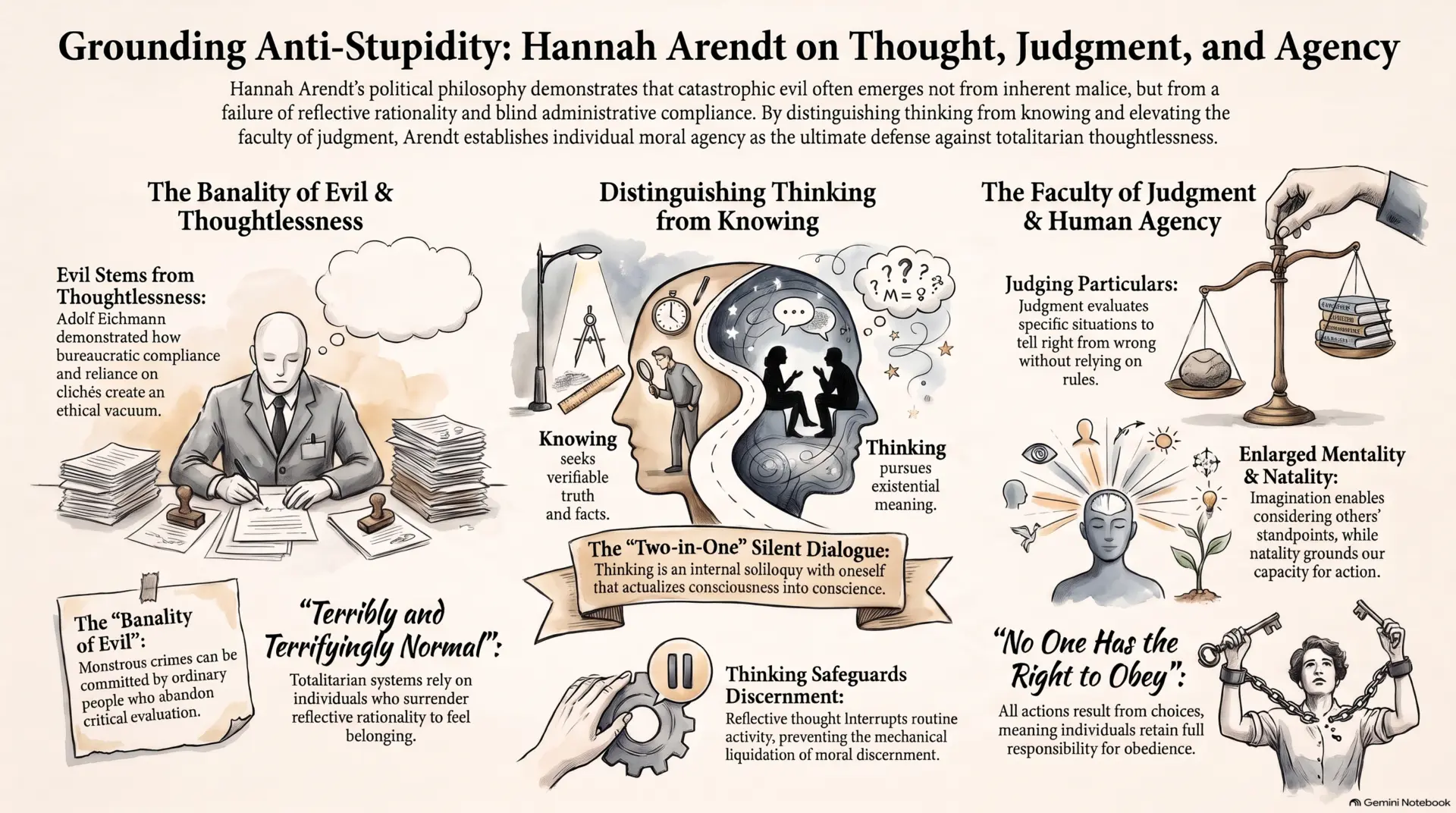
This distinction traces its lineage to Immanuel Kant and Hannah Arendt, who drew a sharp line between Knowing ( Verstand / Intellect) and Thinking ( Vernunft / Reason) (Arendt 1977, p. 15; Buch 2026c, p. 1)[2][6]. While knowing seeks verifiable facts, cognitive certainty, and technical utility, thinking is an endless, non-utilitarian quest for meaning—an internal, soundless dialogue between “me and myself” (the two-in-one) that actualizes conscience and evaluates the significance of our existence (Arendt 1977, pp. 15, 193; Buch 2026c, p. 2)[2]. Factual data alone remains inert and decontextualized until the thinking ego intervenes to “make it so”—sifting particulars, assessing moral weight, and reifying abstract impressions into meaningful human reality (Casey 1976, p. 111; Buch 2026a, p. 188)[8][9].
1. The Measurement Fallacy: Judging Others by Narrow Criteria of “Knowing”
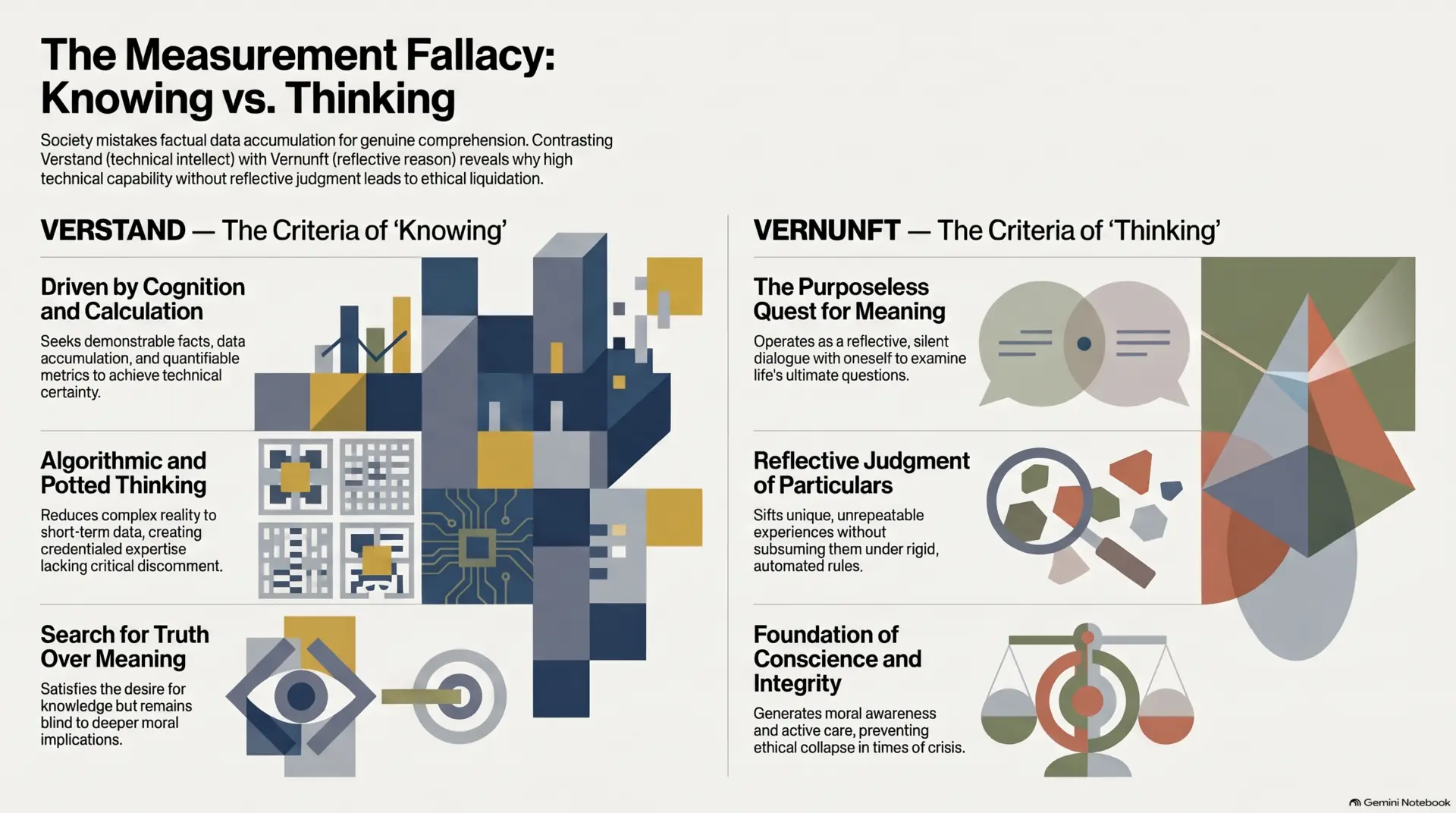
A central pathology of modern society is the tendency to evaluate individuals according to narrow, institutional criteria of “knowing”—such as formal academic credentials, specialized technical expertise, or performance metrics (Arendt 1977, p. 13; Buch 2026f, p. 12)[2][10]. Personalism and Spiral Historiography reveal that measuring human worth or capability solely through this lens is a critical error (Buch 2025e, p. 1; Vanlaere and Gastmans 2011, p. 165)[11][12].
I. The “Learned Idiot” and the Absence of Judgment
As Immanuel Kant observed, a person may undergo rigorous study and acquire vast erudition, becoming a recognized specialist, yet remain thoroughly deficient in the “gift” of judgment (Selbstdenken) (Kant 1781, cited in Arendt 1977, p. 216; Arendt 1977, p. 13)[1][2]. Judgment is the ability to apply general concepts to concrete, particular situations without falling back on mechanical rules (Arendt 1977, p. 256; Buch 2026c, p. 2)[6][13]. When society elevates mere “knowing” over judgment, it creates highly educated functionaries who excel at technical calculation (“reckoning with consequences”) but fail completely when confronted with ethical decisions or novel human crises (Arendt 1977, p. 7; Wikipedia 2026)[14][15].
II. Institutional “Potted Thinking” and Specialized Ignorance
Measuring people by their informational capital reinforces what Dr. Neville Buch identifies as “specialized ignorance” and “potted thinking” (Buch 2026a, p. 157; Buch 2026d, p. 12)[10]. Institutions routinely reduce complex human lives to administrative categories, case numbers, or market demographics (Pinder 2026, p. 3; Vanlaere and Gastmans 2011, p. 165)[18][19]. Individuals who do not possess institutional jargon or official credentials are dismissed as “ignorant,” while those who parrot corporate clichés are rewarded (Arendt 1963, p. 276; Buch 2026f, p. 12)[15].
This measurement fallacy ignores haecceity—the unique, irreducible “thisness” of individual human persons (Duns Scotus, cited in Buch 2025b, p. 4)[20][21]. Factual knowledge without reflective thought degenerates into “institutional bullshit” and manufactured myths, blinding society to the lived, contextual wisdom of concrete human subjects (Buch and Peach 2024, cited in Buch 2026a, p. 157)[17].
2. No One Is “Off the Hook”: Refuting the Anti-Social Deflection on “Knowing”
When confronted with the limits or ambiguities of human knowledge, individuals in society frequently attempt an anti-social deflection: retreating into radical solipsism, cynical non-engagement, or lazy relativism (“everyone has their own truth, so nothing matters”) (Buch 2024, p. 2; Buch 2026d, p. 7)[16]. Personalism and Arendtian philosophy demonstrate that no individual is “off the hook” through such manoeuvres (Arendt 1977, p. 200; Buch 2025e, p. 7)[26][27].
I. The Sensus Privatus vs. Sensus Communis
In her analysis of Kant’s political philosophy, Arendt contrasts sensus privatus (a private, self-absorbed logic or logical Eigensinn) with sensus communis (the community sense or shared human perspective) (Arendt 1977, pp. 263–268)[27]. Retreating into an anti-social stance regarding what can be known is a form of intellectual “insanity,” as it cuts the mind off from the shared world of appearances (sensus communis) that alone validates human experience (Arendt 1977, p. 263)[27].
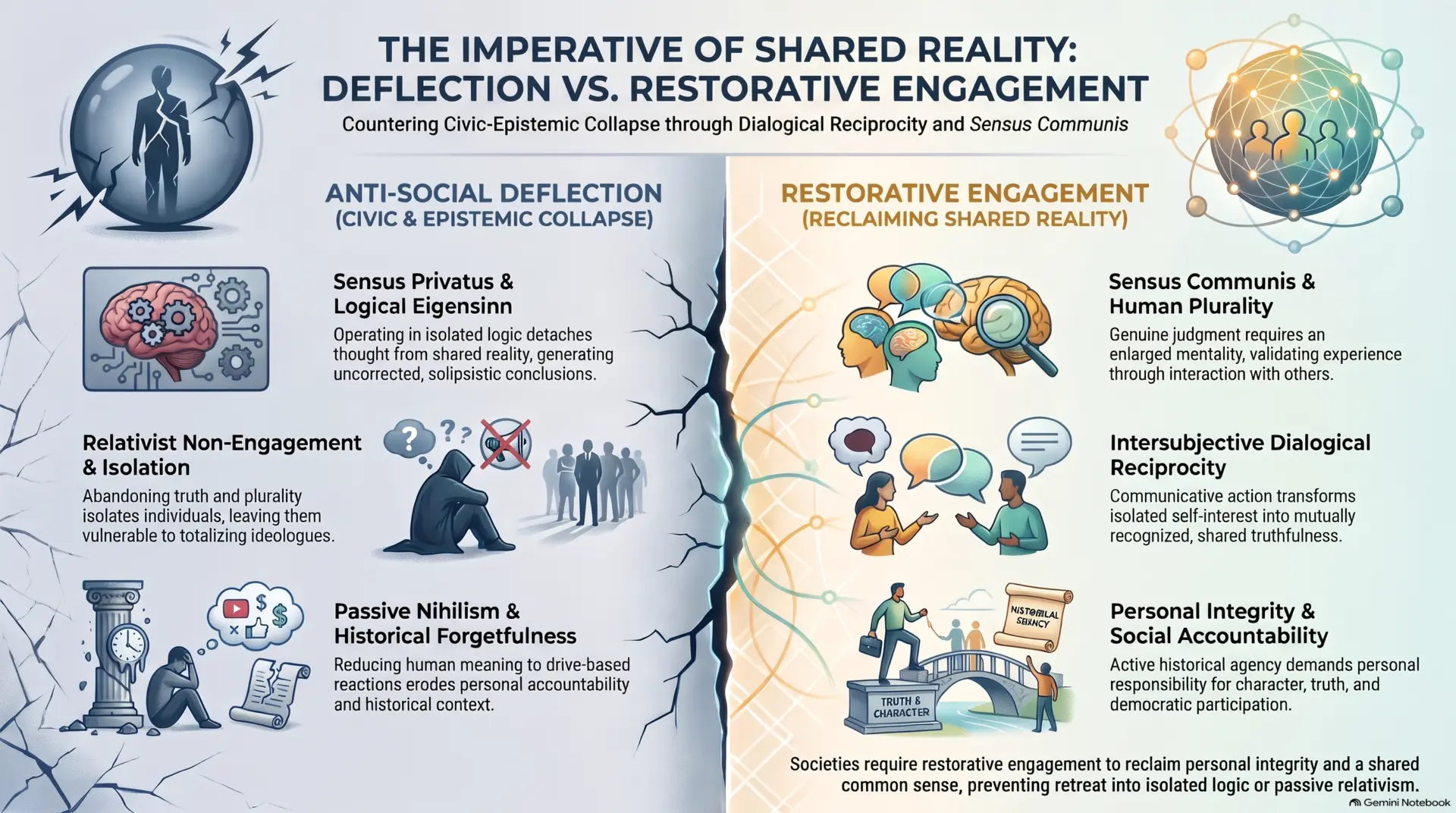
Knowledge is never an isolated, individual creation. As Thomistic and Louvain personalists emphasize, the human person develops a sense of “I” only in relation to a “Thou” (ohne Du ist das Ich unmöglich) (Jacobi 1785, cited in Buch 2026b, p. 2; McKenzie 2022, p. 4)[32][33]. Deflecting to an anti-social position attempts to deny this fundamental intersubjectivity, reducing speech to an idle monologue rather than a transformative, relational encounter (sermo) (Erasmus 1519, cited in Buch 2026a, p. 72; Vanlaere and Gastmans 2011, p. 165)[11].
II. Fallibilism and Metacognitive Accountability
Dr. Neville Buch’s Spiral Historiography insists on fallibilism and tertiary scoping (meta-judgment) as the antidotes to anti-social deflection (Buch 2025b, p. 3; Buch 2026d, p. 8)[4]. Citing Bernard Stiegler and Nel Noddings, Buch argues that epistemological ambiguity does not destroy the capacity to know or the obligation to be accountable (Buch 2024, p. 2; Buch 2025b, p. 3)[24].
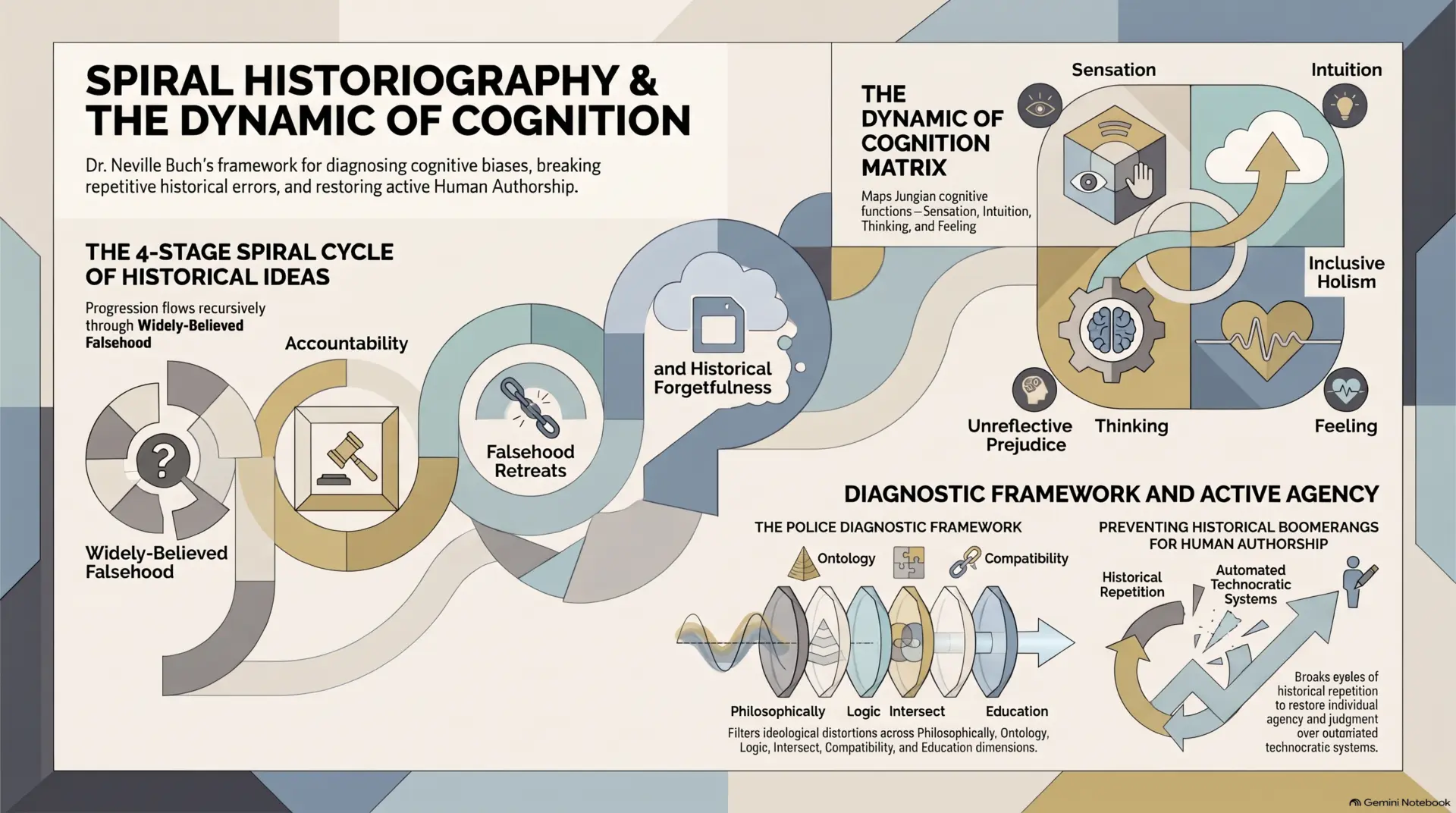
A person cannot claim that because ultimate truth is complex, they are relieved of the duty to exercise “crap detecting,” verify empirical evidence, or care about the consequences of their beliefs (Postman 1969, cited in Buch 2026f, p. 12; Buch 2026d, p. 8)[44]. To exist as a person in society means to be “context-embedded,” taking responsibility for one’s cognitive choices and participating in the public sphere through the POLICE framework (Philosophically, Ontology, Logic, Intersect, Compatibility, Education) (Buch and Peach 2024, cited in Buch 2026a, p. 157; Buch 2026d, p. 8)[17].
3. Avoir une pensée pour: How “Having a Thought for Someone” Transforms Thinking into Caring (Panser)
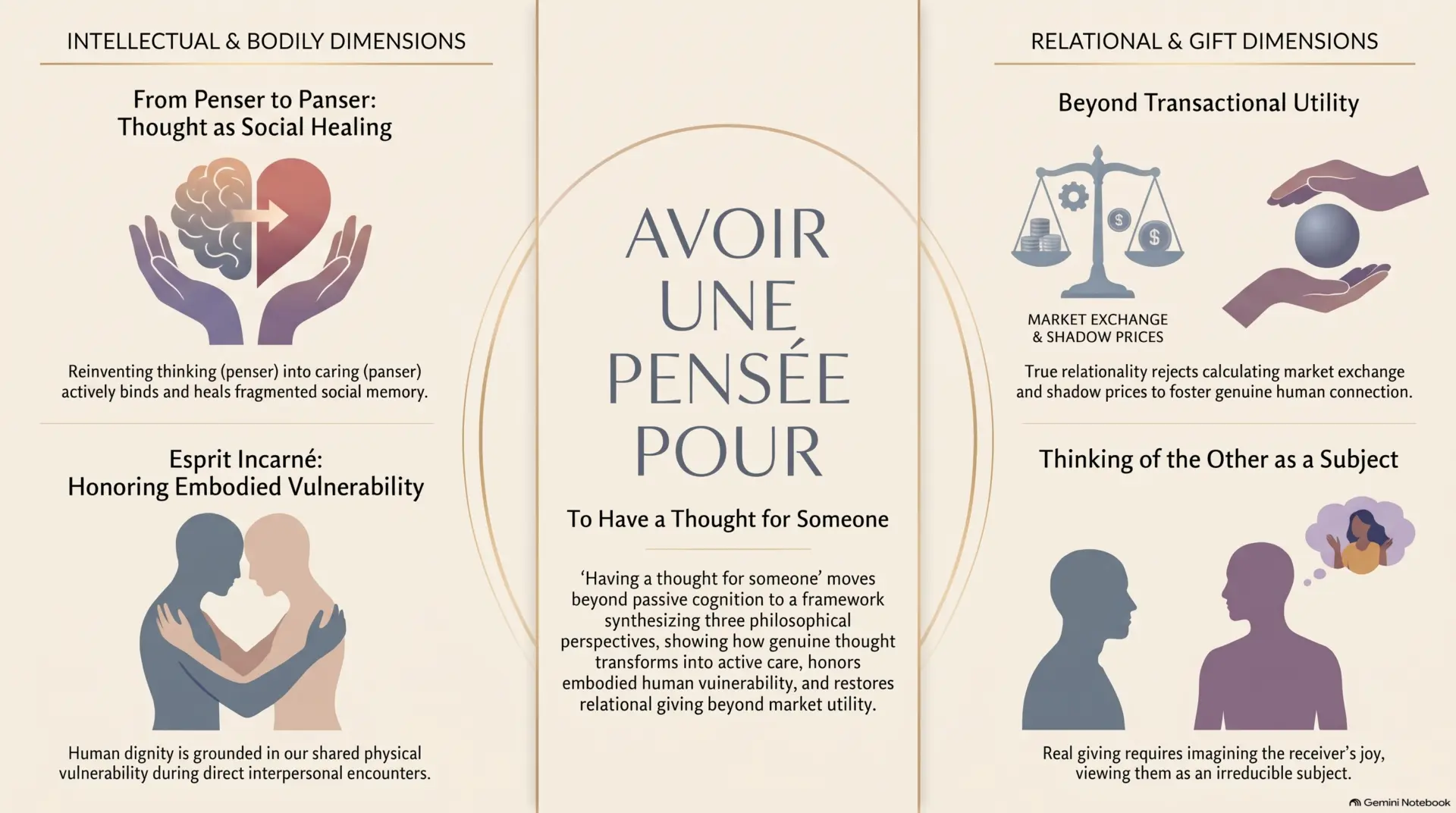
The shift from factual “knowing” to transformative “thinking” finds its most poignant linguistic and ethical expression in the French phrase “avoir une pensée pour…” (or avoir une pensée), which translates literally to “to have a thought for someone” (Stiegler 2025, cited in Buch 2026a, p. 10; Vanlaere and Gastmans 2011, p. 165)[3]. This phrase changes everything because it reveals that authentic thought is never an abstract, cold calculation; it is an act of directed relational care (Stiegler 2025, cited in Buch 2026a, p. 10; Hoevel 2008, p. 1)[3].
I. Bernard Stiegler’s Homophone: Penser as Panser
Drawing on Bernard Stiegler’s neganthropology, Buch highlights the profound play between the French verbs penser (to think) and panser (to dress a wound, to care for, to tend) (Stiegler 2025, cited in Buch 2026a, p. 10; Buch 2026b, p. 4)[3]. When an individual has “a thought for someone” (une pensée pour), thinking ceases to be an extractive, technical operation. It becomes the practice of the panseur —a thinker who acts as a healer of social memory and civic alienation (Stiegler 2025, cited in Buch 2026a, p. 10)[3].
Without this element of care (panser), what a person claims to “know” remains sterile and un-internalized (Buch 2025b, p. 3)[38]. As Nel Noddings established in her care ethics, “if you are not caring in the comprehension, you are not learning, and what you think you might know, you do not” (Noddings 1984, cited in Buch 2025b, p. 3)[38].
II. The Person as Esprit Incarné and the Logic of the Gift
In Louvain personalism, the human person is understood as an incarnate spirit ( esprit incarné ) whose dignity is revealed not through abstract intellect, but through embodied vulnerability and interpersonal contact (Janssens 1998, cited in Vanlaere and Gastmans 2011, p. 164; Selling 1998, p. 99)[52][53]. To “have a thought for someone” means recognizing the other as an equal subject rather than an object of utility or a consumer target (Hoevel 2008, p. 1; Vanlaere and Gastmans 2011, p. 165)[11][50].
This aligns with Theodor Adorno’s famous critique of gift-giving in Minima Moralia: genuine thought and giving require “choosing, expending time, going out of one’s way, thinking of the other as a subject: the opposite of distraction” (Adorno 1951, p. 42, cited in Hoevel 2008, p. 1)[50]. By introducing care into thought, avoir une pensée pour replaces the cold exchange world of do ut des (“I give so that you might give”) with the Goodwill Market—a network where people keep themselves available to support and heal one another regardless of transactional reward (Pinder 2026, p. 5; Hoevel 2008, p. 3)[50][54].
4. Why This Message Is Important: Reclaiming Human Authorship Against Denoetization
The message embedded in Buch’s quote—that thinking, cared-for and judged, is what makes reality meaningful—is an urgent civilizational imperative in the twenty-first century (Buch 2026a, p. 9; Corwin 2026, p. 12)[3][55].
I. Breaking the Algorithmic Iron Cage and Defeating “Denoetization”
Modern digital society is increasingly dominated by automated algorithms, hyper-industrialized attention extraction, and generative language models (Buch 2026a, p. 9; Corwin 2026, p. 12)[3][55]. When individuals delegate their cognitive synthesis, memory, and writing to automated systems, they succumb to denoetization—the mechanical liquidation of the capacity to reflect, evaluate, and care (Stiegler 2025, cited in Buch 2026a, p. 9; Corwin 2026, p. 12)[3][55].
People develop an “algorithmic character,” valuing only immediate speed, short-term metrics, and automated consensus, while blinding their inner “Mind’s Eye” (Corwin 2026, cited in Buch 2026a, p. 156)[17]. Buch’s message provides the essential intellectual resistance: it asserts that the human “who” must remain the proactive pilot of the technological “what,” ensuring that digital tools serve as prostheses for deep reflection rather than shortcuts that eliminate thought (Stiegler 1998, cited in Buch 2026a, p. 10; Buch 2026d, p. 8)[3].
II. Eradicating Historical Forgetfulness
Without reflective thought, societies suffer from Historical Forgetfulness—the active vice of allowing historical context and intellectual genealogies to be erased (Buch 2024, p. 2; Buch 2026a, p. 9)[3]. Deprived of temporal depth, public discourse collapses into superficial, polarized culture wars driven by rigid, manufactured binaries (Buch 2026a, p. 9)[3][17]. Reclaiming “thinking” through Spiral Historiography allows society to “uncoil” from repeated historical mistakes, retrieving foundational insights from past reforming movements and applying them with modern, inclusive understanding (Buch 2025c, p. 2; Buch 2026e, p. 1)[4].
III. Preserving Inviolable Dignity and Aristotelian Flourishing (Eudaimonia)
Ultimately, this message is vital because it restores Human Authorship—the conviction that human beings are the intentional, creative authors of their own lives, histories, and institutions (Buch 2026a, p. 10; Buch 2026d, p. 8)[22]. By grounding thought in the inviolable dignity of the human person (esprit incarné) and practicing panser (thinking as caring), society directs its collective energy away from technocratic “measurable utility” and toward genuine Aristotelian flourishing ( eudaimonia )—a life of virtue, wisdom, mutual care, and active democratic participation (Buch 2025a, p. 8; Buch 2026a, p. 10; Vanlaere and Gastmans 2011, p. 165)[56].
Conclusion: “Thinking Always Makes It So”
Dr. Neville Buch’s declaration—”I know many things, but thinking always makes it so”—serves as a timeless manifesto for intellectual integrity and human dignity (Buch 2025b, p. 8; Buch 2026a, p. 111)[4][5]. Factual knowledge (“knowing”) provides the raw material of our world, but it is reflective, care-filled thought (“thinking”) that breathes meaning, moral weight, and relational truth into existence (Arendt 1977, p. 15; Stiegler 2025, cited in Buch 2026a, p. 10)[2][3]. By rejecting the fallacy of measuring others by narrow informational criteria, refusing the escape of anti-social indifference, adopting the stance of the panseur (avoir une pensée pour), and asserting our active authorship, we ensure that human consciousness remains the guiding light of our shared historical journey (Buch 2026a, p. 10; Buch 2026d, p. 8)[56].
References / Bibliography
Adorno, T., 1951. Minima Moralia: Reflections on Damaged Life. Translated by E.F.N. Jephcott, 1974. London: New Left Books. Cited in C. Hoevel, 2008. ‘Gift and Market Relations: A Personalist Approach’, Journal of Markets & Morality, 11(2), p. 1.
Arendt, H., 1963. Eichmann in Jerusalem: A Report on the Banality of Evil. New York: Viking Press.
Arendt, H., 1977. The Life of the Mind (Two Volumes: Thinking and Willing). Edited by M. McCarthy. New York: Harcourt Brace Jovanovich.
Buch, N., 2024. Spiral Historiography. Brisbane: Dr Neville Buch Blog / SOFiA.
Buch, N., 2025a. 01. Personal History Workshop: What is Personal History. Brisbane: Dr Neville Buch and Sam Fiaalii.
Buch, N., 2025b. Spiral Historiography. Socio-Historical Change in Unitarian Universalism. Brisbane: Management Institute for Contributory Economy (MICE).
Buch, N., 2025c. Concept-Practice X.5. Spiral Historiography. Brisbane: Management Institute for Contributory Economy (MICE).
Buch, N., 2025d. Personal Intellectual History of Queensland (Chapter 4). Brisbane: Dr Neville Buch.
Buch, N., 2025e. The Worldview of Personalism: How We Got to the Misunderstanding of ‘Persons’. Brisbane: Management Institute for Contributory Economy (MICE).
Buch, N., 2026a. The Crucible of Consciousness: Historiography and the Genesis of Reforming Thought. Brisbane: Neville Buch and Management Institute for Contributory Economy (MICE).
Buch, N., 2026b. Notes on Bengtsson. Personal Unity-in-Diversity. Brisbane: Dr Neville Buch.
Buch, N., 2026c. Hannah Arendt: Intelligence and Ethics Part 1. Brisbane: Dr Neville Buch.
Buch, N., 2026d. Pathways on the Spiral Historiography. Brisbane: Dr Neville Buch.
Buch, N., 2026e. Research Note: Conflict in Spiral Historiography. Brisbane: Dr Neville Buch.
Buch, N., 2026f. Spiral Historiography and the Pedagogy of Consciousness in Australia. Brisbane: MICE.
Buch, N. and Peach, N., 2024. Philosophically Ontology Logic Intersect Compatibility Education (POLICE). Brisbane: Dr Neville Buch ABN: 86703686642.
Casey, E.S., 1976. ‘Comparative Phenomenology of Mental Activity’, The Philosophical Forum, 8(1), pp. 106–126.
Corwin, S.L., 2026. The Hall of Mirrors: A Critique of Neville Buch’s Contributory Economy. Seattle: Sardonic Review Press.
Erasmus, D., 1519. Novum Testamentum Omne. Basel: Johann Froben. Cited in N. Buch, 2026a. The Crucible of Consciousness, p. 72.
Hoevel, C., 2008. ‘Gift and Market Relations: A Personalist Approach’, Journal of Markets & Morality, 11(2), pp. 1–20.
Jacobi, F.H., 1785. Über die Lehre des Spinoza in Briefen an den Herrn Moses Mendelssohn. Breslau: Gottl. Löwe. Cited in N. Buch, 2026b. Notes on Bengtsson, p. 2.
Janssens, L., 1998. ‘Personalism and Care’. In: L. Vanlaere and C. Gastmans, 2011. ‘A Personalist Approach to Care Ethics’, Nursing Ethics, 18(2), pp. 164–166.
Kant, I., 1781. Kritik der reinen Vernunft (Critique of Pure Reason). Riga: Johann Friedrich Hartknoch.
McKenzie, G., 2022. ‘A Thomistic Personalist Approach to Social Structure’, American Maritain Association Annual Meeting, pp. 1–16.
Noddings, N., 1984. Caring: A Feminine Approach to Ethics and Moral Education. Berkeley: University of California Press. Cited in N. Buch, 2025b, p. 3.
Pinder, D., 2026. ‘In a World Run by Function Systems’, Aargh! Substack Publication, pp. 1–6.
Postman, N. and Weingartner, C., 1969. Teaching as a Subversive Activity (Chapter 1: ‘Crap Detecting’). New York: Delacorte Press.
Selling, J., 1998. ‘The Human Person’. In: B. Hoose, ed. Christian Ethics: An Introduction. London: Cassell, pp. 95–109.
Stiegler, B., 1998. Technics and Time, 1: The Fault of Epimetheus. Stanford: Stanford University Press.
Stiegler, B., 2025. The Immense Regression: What is Called Caring? (Vol. 1). Berlin: K. Verlag.
Vanlaere, L. and Gastmans, C., 2011. ‘A Personalist Approach to Care Ethics’, Nursing Ethics, 18(2), pp. 161–173.
Wikipedia, 2026. Hannah Arendt. Wikimedia Foundation.
Take the MICE Quiz
[1] Artificial Intelligence (A.I.) has been fairly used in the production of this work. The tool used is Google NotebookLM (recently rebranded as Gemini Notebook). It is an AI-powered virtual research assistant and thinking partner designed to help a person interact deeply with their own documents. Unlike general chatbots, it is source-grounded, meaning it only generates answers based on the specific PDFs, documents, or links uploaded. The A.I. process in the production of this work has been limited to the attached (prompts) on each of the questions in turn. This ensures an accurate reading of each source. The author then rearranged and re-edited the answers the A.I. provided. The human author publishes this work. A.I. is never an author when used properly. This assistance is not qualitatively different from a human research assistant when that assistance is deemed to have no authorial status but is acknowledged.


Neville Buch
Latest posts by Neville Buch (see all)
- The Unbound Mind: Macro-Governance Architecture & Lebensphilosophie (with Arif Jameel) – October 30, 2026
- Truth is Truth But Meaning is More Important – October 30, 2026
- Dr. Neville Buch and the Evolution of Australian Religion-Secular Historiography – October 29, 2026