
Dr Neville Buch
Abstract
The 1986 Pentecostal Gathering at the Christian Outreach Centre in Mansfield represents a definitive moment in the intersection of Queensland’s political and religious sub-cultures, marking the peak of an alliance between the Bjelke-Petersen administration and neo-Pentecostalism. This essay explores how the state’s political culture—defined by a “Deep North” ethos of development and rugged individualism—facilitated this alliance through a synthesis of evangelical pietism and prosperity theology. By tracing the development from the subsequent fallout of the Fitzgerald Inquiry to contemporary manifestations such as “ScoMo’s Pentecostalism,” the paper evaluates the possibility of spiritual reform through the theological concept of metanoia and the “discipline of hope”.
——————————————————————————–
The 1986 Pentecostal Gathering and Queensland Political Culture
The Queensland political culture has historically been compared to the American Deep South, characterized by a “Deep North” ethos that prioritizes rugged individualism and a business-oriented society. Under the long premiership of Joh Bjelke-Petersen (1968-1987), this culture was flavoured by militant conservative religious thought, specifically evangelical pietism and a congregationalist church polity. At the heart of this political sub-culture was the “doctrine of development,” which functioned as an article of faith among both politicians and many religious leaders who linked material prosperity with divine favour. This environment provided fertile ground for the 1986 Pentecostal Gathering, held on October 19 at the Christian Outreach Centre in suburban Mansfield.
The 1986 gathering served as a powerful catalyst for the National Party’s successful bid to retain power during the state election. Billed as a “Pray for Australia” rally, the event was strategically timed just before Bjelke-Petersen announced the election date. The impact was most evident in the targeting of marginal “Bible Belt” seats—Mt Gravatt, Greenslopes, and Mansfield—where candidates like Ian Henderson, Leisha Harvey, and Craig Sherrin campaigned on “righteousness” platforms and identified strongly with the neo-Pentecostal movement. Crucially, the gathering marked a shift from traditional Pentecostal quietism to overt political endorsement, as COC founder Clark Taylor explicitly recommended Bjelke-Petersen from the pulpit, framing the National Party’s focus on development as a form of “godly government”.
Development from 1986 to the Present and Beyond
The development of this religious-political alliance reached its messianic peak during the “Joh for PM” campaign of 1987, where Bjelke-Petersen was portrayed by supporters as a God-chosen instrument for national salvation. However, this “cosmic war” framing was challenged by critics like Sophia Corwin, who dismissed it as “provincial hysteria” used to mask “naked political corruption”. The subsequent Fitzgerald Inquiry (1987-1989) exposed a profound dissonance between Bjelke-Petersen’s personal piety and the systemic corruption of his administration, eventually leading to his deposition and the National Party’s defeat in 1989. In the post-1989 era, the influence of neo-pietism shifted but did not disappear; it morphed into “Protestant civic piety,” a form of civil religion that continues to value “deeds not creeds” and pragmatism over traditional Christian orthodoxy.
In contemporary times, this legacy is seen in “ScoMo’s Pentecostalism,” represented by Scott Morrison’s affiliation with the Horizon Church. Like the Bjelke-Petersen era, this contemporary system has been criticized for promoting a self-propagating culture war that downplays indigenous experiences and favours American-style prosperity models. Furthermore, the increasing formalization of online learning and machine-based education in 2026 presents new cognitive hazards, potentially creating “passive, dependent, filled minds” that are susceptible to the same “banking system” of knowledge that treated historical subjects as objects rather than critical investigators.
Can Queensland Pentecostals Repent and Reform?
The question of whether Queensland Pentecostals can reform their spirituality lies in the concept of metanoia—a fundamental shift in one’s relationship with the divine and a turning toward a life of commitment. Sources suggest that such a reform requires a “discipline of hope,” which acts as an indispensable precondition for both religious practice and secular politics, allowing individuals to live faith under conditions of doubt and uncertainty. For reform to be genuine, it must move beyond “theological capture”—where theology is used as a tool for political control—toward a “kenotic” (self-emptying) ethics of humility and solidarity.
Spiritual reform would also necessitate rejecting the “wooden epistemology” of the professional guild and the narrow focus on prosperity theology. Instead, it would embrace the “craftsmanship of the reflexive insider,” where lived experience and a “dialogue of myths” are used to achieve “planetary wisdom”. For Indigenous Pentecostals, this reform would involve moving past the “anti-culture” discourses that demand the rejection of their own heritage, seeking instead a vernacular reality that integrates Aboriginality with faith without surrender to white institutional control. Ultimately, the sources imply that while the “ Sunshine State” faith was often a ritual of power, a shift toward a “pedagogy of contingency” and critical inquiry could allow for a spirituality truly aligned with the liberating power of the Holy Spirit.
——————————————————————————–
Endnotes and References
- Serdyukov notes that contemporary online education is increasingly formalized and algorithmic.
- Bjelke-Petersen believed his election wins were “answers to prayer” and signs of divine favour.
- The 1986 gathering specifically targeted the seats of Mt Gravatt, Greenslopes, and Mansfield.
- Clark Taylor’s pulpit endorsement broke the tradition of Pentecostal detachment from politics.
- The “Bjelke-Petersen Paradox” refers to the gap between his personal piety and governmental corruption.
- Metanoia is defined as a fundamental shift and key part of the process of salvation.
- Prosperity theology in Queensland was influenced by American models such as Oral Roberts and Aimee Semple McPherson.
- The “discipline of hope” is used to bridge the gap between religious practice and secular politics.
- Sophia Corwin critiques the framing of Queensland history as a “cosmic war”.
- The Horizon Church heritage is linked to the 1956 Oral Roberts tour and the “prosperity gospel”.
——————————————————————————–
APA Bibliography
- Breeden, D., & Hooper, J. E. (2023). Resistance at the margins: Pentecostalism. UUA.
- Buch, N. (1995). American influence on the Queensland political culture (Doctoral thesis chapter 11). The University of Queensland.
- Buch, N. (2021). Politics, ScoMo’s Pentecostalism, and Indigenous philosophy. Management Institute for Contributory Economy.
- Buch, N. (2024). Queensland history, religious education, and belief. In D. W. Kim & D. Wright (Eds.), Socio-Anthropological Approaches to Religion: Environmental Hope. Lexington Books.
- Buch, N. (n.d.). 1986 Pentecostal gathering. Management Institute for Contributory Economy.
- Corwin, S. L. (2026). The altar of autocomplete and Buch’s synthetic historiography. Sardonic Review Press.
- Dayton, D. W. (1988). Pentecostal/charismatic renewal and social change: A Western perspective. Transformation, 1988, Vol. 5, No. 4 (1988), pp. 7-13
- Harrison, J. (2004). Joh Bjelke-Petersen: Pietism and the political culture of Queensland. The University of Queensland.
- Ono, A. (2012). You gotta throw away culture once you become Christian: How ‘culture’ is redefined among Aboriginal Pentecostal Christians in rural New South Wales. Oceania, 82(1), 74–85.
- Serdyukov, P. (2021). A growing formalization of contemporary online education. Academia Letters, Article 2601.
******
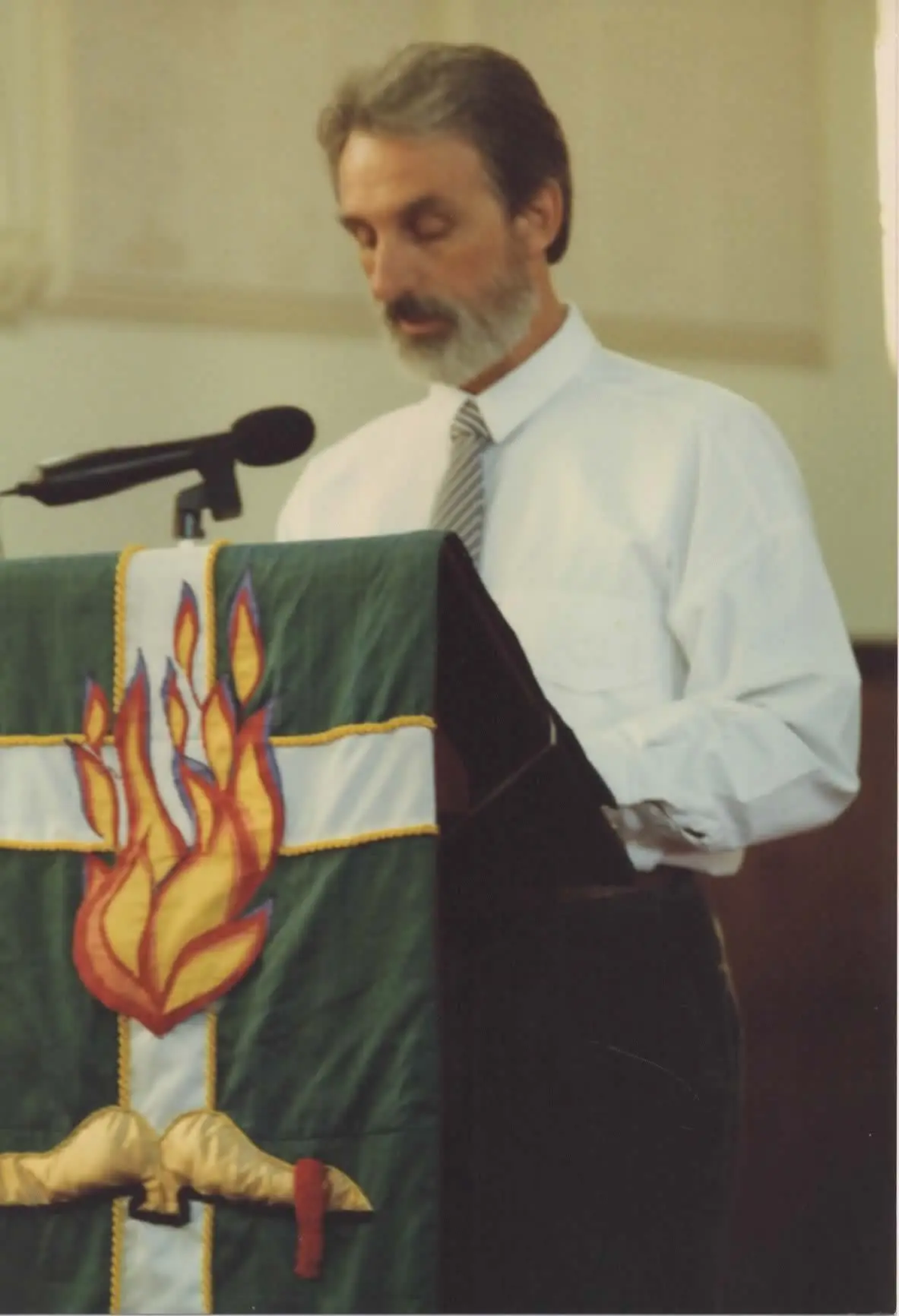
Featured Image: The Very Better Charismatic Leader and Facilitator – Charles Ringma


Neville Buch
Latest posts by Neville Buch (see all)
- Part 3:The Failure of an Educational Institution and How to Spiral Forward – October 10, 2026
- Part 2:The Failure of an Educational Institution and How to Spiral Forward – October 10, 2026
- Part 1:The Failure of an Educational Institution and How to Spiral Forward – October 10, 2026