
Professional Historian and History Consultancy Services Brisbane
Category: Concepts in UQ Philosophy and History
-

The Du Bois Doctrine: Global-Local, Local-Global
Among Du Bois’s key insights was the idea that “the domestic could never be divorced from the global,” Mampilly writes. In his view, “Washington’s quest for a liberal order could never be reconciled with a Jim Crow system at home”—and, conversely, “the success of democracy in the United States required that political and economic equality…
-

The Epistemic Abyss – Ignorance and the Quest for Dialogue: Modern History Curriculum for Queensland Education
Dr Neville Buch[1] The “How algorithms starve the human intellect” audio commentary on MICE’s Contributory Economy and Human Authorship: The “Stop walking backward into digital sewer grates” audio commentary for lessons in Modern History for Queensland Education: Abstract This essay investigates the phenomenon of “cognitive ignorance” and the systemic breakdown of deliberation in contemporary social…
-
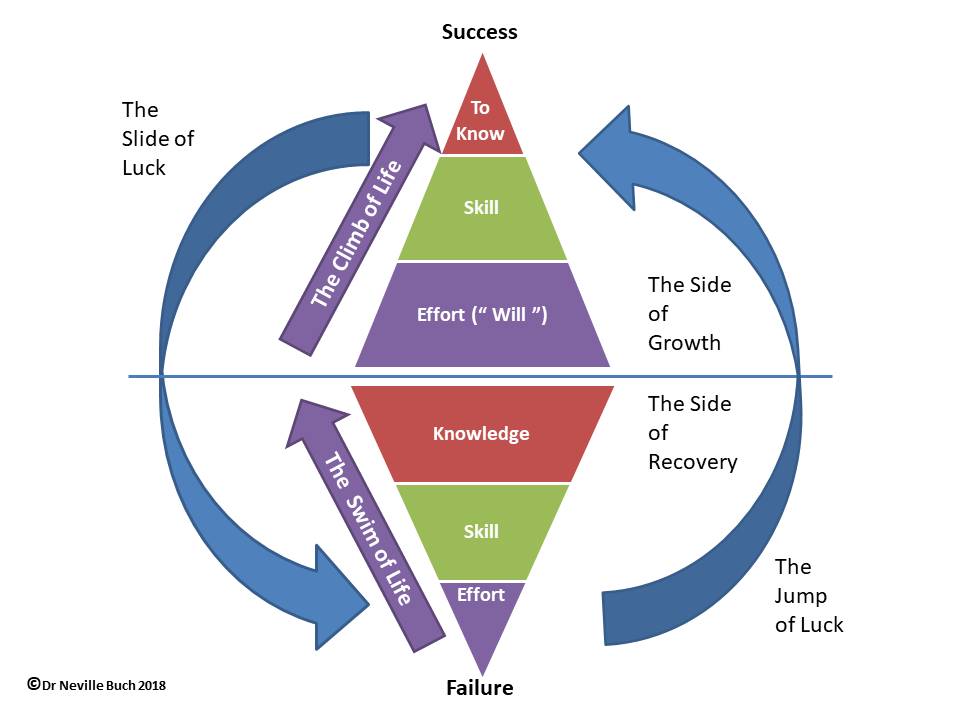
Aesthetic Legitimacy and the Dynamic of Cognition
Dr Neville Buch[1] The audio commentary on MICE’s Contributory Economy and Human Authorship: Abstract This essay evaluates the “Lifestyle State” thesis proposed by independent scholar Arif Jameel through the lens of Dr. Neville Buch’s “Dynamic of Cognition” (DoC) framework. Jameel’s thesis posits a structural succession of institutional and state legitimacy, arguing that the public evaluation…
-

The Technicisation of Thought and the Crisis of Comprehension
The audio commentary on MICE’s Contributory Economy and Human Authorship: Abstract This essay critiques the cognitive and economic pathologies of the digital public sphere, focusing on the content and conversational problems of dominant social media platforms such as Facebook. Utilizing Dr. Neville Buch’s frameworks of Sufficient Comprehension and the Dynamic of Cognition (DoC), we diagnose…
-
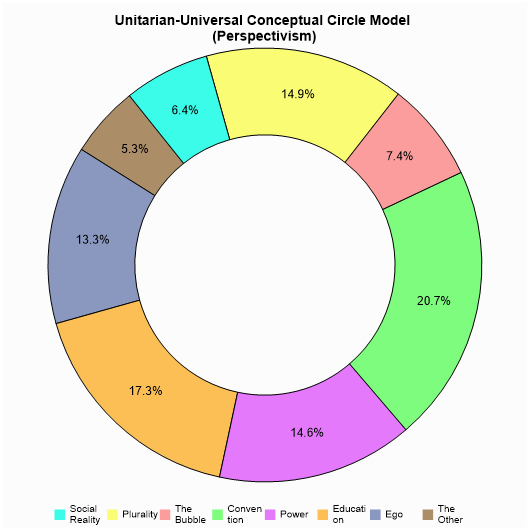
Understanding Local-Global Framing for Unitarian-Universalism (UU)
The audio commentary on MICE’s Contributory Economy and Human Authorship: Abstract This essay explores the intellectual development of Unitarian-Universalism (UU) through the cognitive triad of Unity, Universality, and Sufficient Comprehension. It frames this “cognitive ascent” as a critical countermeasure to contemporary pathologies of thought. By drawing on the Dynamic of Cognition (DoC) and Spiral Historiography,…
-
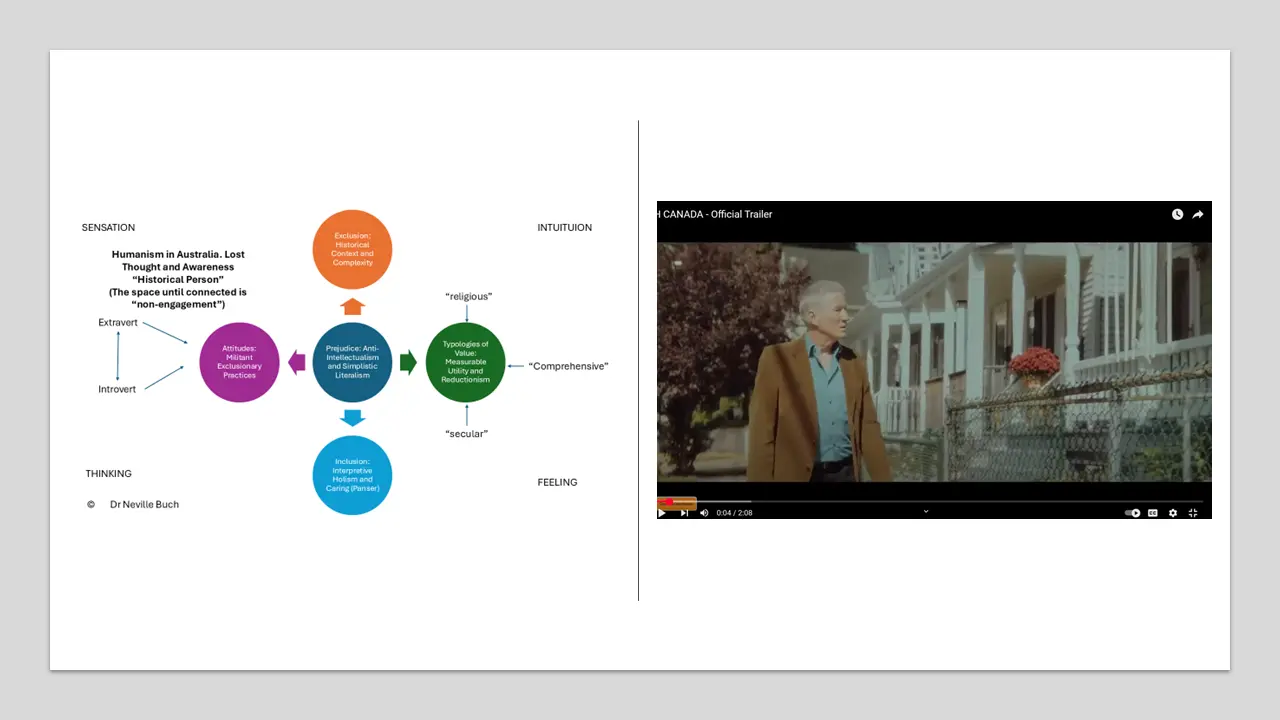
Bureaucratic Humanism in the Early Twentieth Century: Intellectual Failures and Corrective Philosophy
The audio commentary of Dr. Buch’s early 20th century intellectual history. Dr Neville Buch[1] Abstract This essay critiques the rise of bureaucratic humanism in the early twentieth century, a period marked by an intellectual regression where humanism was stripped of its reflective, interpretive depth and captured by elite academic structures and technical reductionism. Originating in…
-

The Hard Question of Generative A.I. Reclaiming Human Authorship in the Age of Generative A.I.
The audio commentary on the work of Dr. Neville Buch and other sociologists and philosophers. Dr Neville Buch[1] Abstract This essay explores the intersecting challenges of human agency, cognitive autonomy, and institutional control in the era of generative artificial intelligence (GenAI). Centred on the critical sociological synthesis of Roe and Perkins (2026), it examines the…
-

The Double Mandate: Faith and Citizenship in 2026
Abstract In the contemporary landscape of 2026, the intersection of civic duty and spiritual commitment is often obscured by “historical forgetfulness” and the “blunt categories” of the religious/secular binary. This essay evaluates Charles Ringma’s draft reflection, “Linkedin.scribblers.citizen.christian,” which argues for a “double mandate” where an individual is simultaneously a secular citizen and a religious participant…
-

Conservative Blindness
David A. Graham, A Stubbornly Naive Group of GOP Senators, The Atlantic, 19 August 2026. The conservative blindness is holding out when everyone else can see the terrible wrongness. A Stubbornly Naive Group of GOP Senators A small caucus of non-MAGA Republicans keeps falling for the president’s flimsy promises. By David A. Graham August 19,…
-

H-E-R-M-E-N-E-U-T-I-C-S. Rules of Hermeneutics. Understanding and Judging Context
Dr Neville Buch[1] Abstract The clash between the rules of hermeneutics and the unthinking rules of politics represents a fundamental struggle between the restoration of meaning and the mechanics of technical reductionism. Hermeneutics, derived from the Greek hermeneuein (“to interpret”) and linked to the messenger god Hermes, is the branch of knowledge dealing with the…