
Table of Contents
Sub Heading
Content Goes Here
Historiography in the Distant Past and the Philosophy of Today in
The University of Queensland 1911-2026
HAPI Past Series
Dr Neville Buch
Series Abstract: For the past few years, I have been researching and writing about the defuncted Department of History, University of Queensland, 1911-2000. It will take a few more years before a tome on the subject may be published. In the meantime, it has occurred to me to write up on the past academics of what is now called the school of “Historical and Philosophy Inquiry”. It is certainly appropriate for myself as my career at UQ began in this direction of interdisciplinary thought. The series publishes the articles in no particular order, and selection is based on the availability of materials. This is the closing of the series.
Abstract
In this series attention has been given to the historians at The University of Queensland after 1980: Kay Saunders, John Moses, Charles Ringma, Geoffrey Bolton, Raymond Evans, Joe Siracusa, and Martin Stuart-Fox. A few only had a tenuous link to the Department of History, but all are part of the legacy of the School of Historical and Philosophical Inquiry. One remaining total summary remains to close the series. This paper is the summary of the work.
——————————————————————————–
The Historiography in The University of Queensland 1911-2026. What happened?
The three documents provide a comprehensive analysis of the global influence, intellectual foundations, and audience demographics associated with the scholarship of Dr. Neville Buch and the Management Institute for Contributory Economy (MICE) in 2026.
Global Resonance: The 2026 Neville Buch Academic Impact Report
This report establishes that Dr. Buch’s work has achieved a top 0.1% rank on the Academia.edu platform, reflecting an extraordinary level of international reach. As of May 2026, the scholarship has amassed over 780,212 public views and maintains a core of nearly 10,000 committed readers. The report highlights that the audience is predominantly composed of “Highly Engaged” users who interact with the material multiple times, including academic faculty such as Soren Dosenrode and independent researchers like Gabor Kendey. Geographically, the impact spans 82 international locations, with major hubs identified in Canada, France, Brazil, Türkiye, and Lithuania. The report concludes that this resonance validates the MICE project’s success in creating an “intellectual immune system” on a planetary scale.
Bibliography of the Management Institute for Contributory Economy
The bibliography serves as the scholarly architecture for the MICE project, integrating diverse interdisciplinary sources into a coherent framework. It is organized to reflect the legacy of Jack McKinney and Judith Wright, as well as the contemporary synthesis of global thinkers like Jürgen Habermas, Bernard Stiegler, and Bernard Williams. Central to the bibliography is the axiom that “understanding history is philosophy in practice,” which anchors Buch’s specific scholarship in the “thick” reality of local and global contexts. Key thematic areas documented include Spiral Historiography, Digital Humanism, and the Dynamic of Cognition (DoC). The bibliography also lists community-based works on Urban Sociology and the histories of radical Christian groups like the House of Freedom, demonstrating a bridge between the academy and local practice.
Dr. Neville Buch: 2026 Academia.edu Engagement and Analytics Data
This data set provides a detailed granular view of the 440 sample contacts interacting with MICE research between January and July 2026. A significant finding in this data is the concentration of 306 contacts from Boardman, United States, representing nearly 70% of the sample. The analysis clarifies that this is likely an effect of IP geolocalization routing traffic from the Huntington Beach Union High School District in California through Oregon-based data centres. This high density of student interaction suggests that MICE frameworks—such as “Thinking as Caring” and the “Contributory Economy”—have been successfully integrated into North American secondary school curricula. The data identifies a successful “Personal Breakout” for these learners, moving them from “Junior” unreflective automaticity toward a “Senior” state of social accountability.
Provide a summary of the Historiography in The University of Queensland 1911-2026 and of the HAPI (School) Past Series.
The historiography of The University of Queensland (UQ) from its founding in 1911 to 2026, and the related HAPI (School) Past Series, represents a transformation from celebratory, pro-development narratives toward a sophisticated, interdisciplinary critique of social power, exclusion, and “Historical Forgetfulness.”
Historiography in The University of Queensland (1911–2026)
The evolution of historical thinking at UQ can be divided into several distinct phases:
- Early Era (1911–1950s): Initial historical writing was largely the work of “ambitious amateurs” who adopted a “tub-thumping approach of pro-development propaganda”. These narratives often sold pages to prominent families for self-prepared biographies and focused on a narrative of steady progress.
- The Critical Turn (Mid-1950s–1980s): Stimulated by the 1959 Queensland centenary and the 1948 founding of the University of Queensland Press (UQP), critical scholarly treatment of local themes increased. This era was dominated by “master craftsmen” such as Denis Murphy and saw the introduction of courses like “American Intellectual History” by Joe Siracusa in 1973.
- The Methodological Revolution (1989–2000s): In 1989, Geoffrey Bolton arrived as the Bicentennial Professor of Australian History, bringing methodological clarity that rejected “metaphysical grand themes” in favour of systematic data collection. This period also saw the 1989 Fitzgerald Inquiry act as a catalyst for a shift toward professional, strategy-based governance and more rigorous historical accountability.
- The HAPI Era (2000s–2026): The transition from the defunct Department of History to the School of Historical and Philosophical Inquiry (HAPI) marked a turn toward interdisciplinary “Synoptic Vision”. However, recent rankings (2006–2025) suggest a period of institutional stagnation, with critiques focusing on a “techné mindset” that prioritizes metrics over deep meaning.
The HAPI (School) Past Series
The HAPI Past Series is a meta-reflective project by Dr. Neville Buch that examines the intellectual lineage of UQ’s past academics. The series frames historical inquiry as “philosophy in practice,” serving as an “intellectual immune system” against manufactured myths.
Key figures and their historiographical contributions within the series include:
- Raymond Evans (Socialist Historiography): Redefined the state narrative as one of “terror, blood and tears,” uncovering a “hidden Queensland” defined by exclusion, exploitation, and extermination.
- Kay Saunders (Liberal Historiography): Originally trained in anthropology and sociology, she utilized a “dark vision” to unmask the power dynamics of the plantation system and state-sanctioned internment.
- Geoffrey Bolton (Comprehensive Historiography): Advocated a “Middle Way” interpretation that integrated environmental history and Indigenous perspectives, intentionally challenging the intellectual dominance of the Sydney-Melbourne-Canberra axis.
- Joe Siracusa (Cold War Historiography): Employed a “Realist Interpretation” of diplomatic history, functioning as a public intellectual who applied historical scrutiny to Queensland’s political corruption.
- John Moses (Anglican Historiography): Defended Historicism and Rankean reconstruction, arguing that religion and theology are central factors in evaluating the patterns of power that shaped the 20th century.
- Charles Ringma (Comprehensively Christian Historiography): Introduced a “Dialogical Hermeneutic” that rejects objectivist methods in favour of a transformative study of the past that uncovers the voices of the oppressed.
The series concludes that the role of the historian is to restore human authorship over narratives otherwise liquidated by bureaucratic and technical systems.
——————————————————————————–
SELECTED BIBLIOGRAPHY
The following bibliography provides an extensive list of the primary analytical essays and foundational historical works that constitute the historiographical record of The University of Queensland (1911–2026) and the HAPI (School) Past Series, as documented in the provided sources.
I. HAPI Past Series: Analytical Essays by Dr. Neville Buch
Buch, N. (2026, March 2). Socialist historiography and the philosophy of Ray Evans (HAPI Past Series). Management Institute for Contributory Economy.
Buch, N. (2026, February 4). Liberal historiography and the philosophy of Kay Saunders (HAPI Past Series). Management Institute for Contributory Economy.
Buch, N. (2026, March 4). Comprehensive historiography and the philosophy of Geoffrey Bolton (HAPI Past Series). Management Institute for Contributory Economy.
Buch, N. (2026, February 16). Cold War historiography and the philosophy of Joe Siracusa (HAPI Past Series). Management Institute for Contributory Economy.
Buch, N. (2026, March 13). Conservative historiography and the philosophy of John Moses (HAPI Past Series). Management Institute for Contributory Economy.
Buch, N. (2026, March 6). Comprehensively Christian historiography and the philosophy of Charles Ringma (HAPI Past Series). Management Institute for Contributory Economy.
Buch, N. (2026, January 21). What UQ and Griffith are missing (Analytical Subject Ranking Review 2006–2025). Management Institute for Contributory Economy.
——————————————————————————–
II. Foundational Works of Key UQ Historiographers
Bolton, G. C. (1963). A thousand miles away: A history of North Queensland to 1920. Jacaranda Press.
Bolton, G. C. (1981). Spoils and spoilers: Australians make their environment 1788-1980. Allen & Unwin.
Bolton, G. C. (1990). The Oxford history of Australia. Volume 5, 1942-1988: The middle way. Oxford University Press.
Bolton, G. C. (1993). Who owns Australia’s past? University of Queensland Press.
Evans, R. (1987). Loyalty and disloyalty: Social conflict on the Queensland homefront, 1914-18. Allen & Unwin.
Evans, R. (2007). A history of Queensland. Cambridge University Press.
Evans, R., Saunders, K., & Cronin, K. (1975). Exclusion, exploitation and extermination: Race relations in colonial Queensland. University of Queensland Press.
Moses, J. A. (1975). The politics of illusion: The Fischer controversy in German historiography. University of Queensland Press.
Moses, J. A. (Ed.). (1979). Historical disciplines and culture in Australasia: An assessment. University of Queensland Press.
Moses, J. A. (1991). The Christian basis of George Arnold Wood’s historiographical assumptions. St Mark’s Review, (146), 17–23.
Ringma, C. R. (1991). Gadamer’s dialogical hermeneutic: The hermeneutics of Bultmann, of the New Testament sociologists and of the social theologians in dialogue with Gadamer’s hermeneutic (Doctoral dissertation). Department of Studies in Religion, University of Queensland.
Saunders, K. (1982). Workers in bondage: The origins and bases of unfree labour in Queensland, 1824–1916. University of Queensland Press.
Saunders, K. (1993). War on the homefront: State intervention in Queensland, 1938–1948. University of Queensland Press.
Siracusa, J. M. (1975). New Left diplomatic histories and historians: The American diplomatic experience in philosophical perspective. Kennikat Press.
Siracusa, J. M. (1987). Sallyanne: Portrait of a Lord Mayor. Jacaranda Wiley Press.
——————————————————————————–
III. Contextual and Institutional References for UQ Historiography
Atkinson, S. (2016). No job for a woman. St Lucia, QLD: University of Queensland Press.
Buch, N. (1995). American influence on Protestantism in Queensland since 1945 (Ph.D. thesis). Department of History, University of Queensland.
Cilento, R., & Lack, C. (1959). Triumph in the Tropics: An historical sketch of Queensland. Smith & Patterson.
Cole, J. R. (1984). Shaping a city: Greater Brisbane 1925-1985. William Brooks Queensland.
Greenwood, G., & Laverty, J. (1959). Brisbane 1859 to 1959: A history of local government. Ziegler.
International Society for Intellectual History. (2019). Revolutions and evolutions in intellectual history: ISIH 2019 conference program. Brisbane, QLD: University of Queensland.
Laverty, J. (2009). The making of a metropolis: Brisbane 1823-1925. Brisbane History Group.
McKinney, J. P. (1971). The structure of modern thought. London: Chatto & Windus. (Edited posthumously by Judith Wright).
Temby, A. (2024). Governance and public space in the Australian city: Negotiating public order in Brisbane, 1875-1914. Routledge.
Wanna, J., & Arklay, T. (2010). The ayes have it: The history of the Queensland Parliament, 1957-1989. ANU Press.
Featured Image:
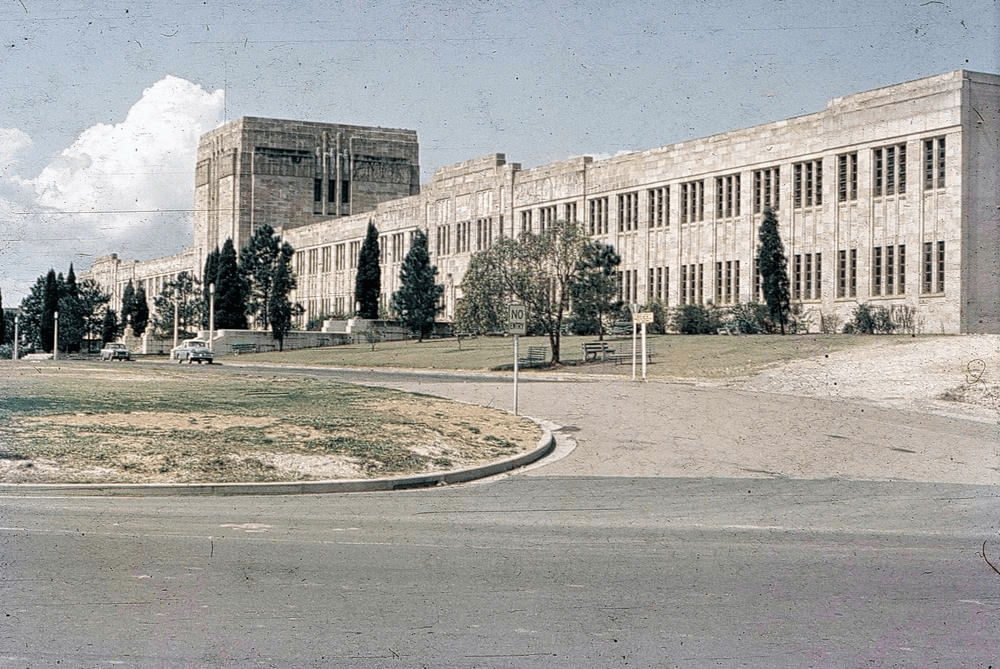


Neville Buch
Latest posts by Neville Buch (see all)
- From Augustine’s Pears to Academic Boycotts: Fundamental Sociological Change in Australian Cultural Relations – October 11, 2026
- Yes, I want Anger Expressed But Then Resolved – October 11, 2026
- Part 3:The Failure of an Educational Institution and How to Spiral Forward – October 10, 2026