
Dr Neville Buch
Abstract
Nick Spencer’s article, “Christian Nationalism,” provides a valuable taxonomy of a burgeoning global phenomenon, yet from the perspective of Dr. Neville Buch’s Matrix of Sociology and the Dynamic of Cognition (DoC), it ultimately “hedges” by failing to diagnose the movement as a profound state of denoetization and Passive Nihilism. While Spencer correctly identifies the “coterminosity” of Christianity and the nation as the movement’s core, he treats this primarily as a descriptive political problem rather than a cognitive “immense regression”. This critique “leaves no stone unturned,” utilizing the insights of Hannah Arendt, Bernard Stiegler, and Bernard Williams to argue that Christian Nationalism functions as a “theological mask” for strategic domination. By failing to apply the rigours of Active Nihilism and “crap detecting,” Spencer’s analysis remains a “vindicatory narrative” that risks validating the very symbolic misery it seeks to describe.
——————————————————————————–
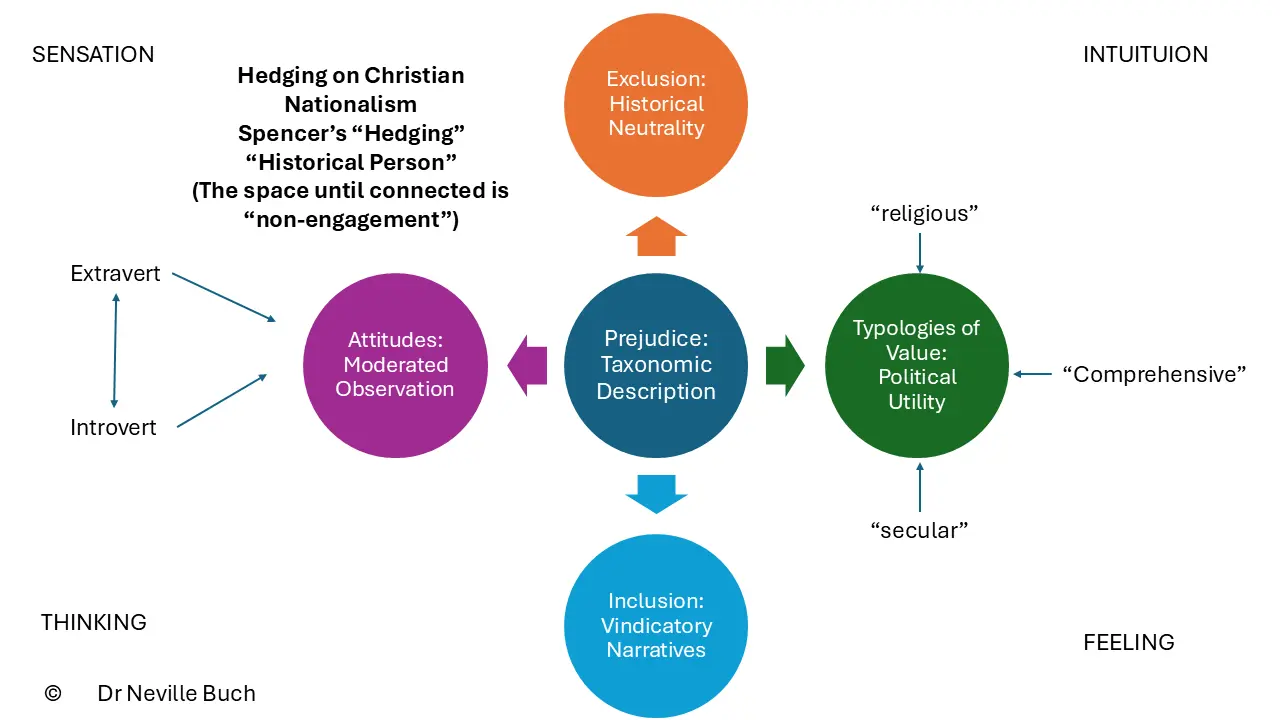
Critique: The “Theological Mask” of National Totality
Nick Spencer’s overview of Christian Nationalism (CN) correctly identifies the term as a “dustbin” for things people dislike. However, from a Stieglerian perspective, this vagueness is not merely a linguistic accident but a symptom of symbolic misery—the mechanical liquidation of the human capacity to judge.
I. Coterminosity as the Destruction of Plurality
Spencer defines CN as seeing “Christianity” and “the nation” as coterminous. In Arendtian terms, this is a movement toward totality that seeks to erase the fundamental condition of plurality—the fact that “men, not Man [person], live on the earth”. By merging these identities, CN creates a “stultifying political and social conservatism” that reduces the individual to a “puny human node” in a nationalistic network. Spencer’s analysis notes the “exclusivist and authoritarian” nature of this merger, but it fails to identify it as a “vicious circle of historical forgetfulness,” where the historical contingency of the nation is treated as a divinely ordained natural fact.
II. The “Theological Mask” and Strategic Domination
Spencer breaks down CN into “flavours” like Charismatic dominionism and Catholic Integralism. Buch’s Matrix reveals these are not merely theological variations but “theological masks” used to shield partisan agendas and justify elite domination.
- Charismatic Dominionism: Spencer identifies the “seven mountains mandate”. Sociologically, this is Strategic Domination (Habermas), replacing Communicative Action oriented toward mutual accord with an “unholy spirit” of mass-populist power.
- Integralism/Reconstructionism: These movements represent Institutional Arrogance, valuing dogmatic purity over the Person archetype. They attempt to “short-circuit” the “long circuits” of individuation—deep reflection and writing—by imposing a “mechanical techné mindset” on spiritual life.
III. Vindicatory Narratives vs. Spiral Historiography
Spencer suggests that much of CN is a “visceral reaction” where the “political tail wags the theological dog”. However, by simply reporting these justifications, Spencer risks producing what Bernard Williams calls a “vindicatory narrative”—one that justifies the status quo by ignoring its problematic origins. A more robust response requires Spiral Historiography, which re-reads these “ancient texts with modern inclusivity” to expose how they have been weaponized. For example, Manning Clark identifies such movements as “spiritual warfare” meant to end in “material conquest”. Spencer’s “hedging” occurs because he does not utilize the POLICE model (Philosophically Ontology Logic Intersect Compatibility Education) to “police” the logic-based choices of the movement, filtering out “institutional bullshit”.
IV. Passive vs. Active Nihilism
Spencer concludes that CN is a “convenient ideology” for troubled times. This is the essence of Passive Nihilism—a retreat into the comfort of established ideological frames. The required ascent, absent in Spencer’s piece, is Active Nihilism: the systematic negation of idols and external metaphysical certainties through skeptical doubt. Without this “pharmacological” necessity, the subject remains in a state of denoetization, unable to reclaim Human Authorship over their social Existence.
Conclusion
While Spencer provides a useful map of the socio-political landscape, he does not go far enough in his “crap detecting.” Christian Nationalism is not just a “cluster of things”; it is a cognitive regression that replaces Aristotelian flourishing with Instrumental-Rationality. To truly understand the “Meaning of the West” (Cupitt), we must move beyond Spencer’s taxonomy and engage in a reflective self-criticism that uncoils the mind from the comfortable prejudices of the “national demos”.
——————————————————————————–
Dynamic of Cognition (DoC) Table: Critique of Spencer’s “Christian Nationalism”
| DoC Component | Spencer’s “Hedging” (Passive/Regression) | Humanistic Critique (Active/Ascent) | Rationale / Source |
| Prejudice (Centre) | Taxonomic Description: Seeing CN as a “cluster” of political views. | Reflective Self-Criticism: Diagnosing CN as a state of denoetization. | Moves from unreflective habit to logic-based choice. |
| Attitudes (Thinking) | Moderated Observation: Treating “visceral reactions” as descriptive data. | Crap Detecting: Systematically filtering out “theological masks” and propaganda. | Replaces strategic domination with communicative action. |
| Typologies of Value | Political Utility: Valuing CN as a “convenient” response to demographic decline. | Holistic Flourishing: Affirming the Person archetype against nationalistic reduction. | Prioritizes “Common Human Valuing” over sectarian identity. |
| Exclusion (Sensation) | Historical Neutrality: Accepting “coterminosity” without unmasking its origins. | Spiral Historiography: Reading ancient claims with modern inclusivity to reveal contingency. | “Uncoils” the mind from hegemonic systems. |
| Inclusion (Intuition) | Vindicatory Narratives: Justifying current anxiety through reported theology. | Human Authorship: Reclaiming the “who” as the proactive operator of the system. | Restores the capacity for “Natality” and new beginnings. |
——————————————————————————–
BIBLIOGRAPHY
Aramini, D. (2021). Confronting Nationalism and the Recurring Crisis of Liberal Democracies: Mosse’s Contribution to the Public Debate. Journal of Contemporary History, 56(4), 1009–1039. https://www.jstor.org/stable/27199345
Arendt, H. (1958). The human condition. University of Chicago Press.
Arendt, H. (1977). The life of the mind. Harcourt Brace Jovanovich.
Avraham, D. (2019). German Neo-Pietism and the Formation of National Identity. Church History, 88(1), 87–119. https://www.jstor.org/stable/26785175
Berlin, I. (1979). Concepts and categories: Philosophical essays. Pimlico.
Buch, N. (1995). American influence on Protestantism in Queensland since 1945. Ph.D. thesis, University of Queensland.
Buch, N. (2025). The dynamic of cognition. Academia.edu.
Buch, N. (2026). A matrix of sociology. Management Institute for Contributory Economy.
Clark, M. (2006). A short history of Australia (Fourth revised edition). Penguin Group Australia, Camberwell, Victoria
Collins, R. (1998). The sociology of philosophies: A global theory of intellectual change. Harvard University Press.
Cupitt, D. (2008). The meaning of the West. SCM Press.
Davis, J. T., & Perry, S. L. (2021). White Christian Nationalism and Relative Political Tolerance for Racists. Social Problems, 68(3), 513–534. https://www.jstor.org/stable/27305751
Elgenius, G., & Rydgren, J. (2022). Nationalism and the Politics of Nostalgia. Sociological Forum, 37, 1230–1243. https://www.jstor.org/stable/48813697
Habermas, J. (1979). Communication and the evolution of society. Beacon Press.
Jensen, K. K., & Mouritsen, P. (2019). Nationalism in a Liberal Register: Beyond the ‘Paradox of Universalism’ in Immigrant Integration Politics. British Journal of Political Science, 49(3), 837–856. https://www.jstor.org/stable/26781737
Lonergan, B. J. F. (1962). Regis college lectures. University of Toronto Press.
Miller, D. D. (2022). American Christian Nationalism and the Meaning of “Religion.” Method & Theory in the Study of Religion, 34(1/2), 64–85. https://www.jstor.org/stable/27362958
Moro, R. (2021). George L. Mosse and Christian Religious Thought in Contemporary History. Journal of Contemporary History, 56(4), 896–930. https://www.jstor.org/stable/27199340
Moses, J. (1979). Historical disciplines and culture in Australia. University of Queensland Press.
Piirimäe, E. (2015). Sociability, Nationalism and Cosmopolitanism in Herder’s Early Philosophy Of History. History of Political Thought, 36(3), 521–559. http://www.jstor.org/stable/26228631
Spencer, N. (2025). Christian nationalism. Theos.
Stiegler, B. (2014). Symbolic misery, 1: The hyperindustrial epoch. Polity Press.
Stroope, S., Froese, P., Rackin, H. M., & Delehanty, J. (2021). Unchurched Christian Nationalism and the 2016 U.S. Presidential Election. Sociological Forum, 36(2), 405–425. https://www.jstor.org/stable/48642547
Turner, B. (2023). Returning to judgment: Bernard Stiegler and continental political theory. SUNY Press.
Whitehead, A. L., & Perry, S. L. (2015). A More Perfect Union? Christian Nationalism and Support for Same-sex Unions. Sociological Perspectives, 58(3), 422–440. http://www.jstor.org/stable/44290121
Williams, B. (1985). Ethics and the limits of philosophy. Harvard University Press.
Zurlo, G. A. (2018). More than Numbers: David B. Barrett and the Twentieth-Century Historiography of World Christianity. Journal of World Christianity, 8(2), 89–108. https://doi.org/10.5325/jworlchri.8.2.0089
——————————————————————————–
Footnote
Spencer notes the usage spike but misses the cognitive diagnosis of denoetization. “Coterminosity” is a totalizing image that erases Arendtian plurality. Nationalism in CN acts as a “theological mask” for strategic dominance. “Visceral reactions” indicate a state of Passive Nihilism rather than rational deliberation. Spencer’s reportage functions as a vindicatory narrative according to Williams. The failure to “police” theological logic allows institutional arrogance to persist. Active Nihilism is the necessary “pharmacological” cure for CN’s symbolic misery. The goal must be the restoration of Human Authorship over the “what” of the nation.
Featured Image: Henri Bergson, Pierre Bourdieu, Bernard Stiegler

Bernard Stiegler’s Memories of the Future.pdf:
Bernard_Stiegler_Memories_of_the_Future


Neville Buch
Latest posts by Neville Buch (see all)
- Agency, Cultural Construction, and Synoptic Vision: On Matt Patterson’s Comprehensive Examination in Sociological Theory (2009) – September 20, 2026
- Human Existence, Existential Angst, and the Protestant Worldview: An Essay on Buch’s Existential Thesis – September 20, 2026
- Salus Populi Suprema Lex Esto. Ciceronian Statecraft, Spinozan Toleration, and Prophetic Praxis – September 19, 2026